
SLIDE 1
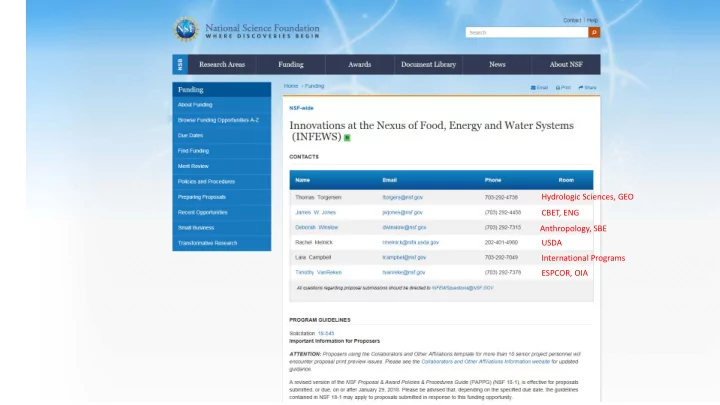
Hydrologic Sciences, GEO CBET, ENG Anthropology, SBE USDA International Programs ESPCOR, OIA
Hydrologic Sciences, GEO CBET, ENG Anthropology, SBE USDA - - PowerPoint PPT Presentation
Hydrologic Sciences, GEO CBET, ENG Anthropology, SBE USDA International Programs ESPCOR, OIA INFEWS Solicitation The overarching goal of the INFEWS program is to catalyze well-integrated, convergent research to transform understanding of the
Hydrologic Sciences, GEO CBET, ENG Anthropology, SBE USDA International Programs ESPCOR, OIA
quantitative, predictive and computational modeling, including support for relevant cyberinfrastructure;
FEW systems and increase decision support capability;
natural systems solutions to critical FEW systems problems;
through education and other professional development opportunities.
FEW systems with advanced modeling that investigates the functioning of coupled social, physical, biotic, abiotic, and engineered systems. The goal is to define and understand the couplings/linkages, feedback mechanisms and processes among the FEW systems components and to elucidate the factors that influence resilience, thresholds and criticalities. Track 1 projects should articulate clear hypotheses and/or describe what anticipated theoretical advancements will likely emerge from the systems modeling efforts. Development of advanced computational methods and effective means for incorporation of large quantities
innovative solutions that address specific FEW system challenges and aim to enhance FEW systems’ resilience and sustainability. Research on innovative institutional, behavioral, and technological solutions – and the coupled-combinations of solutions – is needed. Track 2 research might explore sustainable management solutions, examine the drivers of resource consumption, and study the means of extending resources via methods such as reducing, recycling, recovery, and reuse, among other topics
new networks of interdisciplinary researchers from multiple organizations who will collectively and significantly advance INFEWS concepts, knowledge and new directions through active exchange of ideas, development of new directions in fundamental research and education, and other approaches.
The FEW Context Statement is an important component of the submission and review process. It is not a project summary or a synopsis; it is a critical document specifically addressing the points noted below.
and why that overall FEW systems to be studied is of importance.
work will significantly enhance knowledge of FEW systems
how the network will significantly enhance the FEW community
in the project. The three or more intellectually distinct disciplines must represent at least 3 scientific areas typically supported (one each) by the three participating NSF Directorates (ENG, GEO, SBE), or two (or more) participating NSF Directorates and USDA/NIFA. (USDA/NIFA may be invoked as a "discipline" if the research focus represents a topical area that is uniquely distinct from disciplines typically supported by participating NSF Directorates ENG, GEO, and SBE. The FEW Context Statement should carefully elaborate the specific disciplines as well as the relevant differences between NSF and a USDA/NIFA "discipline").
Advance discovery and understanding while promoting teaching, training, and learning Broaden participation of underrepresented groups Enhance infrastructure for research and education Broad dissemination to enhance scientific and technological understanding Benefits to society
curriculum; students; REU; teachers; K-12; RET; mentoring; postdoc community college; HBCU; minority; Native Americans international collaboration in developing countries; equipment; laboratories blogs; citizen-science; local media; museums hazards; policy; environmental impacts; local + state agencies
Build or enhance partnerships
with industry, internationally, with other federal agencies, etc. It is better to do
these solidly and well, than to try and cover a number of them superficially.
Award Number:1739835; Principal Investigator:Hatim Geli; Organization:New Mexico State University;NSF Organization:BCS Start Date:09/01/2017; Award Amount:$842,465.00;
BasinAward Number:1740082; Principal Investigator:Chad Higgins; Organization:Oregon State University;NSF Organization:EAR Start Date:09/01/2017; Award Amount:$1,828,428.00;
BeltsAward Number:1639327; Principal Investigator:Xin-Zhong Liang; Organization:University of Maryland College Park;NSF Organization:EAR Start Date:09/01/2016; Award Amount:$3,000,000.00;
Nutrient CyclingAward Number:1739788; Principal Investigator:Ximing CaiOrganization:University of Illinois at Urbana- Champaign;NSF Organization:EAR Start Date:09/01/2017; Award Amount:$997,093.00;
Principal Investigator:Elena Irwin; Organization:Ohio State University;NSF Organization:SES Start Date:09/01/2017; Award Amount:$1,769,794.00;
management,technology and institutions. Award Number:1639458; Principal Investigator:Jennifer Adam; Organization:Washington State University;NSF Organization:EAR Start Date:09/15/2016; Award Amount:$2,788,042.00;
energy demand, and environmental integrity in a changing climate Award Number:1739724; Principal Investigator:Michael CoeOrganization:Woods Hole Research Center;NSF Organization:EAR Start Date:08/15/2017; Award Amount:$828,428.00;
the Lower Mekong Basin Award Number:1740042; Principal Investigator:John SaboOrganization:Arizona State University;NSF Organization:EAR Start Date:08/15/2017; Award Amount:$1,331,133.00;
Award Number:1639529; Principal Investigator:Benjamin Ruddell; Organization:Northern Arizona University;NSF Organization:OAC Start Date:09/01/2016; Award Amount:$3,463,681.00;
Award Number:1639318; Principal Investigator:Steve Davis; Organization:University of California-Irvine;NSF Organization:EAR Start Date:09/01/2016; Award Amount:$1,890,219.00;
Award Number:1739676; Principal Investigator:Arpad Horvath; Organization:University of California- Berkeley;NSF Organization:EAR Start Date:08/15/2017; Award Amount:$828,428.00;
Award Number:1639214; Principal Investigator:Benjamin Zaitchik; Organization:Johns Hopkins University;NSF Organization:BCS Start Date:09/15/2016; Award Amount:$2,999,021.00;
Technologies, Data, And Human Behavior. Award Number:1739191; Principal Investigator:Jeffrey Peterson; Organization:University of Minnesota-Twin Cities;NSF Organization:CBET Start Date:10/01/2017; Award Amount:$930,904.00
a Risk-Based Framework. Award Number:1639244; Principal Investigator:Nancy Love; Organization:University of Michigan Ann Arbor;NSF Organization:CBET Start Date:09/01/2016; Award Amount:$2,999,968.00
Nutrient, and Water Recovery from Biowastes. Award Number:1739884; Principal Investigator:Yuanzhi Tang; Organization:Georgia Tech Research Corporation;NSF Organization:CBET Start Date:09/15/2017; Award Amount:$1,730,953.00;
communities: MicroFEWs Award Number:1740075; Principal Investigator:William Schnabel; Organization:University of Alaska Fairbanks Campus;NSF Organization:CBET Start Date:10/01/2017; Award Amount:$2,419,338.00;
Fertilizer Award Number:1739473; Principal Investigator:Lauren Greenlee; Organization:University of Arkansas;NSF Organization:CHE Start Date:09/15/2017; Award Amount:$1,930,597.00;
Investigator:Bruce McCarlOrganization:Texas A&M AgriLife Research;NSF Organization:SES Start Date:10/01/2017; Award Amount:$1,162,358.00;
Award Number:1639391; Principal Investigator:Callie Babbitt; Organization:Rochester Institute of Tech;NSF Organization:CBET Start Date:09/01/2016; Award Amount:$991,925.00;
Impacts of Conservation Award Number:1639342; Principal Investigator:David Watkins; Organization:Michigan Technological University;NSF Organization:CBET Start Date:10/01/2016; Award Amount:$2,983,358.00;
sustainable communitiesAward Number:1639115; Principal Investigator:Emilio Moran; Organization:Michigan State University;NSF Organization:CBET Start Date:01/01/2017; Award Amount:$2,618,489.00;
Award Number:1639524; Principal Investigator:Lilian Alessa; Organization:University of Idaho;NSF Organization:SES Start Date:09/01/2016; Award Amount:$2,698,207.00;
Complete Solar Utilization. Award Number:1639429; Principal Investigator:Brendan O'Connor; Organization:North Carolina State University;NSF Organization:CBET Start Date:01/01/2017; Award Amount:$2,996,668.00;
Metropolitan Areas Award Number:1739163; Principal Investigator:Neil Mattson; Organization:Cornell University;NSF Organization:CBET Start Date:01/01/2018; Award Amount:$1,923,476.00;