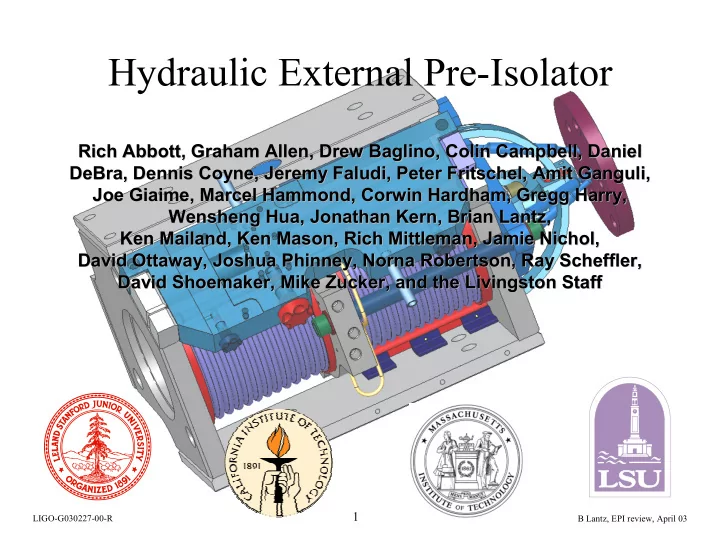
Hydraulic External Pre-Isolator Rich Abbott, Graham Allen, Drew - - PowerPoint PPT Presentation

hydraulic external pre isolator
SMART_READER_LITE
LIVE PREVIEW

Hydraulic External Pre-Isolator Rich Abbott, Graham Allen, Drew - - PowerPoint PPT Presentation

Hydraulic External Pre-Isolator Rich Abbott, Graham Allen, Drew Baglino, Colin Campbell, Daniel Rich Abbott, Graham Allen, Drew Baglino, Colin Campbell, Daniel DeBra, Dennis Coyne, Jeremy Faludi, Peter Fritschel, Amit Ganguli, i, DeBra, Dennis


slide-1
SLIDE 1

LIGO-G030227-00-R

1

B Lantz, EPI review, April 03

Rich Abbott, Graham Allen, Drew Baglino, Colin Campbell, Daniel Rich Abbott, Graham Allen, Drew Baglino, Colin Campbell, Daniel DeBra, Dennis Coyne, Jeremy Faludi, Peter Fritschel, Amit Gangul DeBra, Dennis Coyne, Jeremy Faludi, Peter Fritschel, Amit Ganguli, i, Joe Giaime, Marcel Hammond, Corwin Hardham, Gregg Harry, Joe Giaime, Marcel Hammond, Corwin Hardham, Gregg Harry, Wensheng Hua, Jonathan Kern, Brian Lantz, Wensheng Hua, Jonathan Kern, Brian Lantz, Ken Mailand, Ken Mason, Rich Mittleman, Jamie Nichol, Ken Mailand, Ken Mason, Rich Mittleman, Jamie Nichol, David David Ottaway Ottaway, Joshua Phinney, Norna Robertson, Ray Scheffler, , Joshua Phinney, Norna Robertson, Ray Scheffler, David Shoemaker, Mike Zucker, and the Livingston Staff David Shoemaker, Mike Zucker, and the Livingston Staff

Hydraulic External Pre-Isolator

slide-2
SLIDE 2

LIGO-G030227-00-R

2

B Lantz, EPI review, April 03

Outline

Why choose hydraulics? How the actuator works Pump Station Sensor Blending Control loop shaping Performance

slide-3
SLIDE 3

LIGO-G030227-00-R

3

B Lantz, EPI review, April 03

Benefits of Hydraulics

Heating: Actuator dissipates 10W and heat is carried away by the working fluid. Range: +/- 1 mm gives headroom for seasonal drift, small earthquakes, tilts of the floor. Response to saturation: Good recovery from saturation, simple loops and max velocity of 80 microns/ sec make recovery smooth. Damping of the elastic behavior of the stack – it’s like having a dashpot at the tip of the crossbeam. Stiffness gives large rejection of stack dynamics, makes control easy.

slide-4
SLIDE 4

LIGO-G030227-00-R

4

B Lantz, EPI review, April 03

Candidate Actuators

Hydraulic

Force V e l

  • c

i t y Displacement S t i c t i

  • n

Mechanical Noise Hysteresis Stiffness

High Med High Low Med Low Low Low High High Med Low Low High High High Low High Low Low Low Low High High Low Low High

Piezo or Magnetostriction Linear Motor Ball Screw

High

slide-5
SLIDE 5

LIGO-G030227-00-R

5

B Lantz, EPI review, April 03

pump 1 3 4 5 4 3 2

  • Laminar flow

high viscosity (100 x water), low velocity (80 microns/ sec.), fluid path geometry.

  • Motion with flexures
  • Offload springs to keep bridge balanced

common mode rejection of pump noise

Hydraulic Actuator Basics

(1) Pump supplies a constant flow of fluid to the actuator. (2) Fluid flows continuously through a hydraulic Wheatstone bridge. (3) By controlling the resistance, one generates differential pressure across the bridge, which are connected to (4) Differential bellows which act as a stiction- free piston. (5) The actuator plate is between the bellows, and is connected to the payload with a flexure stiff in 1 DOF

slide-6
SLIDE 6

LIGO-G030227-00-R

6

B Lantz, EPI review, April 03

Hydraulic Valve forms the bridge

Ps Pr C1 C2

nozzle f l a p p e r torquer motor DYP-2S valve

The new nozzle Parker DYP-2S valve

  • Differential bridge in a single valve body
  • 4 nozzles – one for each resistor in the

bridge

  • Original nozzles replaced with custom units

shown below right.

  • riginal

new Flow in the DYP-2S

slide-7
SLIDE 7

LIGO-G030227-00-R

7

B Lantz, EPI review, April 03

D i a p h r a g m Flow restrictor Actuator plate

pump 1 3 4 5 4 3 2

Bypass Network

slide-8
SLIDE 8

LIGO-G030227-00-R

8

B Lantz, EPI review, April 03

Vertical Actuator (version 1) Witness Seismometer (Geotech S-13) Seismometer (STS-2) 800 lb Test Mass Horizontal Actuator

Vertical Actuator –version 2

Offload Springs Bellows (within shield) Actuator plate Tripod flexure Sensor platform Valve (not visible)

The Test Platform at Stanford

slide-9
SLIDE 9

LIGO-G030227-00-R

9

B Lantz, EPI review, April 03 10

  • 1

10 10

1

10

2

10

  • 2

10 Mag hertz Valve to Displacement Sensor With Bypass Without 10

  • 1

10 10

1

10

2

  • 600
  • 400
  • 200

degrees hertz

Test Platform Dynamics

Valve drive -> Payload displacement System acts like an integrator until:

  • ffload spring balances pressure difference (30 mHz)

payload resonance against bellows spring (23- ~40 Hz)

slide-10
SLIDE 10

LIGO-G030227-00-R

10

B Lantz, EPI review, April 03

Drawings of the Actuator

Actuator Plate Connection tripod L-4C connector Payload attachement point Valve Bellows enclosed with protective shields L-4C Actuator Plate Bellows

Isometric view left shows major components Cross section above shows buried L-4C geophone

slide-11
SLIDE 11

LIGO-G030227-00-R

11

B Lantz, EPI review, April 03

Pump Station

reservoir motor pump tach pump stand controller motor controller external pressure input STS-2 Hydraulic Actuator Existing 4-layer passive stack

accumulator

STS-2 Hydraulic Actuator Existing 4-layer passive stack

accumulator

Distribution Network

60 meter supply and return

slide-12
SLIDE 12

LIGO-G030227-00-R

12

B Lantz, EPI review, April 03

Allowed Pump Noise

10

  • 1

10 10

1

10

2

10

  • 6

10

  • 5

10

  • 4

10

  • 3

10

  • 2

10

  • 1

10 Allowed pressure fluctuations, actuator servos on, 70 psi nominal, 0.25 pressure recovery freq (Hz) pressure fluct, psi/rtHz

maximum allowed pump noise maximum allowed pump noise maximum allowed pump noise maximum allowed pump noise pump noise goal pump noise goal pump noise goal pump noise goal measured pump * calculated impedance measured pump * calculated impedance measured pump * calculated impedance measured pump * calculated impedance

final_allowed_noise_btl4.fig

slide-13
SLIDE 13

LIGO-G030227-00-R

13

B Lantz, EPI review, April 03

Extra slide – pump noise

10

  • 1

10 10

1

10

2

10

  • 4

10

  • 3

10

  • 2

Pressure Noise at the Distribution Manifold pressure ASD (psi/rtHz) freq (Hz)

requirement

slide-14
SLIDE 14

LIGO-G030227-00-R

14

B Lantz, EPI review, April 03

Placement of an External Isolation System

HAM BSC

  • Install an isolation and alignment

system without opening the chambers.

  • Replace the coarse and fine actuators

which are currently between the pier and the cross beam weldment (which hold the support tubes and support table)

  • New system will act to hold support

table still in the presence of ground motion

slide-15
SLIDE 15

LIGO-G030227-00-R

15

B Lantz, EPI review, April 03

STS-2 b L-4C geophone DIT-5200 displac (Hydraulic Existing 4-layer passive stack

Placement of the Actuators and Offload Springs

Frame holds: 1 vertical and 1 tangential actuator, (isolation and alignment in 6 DOF) Pair of offload springs and initial alignment fixtures Sensors which are not included in the actuators All the pier-top components are mounted into a frame

tangential actuator vertical actuator

  • ffload springs (2)

payload

slide-16
SLIDE 16

LIGO-G030227-00-R

16

B Lantz, EPI review, April 03

How to maintain Alignment, and have Isolation from the Ground

STS-2

  • ffload spring supports payload

payload Geo displacement sensor ground

Simple model for 1 DOF has:

  • Payload to be isolated from the
  • Ground
  • Offload springs to support the load

and set the static alignment

  • Feedback displacement sensor
  • Feedback inertial sensor
  • Actuator
  • Translational DOFs have ground

motion sensors

slide-17
SLIDE 17

LIGO-G030227-00-R

17

B Lantz, EPI review, April 03

disp geo

How to maintain Alignment, and have Isolation from the Ground

STS-2

  • ffload spring supports payload

payload Geo displacement sensor ground

blend K

To make a control loop:

  • Blend displacement and inertial sensors

(super sensor)

  • Add control, drive actuator
  • Below blend freq it’s a positioning

system (command alignment to DC)

  • Above blend freq it’s an isolation

system from ground motion

  • Always resists external payload forces
slide-18
SLIDE 18

LIGO-G030227-00-R

18

B Lantz, EPI review, April 03

How to maintain Alignment, and have Isolation from the Ground

STS-2

  • ffload spring supports payload

payload Geo displacement sensor ground

blend and correct

disp geo

S T S

  • 2

K

Sensor correction extends isolation:

  • Low freq control with disp. sensor has

typical benefits – improved linearity, hysteresis, since our sensors are better than our actuators

  • Replace low freq crossover with blend
  • To achieve isolation, feed information

from STS-2 to correct the displacement sensor.

slide-19
SLIDE 19

LIGO-G030227-00-R

19

B Lantz, EPI review, April 03

Implementation in 6 DOF

  • Piers at the four corners can be used for 6 DOF system with

vertical and tangential actuators, sensors, and offload springs.

  • Offload springs form a V to give better load handling.
  • At low frequencies, translations are different than rotations

because (based on PEPI results) slab translations cause more problems that slab rotations.

  • At low freq (microseism to a few Hz) isolate against

translations, and actively lock payload rotations to slab rotations.

slide-20
SLIDE 20

LIGO-G030227-00-R

20

B Lantz, EPI review, April 03

Implementation in 6 DOF

Piers support the payload (blue) EPI system frame (purple) atop the pier EPI controls the support table (green) Stack (not shown) sits on the support table

slide-21
SLIDE 21

LIGO-G030227-00-R

21

B Lantz, EPI review, April 03

Hydraulic Installation

Offload Springs Hydraulic Lines Hydraulic lines & valves Crossbeam Horizontal Actuator Pump Station

fun!

slide-22
SLIDE 22

LIGO-G030227-00-R

22

B Lantz, EPI review, April 03

Sensor Blending, pier 1 Vertical

Filtering for the displacement sensor 1V

Frequency (Hz) Phase (deg) Magnitude (abs) 10

  • 4

10

  • 3

10

  • 2

10

  • 1

10 10

1

10

  • 1

10 10

1

  • 270
  • 180
  • 90

90 plant-disp filter blend signal

Filtering for the geophone 1V

Frequency (Hz) Phase (deg) Magnitude (abs) 10

  • 3

10

  • 2

10

  • 1

10 10

1

10

2

plant-geo filter blend signal 10

  • 1

10 10

1

  • 180
  • 90

90 180

Vertical Blending for V1

Frequency (Hz) Phase (deg) Magnitude (abs) 10

  • 3

10

  • 2

10

  • 1

10 Filtered Geo Filtered Disp Sum 10

  • 1

10 10

1

  • 180
  • 90

90 180

dewhitened displacement sensor response in mm/dspace drive. Filter attenuates above 10 Hz L-4C geophone has 1 Hz character response in dspace in/dspace drive. Filter “extends” low freq of geo gain*filtered geophone crosses filtered displacement at 0.8 Hz to form supersensor.

slide-23
SLIDE 23

LIGO-G030227-00-R

23

B Lantz, EPI review, April 03

Vertical Plant, diagonal terms

Vertical plant displacement sensors in new basis Frequency (Hz) Magnitude (abs) 10

  • 1

10 10

1

10

2

10

  • 4

10

  • 3

10

  • 2

10

  • 1

z->z pitch->pitch roll->roll

  • cv->ocv

Vertical plant disp sensor in original Pier basis Frequency (Hz) Magnitude (abs) 10

  • 1

10 10

1

10

2

10

  • 4

10

  • 3

10

  • 2

10

  • 1

1->1 2->2 3->3 4->4

Open loop response of the vertical disp. sensors to local drives (mm/dspace drive) Corners all very similar, and couple to modes at 20 Hz and 30 Hz Open loop response of the vertical disp. sensors in the new “coordinate basis” (mm/dspace drive) Directions still similar at low freq,

  • nly couple to single mode at 20 Hz - 30 Hz
slide-24
SLIDE 24

LIGO-G030227-00-R

24

B Lantz, EPI review, April 03

Vertical Plant, cross coupling

Vertical plant displacement sensors in new basis Cross coupling of plant in coord basis, Drive Z Frequency (Hz) Magnitude (abs) 10

  • 1

10 10

1

10

2

10

  • 4

10

  • 3

10

  • 2

10

  • 1

z -> z z -> pitch z -> roll z -> ocv Vertical plant disp sensors in original Pier basis Cross coupling of plant in Pier basis, Drive 1 Frequency (Hz) Magnitude (abs) 10

  • 1

10 10

1

10

2

10

  • 4

10

  • 3

10

  • 2

10

  • 1

1->1 1->2 1->3 1->4

Open loop response of the 4 vertical disp. sensors to drives at pier 1 (mm/dspace drive) Corners 1 and 2 are coupled at 20 Hz (near the upper unity gain freq, they share a crossbeam) Open loop response of the vertical disp. sensors in “coordinate basis” to z drive (mm/dspace drive) Coupling is small

slide-25
SLIDE 25

LIGO-G030227-00-R

25

B Lantz, EPI review, April 03

Open loop Z control Frequency (Hz) Phase (deg) Magnitude (abs) 10 10

1

10

2

  • 180
  • 135
  • 90
  • 45

45 90 10

  • 4

10

  • 2

10 10

2

10

4

Uncond stable controller Open loop Open loop w/ res gain plant

Blended Z control

Open Loop Transfer Function of Blended Z plant – magnenta (mm/dspace drive) Controller – blue (dspace drive/mm) Open loop response (green) Open loop with res. gain (red) Controller is simple

slide-26
SLIDE 26

LIGO-G030227-00-R

26

B Lantz, EPI review, April 03

  • pen loop vertical TF

Frequency (Hz) Phase (deg) Magnitude (abs) 10 10

1

10

2

  • 180
  • 135
  • 90
  • 45

45 90 10

  • 4

10

  • 2

10 10

2

10

4

controller Open Loop response Z displacement plant

Displacement Z control

Open Loop Transfer Function of

  • Disp. only Z plant – magnenta

(mm/dspace drive) Controller – blue (dspace drive/mm) Open loop response (green) Controller is really simple Stack mode coupling at 2.9 and 6 Hz is small

slide-27
SLIDE 27

LIGO-G030227-00-R

27

B Lantz, EPI review, April 03

Open loop Bode of pitch control Frequency (Hz) Phase (deg) Magnitude (abs) 10 10

1

10

2

  • 180
  • 135
  • 90
  • 45

45 90 10

  • 4

10

  • 2

10 10

2

10

4

controller Open Loop response pitch plant, disp

Displacement Pitch control

Open Loop Transfer Function of

  • Disp. only pitch plant – magnenta

(mm/dspace drive) Controller – blue (dspace drive/mm) Open loop response (green) Prototypical of all the rotation DOFs Controller is really simple Stack mode coupling not visible

slide-28
SLIDE 28

LIGO-G030227-00-R

28

B Lantz, EPI review, April 03

Bode Plot of plant in X direction, with and without sensor blending Frequency (Hz) Phase (deg) Magnitude (abs) 10

  • 4

10

  • 3

10

  • 2

10

  • 1

10 blended plant x disp plant x 10

  • 1

10 10

1

10

2

  • 180
  • 135
  • 90
  • 45

45 90

Blending in X

Open Loop Transfer Function of

  • Disp. only X plant – magenta

(mm/dspace drive) Blended X plant – blue (mm/dspace drive) We use the displacement sensor only, as the dynamics are simpler

slide-29
SLIDE 29

LIGO-G030227-00-R

29

B Lantz, EPI review, April 03

Bode of X control Frequency (Hz) Phase (deg) Magnitude (abs) 10 10

1

10

2

  • 180
  • 135
  • 90
  • 45

45 90 10

  • 2

10 10

2

controller (/30) x plant (*30) uncond stable Open loop Open Loop with res gain

Control in X

Open Loop Transfer Function of

  • Disp. only X plant – magnenta

(mm/dspace drive) Controller – blue (dspace drive/mm) Open loop system (green) Open loop with res. gain (red) Prototypical of X and Y DOFs Controller is simple Stack mode coupling is small

slide-30
SLIDE 30

LIGO-G030227-00-R

30

B Lantz, EPI review, April 03

signals are x, y, and z U U(E) vertical Selector1 U U(E) vertical Selector vert_disp_controller vert_set_controller_disp vert_blend_controller vert_set_controller_blend geo_filter_matrix vert_geo_blend disp_filter_matrix vert_disp_blend

  • K-

vert_conditional_gains vert blend 1* u support3_gain 1* u support1_gain U U(E) support table witness pier 3 U U(E) support table witness pier 1 sum coord offsets sum disp

  • ffset

sum STS

  • ffset

disp_norm_matrix set disp to 1dspace/mm STS_filter_matrix set STS to 1dspace/mm U U(E) select horz geos U U(E) select Z U U(E) select X Y Out1 platform offsets (mm) notch_matrix notch out 800 in disp U U(E) horzontal selector horz_disp_controller horz_control_matrix

  • K-

horz_chan_gain vert_bonus_path extra_vert_gain

  • K-

corrector gain K*u convert vert to actuators K*u convert to vert disp basis K*u convert to vert blend basis K*u convert to horz coords witness K*u convert to horz coords K*u convert to disp sens basis K*u convert horz to actuators control sum conditional sum

  • K-

blend_channel_gains K*u Witness Z Vert Master Gain SaturationH Saturation U U(E) STS-2 RTI Data Out1 PS offsets (mm) U U(E) PS Horz Master Gain U U(E) GEO Demux em Demux1 em In1 In2 In3 In4 In5 In6 DAC #2 In1 In2 In3 In4 In5 In6 DAC #1

  • K-

Channel gains 1 signal from ADC 32 32 32 32 32 32 8 8 8 8 4 4 4 4 4 4 8 8 8 4 8 8 8 3 3 4 4 4 4 4 4 4 4 4 4 4 4 4 4 4 4 4 4 4 4 4 4 2 2 4 3 3 3 3 4 4 4 4 4 4 8 8 8 8 3 3 3 3

Control Diagram

calibrate ground motion into mm calibrate disp sensor into mm disp only vertical controllers blended vertical controllers disp only horz controllers

Control diagram for later reference sensor correction is done by

  • 1. Calibrating STS-2 signals into mm (yellow)
  • 2. Calibrating disp signals into mm (red)
  • 3. Subtracting
slide-31
SLIDE 31

LIGO-G030227-00-R

31

B Lantz, EPI review, April 03

Sensor Correction

Signal fitler for the STS-2

Frequency (Hz) Phase (deg) Magnitude (abs)

10

  • 3

10

  • 2

10

  • 1

10 10

  • 2

10

  • 1

10 10

1

10

2

  • 90
  • 45

45 90

Transfer Function of the Corrector

  • Integrate and calibrate the STS-2 signal
  • Output signal is mm of ground motion
  • Directly subtract from the calibrated

displacement sensor

  • Same for various systems
slide-32
SLIDE 32

LIGO-G030227-00-R

32

B Lantz, EPI review, April 03

10

  • 1

10 10

1

10

  • 9

10

  • 8

10

  • 7

10

  • 6

Displacement [m/√Hz] freq [Hz]

Normalized Absolute Motion of Platform and Ground

ground mass mass, control off 10

  • 1

10 10

1

10

  • 2

10

  • 1

10 10

1

10

2

Magnitude Ratio [platform motion / ground motion] freq [Hz]

Transmission with Sensor Correction

passive active absolute motion ratio

Performance in X

Performance measures: Top plot shows ASDs of motion: Ground (blue) Support table with control off (red) Support table with control on (green) Lower plot shows ratios: Transmission with control off (blue) Transmission with control on (green) Relative motion with control on (red) Good performance. See motion of 2e-9 m/rtHz Match of trans&ratio indicates limits are loop gain and correction match.

slide-33
SLIDE 33

LIGO-G030227-00-R

33

B Lantz, EPI review, April 03

Performance in Y

10

  • 1

10 10

1

10

  • 9

10

  • 8

10

  • 7

10

  • 6

Displacement [m/√Hz] freq [Hz]

Normalized Absolute Motion of Platform and Ground Y 04/14

ground mass mass, control off 10

  • 1

10 10

1

10

  • 1

10 10

1

10

2

Magnitude Ratio [platform motion / ground motion] freq [Hz]

Transmission with Sensor Correction

passive active absolute motion ratio

slide-34
SLIDE 34

LIGO-G030227-00-R

34

B Lantz, EPI review, April 03

Performance in Z

January data for z direction, a good set of data. Top plot shows ASDs of motion: Ground (blue) Support table with control on (green) Lower plot shows ratios: Transmission with control off (blue) Transmission with control on (green) Peak above 1 Hz is ADC noise Performance not always this good – Coupling between payload motion and the ground motion STS-2?