Humans to Mars: HEOMD and MEPAG John Connolly Exploration Chief - - PowerPoint PPT Presentation

humans to mars
SMART_READER_LITE
LIVE PREVIEW

Humans to Mars: HEOMD and MEPAG John Connolly Exploration Chief - - PowerPoint PPT Presentation

National Aeronautics and Space Administration Humans to Mars: HEOMD and MEPAG John Connolly Exploration Chief Scientist (acting) NASA Human Exploration and Operations Mission Directorate NOTE ADDED BY JPL WEBMASTER: This content has not been


slide-1
SLIDE 1

National Aeronautics and Space Administration

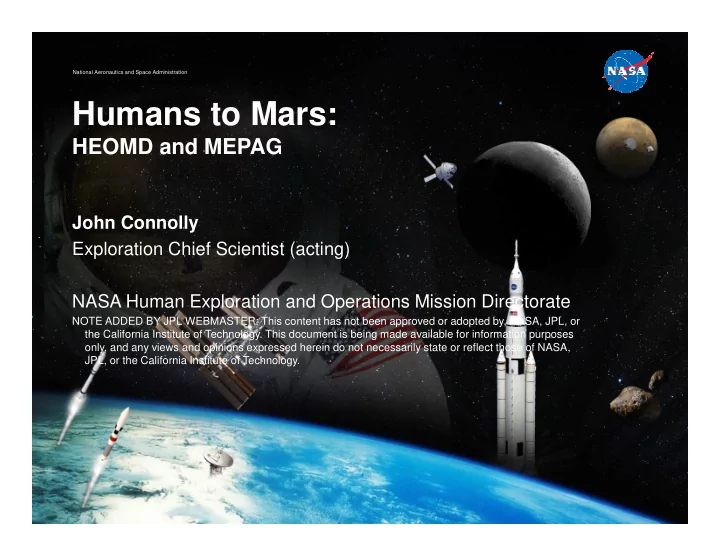
Humans to Mars:

HEOMD and MEPAG

John Connolly Exploration Chief Scientist (acting) NASA Human Exploration and Operations Mission Directorate

NOTE ADDED BY JPL WEBMASTER: This content has not been approved or adopted by, NASA, JPL, or the California Institute of Technology. This document is being made available for information purposes

  • nly, and any views and opinions expressed herein do not necessarily state or reflect those of NASA,

JPL, or the California Institute of Technology.

slide-2
SLIDE 2

2

  • NASA Mars Focus
  • NASA’s singular vision
  • Asteroid Retrieval Mission (ARM)
  • Global Exploration Roadmap
  • SMD + HEOMD + STMD
  • Historical Progress
  • Mars 2020
  • Beyond
  • Strategic Knowledge Gaps
  • MEPAG contribution and future action
  • Human Exploration and MEPAG – turning up the gain
slide-3
SLIDE 3

For Human Exploration, All Roads Lead to Mars

3

3

Earth Reliant Proving Ground Earth Independent

  • NASA’s vision:
  • To reach for new heights and reveal the unknown

so that what we do and learn will benefit all humankind

  • Why is Mars the new height?
  • It is the only destination if humanity is to leave the cradle of Earth
  • How do we get to Mars?
  • Through science, technology, commercial, international

and human endeavors

Road to Mars

slide-4
SLIDE 4

The Science Road to Mars: Charting the Course

4

Earth Reliant Proving Ground Identify & Solve Challenges

How does weightlessness affect human and physical processes?

Learn to Live & Work

How do radiation and isolation affect human ability to live and work?

Explore & Pioneer

What’s the environment and how does it impact human habitability?

Science

Earth Independent

slide-5
SLIDE 5

Vision Basis for Cross Cutting Mars Exploration

5

slide-6
SLIDE 6
slide-7
SLIDE 7

Asteroid Redirect Mission Provides Capabilities For Deep Space/Mars Missions

High Efficiency Large Solar Arrays Solar Electric Propulsion (SEP) In-space Power and Propulsion :

  • High Efficiency Solar Arrays and SEP

advance state of art toward capability required for Mars

  • Robotic ARM mission 40kW vehicle

components prepare for Mars cargo delivery architectures

  • Power enhancements feed forward to

Deep Space Habitats and Transit Vehicles Exploration EVA Capabilities EVA:

  • Build capability for future exploration

through Primary Life Support System Design which accommodates Mars

  • Test sample collection and containment

techniques including planetary protection

  • Follow-on missions in DRO can provide more

capable exploration suit and tools Deep Space Rendezvous Sensors & Docking Capabilities Crew Transportation and Operations:

  • Rendezvous Sensors and Docking Systems provide a

multi-mission capability needed for Deep Space and Mars

  • Asteroid Initiative in cis-lunar space is a proving ground

for Deep Space operations, trajectory, and navigation.

7 7

slide-8
SLIDE 8

Global Exploration Roadmap

8

slide-9
SLIDE 9

Collaboration Among SMD, HEOMD and STMD

  • HEOMD (then HEDS) participated in the formation of MEPAG and

the creation of the first MEPAG Goals/Objectives/Investigations document

  • Continuous Human Exploration representation on MEPAG Goals

committee

  • Human Exploration participation in Mars Odyssey, Phoenix,

Curiosity

  • MEPAG inputs into Strategic Knowledge Gaps (SKGs)
  • Space Technology Mission Directorate (STMD) a relatively new, but

important player

9

slide-10
SLIDE 10

Mars 2020 Collaboration Among SMD, HEOMD and STMD

Mars 2020 will seek signs of past life on Mars, collect and store a set of soil and rock samples that could be returned to Earth in the future, and test new technology to benefit future robotic and human exploration of Mars. HEOMD / SMD / STMD are jointly sponsoring investigations to address high priority strategic knowledge gaps and technology development

  • bjectives for Human Exploration
  • Mars Entry, Descent and Landing Instrumentation (MEDLI) to refine

atmospheric entry models to inform future landing system design

  • Exploration technology payloads that make significant progress towards filling

at least one major Strategic Knowledge Gap.

10

slide-11
SLIDE 11

Mars Program Re-Planning 2012

11

  • A Strategic Knowledge Gap (SKG) is an unknown or

incomplete data set that contributes risk or cost to future human Mars missions

  • Apollo example – Footpads oversized due to poor

knowledge of lunar soil bearing strength

  • SKGs are not unique to human exploration; all NASA

missions are designed based upon what is It is known and what is not.

  • Science measurements are the greatest source of

strategic Knowledge that has benefitted future human Mars exploration.

  • A Strategic Knowledge Gap (SKG) is an unknown or

incomplete data set that contributes risk or cost to future human Mars missions

  • Apollo example – Footpads oversized due to poor

knowledge of lunar soil bearing strength

  • SKGs are not unique to human exploration; all NASA

missions are designed based upon what is It is known and what is not.

  • Science measurements are the greatest source of

strategic Knowledge that has benefitted future human Mars exploration.

Strategic Knowledge Gaps

slide-12
SLIDE 12

Mars Program Re-Planning 2012

The SKG Continuum-

Robotic Mission Contributions to Date

slide-13
SLIDE 13

Mars Program Re-Planning 2012

13

  • For the past 50 years, robotic missions have

contributed data that reduces the risks of future human Mars exploration

  • For the past 50 years, robotic missions have

contributed data that reduces the risks of future human Mars exploration

The SKG Continuum- What’s Left to Know?

  • There’s

more to know, but we’re well

  • n our way
  • There’s

more to know, but we’re well

  • n our way

No data, Most “unknowns” No unknown data sets, Planet completely characterized

slide-14
SLIDE 14

Mars Program Re-Planning 2012

Current Mars Strategic Knowledge Gaps (SKG’s) 1/4

  • Mars Atmosphere

– Upper atmosphere global temperature field – Upper atmosphere global aerosol profiles and properties – Upper atmosphere Global wind and wind profiles – Orbital particulate environment – Lower atmosphere- global surface pressure; local weather – Lower atmosphere- surface winds – Lower atmosphere – EDL profile – Lower atmosphere – electrification

  • Landing Site Characterization
  • Landing Site Hazards
  • Regolith physical properties and structure
  • Landing site selection
  • Surface trafficability
slide-15
SLIDE 15

Mars Program Re-Planning 2012

Mars Strategic Knowledge Gaps (SKG’s) 2/4

  • Contamination

Back Contamination to Earth:

  • Mars Biohazards

Forward Contamination to Mars:

  • Identify and map special regions
  • Microbial survival, Mars conditions
  • Crew Health
  • Human Health & Performance
  • Dust toxicity
  • Dust Effects
  • Dust physical, chemical and electrical properties
  • Regolith physical properties and structure
slide-16
SLIDE 16

Mars Program Re-Planning 2012

Mars Strategic Knowledge Gaps (SKG’s) 3/4

  • ISRU Resource Potential

Atmospheric ISRU:

  • Dust physical, chemical and electrical properties
  • Dust column abundances
  • Trace gas abundances

Surface ISRU:

  • Hydrated mineral compositions
  • Hydrated mineral occurrences
  • Shallow water ice composition and properties
  • Shallow water ice occurrences
slide-17
SLIDE 17

Mars Program Re-Planning 2012

Mars Strategic Knowledge Gaps (SKG’s) 4/4

  • Environment & Effects Radiation
  • Simultaneous spectra of solar energetic particles in space

and in the surface.

  • Spectra of galactic cosmic rays in space
  • Dust Effects on Engineered Systems
  • Phobos/ Deimos
  • Surface composition
  • Surface operations
  • Electric and plasma environments
  • Gravitational fields
  • Regolith properties
  • Thermal environment
slide-18
SLIDE 18

SKG Version 2.0 Status

Compare Prior SKGs

ISECG SKGs NASA SKGs (Roughly Equal)

1)Correct Inconsis- tencies 2)Add/Re tire as necessar y3)Ration alize to

  • ne level
  • f detail

HAT: Create Metrics, Priority Ranking

We are Here

DPMC; Official NASA Docu- ment

Iterate with Analysis Groups and ISECG

Future MEPAG action

slide-19
SLIDE 19

19

  • Exploration Chief Scientist
  • MEPAG Goals Committee
  • Human Exploration Science
  • Human Exploration Engineering
  • Exploration Technology
  • Exploration Chief Scientist
  • MEPAG Goals Committee
  • Human Exploration Science
  • Human Exploration Engineering
  • Exploration Technology

Human Exploration and MEPAG – turning up the gain

slide-20
SLIDE 20

20

20