Human Subjects Statistical Ethics Principles: Respect Aaron - - PowerPoint PPT Presentation

human subjects statistical ethics
SMART_READER_LITE
LIVE PREVIEW

Human Subjects Statistical Ethics Principles: Respect Aaron - - PowerPoint PPT Presentation

Human Subjects Statistical Ethics Principles: Respect Aaron Rendahl Beneficence slides by Gary W. Oehlert, rev. by S. Weisberg Justice which generally requires School of Statistics University of Minnesota Informed consent Reasonable


slide-1
SLIDE 1

Statistical Ethics

Aaron Rendahl slides by Gary W. Oehlert, rev. by S. Weisberg

School of Statistics University of Minnesota

March 9, 2009

STAT8801 (Univ. of Minnesota) Statistical Ethics March 9, 2009 1 / 20

Human Subjects

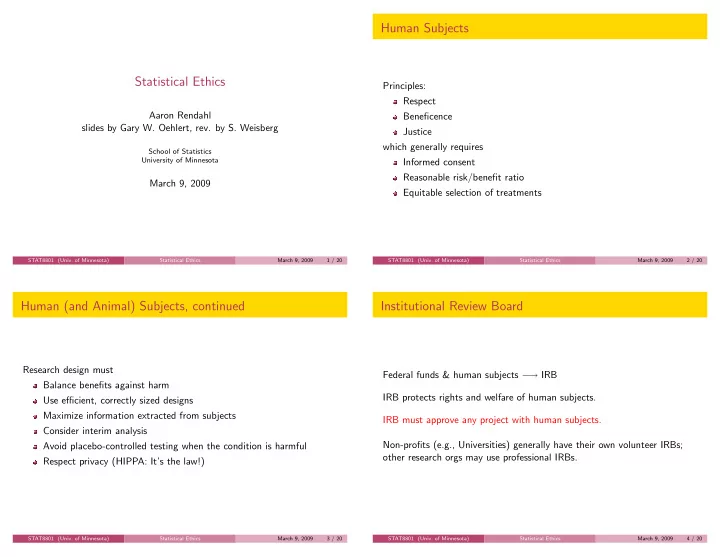
Principles: Respect Beneficence Justice which generally requires Informed consent Reasonable risk/benefit ratio Equitable selection of treatments

STAT8801 (Univ. of Minnesota) Statistical Ethics March 9, 2009 2 / 20

Human (and Animal) Subjects, continued

Research design must Balance benefits against harm Use efficient, correctly sized designs Maximize information extracted from subjects Consider interim analysis Avoid placebo-controlled testing when the condition is harmful Respect privacy (HIPPA: It’s the law!)

STAT8801 (Univ. of Minnesota) Statistical Ethics March 9, 2009 3 / 20

Institutional Review Board

Federal funds & human subjects − → IRB IRB protects rights and welfare of human subjects. IRB must approve any project with human subjects. Non-profits (e.g., Universities) generally have their own volunteer IRBs;

  • ther research orgs may use professional IRBs.

STAT8801 (Univ. of Minnesota) Statistical Ethics March 9, 2009 4 / 20

slide-2
SLIDE 2

Investigator must

Possess skills needed for the research Design research that meets risk/beneift criteria Submit research plans to IRB Ensure prior informed consent Protect vulnerable populations Train personnel Adhere to high ethical standards Ensure privacy Keep records/make reports Comply with all regulations

STAT8801 (Univ. of Minnesota) Statistical Ethics March 9, 2009 5 / 20

IRB will

Weigh risks and benefits Deny substandard designs Provide oversight through completion

  • but. . .

Researchers don’t like IRB’s. IRB’s can ask for the impossible. IRB’s can be very slow

STAT8801 (Univ. of Minnesota) Statistical Ethics March 9, 2009 6 / 20

Social Responsibility

As a scientist To keep an open mind. Report honestly what you see. To seek evidence and not accept things at face value. To exercise due diligence and not be sloppy. To make full disclosure to the extent possible. To stay within the limits of your expertise. Don’t over interpret.

STAT8801 (Univ. of Minnesota) Statistical Ethics March 9, 2009 7 / 20

Social Responsibility

As a member of society To use resources wisely. To credit sources and acknowledge priority. To deal fairly with colleagues and subordinates. To act on ethical breaches by others.

STAT8801 (Univ. of Minnesota) Statistical Ethics March 9, 2009 8 / 20

slide-3
SLIDE 3

Ethics for statisticians

Finally, we now look at some ethical ideas that target statistics a little more closely. Sometimes statistics is science, so we need scientific ethics. Sometimes statistics is a business, so we need business ethics Sometimes statistics is societal, so we need social ethics.

STAT8801 (Univ. of Minnesota) Statistical Ethics March 9, 2009 9 / 20

ASA Guidelines

We begin with the American Statistical Association’s Ethical Guidelines for Statistical Practice, which can be found at

www.amstat.org/profession/index.cfm?fuseaction=ethicalstatistics

These guidelines list eight areas to consider.

STAT8801 (Univ. of Minnesota) Statistical Ethics March 9, 2009 10 / 20

Professionalism

1 Guard against predisposition of results 2 Keep current in methodology 3 Acquire adequate statistical and subject matter expertise 4 Work with ethical collaborators 5 Assure appropriateness of procedures (even automated ones) 6 Deal with multiple comparisons 7 Respect contributions and IP of others 8 Disclose conflicts of interest STAT8801 (Univ. of Minnesota) Statistical Ethics March 9, 2009 11 / 20

Funders, Clients, Employers

1 When possible, present a choice among valid alternatives 2 Clearly state your qualifications and experience 3 Clarify roles in a project 4 Don’t work towards predetermined outcome 5 Fulfill commitments 6 Accept responsibility for your performance STAT8801 (Univ. of Minnesota) Statistical Ethics March 9, 2009 12 / 20

slide-4
SLIDE 4

Publication and Testimony

1 Maintain personal responsibility for work bearing your name 2 Report assumptions and question them 3 Make it clear who did statistical work (pubs or testimony) 4 Have clear basis for authorship order 5 Account for all data considered 6 Report sources and adequacy of data 7 Report/document data cleaning/imputation procedures 8 Address potential confounding variables 9 Identify financial sponsor 10 Report limits on inference and sources of error 11 Share data (modulo privacy/confidentiality) 12 Promptly and publicly correct errors 13 Write to the audience STAT8801 (Univ. of Minnesota) Statistical Ethics March 9, 2009 13 / 20

Official Statistics

1 “. . . unaddressed ethical issues simply threaten the credibility of a

statistical agency, undermining the trust that data providers, the public, and policy makers place in the agency or government statistical work generally.”

2 Use sound methodology. 3 Privacy vs collective needs (homeland security, for example) 4 Conflict between politics and science 5 Equal and public access to data 6 Work to maintain the integrity of statistical agencies and national

statistical offices. Without good data, can we expect good decisions?

7 “Biometrics”.

Source: W. Seltzer (2005). Official statistics and statistical ethics: Selected Issues. ISI proceedings.

STAT8801 (Univ. of Minnesota) Statistical Ethics March 9, 2009 14 / 20

Misconduct

1 Do not condone careless, incompetent, or unethical statistical

practices

2 Deplore professional misconduct 3 Differences of opinion and honest error are not misconduct 4 Follow procedures in a misconduct investigation 5 Help pick up pieces after misconduct investigation 6 Do not retaliate against whistle blowers STAT8801 (Univ. of Minnesota) Statistical Ethics March 9, 2009 15 / 20

Statistics and the Law

Is there objective, legal truth? Ref: P. Meier (1986), “Damned Liars and Expert Witnesses,” JASA, 81, 269-276. Sales tax has been erroneously applied to items not subject to tax. Plaintiff seeks to estimate the amount of the tax applied. Available are sales slips for 826 business days; all sales slips must be examined by hand to determine amount, a very expensive proposition. As statistician for the plaintiff, what do you do?

STAT8801 (Univ. of Minnesota) Statistical Ethics March 9, 2009 16 / 20

slide-5
SLIDE 5

If you work for the defense

Suppose sampling had been done imperfectly by the other side, for example, using some systematic method. What is your role? . . . if you believe sampling was not representative? . . . if you believe that the bias caused by poor sampling is minor? . . . if the sampling for the other side was done by “Dr. Deming or Professor Cochran”?

STAT8801 (Univ. of Minnesota) Statistical Ethics March 9, 2009 17 / 20

From Meier, p. 270

“. . . Cochran was fond of telling of the occasion when he was called on to carry out a sampling study of . . . retail stores,and he instructed that the sample consist of every tenth establishment . . . in the Yellow Pages. The judge, he said, welcomed his expert testimony as a learning experience and remarked, after Cochran has been swarn, ‘I am glad to head and learn from Professor Cochran about this scientific sampling business, because I know virtually nothing about it. In fact, about the only thing I do know is that you should not just start at the beginning and take every 10th after that.’ ” Moral: Be overly cautious.

STAT8801 (Univ. of Minnesota) Statistical Ethics March 9, 2009 18 / 20

It’s the law

SD rule “. . . as a general rule . . . if the difference between the expected value and the observed number is greater than 2 or 3 standard deviations, then the hypothesis that the jury drawing [the issue in this case] was random would be suspect to a social scientist” Casteneda v. Partida Preponderance of the evidence In a civil non-criminal lawsuit, decisions are based on the more convincing evidence and its probable truth or accuracy, and not on the amount of evidence. This contrasts with “beyond a reasonable doubt” in criminal

  • trials. Thus, for example, a Bayes factor of 1.01 could be
  • enough. Source: dictionary.law.com

STAT8801 (Univ. of Minnesota) Statistical Ethics March 9, 2009 19 / 20

Corrupting influences, also from Meier

1 “If you find the expert you choose is independent and not firmly

committed to your theory of the case, be cautious about putting him

  • n the stand. Your cannot be sure of his answers on

cross-examination. when I put an expert on the stand, he is going to know which side we are on.” (John C. Sheperd, cited in Meier, p. 273)

2 “[T]he statistician is temped to give the definitive rather than a

qualified answer to key questions . . . [and] to ignore or minimize qualifications that he might emphasize in a more academic

  • setting. . . ” (Meier, p. 273)

3 Bribery 4 Flattery 5 Co-option to agree with the cause. 6 Gladiatorial role. 7 Personal views. STAT8801 (Univ. of Minnesota) Statistical Ethics March 9, 2009 20 / 20