SLIDE 1
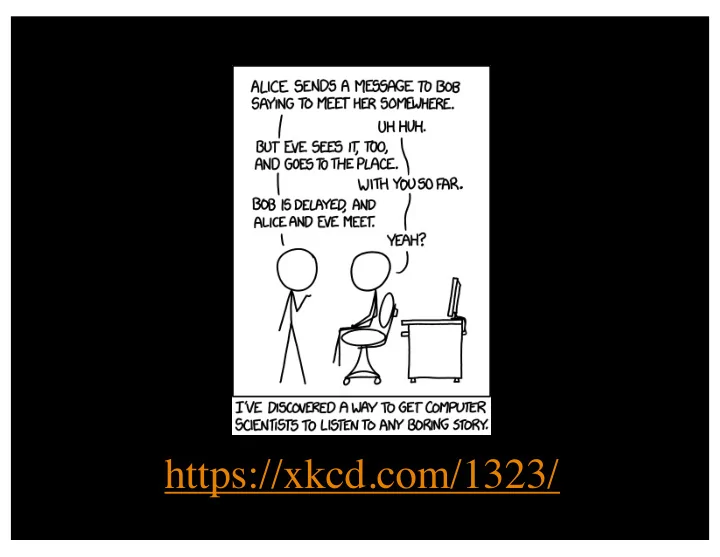
https://xkcd.com/1323/
SLIDE 2 Cryptocurrencies & Security on the Blockchain
San José State University
Digicash, Part 1: Blinded Signatures
SLIDE 3
Lab 3 Review
SLIDE 4 DigiCash
- Created by David Chaum
- A centralized cryptocurrency
– Relies on trusted third party (TTP)
- Anonymous transactions
- Uses blind signatures
SLIDE 5 Review: Digital Signatures
–Public key is known by everyone –Private key known only to the owner
– Public key encrypts – Private key decrypts
– Private key encrypts (signs) – Public key decrypts (verifies)
SLIDE 6
Public key is (N,e) Private key is d
To encrypt message M: C = Me mod N To decrypt ciphertext C: M = Cd mod N
SLIDE 7
Public key is (N,e) Private key is d
To sign message M: S = Md mod N To verify sig. S for message M: M' = Se mod N and verify that M = M'
SLIDE 8 Blinded signatures
- Motivation: Sender wants a notary to sign a
document without revealing the contents.
- Analogy: Signing a piece of carbon paper
through an envelope.
- Can the sender get the notary to sign anything
it wants?
SLIDE 9 Blind Signature Properties
- Signature function and multiplication must be
commutative
- Signature remains valid after unblinding
- Signer cannot determine what was signed,
until it is unblinded
– Signer does not even know when when a particular document was signed
SLIDE 10
Public key is (N,e) Private key is d
To sign message M: S = Md mod N To verify sig. S for message M: M' = Se mod N and verify that M = M'
SLIDE 11 RSA Blind Signature process
- User chooses blinding factor B
– B must be cryptographic quality random number
M' = M * Be mod N
S' = M'd mod N
- User removes blinding factor
S = S' / B
- Note that S' / B = Md mod N
SLIDE 12
Why does it work? M' = M * Be mod N S' = M'd mod N = (M * Be)d mod N = Md * (Be)d mod N = Md * B mod N S' / B = Md mod N
SLIDE 13 Modular Math
- "Clock math"
- Addition – easy
- Subtraction – easy
- Multiplication – easy
- Division… not so much
SLIDE 14 Modular Division
To find a / b mod N:
- 1. Find the modular multiplicative
inverse of b
– Denoted b-1 – Might not be defined
SLIDE 15 Modular Multiplicative Inverse
- Multiplicative inverse of b in mod N math
Find number b-1 such that
– b * b-1 = 1 mod N
- If b-1 exists, then the greatest common divisor of
b and N is 1.
– gcd(b,n) = 1
- Extended Euclidean algorithm calculates b-1
– Modified version of finding gcd – https://en.wikipedia.org/wiki/Extended_Euclidean_alg
SLIDE 16 Lab, Part 1: Implement Blind RSA
Download rsa.js from the course website. It demonstrates the math for the RSA algorithm. Add blind and unblind functions for working with signatures. Test out your solution, then paste these functions into Canvas. For unblinding, you will need to do modular
- division. You may find modularDivision.js
useful.
SLIDE 17 Blinded Signatures library
– From your project directory, type npm install blind-signatures – Source code/documentation available at https://github.com/kevinejohn/blind-signatures
- Signatures happen on the hashes of the
documents
SLIDE 18 JavaScript tip of the day: destructuring assignment
- Uses pattern matching to break apart
more complex values.
- Useful for returning multiple values.
- (Recent versions of JS only).
SLIDE 19
Returning Multiple Values (old school)
function foo() { return [1,"one"]; } let arr = foo(); let n = arr[0]; let s = arr[1]; console.log(n); // Prints '1' console.log(s); // Prints 'one'
SLIDE 20
Destructuring Assignment with Arrays
function foo() { return [1,"one"]; } let [ n, s ] = foo(); console.log(n); // Prints '1' console.log(s); // Prints 'one'
SLIDE 21
Destructuring Function Parameters
function bar({x, y}) { return x + y; } let o = {x: 3, y: 4}; let z = bar(o); console.log(z);
SLIDE 22 Back to Blind Signatures Library …
– Blinded hash of the document – Its blinding factor
- sign: signs blinded document
- unblind: removes blinding factor from
signature
- verify: determines validity of signature
- verify2: same as verify
– uses private key (for efficiency I guess?)
- messageToHash: calculates hash of message
SLIDE 23
Blinding a Document
let { blinded, r } = blindSignatures.blind({ message: document, N: pubKey.N, E: pubKey.E, });
SLIDE 24
Signing a Document
let signed = blindSignatures.sign({ blinded: blinded, key: key, });
SLIDE 25
Unblinding a Document
let unblinded = blindSignatures.unblind({ signed: signed, N: pubKey.N, r: r, })
SLIDE 26
Unblinding a Document
let result = blindSignatures.verify({ unblinded: unblinded, N: pubKey.N, E: pubKey.E, message: document, });
SLIDE 27
Lab, Part 2
Details in Canvas and on course website. Starter code is available on the course website.