SLIDE 1
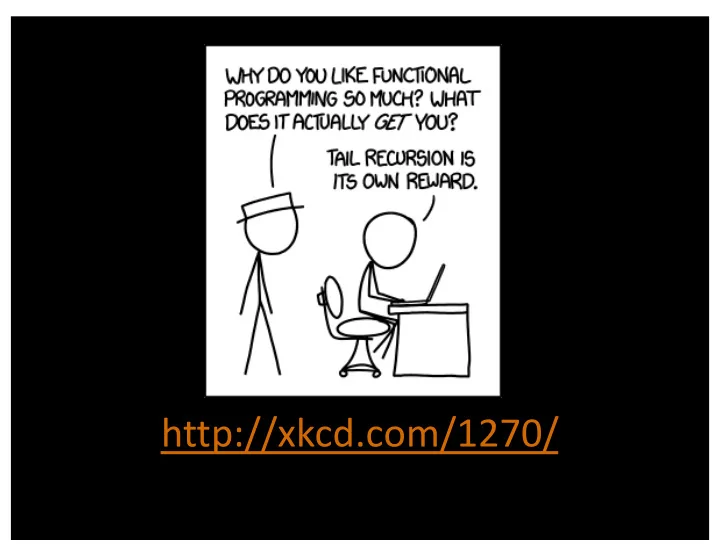
http://xkcd.com/1270/
SLIDE 2
Review: SecretKeeper Language
e ::= true | false | n | if e then e else e | succ e | pred e | secret e
SLIDE 3 CS 252: Advanced Programming Language Principles
San José State University
Lambdas & Higher-Order Functions
SLIDE 4 Lambdas
lambda calculus
anonymous classes in Java
SLIDE 5
Lambda Example
Prelude> (\x -> x+1) 1 2 Prelude> (\x y -> x*y) 2 3 6 Prelude>
SLIDE 6
Function composition
f(g(x))
can be rewritten as
(f . g) x
SLIDE 7 Points-free style
inc x = x + 1 incByTwo = inc . inc
Points-free: no function argument
SLIDE 8 Lambdas & Function Composition
Prelude> let f = (\x -> x – 5) . (\y -> y * 2) Prelude> f 7 9 Prelude> let f = (\x y -> x – y) . (\z -> z * (-1)) Prelude> f 3 4
SLIDE 9
Tail Recursion
SLIDE 10
Iterative solutions tend to be more efficient than recursive solutions. However, compilers are very good at optimizing a tail recursive functions.
SLIDE 11
In tail recursion, the recursive call is the last step performed before returning a value.
SLIDE 12 Is this function tail-recursive?
public int factorial(int n) { if (n==1) return 1; else { return n * factorial(n-1); } }
No: the last step is multiplication
SLIDE 13 Is this function tail-recursive?
public int factorialAcc(int n, int acc) { if (n==1) return acc; else { return factorialAcc(n-1, n*acc); } } Yes: the recursive step is the last thing we do
SLIDE 14 Which version is tail-recursive?
fact :: Integer -> Integer fact 1 = 1 fact n = n * (fact $ n - 1) fact' :: Integer -> Integer -> Integer fact' 0 acc = acc fact' n acc = fact' (n - 1) (n * acc)
SLIDE 15 Is this version tail-recursive?
fact2 :: Integer -> Integer -> Integer fact2 n acc = if n == 0 then acc else fact2 (n - 1) (n * acc) This argument is called an “accumulator” – common design pattern to make your functions tail-recursive.
SLIDE 16
Higher-order functions
SLIDE 17
Programs as Functions
Functional languages treat programs as mathematical functions.
Definition: A function is a rule that associates to each x from some set X of values a unique y from a set of Y values.
SLIDE 18 Definition: A function is a rule that associates to each x from some set X of values a unique y from a set of Y values.
y = f(x)
f is the name of the function
SLIDE 19 Definition: A function is a rule that associates to each x from some set X of values a unique y from a set of Y values.
y = f(x)
x is a variable in the set X X is the domain of f. x∈X is the independent variable.
SLIDE 20 Definition: A function is a rule that associates to each x from some set X of values a unique y from a set of Y values.
y = f(x)
y is a variable in the set Y Y is the range of f. y∈Y is the dependent variable.
SLIDE 21 Qualities of Functional Programing
- 1. Functions clearly distinguish
– incoming values (parameters) – outgoing values (results)
- 2. No assignment
- 3. No loops
- 4. Return value depends only on params
- 5. Functions are first class values
SLIDE 22 Functions are first-class data values, so we can:
- Pass as arguments to a function
- Return from a function
- Construct new functions dynamically
SLIDE 23
A function that either takes a function as a parameter or returns a function as its result is a higher-order function
SLIDE 24
Consider:
addNums x y = x + y
I mean to type 3 * addNums 5 2 But accidentally type 3 * addNums 52 What happens?
SLIDE 25 Non type-variable argument in the constraint: Num (a -> a) (Use FlexibleContexts to permit this) When checking that ‘it’ has the inferred type it :: forall a. (Num a, Num (a -> a)) => a -> a
SLIDE 26
Why does Haskell give such strange error messages?
SLIDE 27
The answer is that Haskell curries functions.
SLIDE 28
Currying a function?
(\x -> x + 1) (\x y -> x * y)
SLIDE 29 Function currying
Transform a function w/ multiple arguments into multiple functions
Haskell Brooks Curry
SLIDE 30 Function currying
- Note the type of our Haskell function
–addNums :: Num a => a -> a -> a
- addNums is a function that takes in a
number and returns a function that takes another number
SLIDE 31 Higher order functions
map :: (a -> b) -> [a] -> [b] filter :: (a -> Bool) -> [a] -> [a] foldl :: (a -> b -> a) -> a -> [b] -> a foldr :: (a -> b -> b) -> b -> [a] -> b
SLIDE 32 Motivation for higher order functions
(in-class)
SLIDE 33 Fold left
foldl applies a function to each sequential pair of elements in a list
- foldl (\x y -> x+y) 0 [1,2,3]
- foldl (\x y -> x+y) (0+1) [2,3]
- foldl (\x y -> x+y) ((0+1)+2) [3]
- foldl (\x y -> x+y) (((0+1)+2)+3) []
- (((0+1)+2)+3)
- 6
This is the accumulator
SLIDE 34 Fold right
foldr folds from the right, and works on infinite lists
- foldr (+) 0 [1,2,3]
- 1+(foldr (+) 0 [2,3]))
- 1+(2+(foldr (+) 0 [3]))
- 1+(2+(3+(foldr (+) 0 [])))
- 1+(2+(3+(0)))
- 6
Note that we can pass '+' as a function
SLIDE 35 foldr on an infinite list
- take 3 $ foldr (:) [] [1..]
- take 3 $ 1:foldr (:) [] [2..]
- take 3 $ 1:2:foldr (:) [] [3..]
- take 3 $ 1:2:3:foldr (:) [] [4..]
- [1,2,3]
SLIDE 36 foldl (& foldr) build a thunk rather than calculate the results as it goes.
> let z = foldl (+) 0 [1..10000000]
Returns quickly
> z
Slow – result needs to be computed
Definition: a thunk is a delayed computation.
SLIDE 37 foldl' – Efficient left fold
- foldl' evaluates its results eagerly
rather than lazily.
import Data.List
- https://wiki.haskell.org/Foldr_Foldl_Foldl'
has more details.
SLIDE 38 Which fold should I use?
- foldr – "foldr is not only the
right fold, it is almost commonly the right fold to use…"
- foldl' – large, but finite lists
- foldl – specialized cases only
SLIDE 39 Related reading
- Learn You a Haskell, Chapter 6 (online)
- https://wiki.haskell.org/Foldr_Foldl_Foldl'
- https://wiki.haskell.org/Foldl_as_foldr
SLIDE 40 Lab 3: Higher order functions
Available in Canvas and on the course website. http://www.cs.sjsu.edu/~austin/cs252- spring18/labs/lab3/lab3.lhs