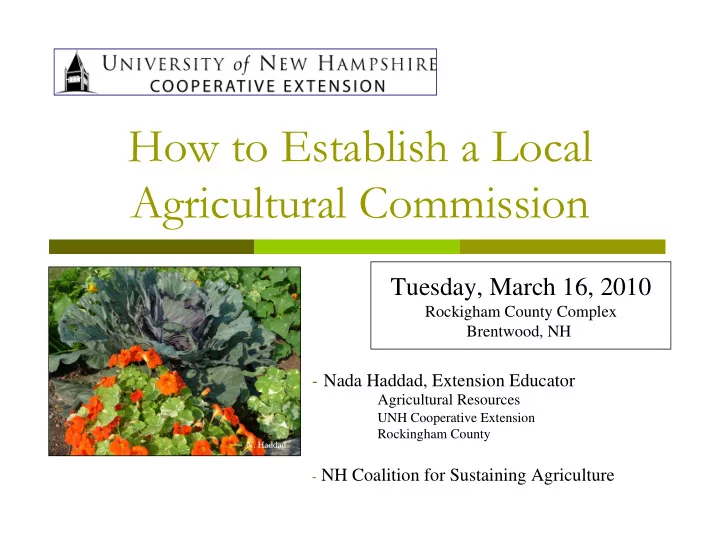
How to Establish a Local Agricultural Commission Tuesday, March 16, - - PowerPoint PPT Presentation

how to establish a local agricultural commission
SMART_READER_LITE
LIVE PREVIEW

How to Establish a Local Agricultural Commission Tuesday, March 16, - - PowerPoint PPT Presentation

How to Establish a Local Agricultural Commission Tuesday, March 16, 2010 Rockigham County Complex Brentwood, NH - Nada Haddad, Extension Educator Agricultural Resources UNH Cooperative Extension Rockingham County N. Haddad - NH Coalition for


slide-1
SLIDE 1

How to Establish a Local Agricultural Commission

  • Nada Haddad, Extension Educator

Agricultural Resources

UNH Cooperative Extension Rockingham County

  • NH Coalition for Sustaining Agriculture

Tuesday, March 16, 2010

Rockigham County Complex Brentwood, NH

  • N. Haddad
slide-2
SLIDE 2

New Hampshire Agricultural Commissions

For Agriculture and the Community

slide-3
SLIDE 3

NH Agriculture Commission: How it Originated

NH Coalition for Sustaining Agriculture

  • N. Haddad
slide-4
SLIDE 4

NH Agriculture Commission: How it Originated

House Bill 293

allows municipalities to establish agricultural commissions

RSA 674:44-e. Agricultural Commission

  • N. Haddad
slide-5
SLIDE 5

New Hampshire Agriculture Today

slide-6
SLIDE 6

New Hampshire Agricultural Commissions

slide-7
SLIDE 7

NH Definition of Agriculture

RSA 21:34-a

Defines farms and farming activities.

slide-8
SLIDE 8
  • VI. The term

"agritourism''

RSA 21:34-a Farm, Agriculture, Farming.

slide-9
SLIDE 9

NH Agriculture Today

  • Diversified industry
  • Large number of

small farms

  • Ornamental horticulture

is top industry sector

  • N. Haddad
slide-10
SLIDE 10

Economic Impact of NH Agriculture

Agriculture has a significant impact on New Hampshire’s economy, employment base and tax revenue

slide-11
SLIDE 11

Economic Impact of NH Agriculture

$935 million

slide-12
SLIDE 12

Economic Impact of NH Agriculture

11,606 jobs $43.8 million Tax revenue

slide-13
SLIDE 13

Economic Impact of NH Agriculture

slide-14
SLIDE 14

Values of NH Agriculture

  • Open space
  • Rural character
  • Scenic views
  • Heritage
  • Fresh food
  • Food security
  • Plants
  • Unique farm experiences
slide-15
SLIDE 15

What’s new in NH Agriculture?

Niche agriculture Direct sales Agri-tourism

slide-16
SLIDE 16

Niche Agriculture

 Unique, unusual,

uncommon

 Product, location, activity

slide-17
SLIDE 17

Direct Sales

 Farm Stands  Harvest Your Own  Summer Farmers Markets  Winter Farmer Markets  Community Supported

Agriculture (CSA’s)

 Garden Centers,

greenhouse, plant nurseries

slide-18
SLIDE 18

Coos Grafton Carroll Merrimack Cheshire Sullivan Hillsborough Rockingham Belknap Strafford

US County Rankings

  • Hillsborough County, 37th
  • Rockingham County, 38th

Value of Direct Market Sales 2007 Census of Agriculture

$964,000 $1,355,000 $945,000 $383,000 $3,706,000 $1,147,000 $3,685,000 $1,864,000 $1,189,000 $784,000

NASS: http://www.nass.usda.gov/Statistics_by_State/index.asp

slide-19
SLIDE 19

Trends: Farm to …

 Restaurants  Institutions

slide-20
SLIDE 20

Urban Agriculture Eat Local Ethnic Markets

slide-21
SLIDE 21

Agri-tourism

slide-22
SLIDE 22

Agriculture is alive and well in New Hampshire today…

slide-23
SLIDE 23

Agricultural Commissions

New tool to enhance agriculture in the community

www.extension.unh.edu

slide-24
SLIDE 24

Number of Farms in New Hampshire

Census of Ag 2002 and 2007

231 229 323 208 421 481 502 445 242 270 274 419 262 615 583 303 294 281 594 552

100 200 300 400 500 600 700

Belknap Carroll Cheshire Coos Grafton Hillsborough Merrimack Rockingham Strafford Sullivan

Number of Farms

5 10 15 20 25 30 35

% change

2002 2007 %change

  • N. Haddad 2010

Source: 2007 Census of Agriculture

slide-25
SLIDE 25

Land in Farms

Census of Ag 2002 and 2007

23,430 79,169 31,656 48,241 50,895 99,964 50,238 43,199 29,785 33,597 36,001 40,104 85,794 44,087 41,256 25,744 33,570 64,642 32,040 23,378

10,000 20,000 30,000 40,000 50,000 60,000 70,000 80,000 90,000 100,000

B e l k n a p C a r r

  • l

l C h e s h i r e C

  • s

G r a f t

  • n

H i l l s b

  • r
  • u

g h M e r r i m a c k R

  • c

k i n g h a m S t r a f f

  • r

d S u l l i v a n

Acres

  • 30
  • 20
  • 10

10 20 30

% change

2002 2007 %change

Source: 2007 Census of Agriculture

  • N. Haddad 2010
slide-26
SLIDE 26
  • 14

113 acres 132 acres Average Size of Farm 6 471,911 acres 444,879 acres Land in Farm s 24 4,166 3,363 Num ber of Farm s % change 2 0 0 7 2 0 0 2

New Hampshire – State Profile

Source: 2007 Census of Agriculture

slide-27
SLIDE 27

Percentage of Farms with Direct Sales New England States and U.S., 2002 and 2007 Census of Agriculture

5 10 15 20 25

C

  • n

n e t i c u t M a i n e M a s s a c h u e t t s N e w H a m p s h i r e R h

  • d

e I s l a n d V e r m

  • n

t U . S .

Percent

2002 2007

NH rank number 1 in nation

Source: 2007 Census of Agriculture USDA/ National Agricultural Statistics Service, New England Field Office

slide-28
SLIDE 28

Percentage of Total Market Value of Agriculture Sales from Direct Sales, New England States and U.S. 2002 and 2007 Census of Agriculture

0.0 1.0 2.0 3.0 4.0 5.0 6.0 7.0 8.0 9.0 10.0

Conneticut Maine Massachuetts New Hampshire Rhode Island Vermont U.S.

Percent

2002 2007

USDA/ National Agricultural Statistics Service, New England Field Office

NH rank number 3 in nation

slide-29
SLIDE 29

What is an Agricultural Commission?

A new voice for farmers and support for agricultural businesses

slide-30
SLIDE 30

What is an Agricultural Commission?

 Municipal committee  Volunteers who care

about agriculture in their town

 Forum for balancing

rural character and growth

slide-31
SLIDE 31

What is the Role of an Agricultural Commission?

 Advises town boards  Focuses public attention

  • n multiple values of

agriculture

 Non-regulatory  Optional  Does what the town needs

to support agriculture

slide-32
SLIDE 32

How is an Agricultural Commission Created?

 By vote at Town Meeting

  • r

 By City or Town Council

  • r

 By the Board of

Selectmen

slide-33
SLIDE 33

 RSA 674:44-e. Agricultural Commission. An

agricultural commission may be established in accordance with RSA 673 for the proper recognition, promotion, enhancement, encouragement, use, management, and protection of agriculture and agricultural resources, tangible or intangible, that are valued for their economic, aesthetic, cultural, historic, or community significance within their natural, built, or cultural

  • contests. The word "agriculture" shall include the

entirety of RSA 21:34-a, which is the definition of farm, agriculture, and farming.

House Bill 293

allows municipalities to establish agricultural commissions

slide-34
SLIDE 34
  • I. Survey and inventory all agricultural resources
  • II. Conduct activities to recognize, promote,

enhance, and encourage agriculture, agricultural resources, and agricultural-based economic

  • pportunities.
  • III. Assist the planning board, as requested, in the

development and review of those sections of the master plan which address agricultural resources.

  • IV. Advise, upon request, local agencies and other

local boards in their review of requests on matters affecting or potentially affecting agricultural

  • resources. (continued)

RSA 674:44-f Powers. Agricultural commissions shall have advisory and review authority and other duties as follows:

slide-35
SLIDE 35
  • V. Coordinate activities with appropriate service
  • rganizations and nonprofit groups.
  • VI. Publicize and report its activities.
  • VII. Hire consultants and contractors as needed
  • VIII. Receive gifts of money to assist in

carrying out its purpose.

  • XI. Hold meetings and hearing necessary to

carry out its duties.

(continued)

RSA 674:44-f Powers RSA 674:44-g Appropriations Authorized.

slide-36
SLIDE 36

Who Serves on an Agricultural Commission?

Appointees, mostly with direct connection to agriculture

slide-37
SLIDE 37

Typical activities of an Agricultural Commission

 Conduct agricultural

inventories

 Cost of community

services studies

 Public education  Farmland protection  Encouraging farm

enterprises

 Starting farmers markets  Hosting farm festivals &

tours

slide-38
SLIDE 38

How do we start an Agricultural Commission in our town?

 Initiate a local

conversation

 Review guide,

“Agricultural Commissions for New Hampshire Communities”

 Build interest and

enthusiasm

(Cont.)

slide-39
SLIDE 39

How do we start an Agricultural Commission in our town?

 Initiate a local

conversation

 Review guide,

“Agricultural Commissions for New Hampshire Communities”

 Build interest and

enthusiasm

(Cont.)

slide-40
SLIDE 40

How do we start an Agricultural Commission in our town? (cont.)

 Hold an exploratory

and informational meeting

 Determine if an

Agricultural Commission is right for your town

 Form steering

committee

slide-41
SLIDE 41

Steering Committee Tasks

 Create and submit warrant

article or council motion

 Conduct public awareness

campaign

slide-42
SLIDE 42

What Happens Next?

 Municipality votes to

create commission

 Commission members

are appointed

 Commission starts work

slide-43
SLIDE 43

Concord Deerfield Bedford Fremont Hudson Salem Hooksett

slide-44
SLIDE 44

Ag Comms in NH

 Boscawen  Brookfield  Canterbury  Effingham  Lee  Loudon  Marlow  Merrimack  North Hampton  Sandwich  Tuftonboro  Weare  Webster  Wolfboro

Others

 Brentwood (dormant AG

committee)

 Hollis (AG committee)

In Progress

  • 1. …

2…. 3…

slide-45
SLIDE 45

Congratulations! You’re on your way to supporting agriculture in your community

slide-46
SLIDE 46

432:33 Immunity from Suit.

No agricultural operation shall be found a public

  • r private nuisance as a result of changed

conditions in or around the locality of the agricultural operation, if such agricultural

  • peration has been in operation for one year or

more and if it was not a nuisance at the time it began operation. This section shall not apply when any aspect of the agricultural operation is determined to be injurious to public health or safety under RSA 147:1 or RSA 147:2.

slide-47
SLIDE 47

Agricultural Uses of Land Section 674:32-b

6 7 4 :3 2 -b Existing Agricultural Uses. – Any agricultural use which exists pursuant to RSA 674:32-a may without restriction be expanded, altered to meet changing technology or markets, or changed to another agricultural use, as set forth in RSA 21:34-a, so long as any such expansion, alteration, or change complies with all federal and state laws, regulations, and rules, including best management practices adopted by the commissioner of agriculture, markets, and food; subject, however, to the following limitations:

  • I. Any new establishment, re-establishment after disuse, or significant expansion of

an operation involving the keeping of livestock, poultry, or other animals may be made subject to special exception, building permit, or other local land use board approval.

  • II. Any new establishment, re-establishment after disuse, or significant expansion of

a farm stand, retail operation, or other use involving on-site transactions with the public, may be made subject to applicable special exception, building permit, or other local land use board approval and may be regulated to prevent traffic and parking from adversely impacting adjacent property, streets and sidewalks, or public safety.

  • Source. 2000, 279:3, eff. July 1, 2001.
slide-48
SLIDE 48

LOCAL LAND USE PLANNING AND REGULATORY POWERS - Agricultural Uses of Land Section 674:32-c

674:32-c Other General Provisions. –

  • I. The tilling of soil and the growing and harvesting of crops and horticultural commodities,

as a primary or accessory use, shall not be prohibited in any district.

  • II. Nothing in this subdivision shall exempt new, re-established, or expanded agricultural
  • perations from generally applicable building and site requirements such as dimensional

standards, setbacks, driveway and traffic regulations, parking requirements, noise, odor, or vibration restrictions or sign regulations; provided, however, that in circumstances where their literal application would effectively prohibit an agricultural use allowed by this subdivision, or would otherwise be unreasonable in the context of an agricultural use, the board of adjustment, building code board of appeals, or other applicable local board, after due notice and hearing, shall grant a waiver from such requirement to the extent necessary to reasonably permit the agricultural use, unless such waiver would have a demonstrated adverse effect on public health

  • r safety, or the value of adjacent property. Such waiver shall continue only as long as utilized

for the permitted agricultural use.

  • III. Nothing in this subdivision shall apply to any aspect of an agricultural operation

determined to be injurious to public health or safety under RSA 147. Nothing in this subdivision shall be deemed to modify or limit the duties and authority of the department of environmental services under RSA 485 or RSA 485-A or the commissioner of the department of agriculture, markets, and food under title XL.

  • IV. Nothing in this subdivision shall be deemed to affect the regulation of sludge or septage.
  • Source. 2000, 279:3, eff. July 1, 2001.
slide-49
SLIDE 49

NH Department of Agriculture Markets & Food www.agriculture.nh.gov 2007 Agriculture Census www.agcensus.usda.gov Some Resources UNH Cooperative Extension

www.extension.unh.edu

Nada.Haddad@UNH.edu 603-679-5616 Ag Comm Listserv