HOW TO DO A PRESENTATION Policy on questions/discussion: o Please - - PowerPoint PPT Presentation

how to do a presentation
SMART_READER_LITE
LIVE PREVIEW

HOW TO DO A PRESENTATION Policy on questions/discussion: o Please - - PowerPoint PPT Presentation

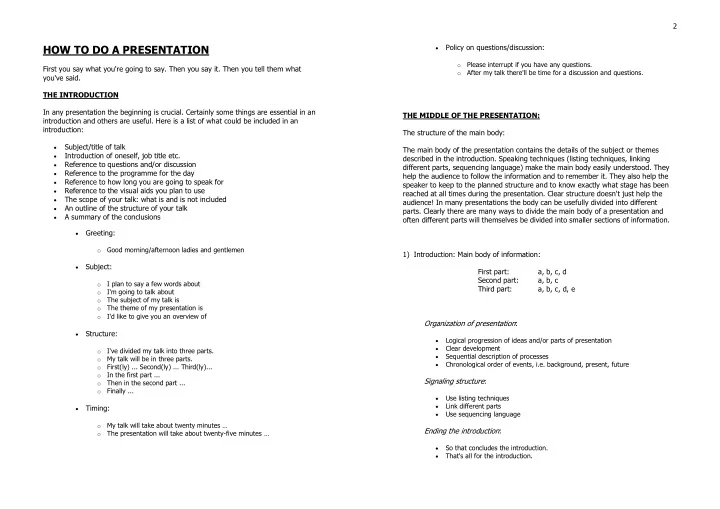
2 HOW TO DO A PRESENTATION Policy on questions/discussion: o Please interrupt if you have any questions. First you say what you're going to say. Then you say it. Then you tell them what o After my talk there'll be time for a discussion and


slide-1
SLIDE 1

HOW TO DO A PRESENTATION

First you say what you're going to say. Then you say it. Then you tell them what you've said. THE INTRODUCTION In any presentation the beginning is crucial. Certainly some things are essential in an introduction and others are useful. Here is a list of what could be included in an introduction:

  • Subject/title of talk
  • Introduction of oneself, job title etc.
  • Reference to questions and/or discussion
  • Reference to the programme for the day
  • Reference to how long you are going to speak for
  • Reference to the visual aids you plan to use
  • The scope of your talk: what is and is not included
  • An outline of the structure of your talk
  • A summary of the conclusions
  • Greeting:
  • Good morning/afternoon ladies and gentlemen
  • Subject:
  • I plan to say a few words about
  • I'm going to talk about
  • The subject of my talk is
  • The theme of my presentation is
  • I'd like to give you an overview of
  • Structure:
  • I've divided my talk into three parts.
  • My talk will be in three parts.
  • First(ly) ... Second(ly) ... Third(ly)...
  • In the first part ...
  • Then in the second part ...
  • Finally ...
  • Timing:
  • My talk will take about twenty minutes …
  • The presentation will take about twenty-five minutes …

2

  • Policy on questions/discussion:
  • Please interrupt if you have any questions.
  • After my talk there'll be time for a discussion and questions.

THE MIDDLE OF THE PRESENTATION: The structure of the main body: The main body of the presentation contains the details of the subject or themes described in the introduction. Speaking techniques (listing techniques, linking different parts, sequencing language) make the main body easily understood. They help the audience to follow the information and to remember it. They also help the speaker to keep to the planned structure and to know exactly what stage has been reached at all times during the presentation. Clear structure doesn't just help the audience! In many presentations the body can be usefully divided into different

  • parts. Clearly there are many ways to divide the main body of a presentation and
  • ften different parts will themselves be divided into smaller sections of information.

1) Introduction: Main body of information: First part: a, b, c, d Second part: a, b, c Third part: a, b, c, d, e Organization of presentation:

  • Logical progression of ideas and/or parts of presentation
  • Clear development
  • Sequential description of processes
  • Chronological order of events, i.e. background, present, future

Signaling structure:

  • Use listing techniques
  • Link different parts
  • Use sequencing language

Ending the introduction:

  • So that concludes the introduction.
  • That's all for the introduction.
slide-2
SLIDE 2

3 2) Beginning the main body

  • Now let's move to the first part of my talk, which is about ...
  • So, first ... To begin with ...

Listing:

  • There are three things to consider. First ... Second ... Third ...
  • There are two kinds of ... . The first is ... The second is ...
  • We can see four advantages and two disadvantages. First, advantages.
  • One is ... Another is ... A third advantage is ... Finally ...
  • On the other hand, the two disadvantages. First ... Second ...

Linking: Ending parts within the main body

  • That completes / concludes ...
  • That's all (I want to say for now) on ...

Linking: Beginning a new part

  • Let's move to (the next part which is) ...
  • So now we come to ...
  • Now I want to describe ...

Sequencing:

  • There are (seven) different stages to the process
  • First / then / next / after that / then (x) / after x there's y, last ...
  • There are two steps involved.
  • The first step is ... . The second step is ...
  • There are four stages to the project.
  • At the beginning, later, then, finally ...
  • I'll describe the development of the idea. First the background, then the

present situation, and then the prospects for further research …

3) The end of a presentation: Ending the main body of the presentation:

  • Right, that ends (the third part of) my talk.
  • That's all I want to say for now on ...

A summary:

  • Restates main point(s).
  • Restates what the audience must understand and remember.
  • Contains no new information.
  • Is short.

4 Beginning the summary:

  • I'd like to end by emphasizing the main point(s).
  • I'd like to finish with ...
  • a summary of the main points.
  • some observations based on what I've said.
  • some conclusions / recommendations.
  • a brief conclusion.

A conclusion:

  • States the logical consequences of what has been said.
  • Often contains recommendations.
  • May contain new and important information.
  • Is short.

Beginning the conclusion:

  • There are two conclusions / recommendations.
  • What we need is ...
  • I think we have to ...
  • I think we have seen that we should …

Questions:

  • Inviting questions implies that the audience are less expert than the speaker.
  • Beware of the nightmare scenario total silence! Have one or two prepared

questions to ask the audience.

  • Keep control of the meeting and watch the time.

Discussion:

  • Inviting discussion gives the impression that the audience have useful

experience, so is often more "diplomatic"

  • You still need to control the discussion and watch the time.

Inviting questions and/or introducing discussion:

  • That concludes (the formal part of) my talk. (Thanks for listening) ... Now I'd

Like to invite your comments.

  • So, now I'd be very interested to hear your comments.
  • Now we have (half an hour) for questions and discussion.

Handling questions:

  • Listen very carefully.
  • Ask for repetition or clarification if necessary.
  • Paraphrase the question to check you understand it.
  • Give yourself time to think - perhaps by paraphrasing the question.
  • Check that the question is relevant. If not, don't answer if you don't want to.
  • Refer questioner to another person if you can't answer.
  • Suggest you'll answer a question later if you prefer.
slide-3
SLIDE 3

5

  • Check that the questioner is happy with your answer: eye contact and a pause

is often sufficient.

  • Keep control.
  • Don't allow one or two people to dominate.
  • Be polite.
  • Signal when time is running out – “Time for one last question.”
  • At the end, thank the audience.

Understood but difficult or impossible to answer:

  • That's a difficult question to answer in a few words.
  • It could be ...
  • In my experience ...
  • I would say ...
  • I don't think I'm the right person to answer that. Perhaps (Mr Holmes)

can help ...

  • I don't have much experience in that field ...

Understood but irrelevant or impossible to answer in the time available:

  • I'm afraid that's outside the scope of my talk / this session. If I were you I'd

discuss that with ...

  • I'll have to come to that later, perhaps during the break as we're short of

time.

Not understood:

  • Sorry, I'm not sure I've understood. Could you repeat?
  • Are you asking if ... ?
  • Do you mean ... ?
  • I didn't catch (the last part of) your question.
  • If I have understood you correctly, you mean ... ? Is that right?

Checking that your answer is sufficient:

  • Does that answer your question?
  • Is that okay?