
SLIDE 1
1
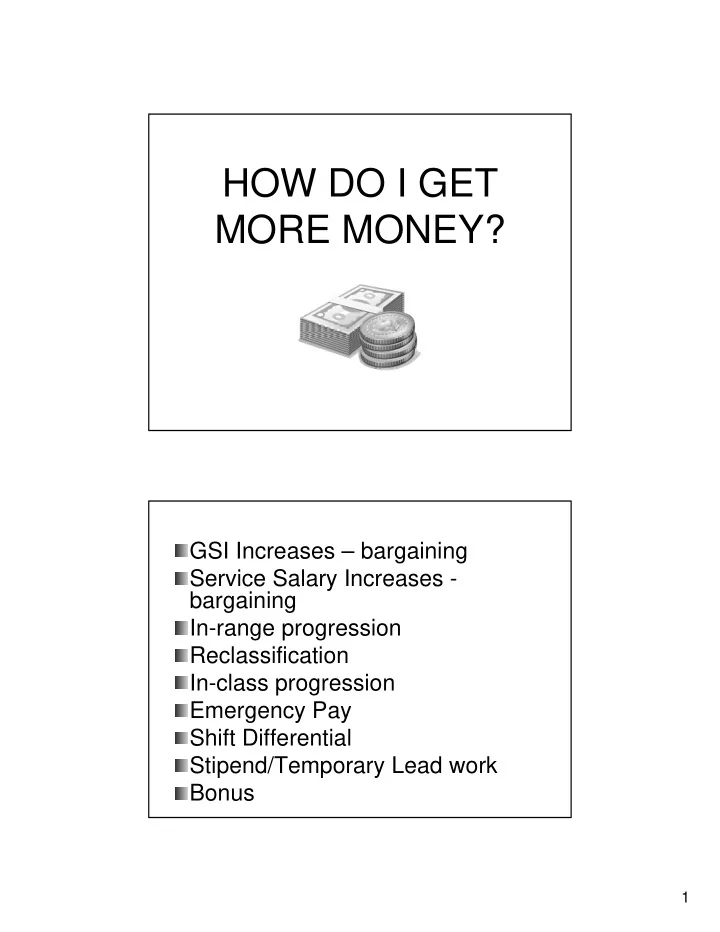
HOW DO I GET MORE MONEY? GSI Increases bargaining Service Salary - - PDF document
HOW DO I GET MORE MONEY? GSI Increases bargaining Service Salary Increases - bargaining In-range progression Reclassification In-class progression Emergency Pay Shift Differential Stipend/Temporary Lead work Bonus 1 EMPLOYEES HAVE A
1
2
3
In-Range Progression
– Movement within a class or skill level – Minimum 3% pay increase
In-class Progression
– Movement between
level and another class or skill level – Minimum 5% pay increase
4
Assigned application of enhanced skill(s) Retention Equity Performance Recognition of new lead work or new project coordination functions given to an employee on an on- going basis by an appropriate administrator where the classification standard/series do not specifically list lead work as a typical duty or responsibility Other salary related criteria.
5
Position description is updated Employee requests are submitted to the supervisor Supervisor must forward the request within 30 days HR has 180 days to complete the review
Justification for request is written Employee requests are submitted to the supervisor Supervisor must forward the request within 30 days HR has 90 days to complete the review
6
Which contains distinct CLASSIFICATIONS:
Administrative Support Assistant Administrative Support Coordinator
Administrative Support Assistant I Administrative Support Assistant II Administrative Coordinator I Administrative Coordinator II
7
To move from an Assistant to a Coordinator is a RECLASSIFICATION
To move from an Assistant I or Coordinator I to an Assistant II or Coordinator II is an IN CLASS PROGRESSION
8
To apply for an In Class Progression Performance Evaluations Review of Class Standards For your personnel file Recruitment To request a Classification Review
Your latest position description (if you don’t have one ask HR). The standards for your current classification and the one to which you aspire
(www.calstate.edu/HRadm/Classification/index.shtml)
9
Position Descriptions of jobs comparable to yours on campus Campus job postings for the classification to which you aspire. Blank campus position description/classification review forms, and any directions, policies and procedures CSEA resource materials such as word lists and the Know Your Rights Flyer on Reclassification and In Class Progression.
10
11
12
Three stonecutters were working at their jobs when a passerby stopped to ask what they were doing. The first answered, “I’m cutting stone.” The second said “I’m building a wall.”
13
“I’m creating a cathedral!” Like the stonecutters, your tasks can have a different meaning depending on your perspective. Redefine your tasks toward the cathedral.
14
Write down everything you do 3-4 broad categories Assign percentages of time Verbs
Use good English Write in Complete Sentences Keep verbs consistent Keep from personalizing (referring to incumbent)
15
Job Functions The purpose of the position The nature and scope of authority Supervision of others Work relationships Skills, knowledge and abilities An organizational chart Special working conditions
16
Criteria
Complexity (difficulty) of work Degree of independence with which you work – how are you supervised? Where does your work come from – self generated
Authority to commit resources – money, labor, things Amount of independent judgment used Types of problems solved Consequence of Error – if you make a mistake, does anyone else catch it? If not, what harm would be done?
17
Direct Supervision – close and regular General Supervision – some delegation of responsibility, some independence in routine matters. General Direction – operates independently under broad guidelines Works as a team. Not supervised in the conventional sense.
18
You do what? To what or whom? To achieve what outcome? At what level of difficulty? Give examples!
NOT how much (workload) you do and how well (performance) you do it.
19
In Range Progression Ask supervisor to make stronger, new request (12 month limit does not apply to management requests) Request a bonus or stipend Reclassification Appeal Request IRP Request payment for reassignment of out-
Request removal of duties above your classification level
20
No appropriate classification exists. The Classification Standards are out of date. The results of a classification review can’t be grieved. The supervisor won’t agree to sign off on the duties in a revised position description. The request for the classification review sits on the desk of the supervisor/dean/director. HR denies the request based on issues other than the merits of the case.
Reviews and appeals Abuses and violations Campus policy The Union believes that the campus should have a Promotion and IRP Policy. Employees should have the opportunity to train and promote in their careers. The campus should use IRP to make sure that all employees progress within their pay ranges on a regular basis.