Hopewell Valley History Project A new volunteer effort to collect - - PDF document

hopewell valley history project
SMART_READER_LITE
LIVE PREVIEW

Hopewell Valley History Project A new volunteer effort to collect - - PDF document

Hopewell Valley History Project A new volunteer effort to collect and organize the important sources of our local heritage in digital form, and share them online for open and convenient access. The Hopewell Valley History Project is: New, from


slide-1
SLIDE 1

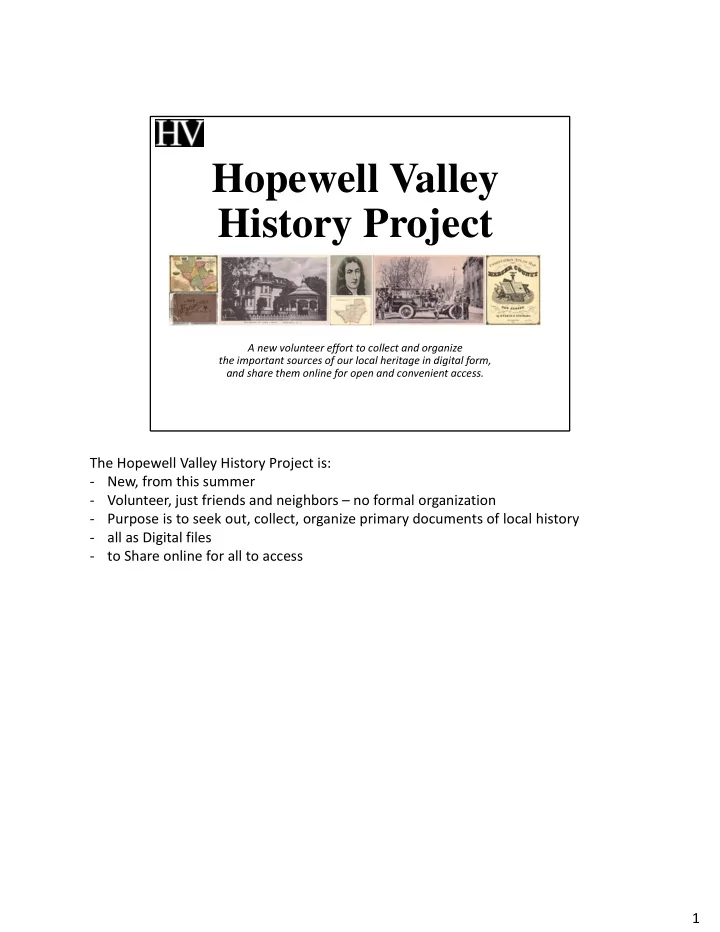
Hopewell Valley History Project

A new volunteer effort to collect and organize the important sources of our local heritage in digital form, and share them online for open and convenient access.

The Hopewell Valley History Project is: ‐ New, from this summer ‐ Volunteer, just friends and neighbors – no formal organization ‐ Purpose is to seek out, collect, organize primary documents of local history ‐ all as Digital files ‐ to Share online for all to access 1

slide-2
SLIDE 2

The The Hope Hopewell ll Va Valley is is Bl Bles essed sed Wi With His History

  • ry

The Hopewell Valley is Blessed With History

  • Hopewell Train Station (1867) – National Register
  • Our towns – Pre‐Revolutionary
  • Our region – Washington’s Ten Crucial Days

Built 1876 Faden 1878 Larry Kidder

2

We are blessed with history in this area ‐ Buildings on the Nation Register ‐ Towns before the Revolutionary War, tracing back to the Lenape ‐ Washington all over our region – Camped in the hills north of Hopewell See Larry Kidder’s new book for more on Washington’s Ten Crucial Days, from crossing the Delaware to the battles of Trenton and Princeton. Larry is also speaking and leading tours at these sites this holiday season. 2

slide-3
SLIDE 3

Bl Bles essed sed wi with Or Organizatio tions & Pe People Pre Preser erving His History

Blessed with Organizations & People Preserving And Sharing History

  • Hopewell Public Library – Reference Shelves
  • Hopewell Museum – Archives (Boro)
  • Hopewell Valley Historical Society – Newsletter (1975)
  • Hopewell Valley Heritage Weekend
  • Hopewell Branch, Mercer Co. Library
  • Pennington Library
  • Trenton – Mercer Co. – N. J. State Library, State Archives
  • Hunterdon Co. (pre 1838) – Archives, Historical Society

3

Museum – Hw 1909 Library – Hw 1909 Hopewell: A Historical Geography Hunter & Porter

And blessed with local organizations and local people saving our history (see later) ‐ Reference shelves in Library – and we are adding materials ‐ Archives at Museum and Historical Society ‐ Community events like Heritage Weekend ‐ Hopewell Branch Library hosts the HVHS archives ‐ Other local libraries also [co‐]sponsor talks on historical topics ‐ Trenton nearby for state, county, township, and borough materials ‐ Hunterdon nearby for pre‐1838 archives (before Mercer Co.) 3

slide-4
SLIDE 4

Genesi Genesis of

  • f the

the Hope Hopewell ll Valle lley His History

  • ry Pr

Projec ect

Interested in investigating historical questions

  • How do you get started? Where do you go?
  • What are the key references? Where do you find them?

Started collecting and organizing primary references

  • Building lists of sources and references
  • Find online (Library of Congress, university libraries)
  • Scan / photograph in municipal archives

Shared online among ourselves …

  • Digital

So make a public site (!)

  • Open and convenient access to digital copies
  • Protect fragile historic documents

4

The Project began this summer with interest in local history inspired by the Library’s Architecture Tour and Garden Tour ‐ We went through the process of spinning up on local history ‐ Started keeping notes of things to know ‐ Started collecting materials – local, online, site visits ‐ Organized as digital files, shared among ourselves ‐ So … next step was to make into a public site 4

slide-5
SLIDE 5

Ov Over ervie view of

  • f the

the We Website

Digital Archives – Books and Maps

  • Over 120 files posted
  • Books and pamphlets, Maps, aerials, and municipal
  • Listed in tables – Sort, search, view, source

Image Archives

  • Over 280 images of buildings and streets
  • Hopewell Boro, Pennington, Titusville
  • Book scans and postcard collectors

Reference Guides

  • Galleries – Quick visual reference of historic primary materials
  • Chronologies – Chronological listings w/ details, sources
  • Sources Guides – Book sources and resources (esp. digital)

Focus on Direct Access

  • Curated files – Selected sources, photo and edit, text recognition
  • Readability – Reduced sizes for download (not wall posters)
  • Not Catalog / Collection – Summary information for access, Guides

5

Website has 3 major sets of materials ‐ Can scroll through Home page to access each, or jump directly with menus ‐ Book & Map files ‐ Access through tables ‐ One‐click thumbnail to see file, click title to see description ‐ Click source to see full description, higher‐resolution versions ‐ Image Archives – Currently hosted on Google Drive ‐ Organized by street address and date ‐ Scroll through to move through time for same building, walk down street ‐ Reference Guides – PDFs to view online or print ‐ Summary in Galleries, further details in Chronologies and Sources Guides ‐ Materials are curated – Selected and edited to be clean & readable & searchable ‐ Reduced as possible for faster download 5

slide-6
SLIDE 6

1905 Family photo – Jack Koeppel

Ex Exam ample ple – W – What / Wh Where is is th this is Im Imag age?

6

Our first example of using the site starts with an unknown – “What is this Image?” ‐ Have no information – No writing, no date, no identification ‐ Baseball team on field – Shirts appear to say “Hopewell” ‐ But if this is Hopewell N.J. – Where is this field? Next to what hill? ‐ Recognize anything? ‐ The “Castle” is on the hill, between the houses ‐ So this is Hart Avenue ‐ With houses on north side of the street, with the fronts facing the street 6

slide-7
SLIDE 7

<1911 <1911

Wh Which Houses Houses on

  • n Hart

Hart Av Avenue ue?

7

The advantage of collecting lots of different materials, of different types, is that you can look for other sources of information. So look in the Image Archives on the site, and find a postcard – with the same three houses, including the distinctive flat top at the peak. Which explicitly confirms that this is Hart Avenue. But which houses are these? 7

slide-8
SLIDE 8

Field Field Train Station Train Station Castle Castle ~#30 ~#30

Hope Hopewell ll N.

  • N. J.
  • J. – M

– Mercer Co.

  • Co. Aerial

Aerial – c – c. 1925 1925

8

Aerial imagery is another useful source, which started being collected in the mid/late 1920s and 1930s. Finding and organizing the available aerial imagery is a current focus of the Project. Here we see the baseball field still exits north of the railroad line in Hopewell. And development has not extended much further than the 1900s photos. Looking at current maps, the sightline from the Castle to the field crosses around #30 Hart Ave. 8

slide-9
SLIDE 9

36 Hart 1896 Castle

[32 Hart c1912, no 34]

30 Hart 1900/04 28 Hart 1898 36 Hart 1896 Castle

[32 Hart c1912, no 34]

30 Hart 1900/04 28 Hart 1898

9

So you can walk along the street and match the front of the houses. (The gap between the houses is because #32 was not build until the next decade.) The charm of Hopewell is that not only are the houses still standing after over a century, but they even still retain the decorative details (i.e., up at the peak of the front). But don’t get cocky with this success … 9

slide-10
SLIDE 10

Re Revers rse View View fr from Cas Castle le to to Bas Basebal ball Fi Fiel eld? d?

Description of Ralston Heights ‐ Booklets ‐ Webster Edgerly ‐ c1905 Description of Ralston Heights ‐ Booklets ‐ Webster Edgerly ‐ c1905

10

So here is the reverse view, from the Castle to the baseball field. This is a photo from a Description of Ralston Heights booklet published by Webster Edgerly c. 1905, as part of his real estate development scheme for the Castle and the hills north of Hopewell. And it matches! – We see a house, then a gap, then two more houses. We’re done! Or are we … 10

slide-11
SLIDE 11

Re Revers rse View View fr from Cas Castle le to to Bas Basebal ball Fi Fiel eld? d?

36 Hart 1896 30 Hart 1900/04 28 Hart 1898 36 Hart 1896 30 Hart 1900/04 28 Hart 1898

11

.. Or does it match? It’s not the same three houses – #30 has the flat peak, which does not appear in the new image. But it’s hard to match images of the fronts of houses with views of the backs. 11

slide-12
SLIDE 12

Mercer County Planning Department – “GIS Data Viewer” ‐ http://www.mercercounty.org/departments/planning

Mer Mercer er Coun County ty my myiDV – Street Addr Addresses esses

12

So we can look at (current) aerial images. This great site from the Mercer County Planning Department shows property lines and street addresses (and lots of other interesting information). So we can try to match the structure of the house, from both sides. There’s #30 with the flat peak at the bottom left, across from the road that was the east edge of the ball field. 12

slide-13
SLIDE 13

Cas Castle to to Basebal Baseball Fi Fiel eld – H – Hart Av

  • Ave. Fr

Fron

  • nt an

and Re Rear

13

#36 1896 #30 1900 #28 1898 #30 1900 #28 1898 #26 1900 #36 1896 #32 1912 #24 1900 #22 1901 #20 1900 #36 1896 #28 1896 #26 1900

<– West to Louellen – Flipped Horizontally – East to Greenwood –> <– West to Louellen – Flipped Horizontally – East to Greenwood –>

#27 1900 #32 1912 #30 1900 #32 1912

And here is a suggested match between the two images. The gap in the second image is actually the size of two houses – The photo is earlier, so the #30 house is missing (not built yet), along with #32. And we even get a peek at the front of #27 across the street. Anyone interested in taking this further? (We also have the view of additional houses down Hart in the first postcard, and additional scenes of the street.) But again – don’t get cocky … 13

slide-14
SLIDE 14

c 1905 Postcard

Ex Exam ample: ple: Hope Hopewell ll N.

  • N. J.
  • J. Fr

From

  • m Rals

Ralston Heig Heights

14

… Because this is the final challenge. The good news is that we have an aerial (hillside) view of the town of Hopewell from the early 1900s. But how is this Hopewell? Where is the train line? The railroad station? Church steeples? Can you see any landmarks? 14

slide-15
SLIDE 15
  • St. Michaels

School Castle Gardens Castle Gardens Hart Ave Hart Ave RR Track RR Track

Hope Hopewell ll Fr From

  • m Rals

Ralston Heig Heights – B – Bearings

15

Zoom in. That’s St. Michael’s orphanage in the distance, so you can see the severe perspective in this image, with Princeton Avenue running almost horizontally in front of it. And that’s the School (now apartments) on Model Avenue, backed onto the railroad track. So the bottom part of the image is the Castle land, with the fanciful buildings on the left that Edgerly constructed around the pond below the Castle, and gardens on the right. And the long line of buildings across the foreground is Hart Avenue, with gaps, so you see some backs and some fronts of buildings. 15

slide-16
SLIDE 16

Hope Hopewell ll Fr From

  • m Rals

Ralston Heig Heights ‐ Anno Annotate

Annotate down Hart Ave. to Greenwood

16

One way to figure out these kinds of puzzles is to invite a working group of friends and neighbors over for dinner, and make sure one of them is an architect who is good at recognizing building structures … So here is a work‐in‐progress identifying the houses down Hart Avenue, some matching the earlier images, and some identified by current residents. This would make a great project for someone to pick up and extend … 16

slide-17
SLIDE 17

Ex Exam ample: ple: House House In Informatio ion

Example: Calvary Baptist Church Review Variety of Sources

  • Maps – Find year(s) when building appears, owners
  • Images – Photos and postcards, owners, neighbors
  • Books – History, chronology, families
  • Municipal Studies – Historic preservation and cultural resource

… Then Ready to Visit Archives

  • for deeds, family histories, etc.

17

Our second example is to start with a known building, and find out more about it – “Tell Me About My House.” We will cheat for this example and use a well‐known building, the Hopewell Calvary Baptist Church, since it changes over time, and is referenced in the various sources that we want to illustrate. So we’ll look at the kind of information that each of these sources can help provide. 17

slide-18
SLIDE 18

== == Ma Maps ps Ar Archi chives es == == Wh When en Build ildin ings Appear Appear

Map of Mercer County (1849) ‐ Otley & Keily Map of Phila. and Trenton (1860) ‐ Lake & Beers Hopewell Borough (1875) ‐ Everts & Stewart Hopewell, New Jersey (1887) ‐ Fowler

18

The first source of information on buildings is maps. Maps can help date a building by providing a year by which it appears in a map, and therefore is known to exist. For the Calvary Baptist Church, it clearly does not exist in 1850 or 1860 (development has not even started on the east side of town). But it clearly appears by 1875, and is joined by the Presbyterian and Catholic churches by 1887. These maps and more are available in the Digital Archives, including versions cropped to show only a selected area or town. [The talk takes a digression into exploring maps…] 18

slide-19
SLIDE 19

== == Im Imag age Ar Archiv chives es == ==

Image Archives

  • Find Buildings, Neighbors, Street – Dates

Books

  • Healthful Historic Hopewell / Normer Gray (1897)
  • 1909 Hopewell New Jersey / Fry & Whitehead (1909)
  • 1909 Hopewell: One‐Hundred Years Later / Roberta Mayer (2009)

Photos & Postcards

  • Roberta Mayer
  • Bob & Carol Meszaros
  • Steve Cohen
  • Dick and Hope Sudlow
  • Irene Wildgrube
  • Jean Harrington
  • Washington Crossing Card Collectors Club (WC4)

19

The next source is images, both photos and postcards. Like maps, images can help date a building by providing a year by which it appears in an image, and therefore is known to exist. Here again we are blessed in Hopewell Borough, because there were two books published around the turn of the century to promote the town as a place to live and have a business, which include not only descriptions of the town and its amenities, but also photos of buildings, residences, and businesses. Also see the site for a full list of acknowledgements of the people who already have kindly contributed materials to share in the Image Archives, particularly local photographers and postcard collectors. 19

slide-20
SLIDE 20

Imag mages es – C – Calvary Bap Baptist Chur Church ch

Healthful Historic Hopewell / Normer Gray (1897)

  • by Normer Gray, 1897, 56 pp., 40 photos
  • Contents: Historical, Schools, Buildings,

Banking, Railroads, Manufactories, Mercantile Business, Real Estate

1897‐HHH_040

20

The first promotional book is Healthful Historic Hopewell, published in 1897, with 40 photos, including buildings, residences, farms, business ads, and local people. Here’s the well‐established Calvary Baptist Church, with the distinctive lower level, and the front door with no additional façade. Plus we can see the manse next door. 20

slide-21
SLIDE 21

Imag mages es – C – Calvary Bap Baptist Chur Church ch

1909 Hopewell N. J. / Fry & Whitehead (1909)

  • Compiled by E.S. Fry,

photos by E.R. Whitehead

  • Issued by Young Men's League,

Calvary Baptist Church

  • 54 pp., 36 photos
  • “Set forth the advantages of Hopewell

as a place of residence”

21

The second promotional book, about a decade later, is 1909 Hopewell New Jersey. This has more descriptive text about the town, plus 36 photos of buildings and residences. Here we see another view of the Calvary Baptist Church, looking much the same, and with a clearer view of the front door. Plus Hopewell now has utility lines. 21

slide-22
SLIDE 22

Imag mages es – C – Calvary Bap Baptist Chur Church ch

1909 Hopewell: One‐Hundred Years Later / Mayer (2009)

  • by Roberta A. Mayer
  • Blurb.com, 2009, 82 pp.
  • 35 pairs of photos on facing pages

2009 vs. 1909

22

Then one hundred years later, Roberta Mayer had the great idea to revisit the 1909 book, re‐taking each photo from the same angle. The resulting book, available at Blurb.com, show 35 pairs of photos, bridging 100 years. And here is the current Calvary Baptist Church, in the same building, now with a new front and a new steeple. The charm of Hopewell is illustrated again by the fact that almost all the buildings in the original book are still with us, and still look much the same. 22

slide-23
SLIDE 23

Imag mages es – C – Calvary Bap Baptist Chur Church ch

Postcards

  • Real Photo ‐ 1900 ‐
  • Undivided Back ‐ 1901 ‐ 1907
  • Early Divided Back ‐ 1907 ‐ 1914

(Golden Era)

1913 1913‐SC_056 19xx‐undiv‐SC_037

23

Postcards also provide an amazing array of images starting in the early 1900s, after postcards were approved for use in the U. S. These were immensely popular over the next couple of decades. In each town, there were postcards of public buildings, residences of prominent people, and even

  • streetscapes. The early postcards had an “undivided back” – The entire back was

reserved for the address (like a letter), so the image on the front was printed with borders around it that could be used for writing the message. These were the text messages of the time – People would write “See you on Tuesday,” paste on a one‐cent stamp, and send off the message. Here from the Image Archives is an early “undivided back” card with the same photo

  • f the Calvary Baptist Church that we saw before, reused from the first book.

And a later card, postmarked 1913, showing a new front on the church, with outside steps leading up to the sanctuary. Plus it shows some of the other houses along the street, thankfully with minimal leaves in the way. 23

slide-24
SLIDE 24

Imag mages es – C – Calvary Bap Baptist Chur Church ch

Postcards – Streets

  • Trolley tracks
  • “Dana” building

1910 ‐ Broad Looking West ‐ MZ 19xx 19xx – Broad Looking East ‐ MZ

24

And here are streetscapes, facing west and east down East Broad Street, with the Calvary Baptist Church and other buildings barely visible through all the leaves on the trees. At the top, facing west, we see the church on the left, before the new front was added, and the blank wall of what is now the Dana building on the right before Greenwood Avenue. On the bottom, facing east, we see the bottom of the church on the right, with the new front added, plus the edge of the Dana building on the other side of the street. This image also shows a couple people out on the street. 24

slide-25
SLIDE 25

Imag mages es – C – Calvary Bap Baptist Chur Church ch

Photos – More Recent

1991 Downtown_Hopewell Bonotto‐DHS 1952‐Calvary_Baptist New_Front‐DHS 1993‐ Weathervane‐DHS

25

And, to complete the story of the Calvary Baptist Church in images, here are some interesting more modern views of its transformation into its current form. The 1952 image is from a church bulletin celebrating the addition of the new front on the building. The 1991 drawing shows the church in the background, but with the steeple removed as it became too unstable. And the 1993 photo shows the new steeple being constructed, with the weathervane being added on the top. 25

slide-26
SLIDE 26

== == Book Books Ar Archiv chives es == == Hope Hopewell ll Bor Borough ugh

The Town Records of Hopewell, N. J. / Colonial Dames (1931)

  • New Jersey Society of the Colonial Dames of America, 1931, 197 pp
  • The Town Book ‐ Town Officers and Town Meetings (1721 ‐ 1799)
  • The Records of the Old School Baptist Church (1749 ‐ 1849)

Historical Sketch of the Village of Hopewell (1876)

  • Historical Sketch of the Village of Hopewell from its Settlement

to Present Days (Centennial Speech – 1876)

Pioneers of Old Hopewell / Ralph Ege (1908 / 1963)

  • With Sketches of Her Revolutionary Heroes
  • Originally 1908, Reprinted 1963, Hopewell Museum, 316 pp
  • 48 genealogical articles, 33 in Hopewell Herald, 1901 – 1905

26

The next source of information on a building of interest is books. Again, Hopewell Borough is blessed with early writings that have been preserved up to our time. The Town Book of Hopewell contains the hand‐written town records from 1721 to

  • 1799. And then in 1931, the Colonial Dames amazingly took on the project of

transcribing the handwriting into a printed book, along with the records of the Old School Baptist Church from 1849. In the Centennial year of 1876, the town wrote a history of Hopewell from its original

  • settlement. And one of the contributors to the history, Ralph Ege, also write a series
  • f genealogical articles in the Hopewell Herald newspaper, which he then published

as a book. These are available on the site. 26

slide-27
SLIDE 27

Book Books – C – Calvary Bap Baptis ist Chur Church ch

Hopewell Valley Heritage / Alice Blackwell Lewis (1973)

  • by Alice Blackwell Lewis
  • Hopewell Museum (50th anniv.), 1973, 319 pp
  • Contents: Early History and Anecdotes, Indians,

families / towns / stories ..., Firsts, Chronology

Chronological History excepts (p. 300): 1715 – First Baptist Church of Hopewell organized in Jonathan Stout’s home. … 1870 ‐ Mercer and Somerset Railroad built. 1871 ‐ October 24th, Calvary Baptist Church of Hopewell organized. Church finished and dedicated December 19th, 1872. 1874 – St. Alphonsus Roman Catholic Church of Hopewell began erection of house of worship. 1874 – “The Hopewell Herald” became name of paper that started earlier by the name of “Hopewell Astonisher.” By 1956 the name changed to “Hopewell Valley News.”

27

And, more recently, others have stepped up to record and share our history. Alice Blackwell Lewis published Hopewell Valley Heritage in 1973, covering the entire Hopewell Valley. Her extensive chronology at the end of the book documents the founding of the Calvary Baptist Church, and reports its completion in December 1872, which fits well with the evidence in the maps. (In this case, the images then give us information on later changes.) 27

slide-28
SLIDE 28

Book Books – C – Calvary Bap Baptis ist Chur Church ch

Hopewell's Past / Betty Gantz (c. 1987)

  • by Elizabeth (Betty) Gantz
  • Hopewell Valley News columns 1975 – 1983
  • Edited 1987, 207+ pp.
  • Unpublished manuscript (dot‐matrix printer)
  • Contents: First settlers, first houses,

“Little Histories” 1870 to 1950, Hw homes, first farms

  • Posted & image courtesy of Robert Gantz

In 1870 Jerome W. Morrell bought the land from Wm. H Riley which he sold on 10‐3‐1871 to the Calvary Baptist Church (Book 83, P234) and (Book 114, P37). ... Mason Ege had a hardware store ... Hopewell Valley Hardware ... old Rorer’s. The second floor of this building was used by the Calvary Baptist before 1871‐72, until the church was finished. [Herald] ... The manse of the Calvary Baptist Church was built in 1872; burned in 1893 but rebuilt soon. ... The Old Baptist had reigned supreme for about 160 years. From 1872 ‐ 1883 the following churches were built: Calvary Baptist, Roman Catholic, Presbyterian and Methodist. The Second Calvary Baptist Church followed. At this time transportation was mainly horse‐and‐buggy or your own feet. It amazes

  • ne to read that many people did walk to worship in the church of their choice ... up to 9 miles!

2007 – age 93

28

And here is a colorful character, Betty Gantz, who wrote a history column in the Hopewell Herald from 1975 to 1983, in which she explored the town and discussed issues with her readers in her friendly style. She then edited the columns into a manuscript, which she donated to the Museum, with a copy to the Library, in the hope that it would be published as a book. Instead, it has languished on the shelves ever since, unappreciated and almost forgotten. Now, working with her son Bob, we have scanned the manuscript and shared her book, Hopewell's Past, online for all. Betty’s information on the Calvary Baptist Church includes the real estate transaction by the church to buy the land in 1871 (including deed references), the construction and demise of the original manse, and where the new congregation met until the building was completed (on the second floor of the hardware store). So the story fits together. 28
slide-29
SLIDE 29

Book Books – C – Calvary Bap Baptis ist Chur Church ch

Hopewell: A Historical Geography / Hunter & Porter (1990)

  • by Richard W. Hunter, Richard L. Porter
  • Hopewell Twp. Historic Sites Committee, 1990, 262 pp.
  • Outgrowth of historic sites survey 1984‐85
  • Contents: Geography, Prehistory, Historical,

Farms, Villages, Industry & Commerce, Transportation, Community, Historic Districts

  • p. 112 – Villages / Hopewell Borough:

“The religious needs of the expanding village led to the establishment of three new churches during the 1870's. The Calvary Baptist Church (1105‐7‐1), a gable‐roofed frame structure that remains in use today, was built for Hopewell's dominant religious denomination in 1872. The First Presbyterian Church was built on the south side of Broad Street just to the west of Hopewell Academy in 1876. The church remined in use into the early twentieth century, when it was moved to its present site on West Prospect Street and converted to its current use as a dwelling (1105‐30‐16). The frame St. Alphonsus Roman Catholic Church was built on Princeton Avenue in 1877 and is still in use today (1105‐13‐9).”

29

Finally, the definite book on the history and geography of the Hopewell Valley is Hopewell: A Historical Geography by Hunter and Porter (more on them coming up). This book is published through Hopewell Township, which uses the profits to fund historical restorations. Hunter and Porter discuss the church in the context of the growth of Hopewell after the arrival of the railroads, with the Calvary Baptist Church built in 1872, followed by the Presbyterian and the Catholic churches (as we also saw in the maps, and are also in the Image Archives on the site). 29

slide-30
SLIDE 30

== == Pre Preser ervation

  • n / Cul

Cultural al Re Resource Stu Studie ies == ==

Historic Preservation and Cultural Resource Studies

  • Municipal Historic Preservation Commissions
  • Historic preservation, Cultural resource management planning
  • Historical research, Architectural history, Archaeological investigation

Honey Hollow, 2019 Richard Hunter, Hunter Research Hopewell Railroad Station Preservation Plan, 1996 Michael Mills et. al. Ford Farewell Mills and Gatsch, Heritage Studies West Trenton Line Bridges Replacement Project, 2005 Richard Porter et. al., RBA (now NV5) The Cultural Landscape The Cultural Landscape

  • f the Sourlands:

Rock Hopper Preserve Ian Burrow, BurrowIntoHistory Mount Rose History Max Hayden, Max Hayden Architect

30

Perhaps the biggest surprise in this project was the profusion of historical and cultural resource studies that have been performed by our municipalities to better understand and protect our heritage. This area is blessed with professionals and companies that are in this business of documenting historical sites. These people also give generously of their time to serve

  • n municipal historic commissions, volunteer with historical organizations, and give

talks on their discoveries: Cultural Resource Studies: ‐ Richard Hunter’s study of Honey Hollow on Baldpate Mountain, and recent talk. ‐ Rick Porter’s work on the proposed West Trenton Line revitalization in 2005. Architectural Studies: ‐ Michael Mills’ work on the 1996 preservation plan for the Hopewell RR Station. ‐ Max Haden’s work on preserving Mount Rose, and recent talk. Archaeological Studies: ‐ Ian Burrow’s recent study on the Sourlands, and associated talk. However, these studies typically end up on shelves in Trenton, basically unknown and inaccessible to the rest of us. So another current focus of the Project is documenting what’s available and getting the interesting material digitized. 30

slide-31
SLIDE 31

Hope Hopewell ll Cul Cultur ural al Re Resource Sur Survey (1985) 985)

Hopewell Cultural Resource Survey (1985)

  • Initiated by Hopewell Township Historic Sites Committee, 1983
  • Survey of Hopewell [Valley] sites, in 60 square mile area
  • Included Hopewell Township and Hopewell and Pennington Borough
  • Documented more than 1,100 sites, pre‐1875
  • History, architecture, significance, with photographs
  • By Heritage Studies, Inc. – Richard Hunter and Richard Porter
  • Hopewell: A Historical Geography / Hunter & Porter (1990)
  • On file: NJ DEP, Historic Preservation Office
  • Hopewell Township, Hopewell Borough, Pennington Borough

31

The holy grail of cultural studies that we started hearing about as we pursued this project was a Cultural Resource Survey of the entire Hopewell Valley that was commissioned in 1985. This work was managed by Hunter and Porter, and lead to their book. The survey produced documentation on over a thousand historic (pre‐1875) sites, which would obviously be of interest to people around the region. But it also was languishing away on shelves in Trenton, where it has been essentially inaccessible for 35 years. But we started poking around, and discovered that Rick Porter had a copy of the Hopewell Borough portion of the survey, which he kindly contributed to be scanned and added to the site, with a paper copy now also available at the Museum. And the HVHS has a paper copy of the Pennington section. Even better, Bonita Grant, archivist for the Museum and the HVHS, got in touch with the N. J. Historic Preservation Office, which is in the process of digitizing its holdings, and was happy to start work on the survey. So soon we should have the entire survey available online, plus electronic copies available at our local institutions. 31

slide-32
SLIDE 32

Hope Hopewell ll Bor Boro Cul Cultural al Re Resource Sur Survey

Hopewell Borough Survey, 1984 ‐ 1985

  • Robert Craig and Richard Porter (Heritage Studies, Inc.)
  • Buildings Survey – 54 buildings (pre‐1875), 63 pp.
  • Streetscape Survey – 56 blocks, 114 pp.

Hopewell Borough Streetscape Survey East Broad Street (from Greenwood) Hopewell Borough Hopewell Borough Building Survey Calvary Baptist Church

32

The Hopewell Borough portion of the survey, done by Rick Porter et. al., documents 54 historic buildings plus 56 streetscapes (entire streets plus blocks along longer streets). So here are the pages for the Calvary Baptist Church, and the first block of East Broad Street Avenue. 32

slide-33
SLIDE 33

Hope Hopewell ll Cul Cultur ural al Re Resource Sur Survey – S – Streetscapes

East Broad Street – Greenwood, Blackwell, and Seminary

33

The Streetscape Survey for the first block of East Broad Street discusses the buildings

  • f interest along the block:

‐ The Calvary Baptist Church, with the construction date and further modifications, plus the manse ‐ The Hopewell Inn, previously the Central Hotel ‐ The Library, previously the Hopewell National Bank ‐ The Dana building, previously the next site of the Bank ‐ Plus additional residences 33

slide-34
SLIDE 34

Hope Hopewell ll Cul Cultur ural al Re Resource Sur Survey – Build uildin ings

Calvary Baptist Church, 3 East Broad Street

34

And the Building Survey for the Calvary Baptist Church has an extensive discussion of the architecture and history of the building, plus an explicit statement of its historical significance. And, circling back to the beginning of this discussion, the references section points back to the maps that we discussed earlier, Everts & Stewart first showing the church, Fowler showing it along with additional churches, and fire maps showing it in an established and growing town. 34

slide-35
SLIDE 35

== == Hope Hopewell ll Va Valley His History

  • ry Pr

Project == ==

Building a digital collection of our local heritage Get Started

  • Resource Guides: Gallery, Chronology, Sources

Review Digital Materials

  • Maps – Find year(s) when building appears, owners
  • Aerials – Properties, streets
  • Images – Photos and postcards, owners, neighbors, street
  • Books – History, chronology, families
  • Cultural Surveys – Municipal studies, architecture, significance

… Then Ready to Visit Archives

  • Know names, dates, subjects
  • Search specific deeds, family histories, etc.

35

In conclusion, the goal for this site is to help you first get started, with the Resource Guides proving an overview of available materials and references for further information. Then you can review the materials, with the maps, aerials, images, books, and cultural surveys already on the site, to get a background on your interests. As a result, you can have a good baseline understanding before you schedule a trip to visit the available archives, allowing you to be more efficient and effective in digging deeper. 35

slide-36
SLIDE 36

Wh What’s Ne Next? xt? In Interested in in a Pr Project?

General

  • Preserve & share stuff! – Attics, institutions, online, ...
  • Broader coverage – Township, Pennington, Titusville, …

Research and Summarize

  • Timelines, Brief histories (towns, buildings), National register, Railroads, Suffrage

Organize and Identify

  • Images, property information, deeds

Hands‐On Research

  • Library, Museum, HVHS – Collections, pamphlets, photos, town / family history
  • State Archives, etc. – Aerials, Tax ratable lists (Rev War), Road Returns / Plat Maps

Sources

  • Fire Maps – Princeton Univ Library, Free Library of Philadelphia
  • Rutgers Special Collections
  • Hunterdon Co. – Records & maps (pre 1838)

How To Reference Guides

  • House Lineage Research, Cemeteries
  • Genealogy (N. J. State Library)
  • Periodicals / newspapers

Interactive Maps

  • Current properties + historic maps + building / ownership chronology + images

36

The key take‐away from this talk, then, is to please help preserve and share historical

  • material. Too much of our history is being lost forever in dumpsters, and time is

running out on finding the remaining materials. And, if you would like to help with investigating and recording local history, here are just some of the types of activities and topics that could use your help. Thanks. 36