Homework Homework 8 Computational Complexity Help after lecture - - PDF document

homework
SMART_READER_LITE
LIVE PREVIEW

Homework Homework 8 Computational Complexity Help after lecture - - PDF document

Homework Homework 8 Computational Complexity Help after lecture Before we start The Turing Machine Any questions? Motivating idea Build a theoretical a human computer Likened to a human with a paper and pencil


slide-1
SLIDE 1

1

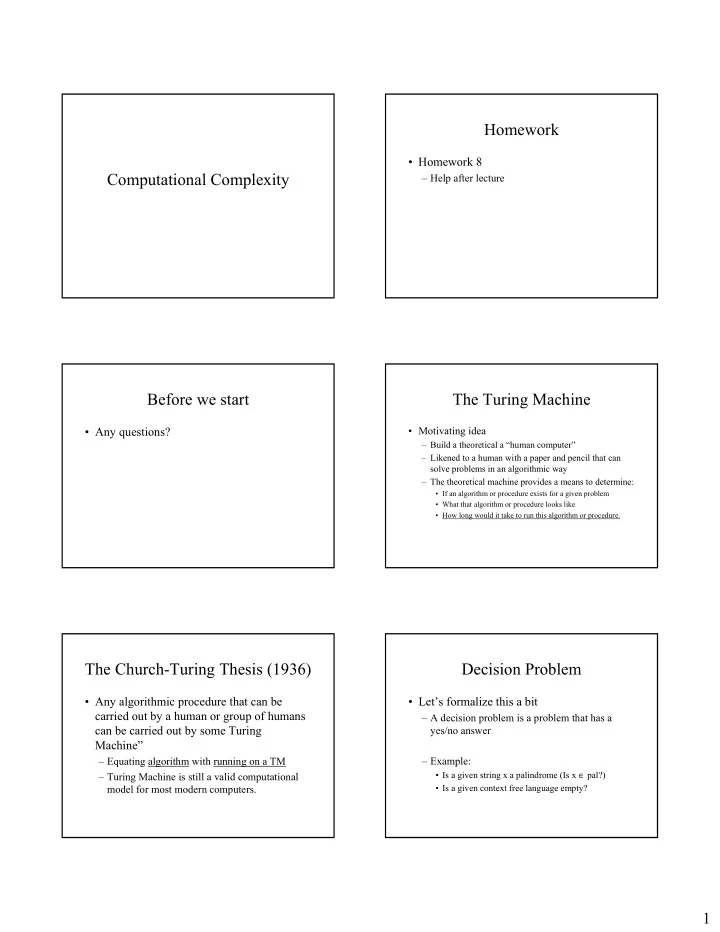
Computational Complexity Homework

  • Homework 8

– Help after lecture

Before we start

  • Any questions?

The Turing Machine

  • Motivating idea

– Build a theoretical a “human computer” – Likened to a human with a paper and pencil that can solve problems in an algorithmic way – The theoretical machine provides a means to determine:

  • If an algorithm or procedure exists for a given problem
  • What that algorithm or procedure looks like
  • How long would it take to run this algorithm or procedure.

The Church-Turing Thesis (1936)

  • Any algorithmic procedure that can be

carried out by a human or group of humans can be carried out by some Turing Machine”

– Equating algorithm with running on a TM – Turing Machine is still a valid computational model for most modern computers.

Decision Problem

  • Let’s formalize this a bit

– A decision problem is a problem that has a yes/no answer – Example:

  • Is a given string x a palindrome (Is x ∈ pal?)
  • Is a given context free language empty?
slide-2
SLIDE 2

2

Decision Problem

  • Running a decision problem on a TM.

– The problem must first be encoded – Example:

  • Is a given string x a palindrome (Is x ∈ pal?)

– x is an instance of the probkem

  • Is a given context free language empty?

– Instance of a problem is a CFG…must be encoded.

What makes a good algorithm?

  • Suppose we know that a decision problem is

decidable, how do we know that there is a good algorithm that solves the problem?

– Consider running time on a TM – Actually, consider the complexity of a TM that can solve the problem.

Complexity

  • Complexity refers to the rate at which the storage
  • r time grows as a function of the input to the

algorithm

– T(n) = time complexity (amount of time an algorithm will take based on input) – S(n) = space complexity (amount of space an algorithm will take based on input)

  • For the rest of this lecture, we’ll only consider

T(n) though the discussion can also be applied to S(n)

Units

  • What does T(n) return?

– A “basic operation” can be defined as a move a TM makes in accepting / rejecting a string – T(n) = number of TM moves

Asymptotic Analysis

  • Based on the idea that as the input to an

algorithm gets large

– The complexity will become proportional to a known function. – Notations:

  • O (Big-O) – upper bounds on the complexity
  • Θ (Big-Theta) – tight bounds on the complexity

Asymptotic Analysis

  • Big-O (order of)

– T(n) = O(f(n)) if and only if there are constants c0 and n0 such that

  • T(n) ≤ c0f(n) for all n ≥ n0

– What this really means

  • Eventually, when the size of the input gets large

enough, the upper bounds on the runtime will be proportional to the function f(n).

slide-3
SLIDE 3

3

Algorithm Efficiencies Are you a good witch?

  • So what should be the cutoff between a “good”

algorithm and a “bad” algorithm?

– In the 1960s, Jack Edmonds proposed:

  • A “good” algorithm is one whose running time is a polynomial

function of the size of the input

  • Other algorithms are “bad”

– This definition was adopted:

  • A problem is called tractable if there exists a “good”

(polynomial time) algorithm that solves it.

  • A problem is called intractable otherwise.

Is this a valid cutoff? The class P

  • The class P contains all decision problems

that are decidable by an “algorithm” that runs in polynomial time.

– Does this define a class of languages? – Yes…

  • The set of all problems whose encodings of “yes

instances” (a language) is recognized by a TM M

  • M recognizes the above language in Polynomial

Time.

The class P

  • If we take the Church-Turing Thesis to be

true:

– P is robust:

  • The problems contained in P remain in P even if we

change our basic model of computation.

– A basic TM – A Sun, a Mac, even a PC running Windows XP!

The class P

  • Are there actually problems in P?

– Most everyday algorithms (e.g. sorting, searching) are in P

  • Are there problems not in P:

– Yes, we know that Self-Accepting is not in P since it isn’t even solvable

  • Are there decidable problems not in P?

– Let’s take a look…

slide-4
SLIDE 4

4

Satisfiability (SAT)

  • INSTANCE

– A Logical expression containing

  • variables xi
  • logical connectors &, |, and !
  • In conjuction normal form (C1 & C2 & C3 … & Cn)
  • PROBLEM

– Is there an assignment of truth values to each of the variables such that the expression will evaluate to true.

Satisfiability (SAT)

  • Example of an instance

– (x1 | x2 | x3 ) & (x4 | !x5) & !x6 & (x7 | x8) – One Solution:

  • x1 = true x5 = false
  • x2 = false x6 = false
  • x3 = false x7 = true
  • x4 = false x8 = false

Satisfiability (SAT)

  • Naïve algorithm to solve

– Systematically consider all combinations of assignments of True and False values for all variables and test the expression – In the worst case, for n variables

  • T(n) = O (2n)

Satisfiability (SAT)

  • Can we do better?

– No known polynomial algorithm

  • Either one doesn’t exist
  • One exists and we haven’t found it yet.

Non-deterministic TM

  • Let’s reconsider the NDTM

– Same as the ordinary TM except:

  • The transition function will return a set of triplets

– (q, x, D)

  • For each state / symbol combination, 0 or more

transitions can be defined.

  • The machine can “choose” which transition to take.

Non-deterministic TM

  • If we map all paths that can possibly be

taken:

– Number of paths will be exponential – Example:

  • Suppose at each of n states, for each character, there

are 2 possible moves.

  • Number of paths 2n
slide-5
SLIDE 5

5

Satisfiability (SAT)

  • Running SAT on a non-deterministic TM.

– Step 1: “Guess” a set of boolean assignments to each variable (this is the non-deterministic part – 2n different choices) – Step 2: Evaluate the truth of the entire expression using the guessed assignment (this part is deterministic) – Can certainly do each step in polynomial time

The class NP

  • The class NP contains all decision problems that

are decidable by a non-deterministic “algorithm” that runs in polynomial time.

  • Represents algorithms that run in exponential time

– Does this define a class of languages? -- Yes…

  • The set of all problems whose encodings of “yes instances” (a

language) is recognized by a NDTM M

  • M recognizes the above language in Polynomial Time.
  • Are there problems in NP

– Well, for one SAT is

The class NP

  • Clearly P is a subset of NP

P NP Is there something in here? After 40 years of research…nobody knows

Reducing one language to another

  • Worked well for deciability…Let’s use it

here.

  • Basic idea

– Take an encoding of one problem – Convert it to another problem we know to be in P or NP – Conversion must be done in polynomial time!

Reducing one language to another

  • Formally (for complexity)

– Let L1 and L2 be languages over Σ1 and Σ2 – We say L1 is polynomial time reducible to L2 (L1 ≤p L2) if

  • There exists a Turing computable function
  • f: Σ1

* → Σ2 * such that

  • x ∈ L1 iff f(x) ∈ L2
  • f can be computed in polynomial time.

Reducing one language to another

  • Informally (for complexity)

– We can take any encoded instance of one problem

  • Use a TM to compute a corresponding encoded instance of

another problem.

– In polynomial time

  • If this other problem has a TM that recognizes the set of “yes

encodings” in polynomial time (P), we can run that TM to solve the first problem.

  • If this other problem has a NDTM that recognizes the set of

“yes encodings” in polynomial time (NP), we can run that TM to solve the first problem.

slide-6
SLIDE 6

6

The class NP-complete

  • The hardest of the problems in class NP are

in the class of NP-complete problems:

  • A language L is in NP if

– L ∈ NP – For every other language L1 ∈ NP

  • L1 ≤p L
  • All NP-complete problems are “equally”

difficult.

The class NP-complete

  • Implications

– Hardest problem – It’s probably not worth looking for a solution for an NP-complete problem – How do we show a problem to be NP-complete

  • Reduction
  • We need a NP-complete problem to kick things off.

The class NP-complete

  • Guess what?

– SAT can be shown to be NP-complete – Cook’s Theorem

NP-Complete and P

  • If any a polynomial algorithm is found for any

NP-complete problem

– A polynomial algorithm can be found for all NP- complete problems (via polynomial reduction).

  • In other words

– For any L ∈ NP-Complete,

  • If L ∈ P then
  • P = NP
  • Finding such a language is still an open problem.

NP-Complete and P

  • The world of NP

P NP Is there something in here? After 40 years of research…nobody knows NP-complete

Practical considerations

slide-7
SLIDE 7

7

Practical considerations Practical considerations Some NP-Complete Problems

  • Traveling Salesman

– INSTANCE

  • A finite set of “cities” C = { c1, c2, …, cn }
  • A distance function d: C2 →N

– d( ci, cj ) = distance between ci and cj

  • Upper bounds B

– PROBLEM

  • Is there a “tour” of all cities such that the distance

traveled will be less than B?

Some NP-Complete Problems

  • Traveling Salesman

– PROBLEM

  • Said another way, is there an ordering of the cities

<ci1, ci2, …, cin> such that

B c c d c c d

i in ii n i ii

≤ +

+ − =

) , ( ) , (

1 1 1 1

Some NP-Complete Problems

  • NDFA inequivalence

– INSTANCE

  • Two nondeterministic finite automata A1 and A2

having the same input language Σ.

– PROBLEM

  • Do A1 and A2 recognize different languages?

– NOTE

  • Can be done in polynomial time if A1 and A2 are

deterministic.

Some NP-Complete Problems

  • Inequivalence of Programs with

Assignments

– INSTANCE

  • Finite set of X variables
  • Two programs P1 and P2

– Each a sequence of the form x0 = (x1 == x2 ) ?x3 : x4

  • A value set V which defines possible values for each

variable.

slide-8
SLIDE 8

8

Some NP-Complete Problems

  • Inequivalence of Programs with

Assignments

– PROBLEM

  • Is there an initial assignment of a value from V for

each variable such that the two programs will yield different final results?

Some NP-Complete Problems

  • Crossword Puzzle Construction

– INSTANCE

  • A finite set W ⊆ Σ* of words
  • An n by n matrix A consisting of 1’s and 0’s

– PROBLEM

  • Can an n by n crossword puzzle be built up

including all words from W and blank squares consisting of the “0” cells in A?

Some NP-Complete Problems

  • You want more?

– “Computers and Intractability” by Michael R. Garey and David S. Johnson.

Dealing with NP-completeness

  • Some NP-complete problems have solutions

that are, on the average, polynomial.

  • Restrict the problem
  • Approximation
  • Heuristics
  • Buy a Supercomputer

Summary

  • Complexity
  • P
  • NP
  • NP-completeness

So There You Have It!

  • I bet you thought I forgot!

– What is a language? – What is a class of languages?

  • Thanks for playing.
slide-9
SLIDE 9

9

Where to next?

  • Language Design / Compiler Construction

– Formal Languages – Compiler Construction Lab

  • Complexity & Computation

– Complexity and Computability

The Theory Hall of Fame

  • Stephen Cole Kleene

– Regular expressions & FAs

  • Noam Chomsky

– The grammar guy

  • W. Ogden

– Pumping Lemma for CFLs

  • Kurt Godel

– Kicked off study of computability

  • Alan Turing

– Turing Machines

The Theory Hall of Fame

  • Alonzo Church

– Unlimited support for TMs

  • Emil Post

– Post Correspondence Problem

  • H.G. Rice

– Decision problems for TMs

  • Stephen Cook

– NP-completeness

  • Aho, Hopcraft, and Ullman

– Bell Labs guys – work on programming language

The Theory Hall of Fame

  • YOU

– If you find a polynomial solution to any problem in NP-complete!

Next Time

  • Final exam review
  • Saturday, Nov 16: Final exam

– 7-1420 – 12:30pm – 2:30pm – Closed book – 1 page study guide okay.

  • Course Evaluations