Homework 7.1 C D Here is the payoff matrix for the most commonly - - PowerPoint PPT Presentation

homework 7 1
SMART_READER_LITE
LIVE PREVIEW

Homework 7.1 C D Here is the payoff matrix for the most commonly - - PowerPoint PPT Presentation

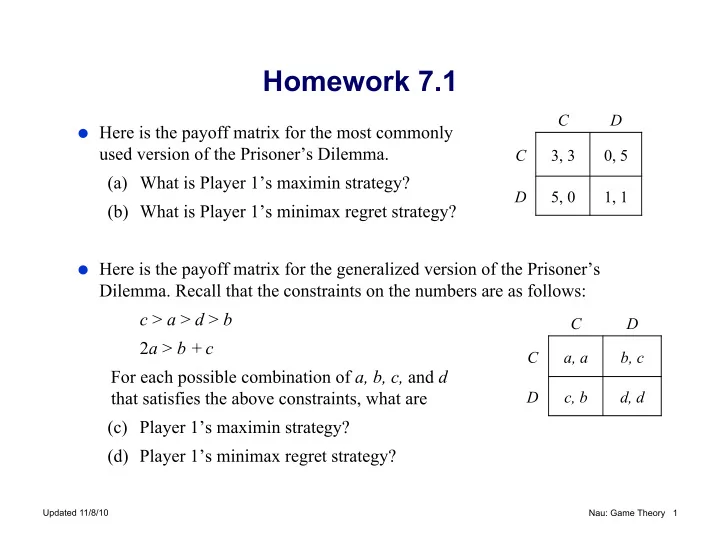
Homework 7.1 C D Here is the payoff matrix for the most commonly used version of the Prisoners Dilemma. C 3, 3 0, 5 (a) What is Player 1s maximin strategy? D 5, 0 1, 1 (b) What is Player 1s minimax regret strategy? Here


slide-1
SLIDE 1

Nau: Game Theory 1 Updated 11/8/10

Homework 7.1

 Here is the payoff matrix for the most commonly

used version of the Prisoner’s Dilemma. (a) What is Player 1’s maximin strategy? (b) What is Player 1’s minimax regret strategy?

 Here is the payoff matrix for the generalized version of the Prisoner’s

  • Dilemma. Recall that the constraints on the numbers are as follows:

c > a > d > b 2a > b + c For each possible combination of a, b, c, and d that satisfies the above constraints, what are (c) Player 1’s maximin strategy? (d) Player 1’s minimax regret strategy?

C D C 3, 3 0, 5 D 5, 0 1, 1 C D C a, a b, c D c, b d, d

slide-2
SLIDE 2

Nau: Game Theory 2 Updated 11/8/10

Homework 7.2

 In the definition of a Bayesian game, why is the following condition part of

the definition?

 Condition 1:

  • The games in G have the same number of agents, and the same strategy

space (set of possible strategies) for each agent. The only difference is in the payoffs of the strategies.

slide-3
SLIDE 3

Nau: Game Theory 3 Updated 11/8/10

Homework 7.3

 Suppose we have an auction in which the object’s owner colludes with the

auctioneer in the following fashion:

  • The owner pretends to be one of the bidders, and places bids on the
  • bject in an attempt to raise the selling price
  • If the owner’s bid wins the auction, then the object remains the

property of the owner (and the owner doesn’t pay the bid)

  • What is the owner’s optimal bidding strategy in each of the following

auctions? (a) English auction (b) First-price sealed-bid auction (c) Second-price sealed-bid auction