HOG PRODUCTION DIVISION NCSU ag econ class discussion 04/18/16 2 - - PowerPoint PPT Presentation

hog production division
SMART_READER_LITE
LIVE PREVIEW

HOG PRODUCTION DIVISION NCSU ag econ class discussion 04/18/16 2 - - PowerPoint PPT Presentation

HOG PRODUCTION DIVISION NCSU ag econ class discussion 04/18/16 2 Todays Topics Who are we? Intro to Smithfield Market news Corn, Wheat, and Soybeans Life as a grain originator for Smithfield Grain Differentiating from


slide-1
SLIDE 1

HOG PRODUCTION DIVISION

04/18/16
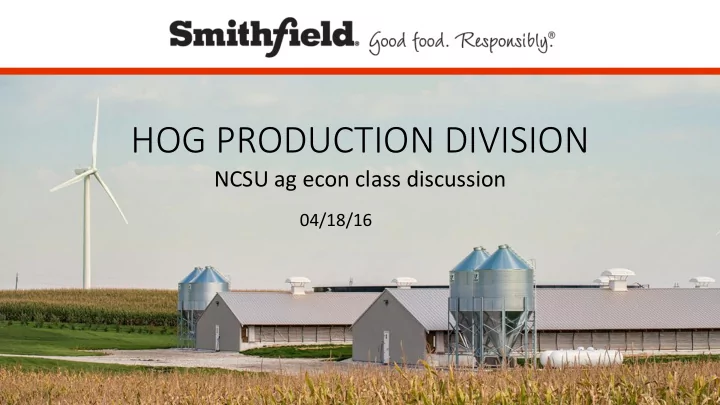
NCSU ag econ class discussion

slide-2
SLIDE 2

2

Today’s Topics

  • Who are we?
  • Intro to Smithfield
  • Market news – Corn, Wheat, and Soybeans
  • Life as a grain originator for Smithfield Grain
  • Differentiating from the competition
  • Intern program
slide-3
SLIDE 3

3

Jo Josh Goode who are we?

  • Grain Origination Manger – Southern Region &

Ohio

  • Kansas State – undergrad (Ag Business)
  • Worked with Smithfield for 3 years (Interned

with MBgrain in 2014 summer cohort)

  • Bagged 3M bushels in Laurinburg during 2014

internship

  • Live in Wilmington, NC
  • Moved from Kansas to North Carolina
slide-4
SLIDE 4

4

Taylor Cowan who are we?

  • Grain Originator
  • Northeast Region
  • Elevators in Hobbsville and Elizabeth City, NC
  • Feed mill in Creswell, NC
  • NCSU - undergrad (Ag Business Management & Economics)
  • Graduated Spring 2017
  • Took this class two years ago
  • Live in Williamston, NC
slide-5
SLIDE 5

5

Intro to Smithfield

  • WH Group (China) purchased Smithfield in 2013.
  • $15B global food company, headquartered in Smithfield, VA
  • World’s largest pork processor and hog producer.
  • 48,000 employees across all divisions.
  • Vertically integrated business. Genetics, farms, feed

manufacturing, processing, packaging, distribution.

  • 15M hogs produced /year (~50K to market /day).
slide-6
SLIDE 6

6

Intro to Smithfield and MBgrain

slide-7
SLIDE 7

7

Intro to Smithfield Grain

  • Based out of Rose Hill, NC.
  • Responsible for sourcing all ingredients delivered to

Smithfield feed mills across the US.

  • Use ~120M bushels (corn/wheat/milo) /year.
  • Grain supplied locally and imported (rail or vessel).
  • Goal is to supply quality grain/ingredients at low cost to

keep hog business competitive.

  • 70% of cost of raising a hog is from grain.
slide-8
SLIDE 8

8

Smithfield Grain – where we trade

Based on this information, where would you grow hogs? 35 buying stations across the Untied States

slide-9
SLIDE 9

9

Smithfield local grain pile in Yuma, Colorado

slide-10
SLIDE 10

10

Bagging corn in Nevada, Missouri

slide-11
SLIDE 11

11

Grain bags full of corn and wheat in Waverly, Virginia

slide-12
SLIDE 12

12

Grain ship unloading at Wilmington port

slide-13
SLIDE 13
slide-14
SLIDE 14

14

Corn/Wheat/Soybean – US and Local news

slide-15
SLIDE 15

15

Corn story

slide-16
SLIDE 16

16

Wheat story

slide-17
SLIDE 17

17

Soybeans story

slide-18
SLIDE 18
slide-19
SLIDE 19

19

Grain Originator’s focus and challenges

  • Responsible for sourcing quality grain to

assigned feed mill(s) at the lowest landed basis possible (Futures + Basis = Flat Price).

  • We’re in the commodity business - hogs

eat everyday, regardless of supply/demand (i.e. costs).

  • Local is most always cheapest grain – but

there’s not enough to feed the hogs

  • Farmer (customer) relationships are key
  • Intercompany relationships are critical to

success

slide-20
SLIDE 20

20

Basis Traders – MBgrain.com

  • Why can a farmer get more $ delivering to feed mill vs.

grain elevator? (aka, why is Feed mill basis greater than elevator basis?)

  • Why do you think Creswell, NC feed mill would be

cheaper at harvest than any other feed mill?

slide-21
SLIDE 21

21

Freight Matters

  • Farmer wants to sell 5,000 bushels of old crop corn
  • His bins are in Raeford, NC

He calls the grain originators for both end users to learn:

  • 1. Smithfield bid = 65CK15
  • 2. Perdue bid = 80CK15

Where should farmer sell his grain? What needs to be considered? 42 miles 20 miles

slide-22
SLIDE 22

22

Freight Matters (cont)

  • 1. Smithfield bid = 65CK15
  • 2. Perdue bid = 80CK15

Where should farmer sell his grain? 42 miles 20 miles

Smithfield Perdue Futures 3.9 3.9 Basis 0.65 0.75 miles 20 45 rate/mile 3.25 3.5 Bushels 929 929 FOB Price 4.48 $ 4.48 $

slide-23
SLIDE 23

23

Life as a grain originator

  • Early morning
  • 7:00a – Read morning grain comments while drinking Starbucks expresso (or 2 diet mountain dews)
  • 7:30a – Review inventories at your feed mill provided daily by mill staff
  • 8:00a – Review mill position (yesterday’s feed production, incoming grain, what’s left to ship from

farmers, upcoming rail, port lineup, freight)

  • Mid-morning – check in with customers (maintenance on existing grain contracts, recruit

new bushels, market intel, inform on market)

  • Lunch – buy a farmer lunch
  • Afternoon – scout fields, understand local crop conditions
  • Evening – paperwork - contracts, put in pricing orders, etc.
slide-24
SLIDE 24

24

Differentiating from other end-users

  • Wheat Seed Program
  • Non-GMO Soybean Progarm
  • We want to be the PREFERRED buyer of local grain.
  • Farmers have choices, and there’s only a limited supply of grain.
  • How do we maximize our local handle?
slide-25
SLIDE 25

25

Differentiating from other end-users

  • We want to be the PREFERRED buyer of local grain
  • Farmers have choices, and there’s only a limited supply of grain.
  • How do we maximize our local handle?
  • 1. Customer Service – from originators, to mill personnel, mill capabilities
  • 2. Marketing Options to fit farmer’s businesses
  • 3. Always have a market
  • 4. Flexible hours at harvest – 24/7
  • 5. Agronomic assistance
  • 6. Quick payment
  • 7. Off the farm pickup program
  • 8. Alternative markets (sorghum, Non-GMO beans)
  • 9. Partner with Universities for research to increase production in Mid-Atlantic Regions
slide-26
SLIDE 26

Smithfield Grain Internship

26

slide-27
SLIDE 27

Smithfield Internship

  • 7th year we’ve done program
  • Ag interest preferred (not required)
  • People skills important
  • Willingness to work long hours
  • Good problem solver

27

slide-28
SLIDE 28

Internship Details

Our goal = improve customer service

Beginning

Exposure to most MB areas – understand what we do

Middle

J/J wheat harvest at feed mills

End

Projects – work with management

28

slide-29
SLIDE 29

What do you get?

  • MONEY!!
  • Exposure to large company in Ag industry
  • Sharpen Communication skills
  • Decision making skills
  • Possible college credit
  • Networking
  • Possible long-term employment

29

slide-30
SLIDE 30

QUESTIONS?

30