History of Present Illness 14 month old previously healthy infant - - PDF document

history of present illness
SMART_READER_LITE
LIVE PREVIEW

History of Present Illness 14 month old previously healthy infant - - PDF document

1/29/2014 Kimberly Johnson Hatchett, MD PGY-4 11/15/13 History of Present Illness 14 month old previously healthy infant boy presented via EMS after being found by his mother to be breathing loudly and non-responsive. Possibly


slide-1
SLIDE 1

1/29/2014 1

Kimberly Johnson Hatchett, MD PGY-4 11/15/13

History of Present Illness

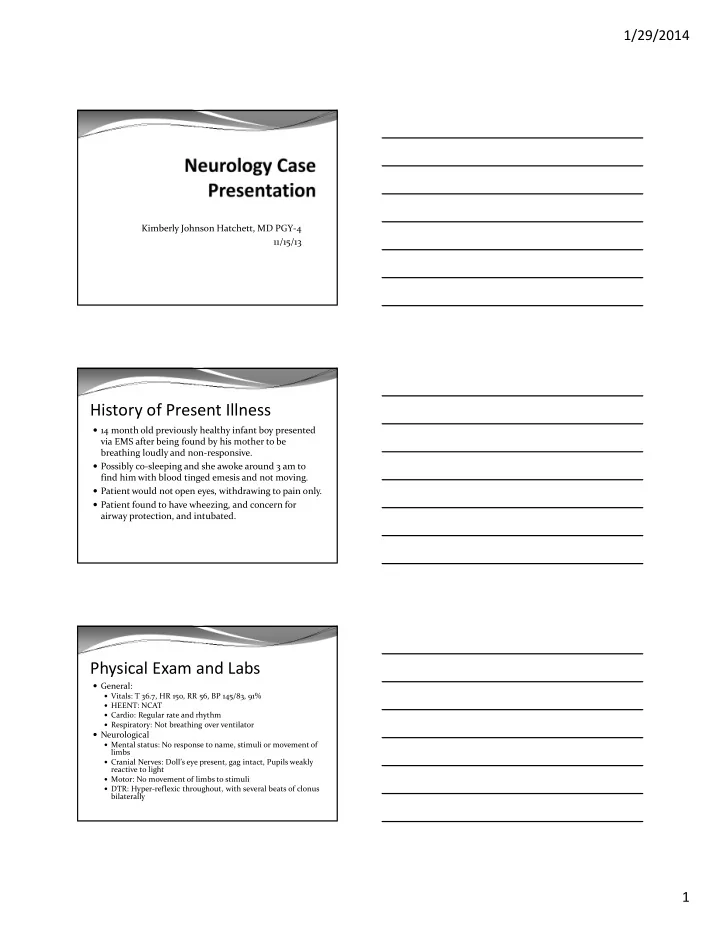
14 month old previously healthy infant boy presented via EMS after being found by his mother to be breathing loudly and non-responsive. Possibly co-sleeping and she awoke around 3 am to find him with blood tinged emesis and not moving. Patient would not open eyes, withdrawing to pain only. Patient found to have wheezing, and concern for airway protection, and intubated.

Physical Exam and Labs

General:

Vitals: T 36.7, HR 150, RR 56, BP 145/83, 91% HEENT: NCAT Cardio: Regular rate and rhythm Respiratory: Not breathing over ventilator

Neurological

Mental status: No response to name, stimuli or movement of

limbs

Cranial Nerves: Doll’s eye present, gag intact, Pupils weakly

reactive to light

Motor: No movement of limbs to stimuli DTR: Hyper-reflexic throughout, with several beats of clonus

bilaterally

slide-2
SLIDE 2

1/29/2014 2

Labs

CBC: WBC 39.5, Hgb 11.2, Plt 501, PT 22.8 BMP: Na 134, K 5.8, Creat 0.66, Glu 445, Lactic Acid 10.4 AST 2654, ALT 2150, Amylase 659 CSF studies: Protein 255, Glucose 130, RBC 37, WBC 92

(92% monocytic – macrophages containing pigment

consistent with hemosiderin) Toxicology screen: Venlafaxine and Norvenlafaxine

Physical Exam and Labs

MRI BRAIN on hospital day 1,

slide-3
SLIDE 3

1/29/2014 3

MRI BRAIN on hospital day 1, MRI BRAIN on hospital day 1, 10/14/13

Differential

Infectious: Herpes, Varicella, Mycoplasma,West Nile, EBV Toxic injestion Post infectious cerebelitis with septic emboli (Rhinovirus/Enterovirus was positive in respirations) Suffocation, Hypoxic Injury.

slide-4
SLIDE 4

1/29/2014 4

Continued story

Interim Physical Exam Initial EEG completed After initial HSV PCR negative, and with OK from Infectious Disease started on High dose steroids for Cerebral Edema Follow up MRI scan on hospital Day 5….

MRI BRAIN on hospital day 5, MRI BRAIN on hospital day 5,

slide-5
SLIDE 5

1/29/2014 5

MRI BRAIN on hospital day 5,

Story continued

Induced Hypothermia Pentobarbital coma with patient in burst suppression EVD placed to monitor intracranial pressure Warmed on Hospital Day 8 Stopped Pentobarbital Electrographic/clinical seizures noted Placed on additional Antiepileptic

Trileptal at 50 mg/kg/day, Phenobarbital 10 mg/kg/day, Keppra 87.5

mg/kg/day Developed left sided chorea, started on Clorazepate 0.3125 mg/kg/day (1.875 mg bid) Developed Rash ACHSS or DRESS Currently in ICU for treatment of skin lesion and systemic reaction MRI BRAIN on hospital day 8,

slide-6
SLIDE 6

1/29/2014 6

MRI BRAIN on hospital day 8,

Hypoxic Ischemic Encephalopathy

Clinical evidence of acute or sub-acute brain injury due to asphyxia Systemic hypoxemia and/or reduced cerebral blood flow Birth asphyxia = 23% of neonatal deaths world wide. Mild versus Moderate versus Severe Locations: Watershed, Basal Nuclei, can involve white matter and extend to the gray.

slide-7
SLIDE 7

1/29/2014 7

slide-8
SLIDE 8

1/29/2014 8

Take home points, conclusions

HIE, Hypoxic Ischemic Encephalopathy MRI findings and functional outcome Cooling and Outcomes, Not much difference? How soon should repeat scan be done? MRI scoring system gives tools to be able to predict future outcomes.

slide-9
SLIDE 9

1/29/2014 9

References

Srinivasakumar P, Zempel J, Wallendorf M, Lawrence R, Inder T, Mathur A. Therapeutic hypothermia in neonatal hypoxic ischemic encephalopathy: electrographic seizures and magnetic resonance imaging evidence of injury. J Pediatr. Aug 2013;163(2):465-70. Grow J, Barks JD. Pathogenesis of hypoxic-ischemic cerebral injury in the term infant: current concepts. Clin Perinatol. Dec 2002;29(4):585- 602, v. Shankaran S, Laptook AR, Ehrenkranz RA, et al. Whole-body hypothermia for neonates with hypoxic-ischemic encephalopathy. N Engl J Med. 2005; 353:1574–84. [PubMed: 16221780] Barkovich AJ, Hajnal BL, Vigneron D, et al. Prediction of neuromotor

  • utcome in perinatal asphyxia: evaluation of MR scoring systems. AJNR

Am J Neuroradiol. 1998; 19:143–9. [PubMed: 9432172] Rutherford M, Ramenghi LA, Edwards AD, et al. Assessment of brain tissue injury after moderate hypothermia in neonates with hypoxic- ischaemic encephalopathy: a nested substudy of a randomised controlled trial. Lancet Neurol. 2010; 9:39–45. [PubMed: 19896902]

Thank you

Questions?????