HiperLoc-EP High Performance Low Cost Electric Propulsion 1 This - - PowerPoint PPT Presentation

hiperloc ep
SMART_READER_LITE
LIVE PREVIEW

HiperLoc-EP High Performance Low Cost Electric Propulsion 1 This - - PowerPoint PPT Presentation

HiperLoc-EP High Performance Low Cost Electric Propulsion 1 This project has received funding from the European Unions Horizon 2020 research and innovation programme under grant agreem ent No 730075 HIPERLOC-EP: D EVELOPMENT OF E LECTROSPRAY C


slide-1
SLIDE 1

This project has received funding from the European Union’s Horizon 2020 research and innovation programme under grant agreement No 730075

1
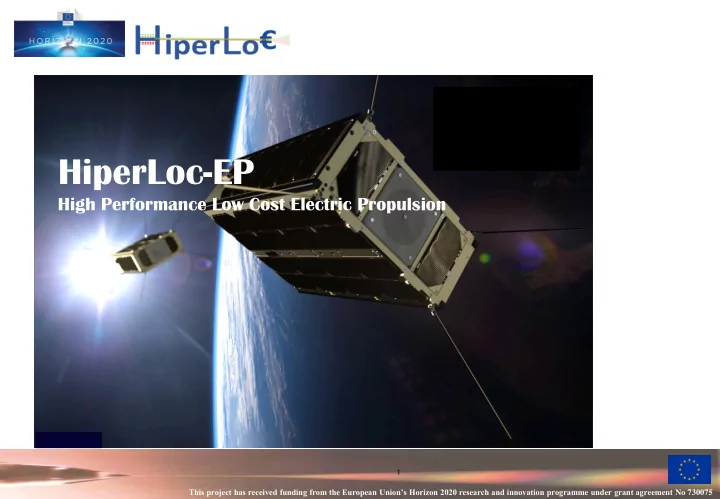
HiperLoc-EP

High Performance Low Cost Electric Propulsion

slide-2
SLIDE 2

This project has received funding from the European Union’s Horizon 2020 research and innovation programme under grant agreement No 730075

HIPERLOC-EP: DEVELOPMENT OF ELECTROSPRAY COLLOID ELECTRIC PROPULSION AS A LOW COST DISRUPTIVE PROPULSION

TECHNOLOGY

PRESENTER: JOHN STARK QUEEN MARY UNIVERSITY OF LONDON

EPIC Workshop 24th October 2017 CDTI Madrid

slide-3
SLIDE 3

This project has received funding from the European Union’s Horizon 2020 research and innovation programme under grant agreement No 730075

Project Lead

  • Queen Mary University Of London (UK)

Team Members

  • Airbus Defence & Space Ltd (UK)
  • NanoSpace AB (Sweden)
  • SystematIC design BV (Netherlands)

THE TEAM

slide-4
SLIDE 4

This project has received funding from the European Union’s Horizon 2020 research and innovation programme under grant agreement No 730075

Project Title

4

High performance Low cost Electric Propulsion system: HiperLoc-EP Vision

To develop an Electric Propulsion System having an efficiency and performance comparable to those used on current commercial platforms but fully scalable in thrust from μN to mN with cost an

  • rder of magnitude below current systems, thus facilitating the

market opportunities for large scale microsatellite constellations and commercial microsatellite platforms

slide-5
SLIDE 5

This project has received funding from the European Union’s Horizon 2020 research and innovation programme under grant agreement No 730075

Project Title

5

High performance Low cost Electric Propulsion system: HiperLoc-EP Vision

To develop an Electric Propulsion System having an efficiency and performance comparable to those used on current commercial platforms but fully scalable in thrust from μN to mN with cost an

  • rder of magnitude below current systems, thus facilitating the

market opportunities for large scale microsatellite constellations and commercial microsatellite platforms

slide-6
SLIDE 6

This project has received funding from the European Union’s Horizon 2020 research and innovation programme under grant agreement No 730075

Project Title

6

High performance Low cost Electric Propulsion system: HiperLoc-EP Vision

To develop an Electric Propulsion System having an efficiency and performance comparable to those used on current commercial platforms but fully scalable in thrust from μN to mN with cost an

  • rder of magnitude below current systems, thus facilitating the

market opportunities for large scale microsatellite constellations and commercial microsatellite platforms

slide-7
SLIDE 7

This project has received funding from the European Union’s Horizon 2020 research and innovation programme under grant agreement No 730075

The Technology Original requirement performance specification

7

Electrospray Colloid Electric Propulsion

Microthrust Array (FP7)

Thrust density mN/cm^2 Specific Impulse (sec) Specific Thrust mN/kW Thrust target μN Volume dm^3 Efficiency % 0.2 2500 40 100 0.3

50

HiperLoc-EP Target performance

slide-8
SLIDE 8

This project has received funding from the European Union’s Horizon 2020 research and innovation programme under grant agreement No 730075

Novelty

8

  • New approach driven by requirement for major

cost reduction

  • Radical paradigm shift in the manufacturing and

materials used for any EP system (including colloid)

  • The design is an integrated system comprising
  • Colloid thrust head
  • Propellant Storage and Feed System
  • Power Processing Unit

HiperLoc-EP test piece

slide-9
SLIDE 9

This project has received funding from the European Union’s Horizon 2020 research and innovation programme under grant agreement No 730075

Activities Completed

9

  • Website now on line http://www.hiperloc.eu/
  • Market analysis identifying initial markets that could be

disrupted by HiperLoc-EP Technology

  • Analysis of functional requirements for target markets
  • Identification of system performance requirements and

updating of original specification

  • Critical component testing (on-going)
  • Developing system architecture (on-going)
slide-10
SLIDE 10

This project has received funding from the European Union’s Horizon 2020 research and innovation programme under grant agreement No 730075

Market Analysis

10

Market Analysis

  • Review has taken place of various markets that may be disrupted by

access to a performant low cost EP

  • Nano-sat market typified by Multi-unit CubeSat individual

systems

  • Science missions
  • Small satellite mega-constellations
  • Sub-50 kg satellite market evaluation based on SpaceWorks forecasts

with additional analysis from market engagement with operators

slide-11
SLIDE 11

This project has received funding from the European Union’s Horizon 2020 research and innovation programme under grant agreement No 730075

Market Analysis

11

  • Growth prediction Nano/micro satellites mass < 50kg
slide-12
SLIDE 12

This project has received funding from the European Union’s Horizon 2020 research and innovation programme under grant agreement No 730075

Market Analysis

12

  • The sub 10kg market has dominated launches
  • Post 2014 reduction due to launch availability
slide-13
SLIDE 13

This project has received funding from the European Union’s Horizon 2020 research and innovation programme under grant agreement No 730075

Market Analysis

13

  • Forecast identifies that commercial sector will dominate sub 50kg

future market

slide-14
SLIDE 14

This project has received funding from the European Union’s Horizon 2020 research and innovation programme under grant agreement No 730075

Cube Sat Constellations

14

slide-15
SLIDE 15

This project has received funding from the European Union’s Horizon 2020 research and innovation programme under grant agreement No 730075

Small satellite Mega-Constellations

15

  • Opportunities developing with “mega-constellations” operating in

LEO typified by One-Web (currently at CDR) and SpaceX and Samsung (speculative)

  • Anticipate cost to be a main system driver with

any suitable EP system requiring mass production

  • Possible future markets: Maritime Surveillance
slide-16
SLIDE 16

This project has received funding from the European Union’s Horizon 2020 research and innovation programme under grant agreement No 730075

Market Conclusions

Conclusions A low cost EP technology could prove to be disruptive in 2 principal market areas, wherein both markets demonstrate existing/growing demand that HiperLoc-EP could enable:

  • 1. Nano/Microsatellite market
  • 2. Small satellite Mega-constellation

16

slide-17
SLIDE 17

This project has received funding from the European Union’s Horizon 2020 research and innovation programme under grant agreement No 730075

Mission & Performance Considerations

17

Mission studies carried out include:

  • NanoSats: Delfi-n3Xt, GOMX-4;
  • MicroSats: OHB QuadSats,
  • SmallSats: OneWeb, SWARM
  • Medium/large Satellites for science mission

Functional requirements

slide-18
SLIDE 18

This project has received funding from the European Union’s Horizon 2020 research and innovation programme under grant agreement No 730075

18

  • Wish-list requirements identified by customers (note unlikely to be

able to meet all these for given systems due to performance conflicts) Mission & Performance Considerations

slide-19
SLIDE 19

This project has received funding from the European Union’s Horizon 2020 research and innovation programme under grant agreement No 730075

Updated technology verification target

19

Thrust density mN/cm^2 Specific Impulse (sec) Specific Thrust mN/kW Thrust target μN Volume dm^3 Thruster Efficiency % Total Impulse (Ns) 0.2 > 1000s ≥ 56 ≥ 500 n/a 50 2000 HiperLoc-EP Target Verification Performance

Note

  • Higher specific impulse is certainly achievable but this will

increase cost

  • Thrust density is not a driving system requirement
  • Thrust level is geared towards perceived market rather than a

limiting factor

slide-20
SLIDE 20

This project has received funding from the European Union’s Horizon 2020 research and innovation programme under grant agreement No 730075

System Highlights

20

slide-21
SLIDE 21

This project has received funding from the European Union’s Horizon 2020 research and innovation programme under grant agreement No 730075

System Highlights

21

  • All propellant and

power is used propulsively:

  • no neutralizer

required

slide-22
SLIDE 22

This project has received funding from the European Union’s Horizon 2020 research and innovation programme under grant agreement No 730075

System Highlights

22

  • Simple interface:
  • nly a power

and data bus

slide-23
SLIDE 23

This project has received funding from the European Union’s Horizon 2020 research and innovation programme under grant agreement No 730075

System Highlights

23

  • PS&FS thermally

integrated with CTH and PPU

  • Propellant is isolated

from ground environment hence simple pre-launch storage

slide-24
SLIDE 24

This project has received funding from the European Union’s Horizon 2020 research and innovation programme under grant agreement No 730075

Conclusions

24

  • High efficiency: No neutralizer required
  • Novel propellants possible
  • HiperLoc-EP provides a radically different way to achieve the

advantages of an electrospray colloid electric propulsion system

  • The paradigm shift in manufacturing approach will result in

an improved performance to cost ratio by an order of magnitude

  • Hence anticipate HiperLoc-EP system will prove to be

disruptive to markets adopting multi-unit CubeSats and with potential for new market mega-constellations of small satellites

slide-25
SLIDE 25

This project has received funding from the European Union’s Horizon 2020 research and innovation programme under grant agreement No 730075

THANK YOU

25