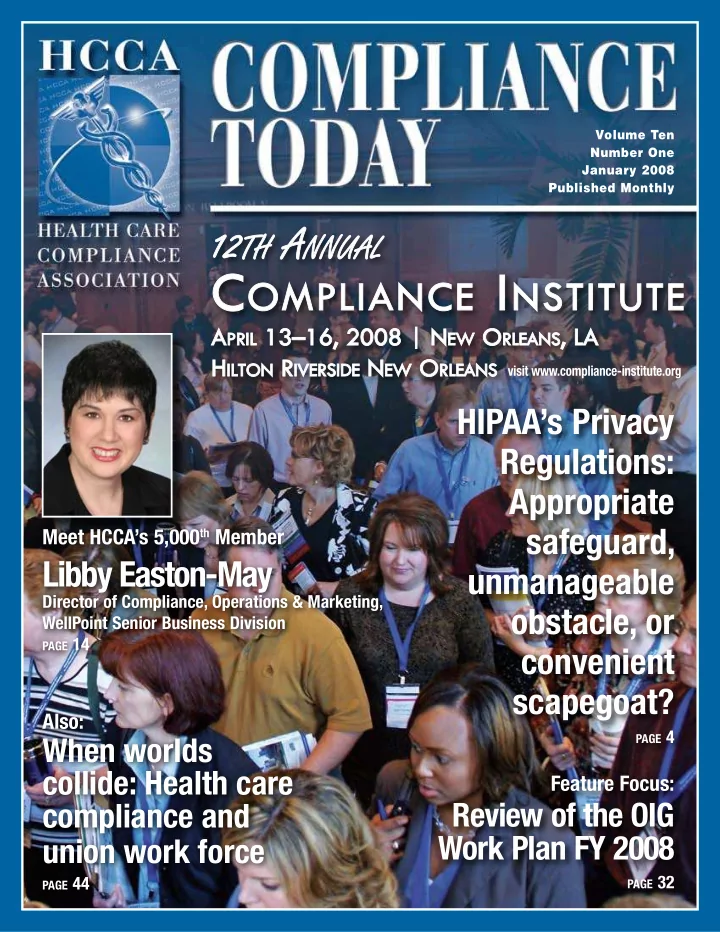
HIPAAs Privacy Regulations: Appropriate safeguard, Meet HCCAs - - PDF document

hipaa s privacy regulations appropriate safeguard
SMART_READER_LITE
LIVE PREVIEW

HIPAAs Privacy Regulations: Appropriate safeguard, Meet HCCAs - - PDF document

Volume Ten Number One January 2008 Published Monthly visit www.compliance-institute.org HIPAAs Privacy Regulations: Appropriate safeguard, Meet HCCAs 5,000 th Member Libby Easton-May unmanageable Director of Compliance, Operations


slide-1
SLIDE 1 Volume Ten Number One January 2008 Published Monthly

Feature Focus:

Review of the OIG Work Plan FY 2008

page 32

Meet HCCA’s 5,000th Member

Libby Easton-May

Director of Compliance, Operations & Marketing, WellPoint Senior Business Division

page 14

Also:

When worlds collide: Health care compliance and union work force

page 44

HIPAA’s Privacy Regulations: Appropriate safeguard, unmanageable

  • bstacle, or

convenient scapegoat?

page 4

visit www.compliance-institute.org

slide-2
SLIDE 2 Health Care Compliance Association • 888-580-8373 • www.hcca-info.org January 2008

34

feature Review of the OIG Work Plan FY 2008

focus

Editor’s note: Tie following articles review items related to hospital, home health/hospice, long-term care, health plans and Medicare Part D outlined in the U.S. Department of Health and Human Services Offjce of Inspec- tor General Fiscal Year 2008 Work Plan. We thank the authors for their contributions to our Feature Focus. If you have questions you may contact the following authors by telephone: Asha B. Scielzo is a Senior Associate in the Washington, DC offjce of Jones Day and may be reached at 202/879-5449. Deborah A. Randall is a Partner in the Washington, DC offjces of Arent Fox LLP and may be reached at 202/857-6341. Mary Ann LeVesque is System Compliance Director for Catholic Healthcare West and may be reached at 916/851-2180. Dorothy DeAngelis is a Managing Director in Huron Consulting Group’s Health Plans and Pharmaceuticals practice and may be reached at 704/927-4480.

Implications for hospitals

By Asha B. Scielzo, Esq.

O

n October 1, 2007, the Office of Inspector General of the Department of Health and Human Services (OIG) released its Work Plan for the 2008 fiscal year. On an annual basis, OIG conducts a comprehensive planning process to identify the pri- mary areas in which it intends to focus its attention for the upcoming fiscal year. The 2008 Work Plan is intended to reflect what OIG “plans to continue or initiate with respect to the programs and operations of the Department of Health and Human Services.” The 2008 Work Plan serves as an important compliance tool for hospitals, physicians, and
  • ther health care providers and should be closely reviewed.
Several provisions of the 2008 Work Plan are of primary importance to hospitals for both Medicare and Medicaid issues. Tiere are 25 work plan topics specifjcally related to hospitals (20 relate to Medicare and 5 relate to Medicaid). Tie 2008 Work Plan as it relates to hospitals includes many of the same action items from the 2007 Work Plan, but it also incorporates 13 new areas identifjed as “new start” (10 relate to Medicare and 3 relate to Medicaid) and 12 areas identifjed as “work in progress” (10 relate to Medicare and 2 relate to Medicaid). Some hospital-related topics can be found in sections outside of the “Medi- care Hospitals” and “Medicaid Hospitals” sections, so a comprehensive review of the entire Work Plan is advisable. Tie following is an over- view of the 2008 Work Plan topics specifjcally related to hospitals. “New Start” Items Identified in the 2008 Work plan Medicare OIG will review: n Hospital inpatient capital spending (i.e., a hospital’s expenditures for assets such as equipment and facilities). OIG will determine whether capital payments to hospitals are appropriate and will examine the methodology used to update capital rates and analyze the appropriateness of the payment level. n Hospital inpatient costs for new services and technologies. Tiese are payments made for new medical services and technologies that qualify as “new” under Medicare regulations and are demonstrated to be otherwise inadequately paid under the Diagnosis-Related Group (DRG) system. OIG will determine whether hospitals have submitted claims in accordance with the criteria and were appropriately reim- bursed for costs associated with the new devices and technologies. n Special payment provisions for patients who are transferred to onsite providers and readmitted to long-term care hospitals (LTCH). Pursuant to Medicare regulations, if an LTCH discharges patients to specifjed co-located providers and directly readmits more than 5% of the total number of its Medicare inpatients discharged from that setting, special payment provisions apply.
slide-3
SLIDE 3 Health Care Compliance Association • 888-580-8373 • www.hcca-info.org January 2008

35

OIG will determine whether the special payment provisions were appropriately applied. n Special payment provisions for patients who are discharged from LTCH to co-located or satellite providers. Pursuant to Medicare regulations, special payment provisions apply to the Medicare inpatient population admitted to an LTCH or LTCH satellite facility from a co-located hospital. If the number of pa- tients admitted from the co-located hospital exceeds the applicable threshold outlined in the regulations, payments to the LTCH may be reduced. OIG will determine whether the special payment provisions were appropriately applied. n Medicare Disproportionate Share Hospital (DSH). DSH serve disproportionate numbers of low-income patients with special
  • needs. According to OIG, Medicare DSH payments have been
steadily increasing, and previous OIG work has identifjed overpay- ments in this area. OIG will determine whether these payments were made in accordance with Medicare criteria and review various components of the calculation methodology, determine whether the hospitals’ classifjcations are appropriate, and examine the total amounts of uncompensated care costs that hospitals incur. n Inpatient psychiatric facility emergency department adjust-
  • ments. OIG will determine whether appropriate adjustments were
made for facilities that operate emergency departments. n Provider bad debts (claimed by acute care inpatient hospitals, LTCHs, inpatient rehabilitation facilities, inpatient psychiatric fa- cilities, and skilled nursing facilities). OIG will determine whether the debts were reimbursable and whether recoveries of prior year write-ofgs were properly used to reduce the cost of benefjciary services for the period in which the recoveries were made. n Diagnostic x-rays in hospital emergency departments. OIG will review a sample of Medicare Part B paid claims and medical records for diagnostic x-rays performed in hospital emergency departments to determine the appropriateness of payments. OIG notes that the Medicare Payment Advisory Commission (MedPAC), in its March 2005 testimony before Congress, reported concerns regarding the increasing cost of imaging services for Medicare benefjciaries and potential overuse of diagnostic imaging services. n Beneficiaries who have other insurance (Medicare secondary payer). OIG will assess the efgectiveness of current procedures in preventing inappropriate Medicare payments for benefjciaries who have other insurance coverage, which will include an evaluation of procedures for identifying and resolving credit balance situations that occur when payments from Medicare and other insurers exceed the providers’ charges or the allowed amount. Oversight of the Joint Commission Hospital Accreditation Process. OIG will evaluate the extent and adequacy of CMS’s policies and procedures regarding the Joint Commission hospital accreditation
  • process. Medicare laws and regulations allow institutions accredited as
hospitals by the Joint Commission to be deemed to meet the Medicare Conditions of Participation for Hospitals. Medicaid OIG will review: n States’ use of funds for mental institutions. OIG will review several state Medicaid programs to determine the magnitude of federal DSH funding being used to pay for services provided to individuals who are 21 to 64 years old and residing in institutions for mental disorders. n Provider eligibility for Medicaid reimbursement. OIG will review whether states appropriately determined provider eligibility for Medicaid reimbursement. n DSH payment threshold. OIG will review the Medicaid inpatient utilization rate used to determine eligibility for Medicaid DSH pay-
  • ments. OIG will examine the threshold that hospitals must meet to
qualify for Medicaid DSH payments and, if appropriate, recom- mend changes to the program. “Work in Progress” continued from 2007 Medicare OIG will review: n Appropriateness of costs for the Medicare-Dependent Hospital (MDH) Program. For a selected number of Medicare-dependent hospitals, OIG will determine whether payments made to MDHs are correct and supported, based on allowable costs from the FY 2002 base-year cost reports. n Adjustments for graduate medical education. Audit adjustments are made by Fiscal Intermediaries for direct and indirect gradu- ate medical education costs when settling Medicare cost reports. OIG will determine whether the adjustments were appropriately refmected in the revised Medicare reimbursement. n Nursing and allied health education payments. OIG will review payments for provider-operated nursing and allied health education programs and determine whether payments to providers for these costs were appropriate. n Inpatient Prospective Payment System (IPPS) wage indices. OIG will evaluate hospital and Medicare controls over the accuracy
  • f the hospital wage data used to calculate wage indices for the
  • IPPS. OIG will determine whether hospitals have complied with
Medicare requirements for reporting wage data and determine the Continued on page 37
slide-4
SLIDE 4 Health Care Compliance Association • 888-580-8373 • www.hcca-info.org January 2008

37

efgect on the Medicare program of incorrect DRG reimbursement caused by inaccurate wage data. OIG will also examine the appro- priateness of using hospital wage indices for other provider types. n Payments to Organ Procurement Organizations (OPOs). Medicare makes payments to organ procurement organizations and OIG will de- termine whether payments made to OPOs are correct and supported. n Long-Term Care Hospital payments for interrupted stays. Cer- tain payments are made to LTCH for interrupted stays. OIG will determine whether these payments were correct. n Long-Term Care Hospital short stay outliers (SSO). Cases dis- charged from LTCHs with lengths of stay well below the average for their DRGs are referred to as short stay outliers. OIG will focus its review on the distribution of and payment amounts for SSO cases and also review cases that only marginally exceeded the SSO threshold. n Critical Access Hospitals (CAH) classification criteria. OIG will determine whether CAHs have met the CAH classifjcation criteria and conditions of participation set forth in Medicare laws and whether payments made to CAHs were made in accordance with Medicare requirements. n Compliance with Medicare’s Transfer Policy. Tie coding of claims submitted by hospitals for erroneously coded discharges that should have been coded as transfers will be reviewed. n Patient care and safety in physician-owned specialty hospitals. Indicators of patient care and safety and policies related to staffjng re- quirements at physician-owned specialty hospitals will be examined. Medicaid OIG will review: n Hospital outlier payments. State Medicaid agencies’ methods
  • f computing inpatient hospital cost outlier payments will be
  • reviewed. Outliers are cases that incur extraordinarily high costs.
OIG will determine whether similar vulnerabilities exist in Medic- aid State payments. n Hospital eligibility for Disproportionate Share Hospital
  • payments. OIG will determine whether states are appropriately
determining hospitals’ eligibility for Medicaid DSH payments and whether appropriate payments have been made. In addition to the foregoing hospital-specific areas of focus, the FY2008 Work Plan identifies a number of other areas for review that relate to hospitals as a “work in progress,” OIG will continue to review: n Medicare payments to hospitals for admissions for observation status versus an inpatient stay for dialysis services. n Medicare Part B payments for laboratory services rendered during an inpatient stay. n Medicare claims submitted for emergency health services furnished to undocumented aliens and other specifjed nonresident aliens to determine whether payments were made in accordance with applicable criteria. On a similar note, OIG will review Medicaid payments for medical services rendered to undocumented aliens to determine whether states appropriately claimed federal funds for allowable medical services. As a “new start” item, OIG will review Medicare payments to terminated Medicare providers and suppliers to determine whether providers received unallowable payments for services furnished after the termination date for participation in the Medicare program. It is also noteworthy that OIG included an action item relating to serious medical errors, also referred to as “never events.” Under the broad category “Medicare Cross-Cutting Issues,” OIG indicates that it will review the incidence, facility response, and payments associated with serious medical errors or “never events”. This series of studies will include an evaluation of medical error reporting and provider response, as well as other targeted studies. OIG will also assess the utility of current state and voluntary reporting systems and examine CMS’s oversight of, and processes for, identifying and responding to “never events.” This article, published in the January 2008 issue of Compliance Today, appears here with permission from the Health Care Compliance Association. Please contact HCCA at 888/580-8373 with reprint requests.