Helping people with Parkinsons disease to live well Dr Natalie - - PowerPoint PPT Presentation

helping people with parkinson s disease to live well
SMART_READER_LITE
LIVE PREVIEW

Helping people with Parkinsons disease to live well Dr Natalie - - PowerPoint PPT Presentation

Helping people with Parkinsons disease to live well Dr Natalie Allen natalie.allen@sydney.edu.au Parkinsons NSW Public Forum September 2019 The University of Sydney Page 1 Image from Queensland Health Background As PD


slide-1
SLIDE 1

The University of Sydney Page 1

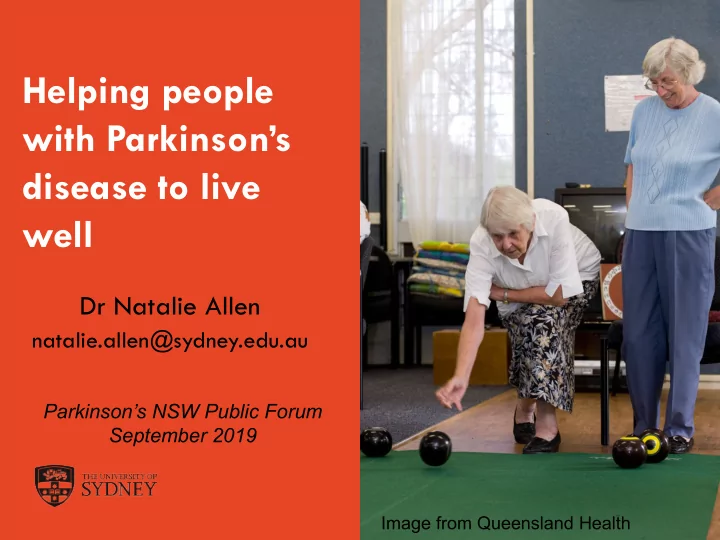
Helping people with Parkinson’s disease to live well

Dr Natalie Allen

natalie.allen@sydney.edu.au

Parkinson’s NSW Public Forum September 2019

Image from Queensland Health
slide-2
SLIDE 2

The University of Sydney Page 2

Background – As PD progresses, people develop a variety of motor and non-motor problems, including – trouble walking – falls – pain – Overall research aim: To help people with PD and their families live better by maintaining safe mobility and managing pain

Image from Queensland Health

slide-3
SLIDE 3

The University of Sydney Page 3

Background - pain – People with more pain undertook less exercise (Allen et al,

2015, Movement Disorders Clinical Practice)

– Systematic review – carefully prescribed exercise might be effective in reducing pain through neurochemical and neuroplastic changes (Allen et al,

2015, Journal of Parkinson’s Disease)

– In some chronic pain conditions (eg fibromyalgia), exercise can increase pain sensitivity

Image from: http://painpatient.com/2014/07/30/relieving-elderly- aches-pains/

slide-4
SLIDE 4

The University of Sydney Page 4

Grant

PNSW Grant 2016:

Towards effective exercise prescription to reduce pain in people with Parkinson’ s disease AIMS:

  • 1. To determine if exercise had an immediate

reduction in pain sensitivity (exercise-induced hypoalgesia)

  • 2. To explore relationships between pain, physical

activity, sleep and mood

slide-5
SLIDE 5

The University of Sydney Page 5

Publication

slide-6
SLIDE 6

The University of Sydney Page 6

  • Measurement of pressure pain thresholds before

and after:

  • 3 minutes of arm exercise (isometric elbow

flexor contraction at 40% 1RM)

  • Treadmill walking at light intensity
  • Treadmill walking at moderate intensity

Exercise sensitivity and pain in people with Parkinson’s disease.

slide-7
SLIDE 7

The University of Sydney Page 7

Exercise leads to an immediate reduction in pain sensitivity in most people

  • Overall increase in pressure-pain threshold

following both isometric arm exercise and aerobic treadmill walking (showing exercise induced hypoalgesia)

  • In people with PD
  • In people without PD

BUT

  • Some individuals did not have this response

No difference between people with and without PD

slide-8
SLIDE 8

The University of Sydney Page 8

Increased physical activity, poor sleep and low mood were associated with increased pain

  • Increased physical activity
  • Sleep disturbance
  • Anxiety and depression

These variables accounted for up to 56% of the variance in the pain scale measure Increased pain

slide-9
SLIDE 9

The University of Sydney Page 9

association ≠ causation

  • Increased activity to manage pain?
  • Inappropriate activity?
slide-10
SLIDE 10

The University of Sydney Page 10

Exercise for pain management

  • Most people with PD have the

usual immediate analgesic response to exercise.

  • The analgesic response occurs

after both aerobic and resistance exercise.

  • People with PD and pain

should consult a physiotherapist to assist them to establish, monitor and progress an appropriate exercise program

https://www.painmanagementdenverco.com/pain-management.html

slide-11
SLIDE 11

The University of Sydney Page 11

Background – safe mobility – Exercise reduces fall rates in people with mild to moderate PD (Canning et al, 2015, Neurology) – Despite this, the rate of falls remains unacceptably high – Exercise alone does not reduce falls in people with more severe disease. – Cognitive problems are associated with increased falls, but most studies exclude people with cognitive problems. One size does not fit all!

slide-12
SLIDE 12

The University of Sydney Page 12

Grant

PNSW Grant 2018:

Integrate: a tailored and multifactorial program for safe mobility in people with more advanced Parkinson’s disease AIMS: Does the 6 month Integrate program improve:

  • 1. Mobility and safe mobility behaviours

and

  • 2. Walking, freezing, leg muscle strength, concern

about falling, activities of daily living, fatigue and care-partner burden in people with Parkinson’s disease?

slide-13
SLIDE 13

The University of Sydney Page 13

Pilot study

4 month trial (7 people and their care-partners) People found the program helpful and liked that it was:

  • Home based
  • Combined OT and physiotherapy, tailored for the

individual

  • Therapists who are experts in Parkinson’s

disease

slide-14
SLIDE 14

The University of Sydney Page 14

Integrate study 40 volunteers with Parkinson’s disease

Keep a falls diary for 2 months Initial assessment (at home) RANDOM ALLOCATION Usual care group

  • Usual activities and

treatment

  • Keep a falls diary

Integrate group

  • OT and physiotherapy

home visits (8 to 12)

  • Home modifications
  • Safe mobility strategies
  • Exercise 3 to 5 times per

week

  • Keep a falls diary

6 months Final assessment (at home) Keep a falls diary for 6 months

slide-15
SLIDE 15

The University of Sydney Page 15

Integrate group – home-based OT and Physio for 6 months

slide-16
SLIDE 16

The University of Sydney Page 16

Who can participate?  Diagnosis of idiopathic Parkinson’s disease  Able to walk 10m on your own (walking aids are permitted)  Have fallen at least 2 times in the last 6 months  People with significant thinking problems will need a care-partner to participate with them Sydney greater-metropolitan area

slide-17
SLIDE 17

The University of Sydney Page 17

Acknowledgments

– Participants – Collaborators – Ben Barry, Matt Brodie, Colleen Canning, Lindy Clemson, Jacqueline Close, Leanne Hassett, Simon Lewis, Niklas Lofgren, Stephen Lord, Niamh Moloney, Vanessa Nguy, Serene Paul, Cathie Sherrington, therapy staff – Parkinson’s NSW funding