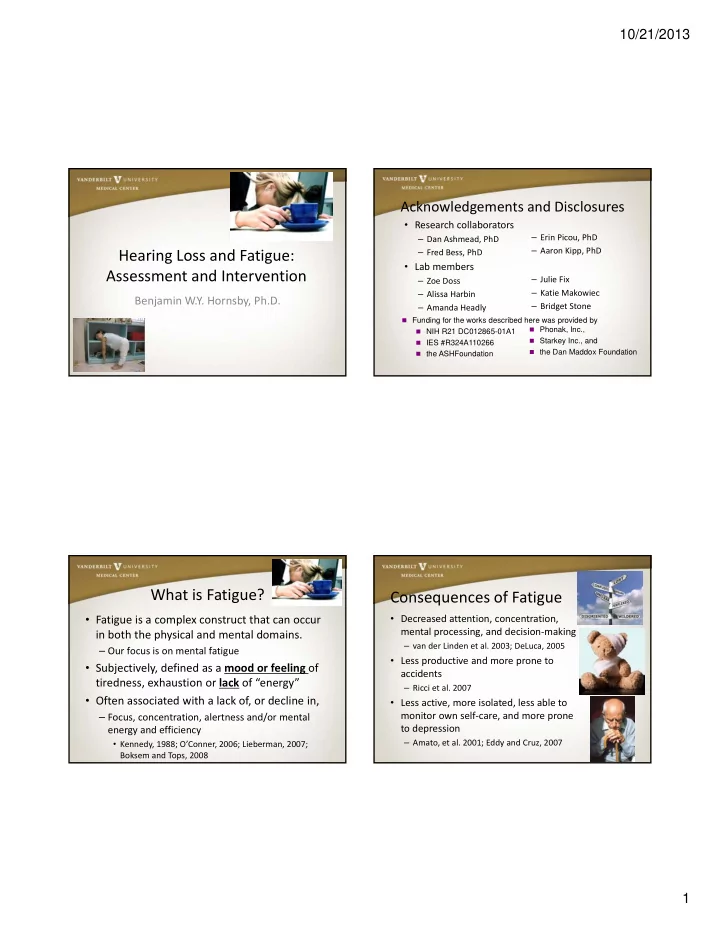
Hearing Loss and Fatigue: Fred Bess, PhD Lab members Assessment and - - PDF document

hearing loss and fatigue
SMART_READER_LITE
LIVE PREVIEW

Hearing Loss and Fatigue: Fred Bess, PhD Lab members Assessment and - - PDF document

10/21/2013 Acknowledgements and Disclosures Research collaborators Erin Picou, PhD Dan Ashmead, PhD Aaron Kipp, PhD Hearing Loss and Fatigue: Fred Bess, PhD Lab members Assessment and Intervention Julie Fix Zoe Doss


slide-1
SLIDE 1

10/21/2013 1

Hearing Loss and Fatigue: Assessment and Intervention

Benjamin W.Y. Hornsby, Ph.D.

Acknowledgements and Disclosures

  • Research collaborators

– Dan Ashmead, PhD – Fred Bess, PhD

  • Lab members

– Zoe Doss – Alissa Harbin – Amanda Headly – Julie Fix – Katie Makowiec – Bridget Stone

 Funding for the works described here was provided by  NIH R21 DC012865-01A1  IES #R324A110266  the ASHFoundation

– Erin Picou, PhD – Aaron Kipp, PhD

 Phonak, Inc.,  Starkey Inc., and  the Dan Maddox Foundation

What is Fatigue?

  • Fatigue is a complex construct that can occur

in both the physical and mental domains.

– Our focus is on mental fatigue

  • Subjectively, defined as a mood or feeling of

tiredness, exhaustion or lack of “energy”

  • Often associated with a lack of, or decline in,

– Focus, concentration, alertness and/or mental energy and efficiency

  • Kennedy, 1988; O’Conner, 2006; Lieberman, 2007;

Boksem and Tops, 2008

Consequences of Fatigue

  • Decreased attention, concentration,

mental processing, and decision‐making

– van der Linden et al. 2003; DeLuca, 2005

  • Less productive and more prone to

accidents

– Ricci et al. 2007

  • Less active, more isolated, less able to

monitor own self‐care, and more prone to depression

– Amato, et al. 2001; Eddy and Cruz, 2007

slide-2
SLIDE 2

10/21/2013 2

Who has Fatigue?

  • Everybody!

– Complaints of transient fatigue are common even in healthy populations

  • Recurrent fatigue is common in many chronic

health conditions

– Cancer, HIV AIDs, Parkinson’s, Multiple Sclerosis – Very little work specifically looking at hearing loss and fatigue

Hearing Loss and Fatigue

  • Fatigue is a common accompaniment of hearing loss

with severe consequences on quality of life

– Listening IS exhausting!!!

  • Post on hearingaidforums.com

– “…since I lost most of my hearing…, I've had periodic bouts

  • f tiredness that are deeper and of a different quality than

I ever experienced before.”

  • Copithorne, 2006

– “I go to bed most nights with nothing left. It takes so much energy to participate in conversations all day, that I’m

  • ften asleep within minutes.”
  • Blog post http://hearingelmo.wordpress.com/2008/06/17/fatigue‐fear‐

and‐coping/

  • Fatigue can be measured many ways

– Subjectively using surveys, rating scales and questionnaires that ask about mood or feelings

  • Many options, none specific to hearing loss
  • Fatigue scales may be

– Uni‐dimensional: Assess “general” fatigue

  • a composite fatigue measure

– Multidimensional: Assess various fatigue constructs

  • E.g., General, physical, mental, emotional, sleep, etc…

– Can also assess frequency and severity

Quantifying Fatigue Subjectively Subjective Measures of Fatigue

  • Profile of Mood States (POMS)

– 65 items used to derive six mood scores including fatigue and vigor (uni‐dimensional)

  • Sensitive to effects of multiple variables on fatigue

Below is a list of words that describe feelings that people have. Please read each word carefully. Then circle the number that best describes how you have been feeling during the PAST WEEK, including today.

McNair et al, 1971

Not at all A little Moderately Quite a bit Extremely Item # Item 1 2 3 4 Construct 4 Worn Out Fatigue 7 Lively Vigor 11 Listless Fatigue 15 Active Vigor 29 Fatigued Fatigue 51 Alert Vigor

slide-3
SLIDE 3

10/21/2013 3

Subjective Measures of Fatigue

  • Multidimensional Fatigue Symptom Inventory

(MFSI‐short form; Stein et al., 2004)

– 30 items; four fatigue scores (General, Physical, Emotional, Mental), a vigor and total score

Below is a list of statements that describe how people sometimes feel. Please read each item carefully, then circle the one number next to each item which best describes how true each statement has been for you in the past 7 days.

Not at all A little Moderately Quite a bit Extremely Item # Item 1 2 3 4 Construct 2My muscles ache Physical 3 I feel upset Emotional 7 I feel lively Vigor 12I am worn out General 15 I have trouble paying attention Mental

Subjective fatigue in adults seeking hearing help

  • Participants: Subset of individuals scheduled for a

hearing test or hearing aid evaluation.

– ≥ 55 years old (mean: 72.3 years; s.d. 10.2 years)

  • range 55‐94 years.

– N=116 adults (63% males).

  • Participants were mailed two self‐report measures of

fatigue and a measure of hearing handicap

– POMS (fatigue and vigor subscales) – Multidimensional fatigue scale (MFSI) – Hearing handicap inventory (HHIE/HHIA)

  • Adults seeking hearing help reported more fatigue

and significantly less vigor than age‐matched adults recruited from church and community groups (Nyenhuis et al., 1999)

*p<0.01

* *

  • Our group was much more likely to report severe

fatigue and vigor deficits

Severe fatigue and vigor deficits

  • 1.5 st. dev above

normative mean is a common “cutpoint” for identifying cases needing additional attention

– Expect ~7% of cases based on normative data

slide-4
SLIDE 4

10/21/2013 4

Degree of loss and subjective fatigue

  • Suggests factors other than “increased effort”

affect fatigue in adults with HL

Better Ear PTA

10 20 30 40 50 60 70 80

POMS Fatigue Score

5 10 15 20 25 30

95% Confidence Interval Regression Prediction Raw Data

  • Surprisingly, no

relationship between degree

  • f hearing loss

and subjective fatigue or vigor

Age: 67 Gender: Male

Hearing handicap and fatigue

  • Strong relationship between hearing handicap

and subjective fatigue (POMS and MFSI)

MFSI Total Score

  • 20 -10

10 20 30 40 50 60 70 80 90

HHIE/A Total Score

20 40 60 80 100

95% Confidence Interval Regression Prediction

MFSI Total Score

  • 20 -10

10 20 30 40 50 60 70 80 90

HHIE/A Total Score

20 40 60 80 100 PTA = 25 dB HL PTA = 75 dB HL

  • As fatigue increases,

hearing handicap increases

  • Suggests

consequences of hearing loss and fatigue are associated

PTA: 35 Age: 67 Gender: Male

Subjective fatigue in children with HL

  • CHL report significantly more fatigue. Pervasive across domains

General Sleep/Rest Cognitive Overall

PedsQL Score

10 20 30 40 50 60 70 80 90 100 CHL CNH

More Fatigue

* * *

* p< 0.05

Hornsby, Werfel, Camarata, and Bess (2013). Subjective Fatigue in Children with Hearing Loss, AJA.

Summary

  • Fatigue is a complex multidimensional construct that

can be defined subjectively as a mood or feeling and quantified using various subjective measures

– E.g., POMS, MFSI, PedsQL‐MFS

  • Results using validated, generic, measures confirm

– fatigue is increased in adults and children with HL, – risk for more severe fatigue is increased in these groups, – Psychosocial consequences of hearing loss and fatigue are related

slide-5
SLIDE 5

10/21/2013 5

  • Fatigue has also been defined behaviorally

– A decline in cognitive performance due to sustained mental demands

  • Kennedy 1988; DeLuca 2005
  • Measures of attention, concentration,

processing speed, and decision‐making have been used as objective markers of fatigue

– van der Linden et al. 2003; DeLuca, 2005

  • Very limited work in this area in HI persons

Objective Measures of Fatigue

Trial Block

ST 1 2 3 4 5 6 Mean

Reaction Time (in ms)

250 300 350 400 450 500

Unaided Aided Basic

Error bars = 1 st. error

Objective fatigue measures

  • Unaided RTs

slow over time consistent with

  • nset of fatigue
  • Aided RTs are

more stable suggesting some resistance to fatigue

Visual Reaction times

  • Reaction times (RT) during a demanding dual‐task

requiring sustained (~50 minutes)speech processing

Hornsby, B. (2013). The Effects of Hearing Aid Use on Listening Effort and Mental Fatigue Associated With Sustained Speech Processing Demands. Ear and Hearing

Subjective Ratings

  • Demanding listening IS fatiguing especially unaided!
  • I.e., Aids help consistently across participants

Pre-Test Post-Test

Fatigue Subscale Score

2 4 6 8 10

Unaided Aided More Fatigued Less Fatigued

Change in POMS Fatigue Scores after sustained listening during a demanding speech task

Change in Unaided Fatigue Rating 5 10 15 20 25 30 Change in Aided Fatigue Rating 5 10 15 20 25 30

Mean

More Fatiguing when Aided More Fatiguing when Unaided

References

  • DeLuca, J. (2005). Fatigue, Cognition, and Mental Effort. In J. DeLuca (Ed.), Fatigue

as a window to the brain (pp. 37‐58). Cambridge, Mass.: MIT Press.

  • Hetu, R., Riverin, L., Lalande, N., Getty, L. and St‐Cyr, C. (1988). "Qualitative

analysis of the handicap associated with occupational hearing loss." British Journal

  • f Audiology 22(4): 251‐64.
  • Hornsby, B. W. Y. (2013). The Effects of Hearing Aid Use on Listening Effort and

Mental Fatigue Associated With Sustained Speech Processing Demands. Ear and

  • Hearing. doi: 10.1097/AUD.0b013e31828003d8
  • Hornsby, B. W., Werfel, K., Camarata, S., & Bess, F. H. (2013). Subjective Fatigue in

Children with Hearing Loss: Some Preliminary Findings. Am J Audiol. doi: 10.1044/1059‐0889(2013/13‐0017)

  • Lieberman, H. R. (2007). Cognitive methods for assessing mental energy. Nutr

Neurosci, 10(5‐6), 229‐242.

  • van der Linden, D., Frese, M., & Meijman, T. F. (2003). Mental fatigue and the

control of cognitive processes: effects on perseveration and planning. Acta Psychol (Amst), 113(1), 45‐65. doi: S0001691802001506 [pii]