Health Legislation, Budget and Reform Update The 2011 NM - - PowerPoint PPT Presentation

health legislation budget and reform update
SMART_READER_LITE
LIVE PREVIEW

Health Legislation, Budget and Reform Update The 2011 NM - - PowerPoint PPT Presentation

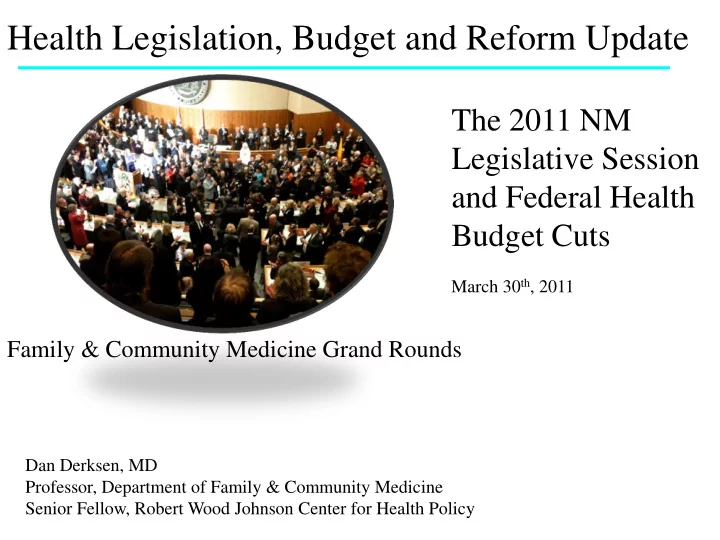
Health Legislation, Budget and Reform Update The 2011 NM Legislative Session and Federal Health Budget Cuts March 30 th , 2011 Family & Community Medicine Grand Rounds Dan Derksen, MD Professor, Department of Family & Community


slide-1
SLIDE 1

Dan Derksen, MD Professor, Department of Family & Community Medicine Senior Fellow, Robert Wood Johnson Center for Health Policy

The 2011 NM Legislative Session and Federal Health Budget Cuts

March 30th, 2011

Family & Community Medicine Grand Rounds

Health Legislation, Budget and Reform Update

slide-2
SLIDE 2

New Mexico

Last in Access to Care*

32/33 Counties HPSA/MUA/P Uninsured 23% (49/50) Hispanic 44% Native Am 10%

*Commonwealth 2009 Study: Accessed 3/29/11 http://www.commonwealthfund.org/Maps-and-Data/State-Data-Center/State-Scorecard.aspx

slide-3
SLIDE 3

NM Legislature

  • Begins the third Tuesday in January
  • Odd years = 60 day session
  • Even years = 30 days (budget,

appropriations, priority items on the “Governor‟s call”)

  • 50th Session: Jan 18 – Mar 19, 2011
slide-4
SLIDE 4

NM Legislature

  • 42 Senators (27 D and 15 R)
  • 70 Representatives (36 D, 33 R, 1

unaffiliated)

  • Nation‟s only unpaid volunteer

citizens‟ Legislature (per diem of $159 day)

slide-5
SLIDE 5

Who Represents You?

  • www.legis.state.nm
  • www.bernco.gov
  • then go to “Elected Officials” then to

“Clerk” then “Where Do I Vote”

  • When to advocate – between sessions (setting

agenda, formulating policy), during a session (informing policy), after a session (implementing policy), campaign

slide-6
SLIDE 6

Ten Essential Services of Public Health

slide-7
SLIDE 7

NM General Fund Expenditures „09

KFF State Health Facts 3/29/11 at: http://www.statehealthfacts.org/profileind.jsp?rgn=33&ind=33&cat=1

NM $ NM % US % Education K-12 $2.5 Billion 41.5% 35.8% Higher Education $0.87 Billion 14.3% 11.5% Medicaid $0.64 Billion 10.5% 15.7% Total Budget $6.08 Billion

slide-8
SLIDE 8

Governor‟s Proposed Budget FY‟12

  • $5.4 Billion General Fund Spending
  • 4.4% Increase from 2011
  • Balance budget w/o increasing taxes
  • Preserve spending in the classroom K-12
  • Maintain health spending for vulnerable pop
  • Gov. Martinez Executive Budget Accessed 3/29/11 at:

http://budget.nmdfa.state.nm.us/cms/kunde/rts/budgetnmdfastatenmus/docs/1043714 049-01-10-2011-13-28-46.pdf

slide-9
SLIDE 9

HB 2 Budget FY‟12

  • $5.47 B General Fund Spending
  • Balanced w/o increasing taxes (state

employees pay 3.5% more retirement)

  • Preserve spending in the classroom

(1.5% cut non-classroom)

  • Maintain health spending for

vulnerable populations (# on Medicaid will grow, GF support will approach $1 billion in 2012, 4:1 federal match)

HB 2 accessed 3/29/11 at: http://www.nmlegis.gov/Sessions/11%20Regular/firs/HB0002.pdf

slide-10
SLIDE 10

Health Bills Passed 2011

  • Introduced: 1,511 total = bills + joint

memorials + resolutions

  • Passed: 284 (129 House, 155 Senate)
  • Bills Passed = 18.8%
  • Governor has until April 8 to sign or veto
  • Unsigned = “pocket veto”

Personal communication Michael Hely, NM Leg Council Service 3/29/11

slide-11
SLIDE 11

Health Bills Passed 2011

  • SB 14 Health Care Work Force Data,

Analysis & Policy Act

  • SB 33/370 Health Insurance Exchange
  • SB 333 Amend the Medical Malpractice Act
  • Gov. Martinez Executive Budget Accessed 3/29/11 at:

http://budget.nmdfa.state.nm.us/cms/kunde/rts/budgetnmdfastatenmus/docs/1043714 049-01-10-2011-13-28-46.pdf

slide-12
SLIDE 12

If we increase NM‟s primary care supply by 400 FTE‟s data shows we will:

  • Improve access to quality care.
  • Create 9,200 jobs in New Mexico
  • Generate $600 million in revenue for

communities

Addressing Access to Quality Care

slide-13
SLIDE 13

Principles of NM‟s Reform: 1)Decreased Statute of Limitations 2)Instituted Mandatory Screening Panel 3)Capped Non-Medical Damages, Since 1995: $600,000 ($200k primary, and $400,000 PCF)

Professional Liability Reform

slide-14
SLIDE 14
  • Protect individual physicians covered

and their corporations

  • Create a separate hospital comp. fund,

limit liability ($1.5 million)

  • Limit punitive damages (2X award)
  • Change to “Professional Liability Act”

Why Open Med Mal Act in 2011?

slide-15
SLIDE 15
  • Cap increased from 600,000 to $1 m
  • Cap increase 3%/yr or CPI (lesser of)
  • No separate hospital comp. fund
  • Corporations Covered
  • No limit punitive damages
  • Still “Medical Malpractice Act”

But what we got for 2012…

slide-16
SLIDE 16

Regional Professional Liability Premiums

Source: Medical Liability Monitor 2009

http://www.mymedicalmalpracticeinsurance.com/new-mexico-medical-malpractice-insurance.php#historicdata

slide-17
SLIDE 17

New Mexico Public Payer

Payer Source # New Mexicans Medicaid 550,000 Uninsured 450,000 Medicare 300,000 Other Public 150,000 CHAMPUS Tricare 50,000 Subtotal Public 1,500,000 Total Pop. NM 2,000,000

slide-18
SLIDE 18

Starting in 2014 in New Mexico

  • 350,000 to 400,000 uninsured New

Mexicans will have health insurance

  • This will increase demand 25-30%
  • We need to prime the health

professions pipeline NOW!

slide-19
SLIDE 19

New Mexico‟s Physician Shortage Numbers and Distribution Problems

NM has a shortage of 2000 physicians currently The largest shortage is of primary care physicians (400 FTE‟s short) Of the 3,100 FTE active clinical physicians, 1,500 (48%) practice in Bernalillo County (which has 31%

  • f NM‟s population)
slide-20
SLIDE 20

40% (N=1,769)1 of NM‟s Total (N = 4,409)2 physicians with active license & NM Address are grads of UNM SOM‟s medical school/ residency programs

1UNM SOM Graduate Location Report 2010 2New Mexico Medical Board 2010 Official List of Active Physicians

Socorro 8/16 San Juan Taos McKinley Sandoval Los Alamos Santa Fe Cibola Sierra 3/10 Grant 20/65 Luna 2/23 Hidalgo 1/2 Doña Ana Colfax 4/17 Union 0/3 Mora 0/1 Harding 0/0 San Miguel Bernalillo Valencia Torrance Lincoln 8/29 Otero Eddy 10/62 Chaves Lea Roosevelt 4/16 De Baca 0/0 Guadalupe Quay 2/9 Curry 8/52 Rio Arriba Catron 54/165 16/46 22/73 21/55 26/102 54/128 131/489 21/54 1/2 3/3 1191/2412 14/23 4/15 0/3 38/115 7/51 16/61 80/307

UNM SOM Medical School and/or Residency Graduates by NM County - 2009 and NM Physicians with Active Licenses
slide-21
SLIDE 21

Can we keep more of our graduates in NM? YES - From 2005-2009, the # UNM grads practicing in NM increased by 103 per year

< http://hsc.unm.edu/som/Locations/ >

From 2000-2005, the # UNM grads practicing in NM increased by 27 per year. From 1994-1999, the # UNM grads practicing in NM increased by 60 per year.

slide-22
SLIDE 22

HB 710 Medical Homes

Medical Home Pilots

Medicaid CHIP SCI

  • Rep. Danice Picraux

Signed by Gov. Richardson 4/09

slide-23
SLIDE 23

Experiential Learning - RWJ Health Policy Fellowship

Dan Derksen, M.D.

slide-24
SLIDE 24

RWJ Health Policy Fellowship

Embedded in the Congressional Staff

POTUS

Finance Committee Health, Education, Labor & Pensions (HELP) Committee U.S. Senator Jeff Bingaman D-NM Elected in 1982, 5th Term Will Retire in 2012

slide-25
SLIDE 25

HR 3590 Patient Protection and Affordable Health Care for America Act

TITLE V – HEALTH CARE WORKFORCE

Subtitle B – Innovations in the Health Care Workforce

  • Sec. 5101.

National health care workforce commission.

  • Sec. 5102.

State health care workforce development grants.

  • Sec. 5103.

Health care workforce assessment.

slide-26
SLIDE 26

Health Workforce & the Affordable Care Act

  • $230 m Teaching Health Centers
  • $168 m PCP Training
  • $32 m Physician Asst Training
  • $45 m NP Training & Practice
  • $5 m State Hlth Workforce Grants
  • $1.5 b National Hlth Svc Corps
slide-27
SLIDE 27

Affordable Care Act

  • Covers 32 million

uninsured

  • Costs $794 billion
  • Reduces deficit

$138 billion 2010- 19

Congressional Budget Office, Joint Commission on Taxation

Accessed 8/23/10: < http://www.cbo.gov> < HTTP://www.thomas.gov >

slide-28
SLIDE 28

HR 3590 “Patient Protection and Affordable Health Care Act”

What happened 2010 :

  • Prohibits lifetime limits and recission of coverage
  • Requires coverage of preventive services
  • Reviews premium increases & “medical loss ratio”
  • Prohibits coverage denial children w pre-existing conditions
  • Reauthorizes, amends Indian Health Care Improvement Act
slide-29
SLIDE 29

HR 3590 “Patient Protection and Affordable Health Care Act”

What Happens In 2011:

  • 10% Medicare bonus payment primary care
  • Creates CMS Innovation Center
  • Requires insurers to spend 85% premiums on claims
  • Expands CHC, NHSC by $10 billion over 5 years

In 2013

  • Increases Medicaid up to Medicare rates for primary care
  • States must demonstrate ability to operate a health

insurance exchange

slide-30
SLIDE 30

HR 3590 “Patient Protection and Affordable Health Care Act”

In 2014:

  • Creates health insurance exchanges
  • Requires guaranteed issue, adjusted community rating
  • Subsidizes premiums for 133 to 400% FPL
  • FPL family of 3 = $18,310
  • Expands Medicaid to those <133% FPL (100% 3 yr FMAP)
slide-31
SLIDE 31

Affordable Care Act In 2014 – THE MANDATE:

  • Taxes individuals without coverage 2.5%
  • f household income or $695 - $2,085 yr
  • Taxes businesses >50 employees w/o

insurance $2000/fte

slide-32
SLIDE 32

Growing Uninsured…. Uninsured in U.S. 2000 38.4 Million 2009 50.7 Million

US Census Bureau: Accessed 2/10/11 < http://www.census.gov/ >.

That‟s a 32% Increase in Ten Years!

slide-33
SLIDE 33

Congressional Budget Office: Peter Orszag

slide-34
SLIDE 34

$2.4 Trillion on Health (17% GDP)* $0.7 to 1.2 Trillion Waste (5% GDP, 30-50% health spending)**

$1.2 Trillion Wasted

$210 B - Overtesting $210 B - Claims Processing $155 B - Defensive Medicine $100 B - Ignoring MD Orders

slide-35
SLIDE 35

Top 3 Reasons We Need to Reform the Way We Manage Chronic Disease

Wennberg J: Tracking Health: A Researcher‟s Quest to Understand Health Care. Oxford Press. New York. 2010.

1) Overreliance on acute care “rescue medicine” for the chronically ill (DM) doesn‟t work 2) In looking to save money – hospitals (1/3 Medicare dollars spent in last 2 yrs of life, half spent in hospitals) 3) It‟s the quantity, stupid. 4 fold variation 306 hospital regions

slide-36
SLIDE 36

H.R. 2: “Repealing the Job-Killing Health Care Law Act”

2 This Act may be cited as the ‘‘Repealing the Job- 3 Killing Health Care Law Act’’. 4 SEC. 2. REPEAL OF THE JOB-KILLING HEALTH CARE LAW 5 AND HEALTH CARE-RELATED PROVISIONS IN 6 THE HEALTH CARE AND EDUCATION REC- 7 ONCILIATION ACT OF 2010. 8 (a) JOB-KILLING HEALTH CARE LAW.—Effective as 9 of the enactment of Public Law 111–148, such Act is re- 10 pealed, and the provisions of law amended or repealed by 11 such Act are restored or revived as if such Act had not 12 been enacted.

Accessed 2/2/11: < HTTP://www.thomas.gov >

1/19/11 PASSED HOUSE 245-189

slide-37
SLIDE 37

CBO Analysis of H.R. 2: “Repealing the Job-Killing Health Care Law Act”

3 Pages, CBO ESTIMATES the bill will:

  • Increase the federal deficit over 10 years

between 2012 and 2021: $230 billion

  • Increase uninsured by 2019 by 32 million,

to total 54 million uninsured

Elmendorf D. Letter to Speaker John Boehner Dated 1/6/11. < http://www.cbo.gov >

slide-38
SLIDE 38

Health Care Adds 19,000 Jobs in November

U.S. Economy Gained 39,000 Jobs Nov 2010 Health Care Employment Added 19,000 Jobs Health Care Industry Added an Average of 21,000 Jobs/Month in 2010

U.S. Bureau of Labor Statistics 12/3/10 Accessed at www.amednews.com

slide-39
SLIDE 39

Moving Upstream Applied Health Policy

  • Changing individual behavior is limited, &

more difficult with current incentive systems

  • Solving problems from a systems perspective
  • Preventing future disease and suffering
  • Applying wisdom from clinical practice
slide-40
SLIDE 40

The Nation‟s Physician Shortage

By 2025, the U.S. will be short 159,300 physicians The largest shortage – 46,000 primary care physicians

Dill MJ, Salsberg ES, 2008. “The Complexities of Physician Supply and Demand: Projections through 2025. Association of American Medical Colleges.

slide-41
SLIDE 41

Your Investment: Medical Student Debt

AAMC 2010 GQ Medical School Graduation Questionnaire. At: https://www.aamc.org/download/140716/data/2010_gq_all_schools.pdf

$124,598 Avg. Educational Debt of All Med Student Grads $158,996 Avg. Educational Debt of Indebted Med Student Grads

slide-42
SLIDE 42

Specialty 2010 Avg. Income Orthopedics $485,297 Gastroenterology $409,628 Cardiology(non-inv) $393,181 Urology $391,406 Cardiology(non-inv) $391,406 Dermatology $371,281 Emergency Med $266,826 Psychiatry $205,934

  • Gen. Internal Med

$205,671

  • Gen. Pediatrics

$193,135 Family Medicine $187,821

Average Compensation by Specialty Modern Healthcare Physician Compensation Survey 2010

slide-43
SLIDE 43

Payment Issues in Primary Care

  • >40% of primary care services (patient communication, arranging

referrals) not reimbursed in fee-for-service methodology1

  • Payment for procedures is 3X payment for primary care2

– For example, 30 minutes spent performing a surgical procedure vs a 30- minute visit with a patient with diabetes

  • AMA‟s specialty dominated RUC Committee (Resource Based Relative

Value Scale Update Committee) advises CMS (accepts >90% RUC rec‟s)

  • Family physician income is half that of specialists
  • 1. Adams J et al. Patient-centered medical home. IBM Web site. www-

935.ibm.com/services/us/gbs/bus/html/gbs-medical-home.html. Accessed July 10, 2009.

  • 2. Bodenheimer T. N Engl J Med. 2006;355:861–864.
slide-44
SLIDE 44

Graduates Intention to Pursue a Generalist Career

5 10 15 20 25 30 35 40 Percentage

Source: AAMC Graduation Questionnaire

1993 Clinton 1998 SGR

In Just 10 Years, US Grads Entering FM Declined >50%

Record number of students match in family medicine residencies

slide-45
SLIDE 45

Federal Funding Public Health Service Act

PHSA Discretionary Funding FY‟09 In Millions Title III – National Health Service Corps $135 Title VII – Primary Care, Dentistry $222 Title VIII - Nursing $171 Total PHSA Health Professions $528 M

slide-46
SLIDE 46

IME - Indirect Medical Education DGME - Direct Graduate Medical Education SSA Entitlement Funding

In Billions % Total IME $8.2 68% DGME $3.8 32% TOTAL $12 B 100%

Federal Funding of Teaching Hospitals – Social Security Act – Medicare/Medicaid

Derksen D, Whelan EM: Closing the Health Workforce Gap: Reforming Federal Health Care Workforce Policies to Meet the Needs of the 21st Century. Center for American Progress 2010. http://www.americanprogress.org/issues/2010/01/health_workforce.html

slide-47
SLIDE 47

For every $1 PHSA, $24 SSA go to teaching hospitals…

slide-48
SLIDE 48

2011 Appropriation

  • Federal fiscal year ends 9/30/11
  • Continuing resolution extends funding

to April 8, or government shutdown

  • Major battles over budget cuts –

discretionary spending targeted

  • “Third Rail” budget cuts to

entitlement programs - Social Security, Medicare, Medicaid

slide-49
SLIDE 49

New Mexico‟s Innovative Reforms

Teaching Health Centers - Health Commons

Community Based, Team Based Education 50 to 75% Primary Care Graduates Practice in NM

slide-50
SLIDE 50

Physicians, Providers Community

Family Medicine Foundation

Office Staff Patients

Health IT

Improved Outcomes

Practice Organization Coordinated Care

Performance Measurement Public Reporting

Patient Experience Meaningful Use of EHR

Primary Care

slide-51
SLIDE 51

Health Information Technology for Economic and Clinical Health Act - HITECH

  • ARRA Stimulus Provision to Promote

Adoption Health Information Technology - HIT

  • Medicare + Medicaid Incentives $30

Billion (Penalties Come Later!) for Providers and Hospitals

Congressional Research Service 4/27/09

slide-52
SLIDE 52

ACOs Synergistic With Other Payment Reforms

ACOs strengthen ongoing reform efforts:

  • Patient Centered Medical home
  • Episode of Care, readmission initiatives
  • HIT, HIE

ACOs operate in conjunction with current payment structures

  • FFS
  • Bundled payments
  • Partial/full capitation

ACOs

Confusing aims Absent or poor measurement Fragmented care Wrong financial incentives

Source: Mark McClellan MD, Brookings Institute 2010

slide-53
SLIDE 53

Truth has no special time

  • f its own. Its hour is

now – always, and indeed most truly when it seems most unsuitable to actual circumstances.

Albert Schweitzer

slide-54
SLIDE 54