
SLIDE 1
Health Information Privacy Breaches Privacy Breaches EHIL Webinar - - PDF document
2011 11 16 Health Information Privacy Breaches Privacy Breaches EHIL Webinar November 14, 2011 1 2011 11 16 Agenda What is a privacy breach? What is a privacy breach? Breaches we investigate How to prepare
What is a privacy breach?
What is a privacy breach?
Breaches we investigate
How to prepare for a breach
What to do when (not if) it happens
How to avoid a breach in the first place
How to learn from your (and others’) mistakes
Not defined in Health Information Act A privacy breach occurs when
Someone collects, uses or discloses health
information in contravention of a privacy law, deliberately or accidentally
An organization/custodian/trustee loses control of An organization/custodian/trustee loses control of
personal information
Confidentiality of health information is compromised
No mandatory breach reporting under Health Information Act
High level of self-reported breaches from health professionals
High level of self-reported breaches from health professionals
Breach reports from health care providers subject to Personal Information Protection Act
People become suspicious when someone ‘knows too much,’ gather evidence and report to us
Lost records are found, delivered to us (or delivered to the media)
Investigate and mediate a resolution
Has the breach been stopped?
Has the breach been stopped?
Reasonable measures been taken to prevent recurrence?
Sanctions administered?
Affected individuals informed?
Public Investigation Report
Purpose is to educate
Hearing, leading to an Order
Offence prosecution
“Knowingly” contravening the Health Information Act
Up to $50,000 fine
In electronic health records, root cause hard to
Is it the viewer, the feeder system, the network?
Custodian boundaries hard to define
Many interrelationships, informal ties
If policies and training are not in place, or not
(under Health Information Act)
2009 2010 2010 2011 YTD 2009-2010 2010-2011 YTD Self-report 47 43 32 Complaint 26 26 13 Offence 1 4 2
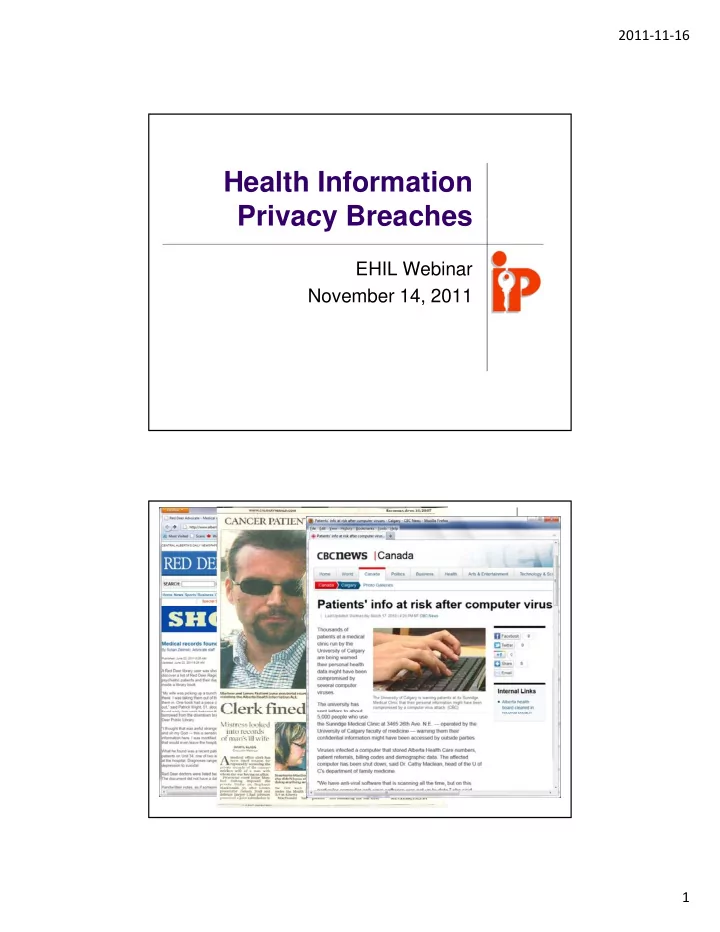
Shredding, disposal mishaps Lost, stolen, unencrypted data Misdirected communications Malware infestation Unauthorized access by insiders So far, no investigations of deliberate hacking in health
Common scenario:
Records found in garbage or dumpster Records blowin’ in the wind (our first HIA investigation) Records forwarded to media, then to us
Causes
Lack of awareness, carelessness Cleaners pick up the wrong box and dump it
Unsecured/informal filing areas
“we store admission forms in a pile by the nursing
station until we have time to file them”
Taking work home, papers stolen from car Files left on the bus, train, etc.
Wrong fax number Wrong email Email with reply to all Data errors – wrong report sent to wrong provider Use secure channel where available
Regional, provincial EHR may have secure messaging – Use it!
Data errors often caused by poor change controls
Lost and stolen mobile devices 3 public Investigation Reports and more on the way Passwords are not enough Common mistakes:
Policy requires staff to encrypt, but no tools or training provided No policy enforcement Decision made to give someone mobile device without considering
necessity or risk
Storing data on device when tools are available to allow secure,
remote access
Unpatched systems Unnecessary administrator privileges Out-of-date anti virus Poor understanding of infrastructure (whose Poor understanding of infrastructure (whose
2 public Investigation Reports
Looking up up friends, family, enemies in health
Increasing number of reports discovered through:
Internal audit by custodians Individuals reviewing own audit logs
Issues
Training and user agreements won’t stop rogue staff, but may make it harder for them if colleagues are more privacy-aware
Lack of training and user agreements hinders discipline, sanctions
User account sharing makes it difficult to investigate reports of abuse
Assume you will have a privacy breach Identify breach-response team ahead of time
Privacy officer, legal counsel, security, contractors/service providers, records management, communications, senior executive
Establish a policy and plan regarding breaches:
Who will you inform? OIPC, Police, clients, business partners?
How do you decide whether to tell (risk of harm, legal obligations under contract or law, professional ethics)?
Determine jurisdiction (If you are a service provider (e.g. EMR), you may be in the private sector but your customer is subject to other laws) the private sector, but your customer is subject to other laws)
Communications are key
Practice makes perfect – test your plan and make sure staff is
aware
Take immediate steps to stop the breach Assemble your team
y
Take remedial action
Investigate what happened Analyse risk to affected individuals Consider notification of regulators, police, individuals
g p
Establish communications plan Make decisions on notification Communicate internally and externally
Describe circumstances, time period
Describe personal information affected
Describe personal information affected
Assess risk to individuals, how many are affected
Steps taken to reduce harm, mitigate risk
Decisions regarding notification to individuals
Contact information for individual who can answer questions
See our website for Breach Reporting form and guidance
Apologize!
Be open and honest
Explain what happened
Identify risks so people can make their own decisions on how to protect themselves
Tell them what you are doing to prevent similar problems in the future
Let them know you have informed OIPC and other relevant authorities, such as police, professional regulators, etc.
Make sure front-line staff are prepared to answer questions
Review OIPC investigation reports, breach reports to learn
about: about:
Encryption on mobile devices
Faxing
Malware
Disposal
Misuse of personal information
Encourage reporting and review of near-misses Encourage reporting and review of near misses
Need internal culture, rewards to support this
If you have a breach, communicate lessons learned internally
Conduct privacy impact assessments for new systems,
processes
Confirm privacy policies and privacy organization implemented
Confirm legal authority to collect, use and disclose personal information
Understand information flows
Identify and mitigate privacy risk
Review
Security reviews/audits, penetration tests Regular policy procedure review Training and awareness Something bad may still happen – standard is reasonableness,
not perfection
Frank Work Brian Hamilton Office of the Information and Privacy Commissioner, Alberta www.oipc.ab.ca 780.422.6860