Health Effects and Geochemistry of Arsenic: The Columbia University - - PowerPoint PPT Presentation

health effects and geochemistry of arsenic the columbia
SMART_READER_LITE
LIVE PREVIEW

Health Effects and Geochemistry of Arsenic: The Columbia University - - PowerPoint PPT Presentation

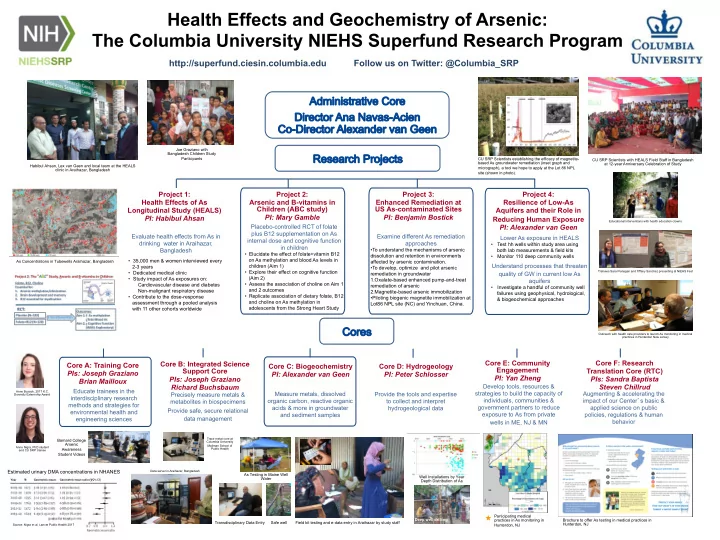
Health Effects and Geochemistry of Arsenic: The Columbia University NIEHS Superfund Research Program http://superfund.ciesin.columbia.edu Follow us on Twitter: @Columbia_SRP Joe Graziano with Bangladesh Children Study Participants CU SRP


slide-1
SLIDE 1
  • ncen ra ons

Health Effects and Geochemistry of Arsenic: The Columbia University NIEHS Superfund Research Program

http://superfund.ciesin.columbia.edu Follow us on Twitter: @Columbia_SRP

Joe Graziano with Bangladesh Children Study Participants Habibul Ahsan, Lex van Geen and local team at the HEALS clinic in Araihazar, Bangladesh

Project 1: Project 2: Project 3: Health Effects of As Arsenic and B-vitamins in Enhanced Remediation at Longitudinal Study (HEALS) Children (ABC study) US As-contaminated Sites PI: Habibul Ahsan PI: Mary Gamble PI: Benjamin Bostick

Placebo-controlled RCT of folate plus B12 supplementation on As Evaluate health effects from As in Examine different As remediation internal dose and cognitive function drinking water in Araihazar, approaches Bangladesh

  • To understand the mechanisms of arsenic

in children

  • Elucidate the effect of folate+vitamin B12

dissolution and retention in environments

As Concentrations in Tubewells Araihazar, Bangladesh

  • 35,000 men & women interviewed every
  • n As methylation and blood As levels in

affected by arsenic contamination. 2-3 years children (Aim 1)

  • To develop, optimize and pilot arsenic
  • Dedicated medical clinic
  • Explore their effect on cognitive function

remediation in groundwater (Aim 2) Cardiovascular disease and diabetes

  • Assess the association of choline on Aim 1

remediation of arsenic

  • Study impact of As exposures on:

1.Oxalate-based enhanced pump-and-treat and 2 outcomes Non-malignant respiratory disease 2.Magnetite-based arsenic immobilization

  • Contribute to the dose-response
  • Replicate association of dietary folate, B12
  • Piloting biogenic magnetite immobilization at

assessment through a pooled analysis and choline on As methylation in Lot86 NPL site (NC) and Yinchuan, China. with 11 other cohorts worldwide adolescents from the Strong Heart Study

Core A: Training Core Core B: Integrated Science Core C: Biogeochemistry Core D: Hydrogeology Support Core PIs: Joseph Graziano PI: Alexander van Geen PI: Peter Schlosser Brian Mailloux PIs: Joseph Graziano Richard Buchsbaum

Anne Bozack, 2017 K.C.

Educate trainees in the

Donnelly Externship Award

Precisely measure metals & Measure metals, dissolved Provide the tools and expertise interdisciplinary research metabolites in biospecimens

  • rganic carbon, reactive organic

to collect and interpret methods and strategies for acids & more in groundwater hydrogeological data environmental health and Provide safe, secure relational and sediment samples engineering sciences data management

Trace metal core at Columbia University

Arsenic Barnard College

Mailman School of and CU SRP trainee

Awareness

Anne Nigra, PhD student Public Health

Student Videos

Data server in Araihazar, Bangladesh

As Testing in Maine Well Water

Estimated urinary DMA concentrations in NHANES

Source: Nigra et al. Lancet Public Health 2017 Well depth (ft)

Well Installations by Year Depth Distribution of As C t ti Deep well drilling Transdisciplinary Data Entry Safe well Field kit testing and e-data entry in Araihazar by study staff CU SRP Scientists establishing the efficacy of magnetite- CU SRP Scientists with HEALS Field Staff in Bangladesh based As groundwater remediation (inset graph and at 12-year Anniversary Celebration of Study micrograph), a tool we hope to apply at the Lot 86 NPL site (shown in photo).

Project 4: Resilience of Low-As Aquifers and their Role in Reducing Human Exposure

Educational Interventions with health education clowns

PI: Alexander van Geen

Lower As exposure in HEALS

  • Test hh wells within study area using

both lab measurements & field kits

  • Monitor 110 deep community wells

Understand processes that threaten

Trainees Sara Flanagan and Tiffany Sanchez presenting at NIEHS Fest

quality of GW in current low As aquifers

  • Investigate a handful of community well

failures using geophysical, hydrological, & biogeochemical approaches

Outreach with health care providers to launch As monitoring in medical practices in Hunterdon New Jersey

Core E: Community Engagement PI: Yan Zheng

Develop tools, resources & strategies to build the capacity of individuals, communities & government partners to reduce exposure to As from private wells in ME, NJ & MN

Core F: Research Translation Core (RTC) PIs: Sandra Baptista Steven Chillrud

Augmenting & accelerating the impact of our Center’s basic & applied science on public policies, regulations & human behavior

Participating medical practices in As monitoring in Brochure to offer As testing in medical practices in Hunterdon, NJ Hunterdon, NJ

slide-2
SLIDE 2

Health Effects and Geochemistry of Arsenic: The Columbia University NIEHS Superfund Research Program

Project 1: Health Effects of As Longitudinal Study (HEALS) PI: Habibul Ahsan

slide-3
SLIDE 3

Health Effects and Geochemistry of Arsenic: The Columbia University NIEHS Superfund Research Program

Project 1: Health Effects of As Longitudinal Study (HEALS) PI: Habibul Ahsan

Water As HR (95%CI) for CHD Urine As HR (95%CI) for CHD <12.0 µg/L 1.00 (ref) < 106 µg/g creat. 1.00 (ref) 12.1-62.0 1.22 (0.65, 2.32) 106-199 1.29 (0.74, 2.27) 62.1-148.0 1.35 (0.71, 2.57) 199-352 1.53 (0.83, 2.82) >148.1 1.92 (1.07, 3.43) >352 2.06 (1.14, 3.72) Per SD (115 µg/L) 1.29 (1.10, 1.52) Per SD (282 µg/g) 1.26 (1.12, 1.42)

Adjusted for age, sex, BMI, smoking status, education CHD: coronary heart disease

slide-4
SLIDE 4

Health Effects and Geochemistry of Arsenic: The Columbia University NIEHS Superfund Research Program

Project 1: Health Effects of As Longitudinal Study (HEALS) PI: Habibul Ahsan

slide-5
SLIDE 5

Health Effects and Geochemistry of Arsenic: The Columbia University NIEHS Superfund Research Program

Project 1: Health Effects of As Longitudinal Study (HEALS) PI: Habibul Ahsan

slide-6
SLIDE 6

Health Effects and Geochemistry of Arsenic: The Columbia University NIEHS Superfund Research Program

Project 1: Health Effects of As Longitudinal Study (HEALS) PI: Habibul Ahsan

slide-7
SLIDE 7

Health Effects and Geochemistry of Arsenic: The Columbia University NIEHS Superfund Research Program

Project 2: Arsenic and B-vitamins in Children (ABC study) PI: Mary Gamble

As of 9/1/2018:

  • 146 children have been enrolled
  • 102 children completed the 12 week intervention
slide-8
SLIDE 8

Health Effects and Geochemistry of Arsenic: The Columbia University NIEHS Superfund Research Program

Project 3: Enhanced Remediation at US As-contaminated Sites PI: Benjamin Bostick

Optimizing and Implementing in situ formation of biogenic magnetite formation for As remediation at NPL Sites

Sun et al. (2018) Environ

  • Sci. Technol.

100n m

slide-9
SLIDE 9

Health Effects and Geochemistry of Arsenic: The Columbia University NIEHS Superfund Research Program

Project 3: Enhanced Remediation at US As-contaminated Sites PI: Benjamin Bostick

Yinchuan Plain, Western China

lot 86, north carolina supErfund sitE

wastE from 1969 to 1980, volatilE organic compounds high manganEsE concEntrations (~ 11 mg/l) arsEnic concEntrations

  • 100 ft
  • North Carolina State University Lot 86 Landfill Site

– to investigate feasibility and mechanisms of magnetite-based approach

  • Yinchuan Plain (Not in this proposal but related to methodology):

– Arsenic concentrations decreased by about 100x, from 500 ppb to <5 ppb. – Rate of pumping affects As removal considerably

slide-10
SLIDE 10

Health Effects and Geochemistry of Arsenic: The Columbia University NIEHS Superfund Research Program

Project 3: Enhanced Remediation at US As-contaminated Sites PI: Benjamin Bostick

Push-Pull experiment in high-As well.

– As removal was significant for approximately 50 injection volumes. – Model results are similar to measured values (triangles, approximated).

slide-11
SLIDE 11

Health Effects and Geochemistry of Arsenic: The Columbia University NIEHS Superfund Research Program

Project 3: Enhanced Remediation at US As-contaminated Sites PI: Benjamin Bostick

Lot 86 Field Studies

slide-12
SLIDE 12

(a) (b) (c)

Health Effects and Geochemistry of Arsenic: The Columbia University NIEHS Superfund Research Program

Project 4: Resilience of Low-As Aquifers and their Role in Reducing Human Exposure PI: Alexander van Geen Shallow wells (10-45 m) Intermediate wells (45-90 m) Deep wells (90-300 m)

slide-13
SLIDE 13

1990 1995 2000 2005 2010 2015 1990 1995 2000 2005 2010 2015

(a )

Health Effects and Geochemistry of Arsenic: The Columbia University NIEHS Superfund Research Program

Project 4: Resilience of Low-As Aquifers and their Role in Reducing Human Exposure PI: Alexander van Geen Many intermediate wells have been installed. Are they likely to remain safe?

)

5000

  • No. wells wells installed

(b

  • No. wells installed

(c)

  • No. wells installed

90-150 m 45-90 m <45 m 4000 3000 2000

Shallow

400

1000

Jan-00 Jan-05 Jan-10 Jan-15 Jan-20 300

1600

Intermediate wells

29 m

1200

41 m

200

53 m 91 m

800

100

400 300

Deep wells

1990 1995 2000 2005 2010 2015 200 100

slide-14
SLIDE 14

Health Effects and Geochemistry of Arsenic: The Columbia University NIEHS Superfund Research Program

Project 4: Resilience of Low-As Aquifers and their Role in Reducing Human Exposure PI: Alexander van Geen Could exported methane rather dissolved organic carbon pose the main threat to low-As aquifers? Relevance to landfills in US

Reduction

  • f

Fe-oxides containing As by dissolved/sedimentary organic carbon

  • CH2O + 4 Fe(OH)3 +

7 H+ => 4 Fe2+ + HCO3 + 10 H2O Reduction of Fe-oxides containing As by dissolved/sedimentary

  • rganic

carbon CH4 + 8 Fe(OH)3 + 15 H+ => HCO3- + 8Fe2+ 21H2O

slide-15
SLIDE 15

Health Effects and Geochemistry of Arsenic: The Columbia University NIEHS Superfund Research Program

Core E: Community Engagement PI: Yan Zheng Core F: Research Translation Core (RTC) PIs: Sandra Baptista and Steven Chillrud

Maine Legislation to Support Education and Outreach for Private Well Water Testing

  • LD 454 (An Act to Ensure Safe Drinking Water for Families in Maine) was passed by the House (113-33) and the Senate (35-0) on

June 19/2017.

  • Columbia SRP studies on child IQ, arsenic testing, and arsenic treatment were cited repeatedly in testimony in favor of the bills

and by legislators during floor debates. Targeted testing through healthcare providers in Hunterdon County, NJ:

  • Grand rounds and staff talks followed by flyers, posters and test kits at medical practices
  • Private wells on medical records
  • Earth Day testing campaign including targeted messages through online patient portal, Facebook Q&A, billboards
  • 457 test kits requested, 67% returned, ~10% water samples > NJ standard of 5 µg/L
slide-16
SLIDE 16

Urine DMA concentrations not derived from food or smoking in NHANES

Public water Private wells