Health Care Spending Benchmark and Opioid Response Kara Odom Walker, - - PDF document

health care spending benchmark and opioid response
SMART_READER_LITE
LIVE PREVIEW

Health Care Spending Benchmark and Opioid Response Kara Odom Walker, - - PDF document

Health Care Spending Benchmark and Opioid Response Kara Odom Walker, MD, MPH, MSHS Cabinet Secretary DELAWARE ACADEMY OF FAMILY PHYSICIANS March 14, 2018 John Ammon Education Center, Christiana Care Health System Join us on Twitter: @Delaware_DHSS


slide-1
SLIDE 1

Health Care Spending Benchmark and Opioid Response

Kara Odom Walker, MD, MPH, MSHS Cabinet Secretary

Join us on Twitter: @Delaware_DHSS

1

DELAWARE ACADEMY OF FAMILY PHYSICIANS March 14, 2018 John Ammon Education Center, Christiana Care Health System

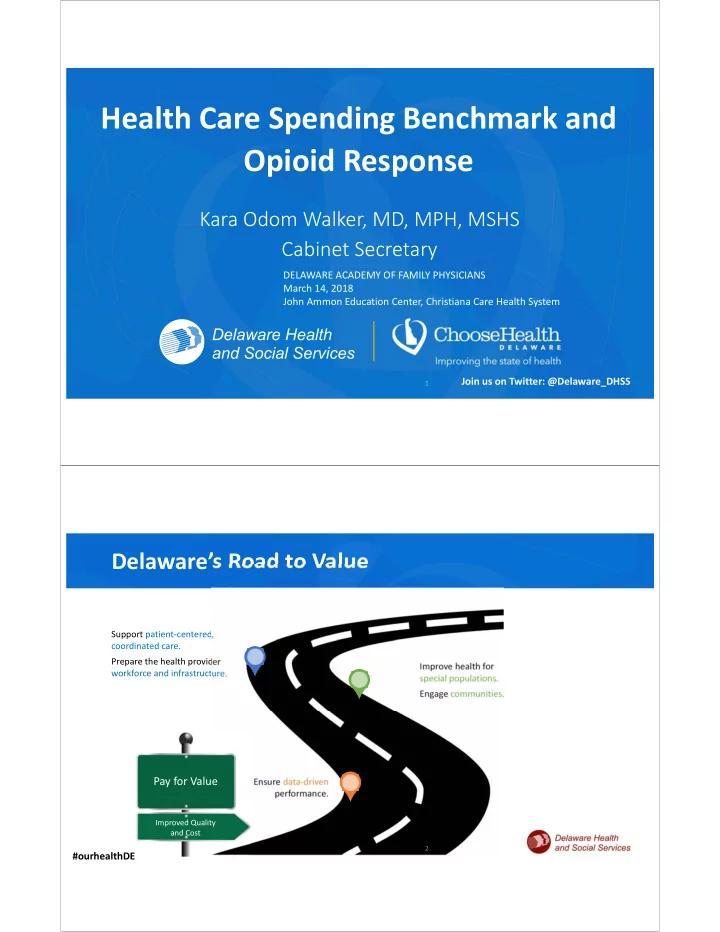
Delaware’s Road to Value

Support patient‐centered, coordinated care. Prepare the health provider workforce and infrastructure. Improve health for special populations. Engage communities. Ensure data‐driven performance.

Pay for Value

Improved Quality and Cost

#ourhealthDE

2

slide-2
SLIDE 2

Why the Benchmark Is Important

  • Delaware’s per‐capita health care costs are

more than 25% above the U.S. average.

  • Delaware’s health care spending is expected

to more than double by 2025.

  • Health care costs consume at least 30 percent of

Delaware’s budget.

#ourhealthDE

3

Delaware’s Overall Health Is Poor

  • Our population is older and aging faster.
  • We are sicker than the average state.
  • Our investments have not led to better
  • utcomes — we are ranked 30th in America’s

Health Rankings.

30

RANKED

#ourhealthDE

4

slide-3
SLIDE 3

SOURCE: Delaware Office of Management and Budget; DEFAC Expenditure Reports. 1- Infrastructure funds reported from Transportation Trust Fund expenditures, not General Fund. 2- Salaries are not inclusive of public education salaries. 3- Healthcare includes employee health benefit expenditures and Medicaid expenditures. 4- Public safety expenditures include expenditures by DSHS, DOC, and Youth Rehabilitative Services (DSCYF)

  • During this same time

frame, General Fund revenue collection has grown by just 7.6%.

  • Health care costs now

account for about 30% of the state’s budget .

Increasing Health Care Costs

DELAWARE GENERAL FUND EXPENDITURES1, FY2013 VS. FY2017

$‐ $200 $400 $600 $800 $1,000 $1,200 $1,400 FY 2013 FY 2017 Salaries2 Health Care3 Public Ed Infrastructure Public Safety4

+$202M (+22%)

  • Crowds out necessary

investments in:

  • Salaries
  • Education
  • Infrastructure
  • Public Safety

5

#ourhealthDE

Delaware Spends More on Health Care Than Most Other States

PER CAPITA PERSONAL HEALTH CARE EXPENDITURES, 2014

NOTE: District of Columbia is not included. SOURCE: Centers for Medicare & Medicaid Services, Health Expenditures by State of Residence, CMS, 2017.

$0 $2,000 $4,000 $6,000 $8,000 $10,000 $12,000 UT AZ GA NV CO ID TX NM NC AL HI SC TN AR CA VA OK MS KS LA WA KY OR MI FL MO IA MT IL IN WY NE MD WI OH NJ MN SD PA WV ME RI NH NY ND CT VT DE MA AK

State NATIONAL AVERAGE

#ourhealthDE

6

slide-4
SLIDE 4

Delaware’s Total Health Spending Will Double from 2015 to 2025

$6.7 $7.1 $7.5 $7.9 $8.4 $8.6 $9.0 $9.5 $10.2 $11.0 $11.9 $12.8 $13.8 $14.8 $16.0 $17.2 $18.5 $19.9 $21.5

2007 2008 2009 2010 2011 2012 2013 2014 2015 2016 2017 2018 2019 2020 2021 2022 2023 2024 2025

ACTUAL PROJECTED 2% 3% 5%

SOURCES: Centers for Medicare & Medicaid Services, Health Expenditures by State of Residence, CMS, 2017;

Year

Growth Target 5% 3% 2%

DELAWARE’S ACTUAL AND PROJECTED PERSONAL HEALTH CARE EXPENDITURES, 2007—2025

(BILLIONS OF DOLLARS)

#ourhealthDE

7

Per Person Spending in Delaware Is Higher Than the National Average in Every Category of Service

UNITED STATES AND DELAWARE PER CAPITA SPENDING BY SERVICE, 2014

SOURCE: Centers for Medicare & Medicaid Services, Health Expenditures by State of Residence, CMS, 2017.

$3,079 $1,874 $1,114 $1,216 $614 $146 $4,078 $2,259 $1,525 $1,438 $757 $197

UNITED STATES DELAWARE

Hospital Care Physician and Clinical Services Drugs and Other Medical Nondurables Nursing Home, Home Health, and Other Personal Care Dental and Other Professional Services Medical Durables

8

#ourhealthDE
slide-5
SLIDE 5

Private Medicare Medicaid

Medicare and Medicaid Account for Nearly 40%

  • f Delaware’s Health Spending

SOURCE: Centers for Medicare & Medicaid Services, Health Expenditures by State of Residence, CMS, 2017

.

16% 64%

Private/Other $6.1

TOTAL PERSONAL HEALTH EXPENDITURES BY PAYER IN DELAWARE, 2009

(MILLIONS OF DOLLARS)

Medicaid $1.51 Medicare $2.0

20%

#ourhealthDE

Opportunities and Threats to Better Health

  • We purchase health care for a greater share
  • f the population than most other states.
  • We have made progress on moving to

value‐based payment models.

  • The current pace of adoption of downside risk

may not be sufficient to achieve our goals.

#ourhealthDE

10

slide-6
SLIDE 6

Our Objectives: Improved Choice and Better Delivery

  • Give Delawareans choices and

information to help them make better health care decisions.

  • Reinforce healthy choices via

institution and neighborhood design.

  • Support primary care infrastructure

that allows for improvements.

#ourhealthDE

11

Strategy One

Improve Health Care Quality and Cost

  • Establish a value‐based, health focused, public

health framework.

  • Create systems of care centered on quality,

patient experience and costs with a strong primary care foundation.

  • Reduce unnecessary and inappropriate care.

$

#ourhealthDE

12

slide-7
SLIDE 7

Strategy Two

Pay for Value

  • Establish a health care spending benchmark

that can examine cost drivers.

  • Reorient data‐driven monitoring of cost

toward value and put this information in the hands of physicians.

  • Require cost and quality thresholds in

Medicaid Managed Care Organization contracts.

#ourhealthDE

13

Strategy Three

Support Patient‐Centered, Coordinated Care

  • Create all‐payer ACOs to facilitate

integration of services and patient‐centered medical homes.

  • Support and pay for coordination of care

across settings.

  • Create reimbursement approaches

for safety‐net services.

  • Examine the Health Resources Board’s

authority to both allow for system growth and right‐sizing.

#ourhealthDE

14

slide-8
SLIDE 8

Strategy Four

Support the Health Care Provider Workforce and Health Care Infrastructure Needs

  • Support primary care workforce, dental, behavioral

health, and health‐professions education.

  • Increase racial and ethnic diversity
  • f workforce.
  • Prepare for safety‐net providers’

increased needs.

  • Invest in telehealth and coordination
  • f services for at‐risk populations.
  • Invest in provider‐readiness

infrastructure.

#ourhealthDE

15

Strategy Five

Improve Health Care for Special Populations

  • Strengthen capacity to promote health equity for

people with disabilities.

  • Continue to focus on maternal‐child health.
  • Establish a trauma‐informed system of care.
  • Use patient‐centered medical homes for

prison‐reentry population.

#ourhealthDE

16

slide-9
SLIDE 9

Strategy Six

Engage Communities

  • Improve community‐based

wellness initiatives, including ACEs, obesity prevention and tobacco cessation.

  • Create population‐health

metrics and community data‐driven approaches.

#ourhealthDE

17

Strategy Seven

Ensure Data‐Driven Performance

  • Use public‐private collaboration to establish

quality and cost targets.

  • Create methodology for ACOs to interpret

quality and cost goals.

  • Align all payers with total‐cost‐of‐care models

leveraging DHIN capacity and HCC‐’like’ authority.

  • Use a multipronged approach to strengthen

the exchange and Medicare ACO strategies.

#ourhealthDE

18

slide-10
SLIDE 10

What’s Included in the Benchmark

19

BASED ON AFFORDABILITY, QUALITY AND TOTAL COST OF HEALTH CARE

Va Value-Based Pa Payments ts Bund Bundled led Pa Payments ts Episodic Episodic Pa Payments ts Managed Care Managed Care Pe Per M Member Per Mont r Month h (PMPM) MPM) All-Incl All-Inclusive e Population-Ba Population-Based sed Pa Payments ts Accou ccounta table e Care Care Organizations ganizations Pa Patient- t- Cent Centered ered Medical Medical Homes Homes Managed Care Managed Care Organizations ganizations Int Integrat grated Deliv ed Deliver ery y Re Reform Pa Payment t Re Reform

Benchmark and Quality: What’s Next

20

slide-11
SLIDE 11

How You Can Get Involved

  • Visit ChooseHealthDE.com’s relaunched website to read more about the benchmark:

https://www.choosehealthde.com/Health‐Care‐Spending‐Benchmark

  • Read more at the Health Care Commission website:

http://dhss.delaware.gov/dhcc/global.html

  • Watch archived Facebook Live videos of benchmark summits:

Facebook.com/DelawareDHSS or youtube.com/DelDHSS

  • View the DHSS report to JFC on the benchmark or Delaware’s Road to Value white paper,

visit: http://dhss.delaware.gov/dhss/dhcc/global.html

  • Send public comments on either report via email to: OurHealthDE@state.de.us

21

#ourhealthDE

SUBSTANCE USE DISORDER RESPONSE

22

slide-12
SLIDE 12

IN 2016, OVERDOSE DEATHS MORE THAN DOUBLE TRAFFIC DEATHS

Traffic Deaths in Delaware

120

Overdose Deaths in Delaware

308

23

DELAWARE’S TREATMENT LANDSCAPE

 8,150 public treatment admissions for

addiction in 2016. Heroin was the most common primary drug listed at time of admission.

 Thousands more sought private treatment,

in-state or out-of-state.

 In the past decade, the number of

Delawareans with Substance Use Disorder nearly doubled from 6,000 to 11,000.

 During the same period, the number of people

receiving SUD treatment increased by 500% from 1,000 to 5,000 – leaving a gap of 6,000.

24

slide-13
SLIDE 13

STATE’S TREATMENT RESPONSE

Withdrawal Management: Two centers in the state.

Residential Treatment: Increased capacity across 4 locations.

Young Adult Opiate Residential Treatment: Doubled capacity.

Sober Living Beds: Doubled capacity.

Outpatient Treatment: Expanded services to include full continuum of support.

Recovery Response Center: Newark and Ellendale centers for 24/7 crisis.

25

  • Created by HB 220, signed by Governor

Carney on August 16, 2017.

  • Representatives from state agencies,

professional communities and the public.

  • Successor to the Prescription Drug

Action Committee.

  • Created to operate under the umbrella
  • f the Behavioral Health Consortium.

ADDICTION ACTION COMMITTEE

26

slide-14
SLIDE 14

ADDICTION ACTION COMMITTEE WORKING GROUPS

 Pain Management: Ensure access to non-

  • pioid approaches to pain management.

 Safe Prescribing: Provider education and

practice change support.

 Access to

Treatment: Access to comprehensive treatment; engage individuals into treatment; build a recovery system.

 Criminal Justice: Engage individuals into

treatment from the criminal justice system.

 Public Education: Youth and their families;

general public.

27

Executive Sponsor: Karyl Rattay

  • 1. Reduction in substance abuse, non-fatal

Overdoses and overdose deaths STRATEGIC OBJECTIVES

Perspective

Assets Health Status Implementation Process & Learning

Strategic Focus:

Prevent Substance Abuse

DHSS Strategy Map

  • 5. Surveillance
  • 6. Communication
  • 8. Partnerships
  • 9. Workforce
  • 7. Grants, Contracts, and

Payment Strategies

  • 2. Prevent

life-threatening adverse outcomes

  • 3. Diagnose, engage, treat

and support individuals with addictions and substance use disorders

  • 4. Reduce the need to

self-medicate, control access to addictive substances and promote protective factors

Vision: Delaware has a coordinated and comprehensive approach to prevent, identify, effectively treat and support those impacted by substance use disorder.

Revised 09-22-2017

28 28

slide-15
SLIDE 15

OVERDOSE PREVENTION AND SUD TREATMENT

 Naloxone Access: Increased access without a

prescription (SB 48).

 Medicaid Changes: Removed barriers to

addiction treatment (SB 109).

 Prescription Monitoring Program (PMP):

Department of State issued new prescriber regulations to cover patients’ first-time use of

  • pioids and for treatment of chronic pain.

 Relaunched HelpIsHereDE: Relaunched our

  • ne-stop website for information and services

related to addiction prevention, treatment and recovery.

29

TIMING

Finding treatment at the moment of readiness.

EVIDENCE-BASED THERAPY

Increased access to evidence based treatment options, including medication assisted therapy.

LEVEL OF CARE

More options at the right level of care balancing resources, social circumstance, and severity.

RE-ENTRY

Others need access when, and if they have to start from the beginning.

OUR TREATMENT SYSTEMS NEED WORK

30

slide-16
SLIDE 16

31

LOOKING AHEAD: SUBSTANCE USE DISORDER TREATMENT STRATEGY

Substance Use Disorder Treatment System

Engaging, comprehensive, coordinated, integrated, high- quality, and person-centered.

Through Centers of Excellence – to cover the entire state. 

Facilitating This Transition

  • Request for Proposals for the technical assistance to

support a Centers of Excellence model is out.

  • DHSS expects the centers to open in 2018.

Behavioral Health Consortium

Led by the Lt. Gov., with oversight of entire system.

32

slide-17
SLIDE 17

WHERE YOU COME IN: MEDICATION-ASSISTED THERAPY (MAT) LANDSCAPE IN DELAWARE There are approximately 90 registered MAT providers in Delaware, representing 6.5%

  • f primary care physicians.

33

THANK YOU

#ourhealthde

34

slide-18
SLIDE 18

MEDICAID SPENDING IS HIGHER IN DE COMPARED TO NATIONAL

$13,063 $16,859 $3,278 $2,577 $5,736 $21,255 $21,875 $6,011 $3,799 $8,046

Aged Individuals with Disabilities Adults Children Total

National DE

Medicaid per enrollee spending $ Thousands; Medicaid total spending, CY 2014

  • DE has 5th highest total per enrollee Medicaid spending by state
  • DE has 3rd highest total per enrollee Medicaid spending by state for aged population; 4th highest for adults, 6th highest for

children

Source: Kaiser Family Foundation

DRAFT

Upper limit: $28,179 Parents in household of three Lower limit: $16,642 for individual without children

slide-19
SLIDE 19

DRAFT

GROWTH IN MEDICAID

FY 08 FY 09 FY 10 FY 11 FY 12 FY 13 FY 14 FY 15 FY 16 FY 17 (est.) Monthly Average 152,316 160,018 173,771 193,633 207,067 212,693 217,658 224,198 220,000 222,000 ‐ 50,000 100,000 150,000 200,000 250,000 N U M B E R O F E L I G I B L E S FISCAL YEAR

Medicaid Eligible Clients FY 08‐ FY 17 Includes Affordable Care Act Growth in FY 15 ‐ FY 17

slide-20
SLIDE 20

MEDICAID COST PER MEMBER PER MONTH

slide-21
SLIDE 21

Commercial individual market 11% 20% 3% 27% State employees2

(over 122,000 covered lives)

Medicaid1

(over 222,000 recipients)

20% Commercial self-insured 13% Medicare

(17,000 state retirees)

6% Uninsured Commercial fully insured

1 Excluding duals 2 Excluding members with supplemental Medicare, estimated Source: CMS Medicare Enrollment Dashboard; Census Population Without Health Insurance Coverage by State: 2013 to 2015; CMS-64 VII Group Break Out Report March 2016; Delaware Health Care Commission Presentation March 3, 2016, “Delaware’s Health Insurance Marketplace: Update on Activity”; State of Delaware Final Report on the State Employees Health Plan Task Force submitted December 15, 2015; MACPAC; AHIP Center for Policy and Research 2014 report “Trends in Medigap Enrollment and Coverage Options”; Employee Benefit Research Institute November 2012 Vol. 33 No. 11; United States Census Bureau QuickFacts

More than 50% under federal/state authority (Medicaid, State employees, retirees and exchange)

DELAWARE’S HEALTH INSURANCE LANDSCAPE

42

Health Care Cost Institute Analysis

  • 2016 data from employer

sponsored plans

  • Included 26% of claims from

5 insurers in Delaware, not Highmark or AmeriHealth To read more:

http://www.healthcostinstitute.org/report/

slide-22
SLIDE 22

43

Despite limited data:

  • Ranked 13th by total cost
  • 8 states have “older

populations”

  • 3rd highest inpatient costs
  • 13th highest outpatient costs

To read more:

http://www.healthcostinstitute.org/report/