
SLIDE 1
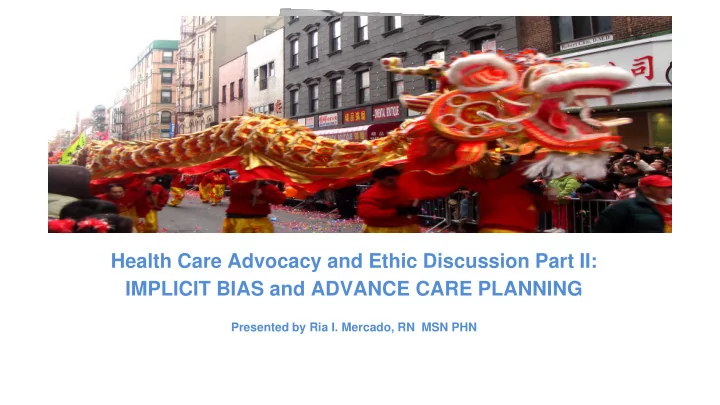
Health Care Advocacy and Ethic Discussion Part II: IMPLICIT BIAS and ADVANCE CARE PLANNING
Presented by Ria I. Mercado, RN MSN PHN
Health Care Advocacy and Ethic Discussion Part II: IMPLICIT BIAS and - - PowerPoint PPT Presentation
Health Care Advocacy and Ethic Discussion Part II: IMPLICIT BIAS and ADVANCE CARE PLANNING Presented by Ria I. Mercado, RN MSN PHN New Year: Renewal or Start of Something new 1.Understanding implicit bias and its impact to healthcare
Presented by Ria I. Mercado, RN MSN PHN
1.Understanding implicit bias and its impact to healthcare planning
2.Lean how "Reframing” can be useful in promoting inclusion and equity in meeting the healthcare needs of older adults and adults with developmental disabilities. 3.Identify core skills for initiating advance care planning discussions.
patterns for survival and with daily activities.
BREAKING DOWN THE BARRIERS: End …Ism
1. Recognize your own bias 2. Training 3. Time 4. Resources
Forms Lots of Forms Legal Witnesses Doctors Nurses Social Workers
B ader Advance Care Planning Is NOT: And Advance Care Planning starts with:
Advance Care Planning (ACP) and Advance Directives Are NOT the same.
Initiate routine and urgent discussions Explore understanding of disease progression Assist in understanding ACP Explore barriers to planning Assist in selection and preparation of proxy Search out values of living well Clarify statements Discover meaning of experiences Advocate for & communicate client’s wishes Make referrals
1. Who has had regular contact with you before and after the illness. 2. Is familiar with your wishes and values and will honor those wishes and values. 3. Is able to provide information about your health history, wishes and values. 4. Is able to understand your medical condition 5. Will be able to make decisions about your care in the middle of emotional situation. 6. Is available to come to the hospital 7. Is able to communicate with your health care team 8. Is able to communicate with your love ones, receive from them and share important information with them.
✓ START the Conversation with understanding of your own biases ✓ START Reframing and countering stereotypes with positive examples from groups that are unfamiliar or new. ✓ STOP and take time to reflect on your own shortcuts, preferences, habits or tendencies that create blind spots and microinequities. ✓ CONTINUE to explore where implicit bias is undermining our goals for healthcare equity and inclusion