Heading Experienced Practitioner Assessment Subheading Pathways to - - PDF document

heading
SMART_READER_LITE
LIVE PREVIEW

Heading Experienced Practitioner Assessment Subheading Pathways to - - PDF document

6/02/2018 Experienced Practitioner Assessment for experienced overseas practitioners Briefing Session Kate Doyle, AACA CEO Heading Experienced Practitioner Assessment Subheading Pathways to Registration As an Architect


slide-1
SLIDE 1

6/02/2018 1

Experienced Practitioner Assessment

for experienced overseas practitioners Briefing Session

Kate Doyle, AACA CEO

Heading

Subheading

6-Feb-18 2

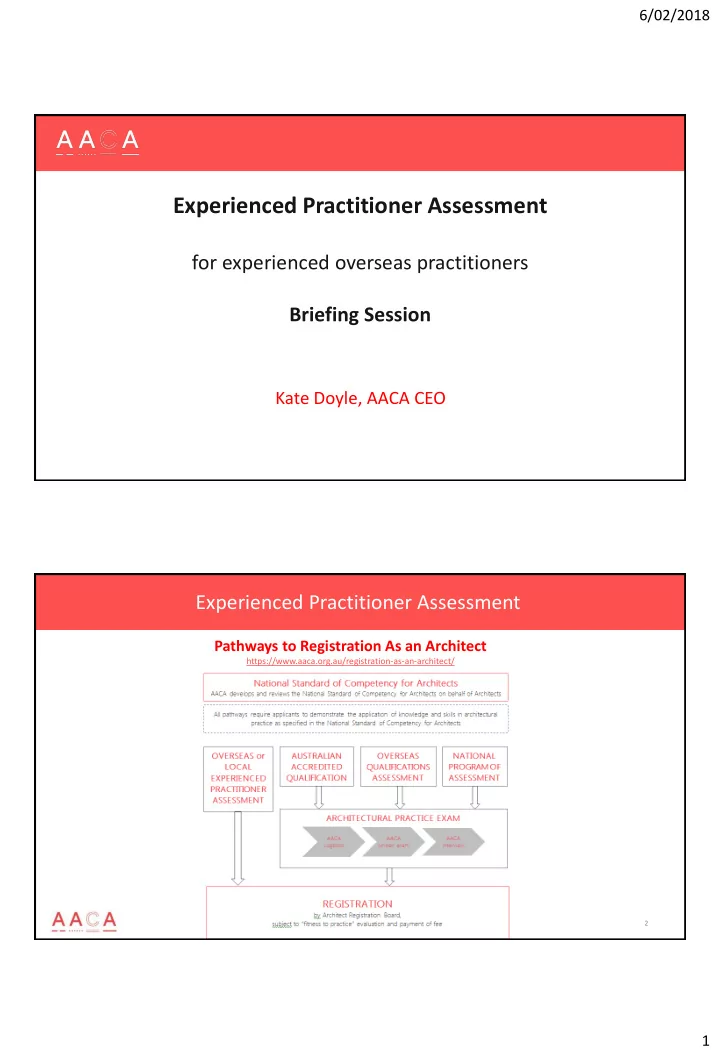
Experienced Practitioner Assessment

Pathways to Registration As an Architect

https://www.aaca.org.au/registration-as-an-architect/

slide-2
SLIDE 2

6/02/2018 2

  • 2. Eligibility

a. Minimum 5-year (or equivalent) professional qualification/s in architecture b. 7-years relevant professional postgraduate experience with a minimum of 3 years as an architect practising at Executive Level (Principal decision-maker) c. 12 months relevant professional experience in Australia within the last 3 years d. Resident in Australia e. English language proficiency

3

Experienced Practitioner Assessment

Components:

  • Portfolio of Complex Projects to demonstrate appropriate experience and practice
  • f architecture at an Executive Level (principal decision-maker), as well as capacity

to exercise professional skill as an architectural practitioner in Australia.

  • A face-to-face interview with two experienced architect Assessors to discuss the

applicant’s Assessable Items and determine the extent to which the required National Standard of Competency for Architects Performance Criteria are met and the applicant’s ability to practice to the standard expected of a practicing architect in Australia.

6-Feb-18 4

Experienced Practitioner Assessment

slide-3
SLIDE 3

6/02/2018 3 What is a Complex Project? Typically a project of medium scale or larger that requires the skill and knowledge to deliver the resolution and integration of complicated aspects including but not limited to: siting, planning, structure, services, materials, composition and configuration. A complex project is demanding in its ordering and organisation of multiple occupancy and/or special purpose user requirements and requires the integration of cultural, social, environmental and technical issues.’ Generally, single dwelling residential projects would not be considered a complex project.

6-Feb-18 5

Experienced Practitioner Assessment

Heading

Subheading

6-Feb-18 6

Experienced Practitioner Assessment

The National Standard of Competency for Architects establishes the Standard for architectural education and assessment of professional competency prior to registration as an Architect in Australia

http://competencystandardforarchitects.aaca.org.au/about http://competencystandardforarchitects.aaca.org.au/matrix/index/index/assessment/5

slide-4
SLIDE 4

6/02/2018 4

Heading

Subheading

6-Feb-18 7

Experienced Practitioner Assessment

What are the ‘Assessable Items’?

  • Brief CV (limited to 4 pages)
  • 2 professional references

– max 2 pages per reference, with minimum 1 from registered Australian architect

  • Project Portfolio

– in specified format, containing min of 4 / max of 6 complex built work projects

  • 1 page checklist of the competency standards

– 27 Performance Criteria from the National Standard of Competency for Architects

8

Experienced Practitioner Assessment

slide-5
SLIDE 5

6/02/2018 5 Project Portfolio – (maximum 2 A4 pages per project) of 4-6 Complex Projects (built work only) demonstrating fulfilment of the relevant Performance Criteria of the NSCA. Projects should be chosen to best demonstrate the extent to which the required NSCA Performance Criteria are met, indicating the application of knowledge and skills in architectural practice and the applicant’s ability to practice to the standard expected of a practising architect in Australia. AACA does not provide sample project portfolios.

6-Feb-18 9

Experienced Practitioner Assessment

For each Project referenced in the Portfolio, include the following information:

  • Project Name and number (numbered 1 through to 4,5 or 6 as necessary)
  • Location (including suburb, city, state, and country)
  • Building type
  • Estimated Cost
  • Project date of completion
  • Statement outlining applicant’s role in the project
  • Brief description of the project
  • Detailed description of applicant’s executive level responsibilities (as linked to the

required NSCA Performance Criteria)

  • Relevant drawings, diagrams or images (noting the limitation of 2 A4 pages per project)

6-Feb-18 10

Experienced Practitioner Assessment

slide-6
SLIDE 6

6/02/2018 6

Heading

Subheading

6-Feb-18 11

Experienced Practitioner Assessment

Applicant must be familiar with relevant Australian contracts, regulations and legal requirements, as required across the specified Performance Criteria.

  • talk to colleagues
  • check Architects Codes of Conduct on Architect Registration Boards
  • review AACA documents – Profile of the Profession, Regulation of Architects in

Australia

  • complete relevant continuing professional development seminars eg Practice of

Architecture Learning Series (PALS) and Practicing ARChitecture (PARC)

6-Feb-18 12

Experienced Practitioner Assessment

slide-7
SLIDE 7

6/02/2018 7 Useful Information

National Standard of Competency for Architects Industry Profile: The Profession of Architecture in Australia The Regulation of the Architect Profession in Australia Architect’s Model Statutory Code of Professional Standards and Conduct Guide for applicants: The EPA Guide for Applicants for Overseas Practitioners

6-Feb-18 13

Experienced Practitioner Assessment