SLIDE 1
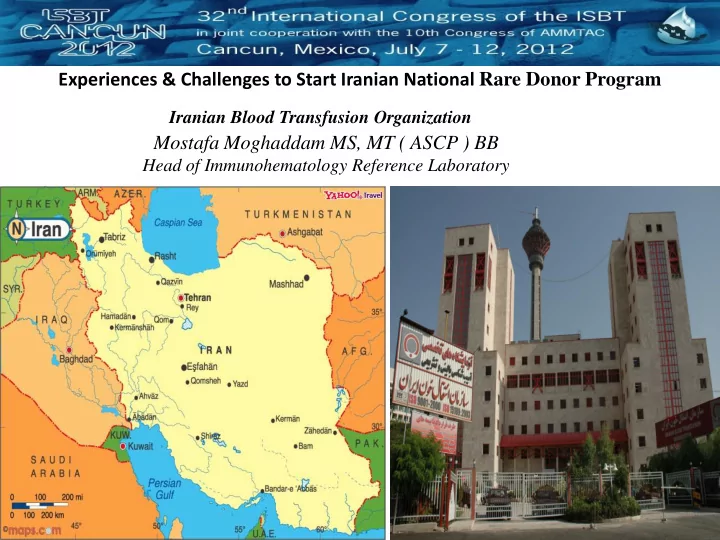
Experiences & Challenges to Start Iranian National Rare Donor Program Mostafa Moghaddam MS, MT ( ASCP ) BB
Head of Immunohematology Reference Laboratory Iranian Blood Transfusion Organization
SLIDE 2
Experiences & Challenges to Start Iranian National Rare Donor Program
Situation analysis and justification of program Financial & Administrative support by Higher Management Technologist Education& Training in advanced Immunohematology
Employee Awareness and Communication between Regional blood center
Accessibility to Rare anti-sera , Equipments & Consumables Public Relation Department Collaboration Facility and Environmental Engineering &Technical maintenance Comprehensive Information Technology Packaging & Reliable Transportation
10 important steps to ensure success
SLIDE 3 Experiences & Challenges to Start Iranian National Rare Donor Program
51%
Persian
24%
Azeri
8%
Gilaki, mazandrai
7%
Kurd
3%
Arab
2%
Lur
2%
Baloch
2%
Turkmen
1%
Other 2010 75000000
Population
2012 31
Provinces
2010 2011 1986992
Total number
donation
2010 2011 26.2%
Per capita donation (1000)
2010 2011 0.004%
HIV
( western blot)
2010 2011 0.20%
HBV
(Neutralization)/ (HBcAb)
2010 2011 0.061%
HCV
(Riba)
2010 2011 0.18%
HTLV khorasan
(western blot)
2010 2010 0.001%
RPR ( FTA-ABS)
Situation analysis , Demographic & Ethnic profile
SLIDE 4 218 Total number of Blood Centers/ Blood Donation Centers 127 Blood Donation Centers 37 Blood Collection & Preparation Centers 54 Blood Centers Provincial Centers 31 Regional & Educational Centers 9
100 % Volunteer Whole Blood Per- request Autologous Replacement Directed
Donations from
Autologous donors Paid donors Family Replacement donors Regular donors Lapsed donors New donors
Per request
0.0% 0.0% 49.31% 23.7% 27%
Experiences & Challenges to Start Iranian National Rare Donor Program
SLIDE 5 Experiences & Challenges to Start Iranian National Rare Donor Program Financial & Administrative support by Higher Management
Willingness for allocation
initial establishment and continuous improvement
Iranian National Rare Donor program
SLIDE 6
Emphasis on continuous education, training and improving knowledge of technologists in special serology from various provincial blood donor centers Promoting importance of services provided to patients with difficult samples by rare donor program resulting in prevention of transfusion related adverse effect Concern for lack of experiences to use specific advanced special immunohematology procedures Concern for technical and human errors in reporting test results Need for contact and collaboration with international Immunohematology Reference Laboratory for technical help and testing confirmation
Experiences & Challenges to Start Iranian National Rare Donor Program
Technologist Education& Training in advanced Immunohematology
SLIDE 7
Experiences & Challenges to Start Iranian National Rare Donor Program
Access to expensive internationally accepted anti-sera Availability of automated machines, supplies and consumables for glycerolization and deglycerolization of rare RBCs
Accessibility to Rare anti-sera , Equipments & Consumables
SLIDE 8
Emphasis on employee awareness and effective communication between countries regional blood donor centers and IBTO’s IRL Promoting employee awareness on importance of rare donor program
Donor registration Donor interviewer Component preparation Component storage Packaging & shipment of collected rare blood
Experiences & Challenges to Start Iranian National Rare Donor Program
Employee Awareness and Communication between Regional blood center
SLIDE 9
Selection of talented & people oriented employees Continuous pleasant and good public relation skills by employees in rare blood donor program Offering correct & complete answers to rare donor questions &concerns Need to support rare donor moral feeling / how their blood can help patients Continuous contact with rare blood donor to update personal information & help for retention of rare donor Close collaboration between IBTO public relation department and IRL Rare donor interview in local and national media for recognition of rare donors and public awareness Meeting of rare donors , patients and surgical team in National & International blood donor days Establishing a National Rare Blood Donor day
Experiences & Challenges to Start Iranian National Rare Donor Program
Public Relation Department Collaboration
SLIDE 10
Concern for access to sufficient storage area and good environmental condition Sufficient number of -80°C standard freezer for longer blood storage Empty back up freezer Controlled access area Temperature controlled environment (-18°C-22°C) by central heating and cooling system Central 24 hour temperature control alert system for any electrical failure
Experiences & Challenges to Start Iranian National Rare Donor Program
Facility and Environmental
SLIDE 11
Access to skilled technical person for maintenance of blood group automated machines , RBC processor machines, freezers, instruments and calibrated blood bank centrifuges Availability of equipments and spare parts from country of origin
Experiences & Challenges to Start Iranian National Rare Donor Program
Engineering &Technical maintenance
SLIDE 12
Producing a comprehensive National Rare Donor software (Mak System) for
rare donor personal information record and phenotype database archiving complete serologic test results blood inventory management
Experiences & Challenges to Start Iranian National Rare Donor Program
Comprehensive Information Technology
SLIDE 13
Experiences & Challenges to Start Iranian National Rare Donor Program
Packaging & Reliable Transportation Difficulty in transporting and delivery of requested rare blood to hospital Large country with long distances Lack of experienced private company for blood transportation Delivery by Air and Land
(bureaucratic procedures /ticket purchase / cancelation of flights/ flight delays )