Hea Health lth Car Care e in in Nige Nigeria ria Prof Pr - - PowerPoint PPT Presentation

hea health lth car care e in in nige nigeria ria
SMART_READER_LITE
LIVE PREVIEW

Hea Health lth Car Care e in in Nige Nigeria ria Prof Pr - - PowerPoint PPT Presentation

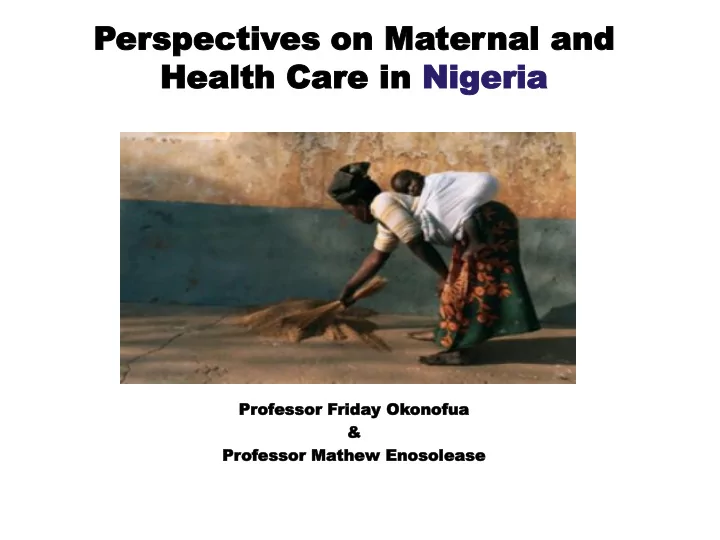
Per erspectiv spectives es on Ma on Mater ternal and nal and Hea Health lth Car Care e in in Nige Nigeria ria Prof Pr ofessor F essor Friday riday Ok Okon onof ofua ua & Pr Prof ofessor Ma essor Mathe thew Enosolea


slide-1
SLIDE 1

Per erspectiv spectives es on Ma

  • n Mater

ternal and nal and Hea Health lth Car Care e in in Nige Nigeria ria

Pr Prof

  • fessor F

essor Friday riday Ok Okon

  • nof
  • fua

ua & Pr Prof

  • fessor Ma

essor Mathe thew Enosolea Enosolease se

slide-2
SLIDE 2

Ma Mater ternal Mor nal Mortalit tality: y: A Social A Social and and De Developmen elopment t Mir Mirror

  • r

 Indicators of maternal and child mortality are the best indicators of human development  2011 (Mo) Ibrahim Index of African Governance ranks Nigeria 41st out of 53 countries, and 51st in health governance  The most serious public health and development challenge that Nigeria currently faces  Current development and “transformational” efforts will not be taken seriously with continued high rates of maternal and neonatal mortality

slide-3
SLIDE 3

Lectur Lecture e Ov Over erview view

 Historical review of trends in maternal mortality and safe motherhood efforts  Is maternal mortality on the decline in Nigeria?  Role of social and economic determinants of maternal and neonatal mortality  Key road maps for achieving MDG-5 in Nigeria  Conclusion and Call for Action

slide-4
SLIDE 4

Professor Harrison’s Research in Nor Northe thern Niger n Nigeria ia

 Revi view ewed mor ed mortali tality ty among among over er 22 22,000 ,000 pr pregn gnan ant w t wome

  • men

n in in Zaria Zaria  Rep epor

  • rted

ted o

  • ver

erall all MMR of

  • f

1,05 1,050/1 0/100 00,000 ,000 bir births ths  Boo

  • oked

ed-he healthy althy wome

  • men:

n: 40 40/10 /100,00 0,000 0 bir births ths  Boo

  • oked

ed w wome

  • men w

n with ith co complica mplications: 3 tions: 370 70/10 /100,00 0,000 bir births ths  Un Unbo book

  • ked

ed eme emerge genc ncies: ies: 2,90 2,900/1 0/100 00,000 ,000 bir births ths  Demonstr emonstrated ted the i the impact mpact of

  • f

ad adver erse s se soc

  • cial

ial fac actor tors

slide-5
SLIDE 5

Na National and tional and G Global lobal Mil Milestone estones s in Saf in Safe e Motherhood Motherhood

1985

  • Prof K.A. Harrison´s groundbreaking

paper on maternal mortality in Nigeria 1987

  • Nairobi Safe Motherhood Conference

1994

  • ICPD, Cairo, Egypt

1995

  • International Conference on Women in

Beijing, China 2000

  • New data on maternal mortality

2000

  • The Millennium Development Goals

2008

  • Mid-term Report on attainment of MDG-5

(the Lancet Paper)

slide-6
SLIDE 6

Trends in Ma ends in Mater ternal nal Mor Mortality in tality in Ni Niger geria: ia: 1990 1990-2010 2010

Year ear Ra Ratio / tio / 100 100,000 ,000 Bir Births ths So Sour urce ce 1985 1,050 Harrison et al, 1985 1990 870 WHO 2000 1,000 UNFPA/UNICEF/WHO 2002 800 UNFPA/UNICEF/WHO 2007 1,000 WHO/National estimates 2008 608 Lancet publication 2008 545 NDHS

slide-7
SLIDE 7

Is MMR Actu Is MMR Actuall ally y Dec Decli lining ning in in Niger Nigeria? ia?

Lik Likel ely y NO NOT:  NDHS NDHS reflected eflected community community da data ta rathe ther than r than hospital hospital da data ta  Use Use of

  • f the

the ¨sisterh sisterhoo

  • od met

d metho hod¨ co could ha uld have e led led to to under under-est estima imation tion of

  • f ma

mate terna nal l de death ths  Lan Lancet cet pa paper per used used new met new method hod of

  • f MMR

R estima estimation tion  Onl Only y 39 398 8 de death ths s rep epor

  • rte

ted d in in th the NDHS e NDHS co coho hort t compa compared ed to 1,000 dea to 1,000 deaths ths fr from

  • m one
  • ne Kano hospital

Kano hospital alone by S alone by SOGON OGON in 2 in 2004 004

slide-8
SLIDE 8

Ma Mate terna nal l mor morta tali lity ty in Niger in Nigeria: ia: The he Rea eali lity ty

 Although MMR has declined worldwide over the past 10 years, Nigeria remains one country with extremely high rates of maternal mortality  Nigeria remains one of 6 countries listed as accounting 50% of maternal deaths.  The current ranking of countries with worst MMR : India, Nigeria, Pakistan, Afghanistan, Ethiopia and DRC (India is first only because of its large population)

slide-9
SLIDE 9

Selecte Selected d Publica Publications tions on Ra

  • n Rates

tes of

  • f Ma

Mater ternal nal Mor Mortality tality in in Niger Nigeria, ia, 2008 2008-2011 2011

Ref Author(s) Date of Publication Location MM ratio/100,000 No of maternal deaths 9 Oye-Adeniran et al May 2011 Lagos 450 111 10 Agan et al Aug 2010 Calabar 1,513.4 231 11 Ezugwu et al Dec 2009 Enugu 840 60 12 Kullima et al Oct 2009 Yobe 2,849 112 13 Mairiga et al Jan 2009 Bauchi 1,732 767 14 Onakewhor & Gharoro June 2008 Benin City 454 32 15 Idris et al Sep 2010 Zaria 1,400 706 16 Ngwan & Swende 2011 Jos 1,260 56 5 NDHS 2010 National 545 398

slide-10
SLIDE 10

Extent Extent of

  • f Ma

Mater ternal nal Mor Mortalit tality, , Morbidit Morbidity, , and and Disa Disabilit bilities ies

Source: The Lancet, October 28, 2006

slide-11
SLIDE 11

The Tip of the Iceberg…

 For every maternal death, there are nearly 100 stillbirths  2nd highest rate of stillbirth in the world (42/1000)  Nearly 800,000 Nigerian women are affected with vesico-vaginal fistula (VVF), accounting for 40%

  • f the 2 million global estimates

 The lifetime risk of a Nigerian women dying from pregnancy–related causes is 1 in 18, compared to 1 in 4,500 for a Swedish woman

slide-12
SLIDE 12

Path thway ay to to Ma Mate terna nal l Mor Morta tali lity ty: : Soc Socio io- Eco Econo nomic mic Det Deter erminan minants ts

Socio-economic & cultural factors Socio-economic and Delay cultural in health factors seeking and Death in medical management

Ob Obstetri stetric co complica mplications tions

slide-13
SLIDE 13

Obstetric Obstetric (Dir (Direct) Causes ect) Causes of

  • f

Ma Mater ternal Mor nal Mortalit tality

 Bleeding during pregnancy and child birth  Hypertension  Infection during and after child birth  Prolonged

  • bstructed labour

 Others

slide-14
SLIDE 14

Inter Intermediar mediary y Deter Determinants minants of

  • f

Ma Mater ternal Mor nal Mortalit tality

 Less than 10% of Nigerian women use contraceptives to prevent unwanted pregnancies  Only 64% of pregnant women attend antenatal care  Less than 35% are attended to by skilled births attendants (doctors and midwives) at the time of delivery  Less than 50% of pregnant women have access to emergencies obstetrics

slide-15
SLIDE 15

The R he Role

  • le of
  • f the

the H Healt ealthcar hcare S e Syste ystem

 Definition: ¨the complex of facilities,

  • rganisations and trained personnel engaged

in providing healthcare within a geographical area¨  Nigeria´s health care system - currently one

  • f the weakest in the world

 Not able to respond to the needs of pregnant women seeking essential and emergency

  • bstetrics care
slide-16
SLIDE 16

Descriptions of Nigeria’s Healthca Healthcare Syst e System em

World ld He Health lth Or Organiza ization tion (20 (2000) ) --

  • Ranked Nigeria 187th out of 191 surveyed countries in

terms of health systems performances, and described it as ¨dysfunctional, ineffective, under capitalized, costly and inaccessible¨ Hea Health lth an and d De Develop elopmen ment t Dialogu Dialogue e (20 (2001 01) ) --

  • ¨The Nigerian health care system is sick, very sick and

in urgent need of intensive Care. It is blind, lacking the vision of its goals and strategies; it is deaf, failing to respond to the cries of the sick and dying; and it is impotent, seemingly incapable of doing things its neighbouring states have mastered¨

slide-17
SLIDE 17

Comparative Performance of Nigeria’s Health System, Out of 191 Countries

187 175 176 184 180 149 50 100 150 200 Overall health system performance Impact on level of health Health expenditure per capita Overall goal attainment Fairness in financial contributions Responsiveness

slide-18
SLIDE 18

Maternal Mortality As An Underlying Social Problem in Nigeria – Harrison, 2009

Dead mother

Poor

  • or

Injured mother

  • bst

bstetr etrics ics

Dead babies

car care

Injured babies VVF Botched abortion Others

CHA CHAOS OS Social Social Polit

  • litical

ical Econo Economic mic

slide-19
SLIDE 19

Cha Chall llen enge ges s Fac acing ing Ma Mate terna nal l Mor Morta tali lity ty Red educ uction tion in in Niger Nigeria ia

 Inadequate political and financial commitment at both international and country levels  Poor alignment of maternal and child health to national development efforts  Weak and poorly responsive healthcare system  Pervading poverty, especially the feminization of poverty  Illiteracy and low level of community education on MCH issues  Harmful traditional and religious beliefs and practices

slide-20
SLIDE 20

Ac Achie hieving ving MDG MDG-5 5 in Ni in Nige geria: ria: Sug Sugge gest sted ed Roa

  • ad

d Ma Map

 Leveraging international commitments and support  Building political will among the three tiers of government  Improvement health infrastructure and the health system  Implementation of poverty alleviating interventions  Investment in community education and women’s education  Elimination of harmful traditional practices  Socio-economic and political empowerment of women

slide-21
SLIDE 21

Le Lever eraging ging Global Global Commitment Commitments

 The Millennium Declaration - commitment to increased funding of maternal and child health  Only about 10 percent of the US $6.1 billion needed to provide assistance for MCH has been

  • ffered by development partners

 Nigeria - one of the countries with some of the lowest development assistance in Africa  Intense advocacy, international lobbying and partnership building needed to increase international funding for Nigeria

slide-22
SLIDE 22

Political

  • litical Commitment

Commitment Is Is Cri Critical tical

Some states have shown that this can be done:  Gov Mimiko in Ondo through the Abiye program  Successful free maternal health care in Kano, Delta and Ebonyi states  Launching of free maternal health care by 18 states  President Obasanjo through his proactive and dynamic approach to maternal health and the empowerment of women

slide-23
SLIDE 23

Results of Free Maternal Healthcare

slide-24
SLIDE 24

Ser Service vice Utiliz Utilization tion at Ebo t Ebony nyi i Hos Hospita pital l Follo

  • llowing

wing Free ee MCH MCH

At Attendance tendance Bef Befor

  • re

e Pr Prog

  • gram

am Star Started ted After After Pr Prog

  • gram

am Star Started ted % Incr % Increase ease Antenatal 600 3,731 521 Delivery 320 1,480 362.5 Postnatal 310 1,406 353.5

slide-25
SLIDE 25

Decrease in Maternal Deaths and Maternal Mortality Ratio

Maternal deaths decreased from 49 in 2006 to 19 in 2009 MMR decreased from 1,280 per 100,000 live births in 2006 to 219 per 100,000 livebirths in 2009

200 400 600 800 1000 1200 1400 2006 2007 2008 2009

Maternal mortality ratio Maternal deaths Data are from the 21 largest medical facilities in Ebonyi State.

slide-26
SLIDE 26

Adv Advoc

  • cac

acy y for

  • r Building

Building Political

  • litical Wil

ill l for

  • r

Saf Safe e Mot Mothe herh rhoo

  • od

A 3 step process: 1) Create awareness among top decision/political leaders about the problem; 2) Explain why it should rank high among the list of issues to be addressed and identify political benefits that are derivable if action is taken; and 3) Propose simple, easily readable and cost-effective solutions in a layered rather than complex manner.

slide-27
SLIDE 27

Ind Indica icato tors s for

  • r Mea

Measu surin ring g Politica

  • litical

l Commit Commitmen ment

 Level of awareness of maternal health by political leaderships  Extent to which states direct their agenda on maternal and child health programming  Number of specific state policies and programs on MCH  Percent of budget devoted to health and to MCH  Extent to which states re-build infrastructure that impacts on MCH  The extent to which states promote transparent, accountable and effective governance based on the rule

  • f law, social justice and anti-corruption.
slide-28
SLIDE 28

Rebu buil ilding ding Hea Health lth Infr Infras astr truc uctu ture e an and d th the e Hea Healthc lthcar are e Sys Syste tem

 Better funding & coordination of NPHCDA Midwifery Scheme  Strengthening referral systems so women using PHCs can reach secondary and tertiary health facilities when complications arise  Strengthening secondary and tertiary facilities with good transfusion services, specialized emergency obstetric care and use of evidence- based protocols  Signing into law of National Health Bill

slide-29
SLIDE 29

Pover erty ty Alle Allevia viation tion an and d Saf Safet ety y Net Nets

 Immediate solution: Free MCH as is presently being done in Ghana, Senegal, Mali, and Burkina Faso  Intermediate solution: National Health insurance should be improved to cover all vulnerable populations, especially women  Long term solution: efforts should be made to address the high level of poverty in the country

Note: Structural adjustment has not worked and the removal of fuel subsidy will worsen rather than ameliorate the situation.

slide-30
SLIDE 30

Women’s Education and Empowerment

 Educating women - shown to have multiple beneficial effects on the health of women and children  Governments must invest in the education of all women  Informal education, especially on issues relating to health and MCH will also help communities overcome pervading ignorance that leads to poor health seeking behaviors  Focusing on formal and informal education alone can reduce maternal mortality very significantly in the long term

slide-31
SLIDE 31

Conc Conclusion: lusion: A Call to Action A Call to Action

 September 2000: 189 countries agreed the Millennium Development Goals  MDG 5: A reduction in the maternal mortality ratio by 75% between 1990 and 2015  Near-term evaluation has shown possibility of reducing maternal mortality by three-quarters within 25 years in some countries.  Unlikely that Nigeria will achieve the goal in 2015 due to inadequate demographic, economic, political and socio- cultural circumstances  However, DON’T LOSE FAITH – remain focused on the MDG target, while thinking beyond 2015 and keeping an eye on the broad picture.

slide-32
SLIDE 32

Conclusion (cont’d)

 What’s needed: High level political will & strong political leadership Strategy that encourages the alignment of our maternal health with the overall development plans

  • f

the country (example

  • Vision

20:20:20) Concerted effort is required at all levels, from international to in-country efforts and among community stakeholders, health professionals and academicians

slide-33
SLIDE 33

“Safe Motherhood is a human (and constitutional) right. we must empower women and ensure choices…. Our task and the task of many like us, many hundreds of thousands like us, is to ensure that in the next decade, safe motherhood is not regarded as a fringe benefit, but as a central and essential issue in global development”.

  • James D. Wolfensohn

Former President, World Bank

slide-34
SLIDE 34

THANK YOU