HCV Genotype Additional Work-Up Confirm infection with HCV RNA (if - - PowerPoint PPT Presentation

hcv genotype
SMART_READER_LITE
LIVE PREVIEW

HCV Genotype Additional Work-Up Confirm infection with HCV RNA (if - - PowerPoint PPT Presentation

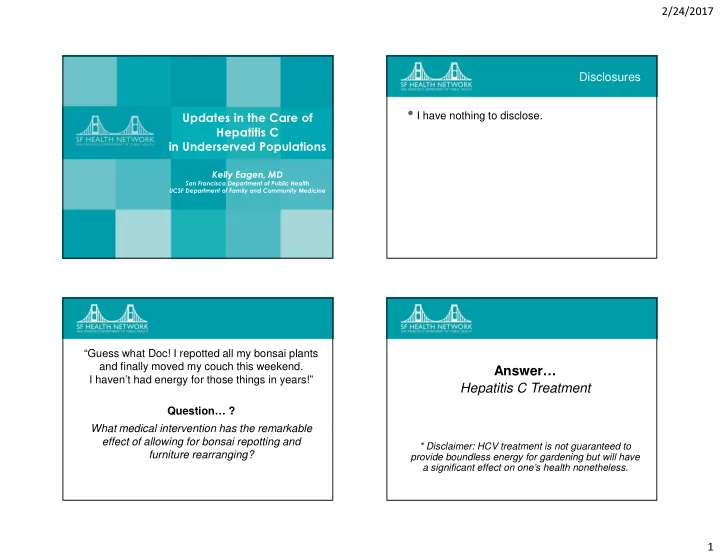
2/24/2017 Disclosures I have nothing to disclose. Updates in the Care of Hepatitis C in Underserved Populations Kelly Eagen, MD San Francisco Department of Public Health UCSF Department of Family and Community Medicine Title Subtitle 1


slide-1
SLIDE 1

2/24/2017 1

Subtitle

Title

1

Updates in the Care of Hepatitis C in Underserved Populations

Kelly Eagen, MD

San Francisco Department of Public Health UCSF Department of Family and Community Medicine

Disclosures

  • I have nothing to disclose.

“Guess what Doc! I repotted all my bonsai plants and finally moved my couch this weekend. I haven’t had energy for those things in years!” Question… ? What medical intervention has the remarkable effect of allowing for bonsai repotting and furniture rearranging?

Answer… Hepatitis C Treatment

* Disclaimer: HCV treatment is not guaranteed to provide boundless energy for gardening but will have a significant effect on one’s health nonetheless.

slide-2
SLIDE 2

2/24/2017 2 Joy in Practice Pearl… Adding Hepatitis C Treatment to your practice as a caregiver for underserved and vulnerable populations will bring joy to your practice.

Objectives

To review:

  • The impact of HCV on vulnerable and underserved

populations

  • The evidence supporting the benefits of HCV cure
  • The elements of primary care-based HCV treatment
  • Current HCV treatments
  • Effective care delivery in marginalized populations

HCV in vulnerable populations

  • NHANES estimate
  • 2.7 million cases with HCV viremia in the US
  • May be a gross underestimate due to exclusion of

underserved populations:

  • More realistic estimate > 4.6 million cases
  • Disproportionate impact on vulnerable populations
  • HIV infected: ~ 25-30% HCV co-infection (in the US)
  • Past/present injection drug use: ~ 50-90%
  • Homeless: ~ 7.5-50%

NHANES, CDC 2014, Edlin Hepatology 2015

HCV Cascade of Care 2000-2013

Yehia PLOS One 2014

Ensure our patients are tested (and retested)

Prevent reinfection

slide-3
SLIDE 3

2/24/2017 3 Meet Mr. Jones

  • 42 yo male, tested HCV Ab+ in jail a few years ago
  • PMHx: HTN, DM, depression, opioid dependence
  • Meds: benazepril, metformin, sertraline, methadone maintenance (NKDA)
  • Social Hx:
  • Active injection heroin use
  • Alcohol - few beers/day, binge drinks on occasion
  • Sexually active with men
  • Lives in SRO

“Nice to meet you doc. I’m a less-is-more-kinda-guy and don’t need much but I figured I should get a doctor because it’s time to do something about this hepatitis before it gets the best of me. A guy I know at methadone clinic is on that drug from TV and he feels like a million bucks. Do you think I can be treated?”

Assessing Treatment Readiness

Sample Checklist:

Patient wants hepatitis C treatment. Patient generally keeps scheduled medical appointments. Patient has a reasonably stable social situation. Patient takes currently prescribed medications, and has relatively good control over

  • ther chronic diseases (HIV, HTN, diabetes, etc).

Patient can articulate a plan to avoid hepatitis C reinfection after treatment. Clinic/pharmacy staff can contact patient by phone or have another reliable way to reach

  • patient. Consider case managers, family/friends or other support people.

If patient has active substance use and/or mental health issues, these conditions are

relatively stable and do not prohibit engagement in general medical care.

Liver toxins (i.e. alcohol, high-dose acetaminophen) are minimized, and ideally eliminated.

Additional Work-Up

  • Confirm infection with HCV RNA (if HCV Ab positive)
  • Check HCV Genotype
  • Screen for HAV, HBV, HIV (vaccinate if indicated)
  • Perform fibrosis assessment :
  • Serum calculations (APRI or FIB4)
  • Imaging (ultrasound)
  • Biomarker test: Fibrosure ($$$)
  • Degree of fibrosis dictates:
  • Decision to screen for HCC and varices
  • Choice and duration of therapy
  • Treatment response
  • GT can impact disease progression
  • GT 3: associated with steatohepatitis
  • Impacts selection and response to therapy
  • Easiest to Cure: 2 > 4 ≥ 1 (1b > 1a) > 3
  • GT 1: most common in US (70%

HCV Genotype

slide-4
SLIDE 4

2/24/2017 4

  • Mr. Jones (cont)
  • HCV RNA: 3,000,000 IU/ml
  • Genotype 1b
  • APRI= 0.4 (does not suggest advanced fibrosis)
  • AST 35/ALT 33, Platelets 210, Alb 3.9, INR 1.1
  • HIV negative
  • HAV/HBV immune
  • Ultrasound: no evidence of cirrhosis

For the audience..

Would you offer HCV treatment to this marginally housed non-cirrhotic patient with active substance use? a) No, I would not treat until evidence of advanced fibrosis or frank cirrhosis as no benefit now b) No, I am worried about reinfection c) Yes, I would pursue treatment now if he is motivated to be treated d) Yes, but only if he demonstrates 6 months of sobriety

www.hcvguidelines.org

High Priority

  • Advanced fibrosis or compensated cirrhosis
  • Cryoglobulinemia with end organ manifestations
  • Renal complications of HCV infection
  • HIV or HBV coinfection
  • Other liver disease (eg. NASH)
  • Insulin resistance
  • Debilitating fatigue resultant from HCV
  • High transmission risk (includes IDU, MSM, vertical

transmission) (Patients who ASK about treatment are excellent candidates!)

slide-5
SLIDE 5

2/24/2017 5 Benefits of HCV Cure

  • Hepatic:
  • Reduce hepatic decompensation, liver transplant and HCC
  • Avert FUTURE liver disease complication in those with LESS fibrosis
  • Non-Hepatic:
  • Renal disease (Chen 2014)
  • Lymphoproliferative disease (Feld 2013)
  • Insulin resistance
  • Vascular disease (CAD & CVA) (Maria

2014)

  • Cognitive impairment
  • Bone Disease & Fracture (Lo Re 2014)
  • Skin disease including porphyria cutanea tarda

HCV cure reduces all cause mortality

HCV treatment as prevention

Kabiri AIM 2014 Aug 5;161(3):170-80

Base Case:

  • Risk based & Baby

boomer screening

  • Treatment with DAA

Ideal

  • Universal Screening
  • Treatment capacity

unlimited

Active Substance Users

Despite substantial drug use during treatment, 96.5% of patients missed ≤ 3 doses during 12 weeks.

Dore AASLD 2015, AIM 2016

REINFECTION:

  • 6 reinfections through week 24
  • 4.6 reinfections/100py

Treating PWID

Martin Hepatology 2013, Martin 2013

More effective when paired with opioid substitution therapy and syringe exchange

slide-6
SLIDE 6

2/24/2017 6 What about alcohol?

  • Alcohol and HCV are negatively synergistic
  • Data support successful interferon-based HCV treatment

in active drinkers

  • Pearl: Successful HCV cure can be a springboard for
  • ther positive health changes.

Counsel regarding alcohol reduction but don’t withhold treatment due to alcohol use alone.

What about the COST?!?

  • Current oral medications remain

extraordinarily expensive

  • Despite the cost, many models find

universal HCV treatment cost effective

  • Cost effective ≠ cheap

Chalal JAMA 2016

Drug procurement

  • Limited access to expensive HCV drugs has

impacted direct acting agents (DAAs)

  • Progress towards improved access
  • Medi-Cal (7/2015): Expanded access to include ≥F2,

those at risk for transmission, HIV co-infection, insulin resistance, and more

  • Worldwide: scale up of generic production
  • Continued advocacy for lower pricing
  • New agents brings some competitive pricing
slide-7
SLIDE 7

2/24/2017 7 Patient Assistance Programs

  • Uninsured patients with low income qualify for

Patient Assistance Programs.

  • Choose a regimen.
  • Contact the appropriate PAP to obtain HCV

medications.

  • Underinsured coverage under PAP varies (by

pharmaceutical company) but can be an

  • ption.

The HCV Arsenal & Principals of therapy

Direct Acting Agents (DAA)

NS5b Inhibitors

Target viral RNA polymerase “-buvir” NS5b Nucleotide Sofosbuvir NS5b Non-nucleotide Dasabuvir

NS5a Inhibitors

Target viral assembly and release “-asvir” Ledipasvir Velpatasvir Ombitasvir Daclatasvir Elbasvir

Protease Inhibitors

Target viral protease “-previr” Simeprevir Paritaprevir Grazoprevir

“P”= Previr “B”= Buvir “A”= Asvir

>90-95% cure rate for most patients

slide-8
SLIDE 8

2/24/2017 8 Current DAA combinations

  • NS5b Nucleotide based therapy
  • Triple therapy without a NS5b Nuke

SOFOSBUVIR NS5a Ribavirin

NS5b Nuke Backbone

One drug from 2nd class

Protease inhibitor

NS5a NS5b Non-Nuke

Protease inhibitor

  • HCV protease inhibitor + NS5a

Protease inhibitor

NS5a

Current DAA combinations

  • NS5b Nucleotide based therapy
  • Triple therapy without a NS5b Nuke

SOFOSBUVIR NS5a Ribavirin

NS5b Nuke Backbone

One drug from 2nd class

Protease inhibitor

NS5a NS5b Non-Nuke

Protease inhibitor

  • HCV protease inhibitor + NS5a

Protease inhibitor

NS5a Sofosbuvir +Ledipasivir

Current DAA combinations

  • NS5b Nucleotide based therapy
  • Triple therapy without a NS5b Nuke

SOFOSBUVIR NS5a Ribavirin

NS5b Nuke Backbone

One drug from 2nd class

Protease inhibitor

NS5a NS5b Non-Nuke

Protease inhibitor

  • HCV protease inhibitor + NS5a

Protease inhibitor

NS5a Sofosbuvir +Velpatasvir

pangenotypic

Current DAA combinations

  • NS5b Nucleotide based therapy
  • Triple therapy without a NS5b Nuke

SOFOSBUVIR NS5a Ribavirin

NS5b Nuke Backbone

One drug from 2nd class

Protease inhibitor

NS5a NS5b Non-Nuke

Protease inhibitor

  • HCV protease inhibitor + NS5a

Protease inhibitor

NS5a Sofosbuvir +Daclatasvir

slide-9
SLIDE 9

2/24/2017 9 Current DAA combinations

  • NS5b Nucleotide based therapy
  • Triple therapy without a NS5b Nuke

SOFOSBUVIR NS5a Ribavirin

NS5b Nuke Backbone

One drug from 2nd class

Protease inhibitor

NS5a NS5b Non-Nuke

Protease inhibitor

  • HCV protease inhibitor + NS5a

Protease inhibitor

NS5a

Sofosbuvir+S imeprevir +/- Ribavirin

Rarely used anymore…

Current DAA combinations

  • NS5b Nucleotide based therapy
  • Triple therapy without a NS5b Nuke

SOFOSBUVIR NS5a Ribavirin

NS5b Nuke Backbone

One drug from 2nd class

Protease inhibitor

NS5a NS5b Non-Nuke

Protease inhibitor

  • HCV protease inhibitor + NS5a

Protease inhibitor

NS5a

Sofosbuvir+R ibavirin Increasingly 2nd line

Current DAA combinations

  • NS5b Nucleotide based therapy
  • Triple therapy without a NS5b Nuke

SOFOSBUVIR NS5a Ribavirin

NS5b Nuke Backbone

One drug from 2nd class

Protease inhibitor

NS5a NS5b Non-Nuke

Protease inhibitor

  • HCV protease inhibitor + NS5a

Protease inhibitor

NS5a

“PrOD”: Pariteprevir/

  • mbitasvir/

ritonavir, dasabuvir +/- Ribavirin

Current DAA combinations

  • NS5b Nucleotide based therapy
  • Triple therapy without a NS5b Nuke

SOFOSBUVIR NS5a Ribavirin

NS5b Nuke Backbone

One drug from 2nd class

Protease inhibitor

NS5a NS5b Non-Nuke

Protease inhibitor

  • HCV protease inhibitor + NS5a

Protease inhibitor

NS5a

Grazoprevir + Elbasvir

  • GT 1,4,6
  • Use in renal failure
slide-10
SLIDE 10

2/24/2017 10

  • Mr. Jones (cont)
  • Mono-infected
  • Genotype 1b, treatment naïve
  • No evidence of advanced fibrosis
  • HCV VL 3,000,000 IU/mL
  • Engaged patient ready for treatment
  • Priority candidate based on:
  • Impaired glucose metabolism
  • Active injection drug use
  • Well controlled diabetes & HTN
  • HAV & HBV Immune

A word about HBV

  • In Oct 2016, FDA added black box warning to warn of

HBV reactivation in pts with current or prior HBV infection on HCV DAAs

  • 24 cases reported, serologies varied
  • Always screen and vaccinate for HBV prior to treatment.
  • If HBV infected, treat HBV before starting HCV treatment.
  • If HBV core Ab +, monitor closely and have low threshold

to consider HBV reactivation if s/s of acute hepatitis develop.

  • Consider treatment by or in consultation with specialist.

Regimen Selection

  • Consult your resources:
  • AASLD guidelines (www.HCVguidelines.org)
  • Specialist (Hepatology, Infectious Disease)
  • Project ECHO
  • A friendly and skilled colleague ☺
  • University of Liverpool (http://www.hep-druginteractions.org)
  • Familiarize yourself with insurance formularies
  • If you do not know what is covered, prescribe what the guidelines recommend.

Insurance will let you know if another agent is preferred…

What factors determine the regimen?

  • HCV genotype (1-6)
  • Stage of liver disease
  • No cirrhosis
  • Compensated cirrhosis (child-pugh A)
  • Decompensated cirrhosis (child-pugh B or C)
  • Prior treatment history
  • Treatment failure (null responder at 12 weeks or relapse after

completed treatment)

  • Treatment intolerance (stopped 2/2 side effects)
  • Other medications
  • Renal disease (CrCl <30)
slide-11
SLIDE 11

2/24/2017 11

  • Mr. Jones (cont)
  • Regimen:
  • Daily fixed-dose combination of elbasvir/grazoprevir for 12
  • weeks. (Rating: Class 1, Grade A)
  • Less costly alternative: Daily fixed-dose combination of

sofosbuvir/ledipasvir for 8 weeks.

  • GT1, monoinfected, treatment naïve, not African American, non-cirrhotic

may be candidates for shortened duration of therapy to 8 (vs 12) weeks.

  • Send sofosbuvir/ledipasvir x 8 weeks to specialty pharmacy.
  • Ask a team member to help obtain the meds and support

the patient through treatment.

Obtaining Medications Support Specialty Pharmacy Insurance Companies Patient Assistance Programs AASLD/IDSA Guidelines Provider Provider Provider Specialist Consult Education and adherence support

A Model for HCV Treatment Why Primary Care-based HCV Treatment?

  • Patient-centered
  • Feasible & safe
  • Efficient
  • Satisfying (to staff and patients alike)
  • Increases access for vulnerable populations
  • In the SFHN, primary care providers are skilled at caring for

people who use drugs.

  • Allows for treatment of HCV in conjunction with opioid

replacement services (ie. buprenorphine)

Primary care-based treatment

Patients more appropriate for treatment by specialist may include:

  • History of decompensated liver disease or Childs Pugh score B/C
  • Cirrhosis with complex medical history
  • Chronic renal dysfunction stage 4 or 5 (CrCl < 30 mL/min)
  • Hepatocellular carcinoma
  • Chronic HBV
  • Prior failed treatment for HCV with direct acting antivirals
slide-12
SLIDE 12

2/24/2017 12 Individualizing treatment

  • Co-administer with other meds
  • ie. At methadone clinic or primary care (Q1-2 weeks)
  • Use navigators / peer support
  • Provide adherence coaching & check-ins
  • Pharmacy
  • Clinic staff
  • Text messaging
  • Support groups
  • Consider clinical trials
  • Monetary incentives
  • Structured monitoring

Back to Mr. Jones

  • LDV/SOF x 8 weeks approved.
  • You work with his methadone counselor to co-

administer HCV treatment with methadone.

  • Week 4 lab check:
  • At week 4, HCV RNA is < lower limit of detection
  • Continue with adherence support in methadone clinic
  • 12 weeks after completing treatment
  • SVR12 = undetectable Cured!

Post-cure counseling

  • HCV Ab may remain positive for life
  • Screen for reinfection with HCV RNA
  • Counsel about reinfection
  • Substance use: shared needles, cookers, straws
  • Sexual contact
  • Highest rates of transmission reported in HIV+ MSM but occurs in HIV- too
  • If cirrhosis is present, continue hepatocellular cancer

screening Q6-12 mos. Pearl: If comfortable, share one’s experience with treatment to reverse stigma and misinformation about HCV treatment.

Conclusions

  • We have the tools to cure HCV in the majority of patients.
  • HCV treatment is well tolerated and highly effective.
  • Vulnerable populations can benefit enormously from HCV cure.

Individualized treatment plans to provide extra support in the context of homelessness, substance use, mental illness, financial barriers and similar to help patients achieve success.

  • To realize the tremendous potential of DAAs, we need providers to identify

HCV and evaluate treatment readiness and provide (or refer to) HCV treatment.

  • Primary care-based HCV treatment is patient centered and satisfying for

both patient and staff.

slide-13
SLIDE 13

2/24/2017 13 What’s next? Get outside the 4-wall clinic!

  • Shelters
  • Methadone programs
  • Street Medicine
  • Syringe exchange
  • Mental health clinics
  • Supportive housing
  • Residential treatment

programs

Acknowledgements

Annie Luetkemeyer, Colleen Lynch, Katie Burk, Aaron Smith & all my patients Contact: kelly.eagen@sdfph.org