
SLIDE 1
Hash Proof Systems and Password Protocols
I – Hash Proof Systems
David Pointcheval
CNRS, Ecole normale sup´ erieure/PSL & INRIA
8th BIU Winter School – Key Exchange February 2018
CNRS/ENS/PSL/INRIA David Pointcheval 1/51
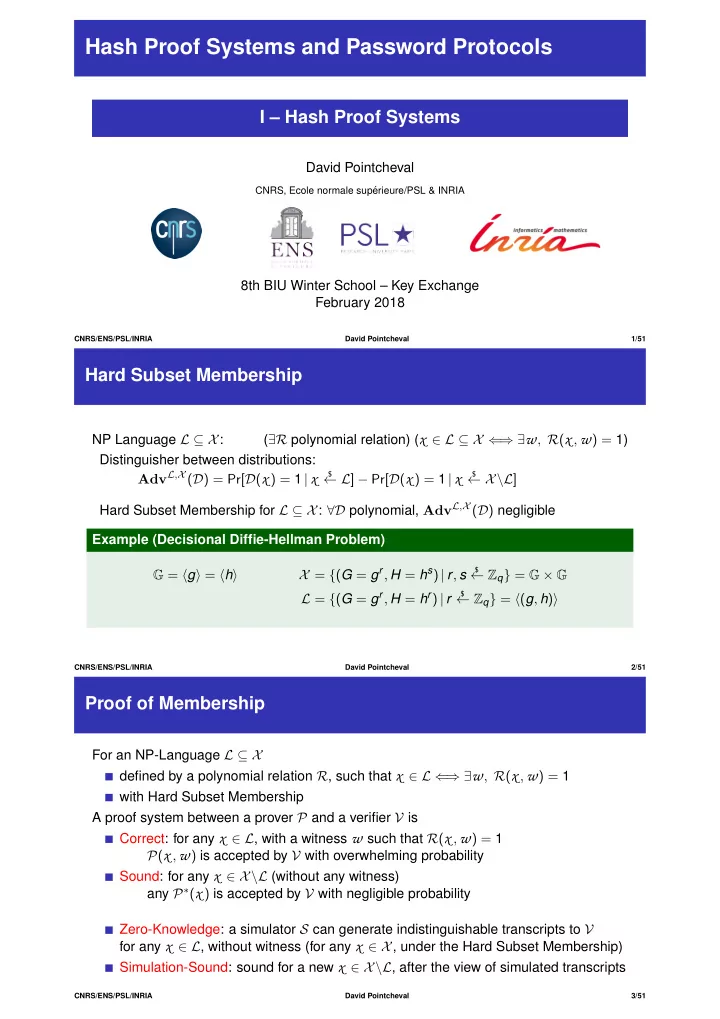
Hard Subset Membership
NP Language L ⊆ X: (∃R polynomial relation) (x ∈ L ⊆ X ⇐ ⇒ ∃w, R(x ,w) = 1) Distinguisher between distributions: AdvL,X (D) = Pr[D(x ) = 1 |x
$
← L] − Pr[D(x ) = 1 |x
$
← X\L] Hard Subset Membership for L ⊆ X: ∀D polynomial, AdvL,X (D) negligible Example (Decisional Diffie-Hellman Problem) G = g = h X = {(G = gr, H = hs) | r, s
$
← Zq} = G × G L = {(G = gr, H = hr) | r
$
← Zq} = (g, h)
CNRS/ENS/PSL/INRIA David Pointcheval 2/51
Proof of Membership
For an NP-Language L ⊆ X defined by a polynomial relation R, such that x ∈ L ⇐ ⇒ ∃w, R(x ,w) = 1 with Hard Subset Membership A proof system between a prover P and a verifier V is Correct: for any x ∈ L, with a witness w such that R(x ,w) = 1 P(x ,w) is accepted by V with overwhelming probability Sound: for any x ∈ X\L (without any witness) any P∗(x ) is accepted by V with negligible probability Zero-Knowledge: a simulator S can generate indistinguishable transcripts to V for any x ∈ L, without witness (for any x ∈ X, under the Hard Subset Membership) Simulation-Sound: sound for a new x ∈ X\L, after the view of simulated transcripts
CNRS/ENS/PSL/INRIA David Pointcheval 3/51