Hash Proof Systems and Password Protocols III SPHF-based PAKE - - PDF document

hash proof systems and password protocols
SMART_READER_LITE
LIVE PREVIEW

Hash Proof Systems and Password Protocols III SPHF-based PAKE - - PDF document

Hash Proof Systems and Password Protocols III SPHF-based PAKE David Pointcheval CNRS, Ecole normale sup erieure/PSL & INRIA 8th BIU Winter School Key Exchange February 2018 CNRS/ENS/PSL/INRIA David Pointcheval 1/53 Intuition


slide-1
SLIDE 1

Hash Proof Systems and Password Protocols

III – SPHF-based PAKE

David Pointcheval

CNRS, Ecole normale sup´ erieure/PSL & INRIA

8th BIU Winter School – Key Exchange February 2018

CNRS/ENS/PSL/INRIA David Pointcheval 1/53

Intuition of PAKE with a Commitment

We denote Lpw the language of the commitments of pw Alice sends CA, a commitment of pwA, to Bob (no leakage: hiding property) Bob can ask to verify that CA ∈ LpwB:

Bob sends hpB to Alice, and computes HA ← Hash(hkB, CA) Alice can compute pHA ← ProjHash(hp, CA,wA)

HA = pHA ⇐ ⇒ pwA = pwB Security: If pwB = pwA, HA is perfectly unpredictable to Alice (smoothness) For a non-trivial language, the commitment must be perfectly binding e.g., ElGamal encryption: CA = (gr, hr × gpwA)

CNRS/ENS/PSL/INRIA David Pointcheval 2/53

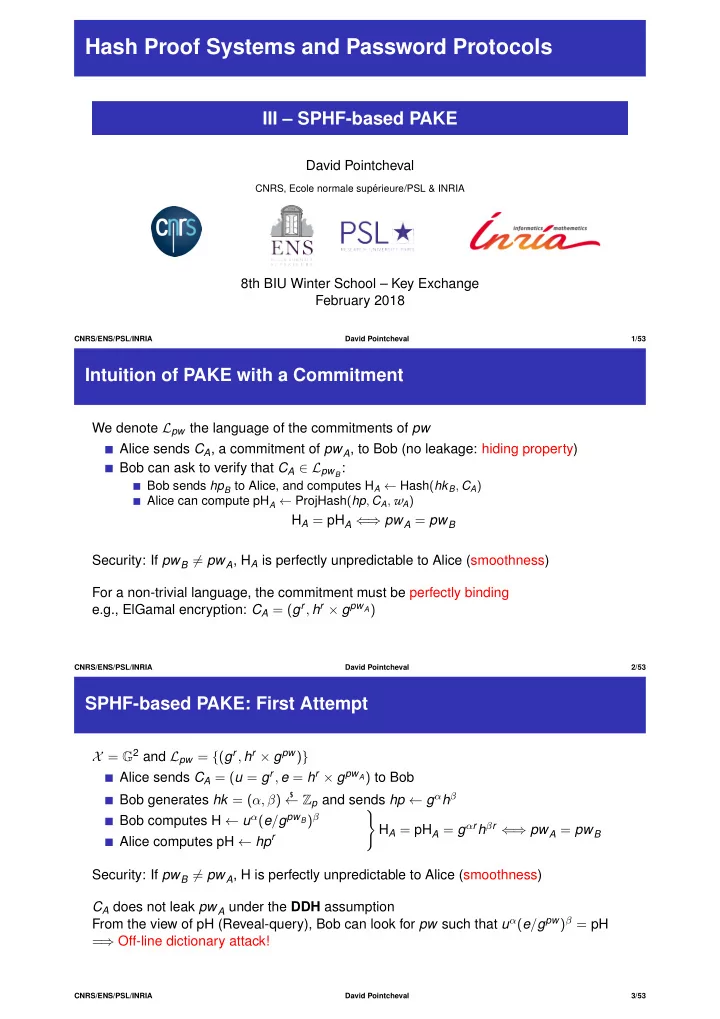
SPHF-based PAKE: First Attempt

X = G2 and Lpw = {(gr, hr × gpw)} Alice sends CA = (u = gr, e = hr × gpwA) to Bob Bob generates hk = (α, β)

$

← Zp and sends hp ← gαhβ Bob computes H ← uα(e/gpwB)β Alice computes pH ← hpr

  • HA = pHA = gαrhβr ⇐

⇒ pwA = pwB Security: If pwB = pwA, H is perfectly unpredictable to Alice (smoothness) CA does not leak pwA under the DDH assumption From the view of pH (Reveal-query), Bob can look for pw such that uα(e/gpw)β = pH = ⇒ Off-line dictionary attack!

CNRS/ENS/PSL/INRIA David Pointcheval 3/53

slide-2
SLIDE 2

SPHF-based PAKE

We denote Lpw the language of the commitments of pw Alice sends CA, a commitment of pwA, to Bob (no leakage: hiding property) Bob can ask to verify that CA ∈ LpwB:

Bob sends hpB to Alice, and computes HA ← Hash(hkB, CA) Alice can compute pHA ← ProjHash(hp, CA,wA)

HA = pHA ⇐ ⇒ pwA = pwB Bob must also prove his knowledge of pwB = pwA before having access to pH Either with an implicit proof

[Gennaro–Lindell – Eurocrypt ’03]

Or with an explicit proof

[Groce-Katz – CCS ’10]

CNRS/ENS/PSL/INRIA David Pointcheval 4/53

Outline

Introduction

1

Game-based Security Gennaro-Lindell PAKE Groce-Katz PAKE Improvements

2

Universal Composability UC-Secure PAKE: Static Corruptions UC-Secure PAKE: Adaptive Corruptions Conclusion

CNRS/ENS/PSL/INRIA David Pointcheval 5/53

Outline

Introduction

1

Game-based Security Gennaro-Lindell PAKE Groce-Katz PAKE Improvements

2

Universal Composability UC-Secure PAKE: Static Corruptions UC-Secure PAKE: Adaptive Corruptions Conclusion

CNRS/ENS/PSL/INRIA David Pointcheval 6/53

slide-3
SLIDE 3

Outline

Introduction

1

Game-based Security Gennaro-Lindell PAKE Groce-Katz PAKE Improvements

2

Universal Composability UC-Secure PAKE: Static Corruptions UC-Secure PAKE: Adaptive Corruptions Conclusion

CNRS/ENS/PSL/INRIA David Pointcheval 7/53

SPHF-based PAKE: Implicit Proof

We denote LA/LB the languages of the commitments of pwA/pwB Alice sends CA, a commitment of pwA, to Bob Bob can ask to verify that CA ∈ LB:

Bob sends hpB to Alice, and computes HA ← HashB(hkB, CA) Alice can compute pHA ← ProjHashA(hpB, CA,wA)

Bob sends CB, a commitment of pwB, to Alice Alice can ask to verify that CB ∈ LA:

Alice sends hpA to Bob, and computes HB ← HashA(hkA, CB) Bob can compute pHB ← ProjHashB(hpA, CB,wB)

Bob computes KB ← HA ⊕ pHB Alice computes KA ← pHA ⊕ HB KB = HA ⊕ pHB = pHA ⊕ HB = KA ⇐ ⇒ pwA = pwB

CNRS/ENS/PSL/INRIA David Pointcheval 8/53

SPHF-based PAKE: Man-In-The-Middle Attack

X = G2 and Lpw = {(gr, hr × gpw)} Alice sends CA = (uA = grA, eA = hrA × gpwA) to Bob Bob generates hkB = (αB, βB)

$

← Zp and sends hpB ← gαBhβB Bob sends CB = (uB = grB, eB = hrB × gpwB) to Alice Alice generates hkA = (αA, βA)

$

← Zp and sends hpA ← gαAhβA Alice computes KA ← uαA

B · (eB/gpwA)βA × hprA B

Bob computes KB ← hprB

A × uαB A · (eA/gpwB)βB

  • KA = KB ⇐

⇒ pwA = pwB The adversary can do a man-in-the-middle attack: forwards everything excepted CB to Alice, that is replaced by C′

B = CB × (g, h)

K ′

A = uαA B gαA · (eB/gpwA)βAhβA × hprA B = KA × gαAhβA = KB × hpA

CNRS/ENS/PSL/INRIA David Pointcheval 9/53

slide-4
SLIDE 4

SPHF-based PAKE: Man-In-The-Middle Attack

From the man-in-the-middle attack: the adversary can ask for a Reveal-query to Alice the adversary can ask for a Test-query to Bob (the session ID’s are different) the adversary can check the relation between the keys to decide on b′ The commitment CB must be non-malleable or confirmed to Bob

CNRS/ENS/PSL/INRIA David Pointcheval 10/53

GL-PAKE

[Gennaro-Lindell – Eurocrypt ’03]

Bob Alice rA

$

← $; CA ← Enc(pwA, rA) CA hkB

$

← HashKG(); hpB ← ProjKG(hkB) HA ← HashB(hkB, CA) rB

$

← $; CB ← Enc′(pwB, rB) hpB, CB pHA ← ProjHashA(hpB, CA, rA) hkA

$

← HashKG(); hpA ← ProjKG(hkA) HB ← HashA(hkA, CB) hpA pHB ← ProjHashB(hpA, CB, rB) KA ← HB × pHA KB ← pHB × HA

Which are the security properties of the encryption schemes ?

CNRS/ENS/PSL/INRIA David Pointcheval 11/53

GL-PAKE: Security Proof

Send-queries to Bob: Oracle-Generated CA with pwA = pwB = pw

Alice rA

$

← $; CA ← Enc(pw, rA) pHA ← ProjHash(hpB, CA, rA) hkA

$

← HashKG(); hpA ← ProjKG(hkA) HB ← Hash(hkA, CB) KA ← HB × pHA Bob CA hpB, CB hpA hkB

$

← HashKG(); hpB ← ProjKG(hkB) HA ← Hash(hkB, CA) /////////////////////////// rB

$

← $; CB ← Enc′(pw, rB) ///////////////////////////////// CB ← Enc′($, $) pHB ← ProjHash(hpA, CB, rB) ///////////////////////////////////// pHB ← HB KB ← pHB × HA //////////////////// KB ← KA

Oracle-generated CA should imply oracle-generated hpA Correctness Oracle-generated hpA should confirm hpB: Correctness IND-CPA

CNRS/ENS/PSL/INRIA David Pointcheval 12/53

slide-5
SLIDE 5

GL-PAKE: Security Proof

Send-queries to Bob: Oracle-Generated CA with pwA = pwB

Alice rA

$

← $; CA ← Enc(pwA, rA) pHA ← ProjHashA(hpB, CA, rA) hkA

$

← HashKG(); hpA ← ProjKG(hkA) HB ← HashA(hkA, CB) KA ← HB × pHA Bob CA hpB, CB hpA hkB

$

← HashKG(); hpB ← ProjKG(hkB) HA ← HashB(hkB, CA) //////////////////////////// rB

$

← $; CB ← Enc′(pw, rB) ///////////////////////////////// CB ← Enc′($, $) pHB ← ProjHashB(hpA, CB, rB) /////////////////////////////////////// KB ← pHB × HA //////////////////// KA ← $

Smoothness IND-CPA

CNRS/ENS/PSL/INRIA David Pointcheval 13/53

GL-PAKE: Security Proof

Send-queries to Bob: Non Oracle-Generated CA

Bob CA hpB, CB hpA Dec(CA) ? = pwB : STOP&WIN hkB

$

← HashKG(); hpB ← ProjKG(hkB) HA ← HashB(hkB, CA) //////////////////////////// rB

$

← $; CB ← Enc′(pw, rB) ///////////////////////////////// CB ← Enc′($, $) pHB ← ProjHashB(hpA, CB, rB) /////////////////////////////////////// KB ← pHB × HA //////////////////// KB ← $

The adversary must encrypt the correct password: password-guessing probability Smoothness IND-CPA

CNRS/ENS/PSL/INRIA David Pointcheval 14/53

GL-PAKE: Security Proof

Send-queries to Alice: Oracle-Generated CB Oracle-Generated CA

Alice hpB, CB rA

$

← $; CA ← Enc(pwA, rA) ////////////////////////////////////// pHA ← ProjHashA(hpB, CA, rA) hkA

$

← HashKG(); hpA ← ProjKG(hkA) //////////////////////////// HB ← HashA(hkA, CB) KA

$

← $ //////////////////// KA ← HB × pHA Bob CA hpA hkB

$

← HashKG(); hpB ← ProjKG(hkB) CB ← Enc′($, $) If pwA = pwB, KB ← KA If pwA = pwB, KB ← $

Non Oracle-Generated CA

Bob CA hpB, CB hpA Dec(CA) ? = pwB : STOP&WIN hkB

$

← HashKG(); hpB ← ProjKG(hkB) CB ← Enc′($, $) KB ← $

Smoothness

CNRS/ENS/PSL/INRIA David Pointcheval 15/53

slide-6
SLIDE 6

GL-PAKE: Security Proof

Send-queries to Alice: Non Oracle-Generated CB

Alice CA hpB, CB hpA rA

$

← $; CA ← Enc(pwA, rA) ////////////////////////////////////// pHA ← ProjHashA(hpB, CA, rA) hkA

$

← HashKG(); hpA ← ProjKG(hkA) Dec′(CB) ? = pwA : STOP&WIN //////////////////////////// HB ← HashA(hkA, CB) KA

$

← $ //////////////////// KA ← HB × pHA

The adversary must encrypt the correct password: password-guessing probability Smoothness

CNRS/ENS/PSL/INRIA David Pointcheval 16/53

GL-PAKE: Security Proof

Oracle-Generated CB Oracle-Generated CA

Alice hpB, CB CA ← Enc($, $) ////////////////////////////////// rA

$

← $; CA ← Enc(pwA, rA) hkA

$

← HashKG(); hpA ← ProjKG(hkA) KA ← $ Bob CA hpA hkB

$

← HashKG(); hpB ← ProjKG(hkB) CB ← Enc′($, $) If pwA = pwB ///////////////// If compatible oracles, KB ← KA If pwA = pwB ///////////////// If incompatible oracles, KB ← $

Non Oracle-Generated CB Non Oracle-Generated CA

Alice hpB, CB CA ← Enc($, $) ////////////////////////////////// rA

$

← $; CA ← Enc(pwA, rA) hkA

$

← HashKG(); hpA ← ProjKG(hkA) Dec′(CB) in P ////////////////////////////////////// Dec′(CB) ? = pwA : STOP&WIN KA ← $ Bob CA hpA Dec(CA) ? = pwB : STOP&WIN ////////////////////////////////////// Dec(CA) in P hkB

$

← HashKG(); hpB ← ProjKG(hkB) CB ← Enc′($, $) KB ← $

IND-CCA + No abort anymore: difference if the guesses are correct

CNRS/ENS/PSL/INRIA David Pointcheval 17/53

GL-PAKE: Security Proof

To be more precise, in the final game The Execute-queries just work as Send-queries with oracle-generated flows The actual passwords are not set at the beginning, but randomly chosen at the end WIN = a random password (with Player ID) is in P: the probability is qS/N Encryption schemes: (Enc, Dec): SPHF-friendly L-IND-CCA encryption scheme ℓ = (A, B, vk) = ⇒ where vk is the verification key of a OT-Signature = ⇒ Labeled Cramer-Shoup Encryption (Enc′, Dec′): SPHF-friendly IND-CPA encryption scheme = ⇒ ElGamal Encryption (CA, hpB, CB, hpA) signed by A: OT-signature (sk, vk) = ⇒ an oracle-generated CA implies the same oracle-generated hpA, and confirms the received (hpB, CB)

CNRS/ENS/PSL/INRIA David Pointcheval 18/53

slide-7
SLIDE 7

Labeled Cramer-Shoup Ciphertext Languages

Cramer-Shoup Encryption Scheme is an L-IND-CCA PKE: C = (u1 = gr

1, u2 = gr 2, e = hrm, v = (cdt)r) with t = H(ℓ, u1, u2, e)

C is a CS ciphertext of pw iff (u1, u2, e/pw, v) is an r-th power of (g1, g2, h, cdt) HashKG() : hk = (α, β, γ, δ)

$

← Z4

q

ProjKG(hk, C) : hp = gα

1 gβ 2 hγ(cdt)δ

Hash(hk, C) : H = uα

1 uβ 2 (e/pw)γvδ

ProjHash(hp, C, r) : pH = hpr This is not a CS-SPHF , hence the GL relaxation

[Gennaro-Lindell – Eurocrypt ’03]

CNRS/ENS/PSL/INRIA David Pointcheval 19/53

GL-PAKE: Complete Protocol

[Gennaro-Lindell – Eurocrypt ’03]

Bob Alice (sk, vk)

$

← SignKG(); ℓ = (A, B, vk) rA

$

← $; CA ← CSℓ(pwA, rA) vk, CA hkB

$

← HashKG(); hpB ← ProjKG(hkB, CA) HA ← HashB(hkB, CA) rB

$

← $; CB ← EG(pwB, rB) hpB, CB pHA ← ProjHashA(hpB, CA, rA) hkA

$

← HashKG(); hpA ← ProjKG(hkA, CB) HB ← HashA(hkA, CB) Σ ← Sign(sk, (CA, hpB, CB, hpA)) hpA, Σ Verif(vk, (CA, hpB, CB, hpA), Σ)? pHB ← ProjHashB(hpA, CB, rB) KA ← HB × pHA KB ← HA × pHB

A key confirmation can be added to the third flow: Explicit Authentication of Alice

CNRS/ENS/PSL/INRIA David Pointcheval 20/53

Outline

Introduction

1

Game-based Security Gennaro-Lindell PAKE Groce-Katz PAKE Improvements

2

Universal Composability UC-Secure PAKE: Static Corruptions UC-Secure PAKE: Adaptive Corruptions Conclusion

CNRS/ENS/PSL/INRIA David Pointcheval 21/53

slide-8
SLIDE 8

SPHF-based PAKE: Explicit Proof

We denote LA/LB the languages of the commitments C of pwA/pwB Alice sends CA, a commitment of pwA with random coins rA, to Bob Bob can ask to verify that CA ∈ LB:

Bob sends hpB to Alice, and computes HA ← HashB(hkB, CA) Alice can compute pHA ← ProjHashA(hp, CA, rA)

Alice parses pHA as r ′

BKA

Bob parses HA as rBKB Bob sends CB, a commitment of pwB with random coins rB, to Alice Alice can recompute the commitment C′

B of pwA with random coins r ′ B

and check whether C′

B ?

= CB For a non-trivial language, the commitment CA must be perfectly binding To avoid false positive on C′

B ?

= CB, the commitment CB must be perfectly binding e.g., Public-Key Encryption Scheme

CNRS/ENS/PSL/INRIA David Pointcheval 22/53

GK-PAKE

[Groce-Katz – CCS ’10]

Bob Alice rA

$

← $; CA ← Enc(pwA, rA) CA hkB

$

← HashKG(); hpB ← ProjKG(hkB) rBKB = HA ← Hash(hkB, CA) CB ← Enc′(pwB, rB) hpB, CB r ′

BKA = pHA ← ProjHash(hpB, CA, rA)

C′

B ← Enc′(pwA, r ′ B)

C′

B ?

= CB

Which are the security properties of the encryption schemes ?

CNRS/ENS/PSL/INRIA David Pointcheval 23/53

GK-PAKE: Security Proof

Send-query to Alice: Oracle-Generated CB with pwB = pwA = pw

Alice rA

$

← $; CA ← Enc(pw, rA) KA ← KB //////////////////////////////////////// r ′

BKA ← ProjHash(hpB, CA, rA)

C′

B ← CB

/////////////////////// C′

B ← Enc′(pw, r ′ B)

OK /////////// C′

B ?

= CB CA hpB, CB Bob hkB

$

← HashKG(); hpB ← ProjKG(hkB) rBKB ← Hash(hkB, CA) CB ← Enc′(pw, rB)

CB must be specific to this execution Oracle-Generated CB must imply Oracle-Generated hpB Correctness

CNRS/ENS/PSL/INRIA David Pointcheval 24/53

slide-9
SLIDE 9

GK-PAKE: Security Proof

Send-query to Alice: Oracle-Generated CB with pwB = pwA

Alice rA

$

← $; CA ← Enc(pwA, rA) ///////////////////////////////////////// r ′

BKA ← ProjHashA(hpB, CA, rA)

///////////////////////// C′

B ← Enc′(pwA, r ′ B)

NOK /////////// C′

B ?

= CB CA hpB, CB Bob hkB

$

← HashKG(); hpB ← ProjKG(hkB) rBKB ← HashB(hkB, CA) CB ← Enc′(pwB, rB)

pwA = pwB = ⇒ C′

B = CB

CNRS/ENS/PSL/INRIA David Pointcheval 25/53

GK-PAKE: Security Proof

Send-query to Alice: Non Oracle-Generated CB

Alice rA

$

← $; CA ← Enc(pwA, rA) ///////////////////////////////////////// r ′

BKA ← ProjHashA(hpB, CA, rA)

Dec′(CB) ? = pwA : STOP&WIN ////////////////////////// C′

B ← Enc′(pwA, r ′ B)

NOK /////////// C′

B ?

= CB CA hpB, CB

CB specific to this execution, and non-malleable The adversary must encrypt the correct password: password-guessing probability Dec′(CB) = pwA = ⇒ C′

B = CB

CNRS/ENS/PSL/INRIA David Pointcheval 26/53

GK-PAKE: Security Proof

Send-query to Alice: Oracle-Generated CB

Alice CA ← Enc($, $) ////////////////////////////////// rA

$

← $; CA ← Enc(pwA, rA) If pwA = pwB, KA ← KB, OK If pwA = pwB, NOK CA hpB, CB Bob hkB

$

← HashKG(); hpB ← ProjKG(hkB) rBKB ← HashB(hkB, CA) CB ← Enc′(pwP, rB)

Send-query to Alice: Non Oracle-Generated CB

Alice CA ← Enc($, $) ////////////////////////////////// rA

$

← $; CA ← Enc(pwA, rA) Dec′(CB) ? = pwA : STOP&WIN NOK CA hpB, CB

IND-CPA

CNRS/ENS/PSL/INRIA David Pointcheval 27/53

slide-10
SLIDE 10

GK-PAKE: Security Proof

Send-query to Bob: Oracle-Generated CA

Alice CA ← Enc($, $) If pwA = pwB, KA ← KB, OK If pwA = pwB, NOK CA hpB, CB Bob hkB

$

← HashKG(); hpB ← ProjKG(hkB) rBKB ← HashB(hkB, CA) //////////////////////////////// KB

$

← $ CB ← Enc′(pwB, rB) ///////////////////////// CB ← Enc′($, $)

Correctness + IND-CCA

CNRS/ENS/PSL/INRIA David Pointcheval 28/53

GK-PAKE: Security Proof

Send-query to Bob: Non Oracle-Generated CA

CA hpB, CB Bob hkB

$

← HashKG(); hpB ← ProjKG(hkB) Dec(CA) ? = pwB : STOP&WIN rBKB ← HashB(hkB, CA) //////////////////////////////// KB

$

← $ CB ← Enc′(pwB, rB) ///////////////////////// CB ← Enc′($, $)

The adversary must encrypt the correct password: password-guessing probability Smoothness + IND-CCA

CNRS/ENS/PSL/INRIA David Pointcheval 29/53

GK-PAKE: Security Proof

Oracle-Generated CB Oracle-Generated CA

Alice CA ← Enc($, $) If compatible oracles ///////////////// If pwA = pwB, KA ← KB, OK If incompatible oracles ///////////////// If pwA = pwB, NOK hpB, CB CA Bob hkB

$

← HashKG(); hpB ← ProjKG(hkB) KB

$

← $ CB ← Enc′($, $)

Non Oracle-Generated CB Non Oracle-Generated CA

Alice CA ← Enc($, $) Dec′(CB) in P ////////////////////////////////////// Dec′(CB) ? = pwA : STOP&WIN NOK hpB, CB CA Bob hkB

$

← HashKG(); hpB ← ProjKG(hkB) Dec(CA) ? = pwB : STOP&WIN ////////////////////////////////////// Dec(CA) in P KB

$

← $ CB ← Enc′($, $)

No abort anymore: difference if the guesses are correct

CNRS/ENS/PSL/INRIA David Pointcheval 30/53

slide-11
SLIDE 11

GK-PAKE: Security Proof

To be more precise, in the final game The Execute-queries just work as Send-queries with oracle-generated flows The actual passwords are not set at the beginning, but randomly chosen at the end WIN = a random password (with Player ID) is in P: the probability is qS/N Encryption schemes: (Enc, Dec): SPHF-friendly IND-CPA encryption scheme = ⇒ ElGamal Encryption (Enc′, Dec′): L-IND-CCA encryption scheme: ℓ′ = (A, B, CA, hpB) = ⇒ this makes CB specific to this execution because of CA = ⇒ an oracle-generated CB implies the same oracle-generated hpB = ⇒ Labeled Cramer-Shoup Encryption

CNRS/ENS/PSL/INRIA David Pointcheval 31/53

GK-PAKE

[Groce-Katz – CCS ’10]

Alice generates and sends CA = (u ← grA, e ← hrAgpwA) ∈ G2 Bob

generates hkB = (α, β) and hpB = gαhβ computes rBKB = KDF(uα · (e/gpwB)β) generates CB = (u1 = grB

1 , u2 = grB 2 , e = hrBgpwB, v = (cdt)rB),

with t = H(A, B, CA, hpB, u1, u2, e) sends (hpB, CB) ∈ G5

Alice

computes r ′

BKA = KDF(hprA B )

generates C′

B = (u′ 1 = gr ′

B

1 , u′ 2 = gr ′

B

2 , e = hr ′

BgpwA, v′ = (cdt′)r ′ B,

with t′ = H(A, B, CA, hpB, u′

1, u′ 2, e′)

aborts if C′

B = CB

A key confirmation can be added to the second flow: Explicit Authentication of Bob

CNRS/ENS/PSL/INRIA David Pointcheval 32/53

Outline

Introduction

1

Game-based Security Gennaro-Lindell PAKE Groce-Katz PAKE Improvements

2

Universal Composability UC-Secure PAKE: Static Corruptions UC-Secure PAKE: Adaptive Corruptions Conclusion

CNRS/ENS/PSL/INRIA David Pointcheval 33/53

slide-12
SLIDE 12

Better Efficiency

IND-PCA Security proofs: WIN = a random password (with Player ID) is in P One either decrypts every C into pw and checks whether pw ∈ P or not = ⇒ need of decryption oracle Or one checks for every pw ∈ P whether C encrypts pw for some ciphertext C = ⇒ need of plaintext-checking oracle The previous proofs work for IND-PCA encryption schemes, instead of IND-CCA KV-SPHF Number of flows in GL-PAKE: 3 flows because hp depends on/after x With hp possibly sent before x : 1-round protocol with KV-SPHF

CNRS/ENS/PSL/INRIA David Pointcheval 34/53

IND-PCA Encryption from KEM

KeyGen() : (sk, pk)

$

← EncapsKG() hk

$

← HashKG(), hp ← ProjKG(hk) sk′ = (sk, hk), pk′ = (pk, hp) Enc(pk′ = (pk, hp), m) : (K, c)

$

← Encaps(pk, r), e ← m + K

x = (K, c),w = r

t = H(c, e), v = ProjHash(hp,x , t,w) C = (c, e, v) Dec(sk′ = (sk, hk), C = (c, e, v)) : K ← Decaps(sk, c), m ← e − K

x = (K, c), t ← H(c, e), v′ ← Hash(hk,x , t)

If (v′ = v) = ⇒ Reject Else Return m

CNRS/ENS/PSL/INRIA David Pointcheval 35/53

IND-PCA Security Proof

(sk, pk) ← EncapsKG(), hk

$

← HashKG(), hp ← ProjKG(hk) pk′ = (pk, hp) m0, m1 ∈ G m0, m1 b

$

← {0, 1}

x = (K, c)

$

← Encaps(pk,w) ////////////////////////////////////

x = ($, c), (K, c)

$

← Encaps(pk, $) e ← K + mb //////////////// e

$

← G t = H(c, e); v ← ProjHash(hp,x , t,w) //////////////////////////////// v ← Hash(hk,x , t) C ← (c, e, v) C b′ ∈ {0, 1} b′ b′ ? = b

PCA(sk′, m′, C′) : K ′ ← Decaps(sk, c′), m′′ ← e′ − K ′ /////////////////////////////////////////////

sk′ = (sk, hk)

/////////////

sk′ = (hk) x ′ ← (e′ − m′, c′), t′ ← H(c′, e′)

C′ = C = ⇒ (x ′, t′) = (x , t)

C′ = (c′, e′, v′)

v′′ ← Hash(hk,x ′, t′) v′′ = v′ or m′′ = m′ /////////////// = ⇒ Reject Smoothness (soundness): v′′ = v′ = ⇒ e′ − m′ valid key = ⇒ m′ valid plaintext + 2-Universal Smoothness (simulation-soundness) Correctness + Indistinguishability/Hard Subset Membership = ⇒ Pr[b′ = b] = 1

2

CNRS/ENS/PSL/INRIA David Pointcheval 36/53

slide-13
SLIDE 13

SCS: Short Cramer-Shoup

[Abdalla-Benhamouda-P. – PKC ’15]

KeyGen() : sk = (s, hk1 = (x1, x2), hk2 = (y1, y2))

$

← Z5

q

pk = (g2 ← gs

1, hp1 ← gx1 1 gx2 2 , hp2 ← gy1 1 gy2 2 )

Enc(pk, m) : r

$

← Zq; u = gr

1, e ← gr 2 × m

v = (hp1 × hp2

t)r, with t ← H(u, e)

Dec(sk, (u, e, v)) : m = e/us, v

?

= ux1+tx2 × (e/m)x2+ty2, with t ← H(u, e) Theorem (IND-PCA Security) This SCS encryption scheme is IND-PCA under the DDH assumption

CNRS/ENS/PSL/INRIA David Pointcheval 37/53

GK-SPOKE (Simple Password-Only Key Exchange)

[Abdalla-Benhamouda-P. – PKC ’15]

Alice generates and sends CA = (u ← grA, e ← hrAgpwA) ∈ G2 Bob

generates hkB = (α, β) and hpB = gαhβ computes rBKB = KDF(uα · (e/gpwB)β) generates CB = (u = grB

1 , e = grB 2 gpwB, v = (cdt)rB),

with t = H(A, B, CA, hpB, u, e) sends (hpB, CB) ∈ G4

Alice

computes r ′

BKA = KDF(hprA B )

generates C′

B = (u′ = gr ′

B

1 , e′ = gr ′

B

2 gpwA, v′ = (cdt′)r ′

B,

with t′ = H(A, B, CA, hpB, u′, e′) aborts if C′

B = CB

Instead of 7 group elements, only 6 group elements with a 2-flow protocol

CNRS/ENS/PSL/INRIA David Pointcheval 38/53

GL-PAKE: Reminder of the Idea

[Gennaro-Lindell – Eurocrypt ’03]

Alice Alice sends CA, a commitment of pwA, to Bob Bob can ask to verify that CA ∈ LB (language of commitments of pwB):

Bob sends hpB to Alice, and computes HA ← HashB(hkB, CA) Alice can compute pHA ← ProjHashA(hpB, CA,wA)

Bob Bob sends CB, a commitment of pwB, to Alice Alice can ask to verify that CB ∈ LA (language of commitments of pwA):

Alice sends hpA to Bob, and computes HB ← HashA(hkA, CB) Bob can compute pHB ← ProjHashB(hpA, CB,wB)

KB = HA ⊕ pHB = pHA ⊕ HB = KA ⇐ ⇒ pwA = pwB

CNRS/ENS/PSL/INRIA David Pointcheval 39/53

slide-14
SLIDE 14

KV-PAKE: Katz-Vaikuntanathan’s Idea

[Katz-Vaikuntanathan – TCC ’11]

Both are sent in parallel: Alice sends CA, hpA to Bob Bob sends CB, hpB to Alice Upon reception of the partner’s flow: Alice computes pHA ← ProjHashA(hpB, CA,wA) and HB ← HashA(hkA, CB) Bob computes pHB ← ProjHashB(hpA, CB,wB) and HA ← HashB(hkB, CA) Then KB = HA ⊕ pHB = pHA ⊕ HB = KA

CNRS/ENS/PSL/INRIA David Pointcheval 40/53

KV Smoothness

[Katz-Vaikuntanathan – TCC ’11]

KV-Smoothness ∀f → X\L, with the probability space hk

$

← HashKG(), hp ← ProjKG(hk) {(hp, H) | H ← Hash(hk, f(hp))} ≈ {(hp, H) | H

$

← Π} Given hp, no adversary can find x ∈ X\L for which it can distinguish Hash(hk,x ) KV-SPHF for SCS Ciphertexts of m

[Abdalla-Benhamouda-P. – PKC ’15]

c = (u = gr, e = hrm, v = (cdt)r) with t = H(u, e) hk = (α, β, γ, δ) hp = (hp1 ← gαhγcδ, hp2 ← gβdδ) Hash(hk, c) = uα+tβ(e/m)γvδ = (hp1hpt

2)r = ProjHash(hp, c, r)

CNRS/ENS/PSL/INRIA David Pointcheval 41/53

KV-SPOKE (Simple Password-Only Key Exchange)

[Abdalla-Benhamouda-P. – PKC ’15]

Alice generates

hkA = (α, β, γ, δ) and hpA = (hp1 ← gαhγcδ, hp2 ← gβdδ) CA = (u ← grA, e ← hrAgpwA, v ← (cdtA)rA) for tA = H(A, B, u, e, hpA)

Alice sends CA ∈ G3 and hpA ∈ G2 Alice receives CB = (u′, e′, v′) ∈ G3 and hpB = (hp′

1, hp′ 2) ∈ G2 from Bob

Alice computes

tB = H(B, A, u′, e′, hpB) HB = u′α+tBβ(e′/pwA)γv′δ pHA = (hp′

1hp′ 2 tA)rA

KA = pHA × HB

Only 5 group elements sent by each player in a 2-simultaneously flow protocol

CNRS/ENS/PSL/INRIA David Pointcheval 42/53

slide-15
SLIDE 15

Outline

Introduction

1

Game-based Security Gennaro-Lindell PAKE Groce-Katz PAKE Improvements

2

Universal Composability UC-Secure PAKE: Static Corruptions UC-Secure PAKE: Adaptive Corruptions Conclusion

CNRS/ENS/PSL/INRIA David Pointcheval 43/53

Outline

Introduction

1

Game-based Security Gennaro-Lindell PAKE Groce-Katz PAKE Improvements

2

Universal Composability UC-Secure PAKE: Static Corruptions UC-Secure PAKE: Adaptive Corruptions Conclusion

CNRS/ENS/PSL/INRIA David Pointcheval 44/53

SPHF-Based PAKE: Protocol

Bob Alice hkA

$

← HashKG(); hpA ← ProjKG(hkA) ℓA = (A, B, hpA), rA

$

← $, CA ← EncℓA(pwA, rA) hpA, CA hkB

$

← HashKG(); hpB ← ProjKG(hkB) ℓB = (B, A, hpB), rB

$

← $; CB ← Encℓ′(pwB, rB) hpB, CB HB ← HashA(hkA, CB) HA ← HashB(hkB, CA) pHA ← ProjHashA(hpB, CA, rA) pHB ← ProjHashB(hpA, CB, rB) KA ← HB × pHA KB ← HA × pHB

UC-secure against static corruptions

CNRS/ENS/PSL/INRIA David Pointcheval 45/53

slide-16
SLIDE 16

SPHF-Based PAKE: Simulation

Bob Alice hkA

$

← HashKG(); hpA ← ProjKG(hkA) ℓA = (A, B, hpA), rA

$

← $, CA ← EncℓA(pwA, rA) hpA, CA hkB

$

← HashKG(); hpB ← ProjKG(hkB) ℓB = (B, A, hpB), rB

$

← $; CB ← Encℓ′(pwB, rB) hpB, CB HB ← HashA(hkA, CB) HA ← HashB(hkB, CA) pHA ← ProjHashA(hpB, CA, rA) pHB ← ProjHashB(hpA, CB, rB) KA ← HB × pHA KB ← HA × pHB

NewSession: for U with U′ hk

$

← HashKG(); hp ← ProjKG(hk) ℓ = (U, U′, hp), r

$

← $, C ← Encℓ(pw, r) Flow hp′, C′ Oracle-Generated from U′: hk′, hp′ ← ProjKG(hk′), C′ ← Encℓ′(pw′, r ′)

H ← Hash(hk, C′) pH ← ProjHash(hp′, C, r) //////////////////////////////// pH ← Hash(hk′, C) K ← H × pH

Non Oracle-Generated: pw′ ← Decℓ′(C′) and TestPwd(pw′)

H ← Hash(hk, C′) /////////////////////// H

$

← $ if incorrect guess pH ← ProjHash(hp′, C, r) K ← H × pH //////////////// K

$

← $ if incorrect guess

Passwords known for corrupted players

CNRS/ENS/PSL/INRIA David Pointcheval 46/53

SPHF-Based PAKE: Simulation

Bob Alice hkA

$

← HashKG(); hpA ← ProjKG(hkA) ℓA = (A, B, hpA), rA

$

← $, CA ← EncℓA(pwA, rA) hpA, CA hkB

$

← HashKG(); hpB ← ProjKG(hkB) ℓB = (B, A, hpB), rB

$

← $; CB ← Encℓ′(pwB, rB) hpB, CB HB ← HashA(hkA, CB) HA ← HashB(hkB, CA) pHA ← ProjHashA(hpB, CA, rA) pHB ← ProjHashB(hpA, CB, rB) KA ← HB × pHA KB ← HA × pHB

Passwords known for corrupted players NewSession: for U with U′

hk

$

← HashKG(); hp ← ProjKG(hk) ℓ = (U, U′, hp), r

$

← $, C ← Encℓ(pw, r) ////////////////////////////// C ← Encℓ($, $)

Flow hp′, C′

Oracle-Generated from U′: hk′, hp′ ← ProjKG(hk′), C′ ← Encℓ′(pw′, r ′)

H ← Hash(hk, C′) /////////////////////// H ← $ pH ← Hash(hk′, C) ///////////////////////// pH ← H′, if pw′ = pw; pH

$

← $, if pw′ = pw K ← H × pH //////////////// Same $ as compatible partner, independent $ if incompatible partner

Non Oracle-Generated: pw′ ← Decℓ′(C′) and TestPwd(pw′)

K

$

← $ if incorrect guess / possibly chosen by the adversary otherwise

CNRS/ENS/PSL/INRIA David Pointcheval 47/53

SPHF-Based PAKE: Simulation

Bob Alice hkA

$

← HashKG(); hpA ← ProjKG(hkA) ℓA = (A, B, hpA), rA

$

← $, CA ← EncℓA(pwA, rA) hpA, CA hkB

$

← HashKG(); hpB ← ProjKG(hkB) ℓB = (B, A, hpB), rB

$

← $; CB ← Encℓ′(pwB, rB) hpB, CB HB ← HashA(hkA, CB) HA ← HashB(hkB, CA) pHA ← ProjHashA(hpB, CA, rA) pHB ← ProjHashB(hpA, CB, rB) KA ← HB × pHA KB ← HA × pHB

NewSession: for U with U′

hk

$

← HashKG(); hp ← ProjKG(hk) ℓ = (U, U′, hp), C ← Encℓ($, $)

Flow hp′, C′

Oracle-Generated from U′: hk′, hp′ ← ProjKG(hk′), C′ ← Encℓ′(pw′, r ′)

Same $ as compatible partner, independent $ if incompatible partner ////////////////////////////////////////////////////////////////////////////////////// NewKey

Non Oracle-Generated: pw′ ← Decℓ′(C′) and TestPwd(pw′)

K

$

← $ if incorrect guess / possibly chosen by the adversary otherwise //////////////////////////////////////////////////////////////////////////////////////// NewKey

CNRS/ENS/PSL/INRIA David Pointcheval 48/53
slide-17
SLIDE 17

Outline

Introduction

1

Game-based Security Gennaro-Lindell PAKE Groce-Katz PAKE Improvements

2

Universal Composability UC-Secure PAKE: Static Corruptions UC-Secure PAKE: Adaptive Corruptions Conclusion

CNRS/ENS/PSL/INRIA David Pointcheval 49/53

SPHF-Based PAKE: Protocol

Bob Alice hkA

$

← HashKG(); hpA ← ProjKG(hkA) ℓA = (A, B, hpA), rA

$

← $, CA ← ComℓA(pwA, rA) hpA, CA hkB

$

← HashKG(); hpB ← ProjKG(hkB) ℓB = (B, A, hpB), rB

$

← $; CB ← Comℓ′(pwB, rB) hpB, CB HB ← HashA(hkA, CB) HA ← HashB(hkB, CA) pHA ← ProjHashA(hpB, CA, rA) pHB ← ProjHashB(hpA, CB, rB) KA ← HB × pHA KB ← HA × pHB

With Com = Enc, if r required for ProjHash(hp, C, r): = ⇒ no security against adaptive corruptions Extractable and equivocable commitment (i.e. UC-secure) and SPHF-friendly: = ⇒ security against adaptive corruptions

CNRS/ENS/PSL/INRIA David Pointcheval 50/53

SPHF-Friendly Commitments

Based on Cramer-Shoup (extractability) and Pedersen (equivocability) Inspired from the Canetti-Fischlin commitment

[Canetti-Fischlin – Crypto ’01]

= ⇒ Commitment size linear in mk2

[Abdalla-Chevalier-P . – Crypto ’09]

Improvement with Haralambiev (equivocability)

[Haralambiev – PhD Thesis ’11]

= ⇒ Commitment size linear in mk

[Abdalla-Benhamouda-Blazy-Chevalier-P . – Asiacrypt ’13]

SPHF-Friendly variant of FLM commitment

[Fischlin-Libert-Manulis – Asiacrypt ’11]

= ⇒ Commitment size linear in k

[Blazy-Chevalier – Asiacrypt ’16]

m = length of the password k = security parameter

CNRS/ENS/PSL/INRIA David Pointcheval 51/53

slide-18
SLIDE 18

Outline

Introduction

1

Game-based Security Gennaro-Lindell PAKE Groce-Katz PAKE Improvements

2

Universal Composability UC-Secure PAKE: Static Corruptions UC-Secure PAKE: Adaptive Corruptions Conclusion

CNRS/ENS/PSL/INRIA David Pointcheval 52/53

Conclusion

In the line of the KOY protocol

[Katz-Ostrovsky-Yung – Crypto ’01]

the GL methodology widely used for PAKE

[Gennaro–Lindell – Eurocrypt ’03]

BPR-secure protocols UC-secure protocols for static corruptions

[Canetti-Halevi-Katz-Lindell-MacKenzie – Eurocrypt ’05]

UC-secure protocols for adaptive corruptions

[Abdalla-Chevalier-P . – Crypto 09]

One-Round protocols (BPR and UC)

[Katz-Vaikuntanathan – TCC ’11]

UC-secure protocols for adaptive corruptions without erasures

[Abdalla-Benhamouda-P . – PKC ’17]

Equivalently, SPHF can be used for Oblivious Transfer

CNRS/ENS/PSL/INRIA David Pointcheval 53/53