
SLIDE 1
1
Class #03: Linear and Polynomial Regression Models
Machine Learning (COMP 135): M. Allen, 27 Jan. 20
1
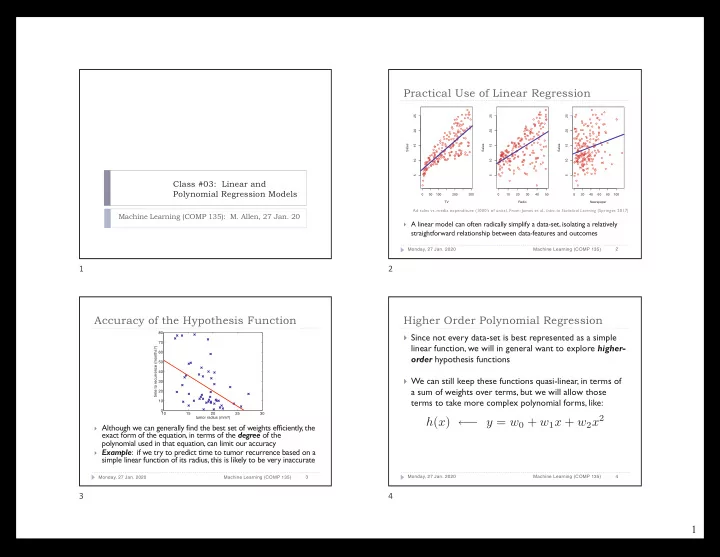
Practical Use of Linear Regression
} A linear model can often radically simplify a data-set, isolating a relatively
straightforward relationship between data-features and outcomes
Monday, 27 Jan. 2020 Machine Learning (COMP 135) 2
50 100 200 300 5 10 15 20 25 TV Sales 10 20 30 40 50 5 10 15 20 25 Radio Sales 20 40 60 80 100 5 10 15 20 25 Newspaper Sales
Ad sales vs. media expenditure (1000’s of units). From: James et al., Intro. to Statistical Learning (Springer, 2017)
2
Accuracy of the Hypothesis Function
} Although we can generally find the best set of weights efficiently, the
exact form of the equation, in terms of the degree of the polynomial used in that equation, can limit our accuracy
} Example: if we try to predict time to tumor recurrence based on a
simple linear function of its radius, this is likely to be very inaccurate
Monday, 27 Jan. 2020 Machine Learning (COMP 135) 3
10 15 20 25 30 10 20 30 40 50 60 70 80 tumor radius (mm?) time to recurrence (months?)
3
Higher Order Polynomial Regression
} Since not every data-set is best represented as a simple
linear function, we will in general want to explore higher-
- rder hypothesis functions
} We can still keep these functions quasi-linear, in terms of
a sum of weights over terms, but we will allow those terms to take more complex polynomial forms, like:
Monday, 27 Jan. 2020 Machine Learning (COMP 135) 4