
SLIDE 1
Guide for States implementing both
National Core Indicators™ (NCI) and National Core Indicators for Aging and Disability™ (NCI-AD)
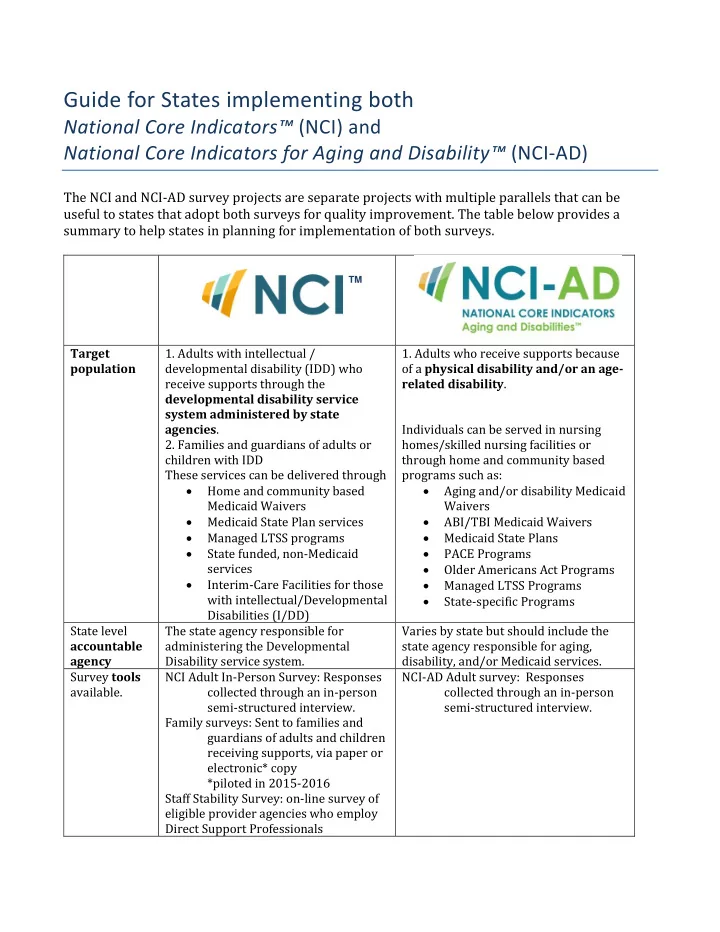
The NCI and NCI-AD survey projects are separate projects with multiple parallels that can be useful to states that adopt both surveys for quality improvement. The table below provides a summary to help states in planning for implementation of both surveys.
Target population
- 1. Adults with intellectual /
developmental disability (IDD) who receive supports through the developmental disability service system administered by state agencies.
- 2. Families and guardians of adults or
children with IDD These services can be delivered through
- Home and community based
Medicaid Waivers
- Medicaid State Plan services
- Managed LTSS programs
- State funded, non-Medicaid
services
- Interim-Care Facilities for those
with intellectual/Developmental Disabilities (I/DD)
- 1. Adults who receive supports because
- f a physical disability and/or an age-
related disability. Individuals can be served in nursing homes/skilled nursing facilities or through home and community based programs such as:
- Aging and/or disability Medicaid
Waivers
- ABI/TBI Medicaid Waivers
- Medicaid State Plans
- PACE Programs
- Older Americans Act Programs
- Managed LTSS Programs
- State-specific Programs
State level accountable agency The state agency responsible for administering the Developmental Disability service system. Varies by state but should include the state agency responsible for aging, disability, and/or Medicaid services. Survey tools available. NCI Adult In-Person Survey: Responses collected through an in-person semi-structured interview. Family surveys: Sent to families and guardians of adults and children receiving supports, via paper or electronic* copy *piloted in 2015-2016 Staff Stability Survey: on-line survey of eligible provider agencies who employ Direct Support Professionals NCI-AD Adult survey: Responses collected through an in-person semi-structured interview.
TM