Guardians of People and the Planet: Think Tanks Promoting Policies - - PowerPoint PPT Presentation

guardians of people and the planet
SMART_READER_LITE
LIVE PREVIEW

Guardians of People and the Planet: Think Tanks Promoting Policies - - PowerPoint PPT Presentation

www.ecologic.eu Guardians of People and the Planet: Think Tanks Promoting Policies on Environment, Resources, Energy, Climate, Health, and Sustainable Development R. Andreas Kraemer Director, Ecologic Institute, Berlin Brussels


slide-1
SLIDE 1

www.ecologic.eu

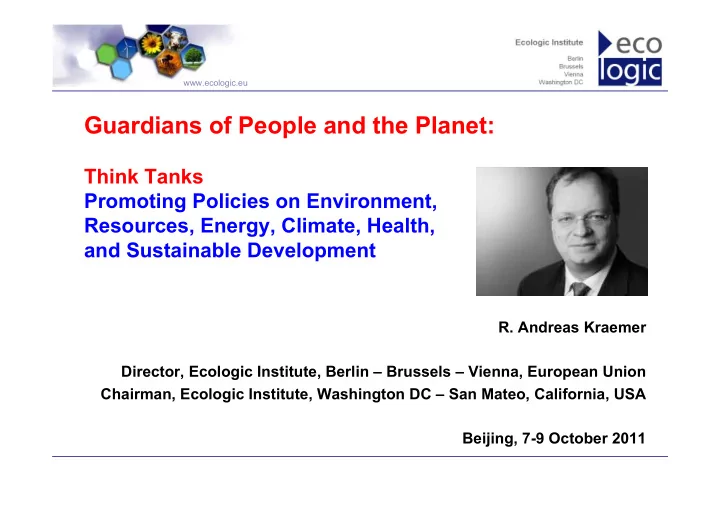
Guardians of People and the Planet:

Think Tanks Promoting Policies on Environment, Resources, Energy, Climate, Health, and Sustainable Development

  • R. Andreas Kraemer

Director, Ecologic Institute, Berlin – Brussels – Vienna, European Union Chairman, Ecologic Institute, Washington DC – San Mateo, California, USA Beijing, 7-9 October 2011

slide-2
SLIDE 2

www.ecologic.eu

http://www.ecologic.eu/ 1995 - 2011

Private, Independent, Non-Partisan, Mission-Based, Non-Profit Independent, constructive and competent Voice for: Environment in international & EU affairs International & EU dimension in environment policy Integration of environment into other policies 'Think tank’, 6 founders, Euro 120K core capital, 1.3 m net assets ('10) Governed by company law (business), ‘Operative Foundation’ 120 Experts & support staff in Berlin, Brussels, Vienna; Washington DC Policy-relevant science, and science-based policy analysis & advisory Project-driven, solution-oriented, inclusive and thus Trans-Disciplinary

2

slide-3
SLIDE 3

www.ecologic.eu

Ecologic Institute Family Structure

slide-4
SLIDE 4

www.ecologic.eu

http://www.ecologic.eu/ 1995 - 2010

1995 Ecologic Institute Berlin, Germany 2000 Ecologic Legal (16 staff lawyers, 2011) 2001 Ecologic Institute Brussels, EU Office 2001 Transatlantic Program 2002 Ecologic Events (in-house agency) 2005 Konrad von Moltke Fund (DE chapter 75K Euro, 2010) 2006 Relaw, Clearing House for Renewable Energy Law 2007 Ecologic Institute Vienna, Austria 2008 Ecologic Institute Washington DC 2009 Konrad von Moltke Fund (US chapter 15K US$, 2010) 2011 Ecologic Institute California, San Mateo Project Office

4

slide-5
SLIDE 5

www.ecologic.eu

http://www.eius.org/ founded on Earth Day 2008

Legally and financially independent Public Charity (laws of the D.C.) Qualified under US IRC Sections 170(b)(10)(A)(vi), 501(c)(3), [509(a)(1)] Programs: Policy-relevant work but no lobbying, in six core areas:

Explaining the European Union (and changing the Washington debate) Climate and Energy (e.g. carbon trading & international negotiations) Infrastructure Finance & Economics of Transition (e.g. crisis & stimulus) Transatlantic Dialogues & Exchanges (e.g. farmers, journalists, business) US & EU as Partners in the World (e.g. Arctic, UN, security) Biodiversity and Conservation (e.g. access & benefit sharing)

Dedicated Team of 4+1 (end 2010) at Dupont Circle in DC Focused on Washington DC, with coast-to-coast Outreach Since 2011 with Project Office in San Mateo, CA

5 Michael Mehling

President, Ecologic Washington

slide-6
SLIDE 6

www.ecologic.eu

What is the "Environment" ?

'Media': Water, oceans, soil, air, fauna & flora (biodiversity), chemicals, ... Renewable resources (water, timber, fish, cattle, bush-meat, ...) in the wild or in management systems (husbandry, agro-forestry, etc.) Non-renewable resources (minerals, coal, oil & gas, ...) Ecosystem Services (functions), e.g. nutrient cycles, heat transfers, ... Requiring integrity and resilience of ecosystems Resources, but also threats: Floods, droughts, fires, pests, predators, ... Relevant for human health, public health, "livelihood security", ... Space for human life, relevant for identity, mental stability, spirituality, ... Today also "Climate", a currently dominant, global theme Need to integrate environmental concerns into other policy fields ! Many Think Tanks work on specific aspects or in limited geographies; There are few "global full-service environment Think Tanks"

6

slide-7
SLIDE 7

www.ecologic.eu

What is Special about Environment Policy ?

Environmental protection and the rational management of resources are in the public interest (even if on occasion small groups benefit)

This forces environmental Think Tanks into (public interest) advocacy

Environmental concerns are "urgent"; civilization is under threat, but, Environmental concerns are largely "low politics" (except for climate)

This forces environmental Think Tanks to rely on attention-creating events, including environmental catastrophes, and to create regular "events"

Environmental concerns play out in the long run, are "future-relevant"

This forces environmental Think Tanks to work with scenarios ("speculation")

Environmental concerns are global, international, or "trans-boundary"

This forces environmental Think Tanks to think globally and form networks (there are few truly global environmental Think Tanks: IUCN, IISD, WRI, ...)

7

slide-8
SLIDE 8

www.ecologic.eu

Environmental Science and Policy – The Interface

Environmental science, technology, economics, regulation are dynamic

This creates uncertainties and a need to act on "precautionary principle"; environmental Think Tanks are drawn into controversies This also creates the need for "adaptive (cyclical) policy management"; environmental Think Tanks are drawn into policy implementation

The urgency of the environmental challenge comes from natural sciences Natural sciences say that individual and collective human behavior must change: Legitimacy for some, "eco-dictatorship" for others. Solutions are formulated through technology, planning & zoning etc. Solutions are implemented through social-science approaches, such as economics, political science, law, sociology, psychology, ...

Environmental Think Tanks must be multi-disciplinary or trans-disciplinary which lowers acceptance of their science output and risks a loss of credibility

8

slide-9
SLIDE 9

www.ecologic.eu

Environmental Think Tanks – Have to Work in Low Politics

Limited influence: Environment remains a marginal policy field; environment continues to deteriorate, persistence of environmentally harmful or "perverse" subsidies Subversive influence: Ideas travel and are "adopted" by politicians,

  • rigin in a Think Tank is forgotten (condition for success of the ideas)

Strategic influence: Good at "packaging arguments" for the longer term, "framing the issues" and "scoping the solutions" Guerilla tactics: "Ambush" an issue at the right time, following events. Needs preparedness and "analysis on the shelf" Creating opportunities for influence: Create "policy rhythm" through regular reports, events, press releases etc. ("policy cycle management") ...

9

slide-10
SLIDE 10

www.ecologic.eu

Environmental Think Tanks – What is Their Influence ?

Limited influence, but Influence cannot be measured or compared because of the complexity

  • f political decisions, multiplicity of actors and the time-delays involved

But case studies and anecdotes can tell stories of influence For fundraising and recruitment, perception of influence is more important than actual influence

Reputation is more important than influence.

But reputation can easily lead to conflicts with (political or governmental) sponsors or clients. Think Tanks engaged in contract research are in competition with their clients about visibility and media attention

10

slide-11
SLIDE 11

www.ecologic.eu

Guarding People & Planet: Environmental Think Tanks I

"Environment" is Overarching Term, like "Sustainable Development"

(Economic) "Resources" were traditional focus since 1950s, for example:

Resources for the Future – RFF, USA (1952) World Resources Institute – WRI, USA (1982) Worldwatch Institute, USA (1974) did not use "Environment"

"Environment" being used in Europe since the 1970s, for example:

International Institute for Environment and Development – IIED, UK (1971) International Institute for Environment and Society – IIES or IIUG, Germany (1972) was first government-financed "environmental policy think tank", closed in 1992? Institute for European Environmental Policy – IEEP, Germany (1976), now London Öko-Institut | Institute for Applied Ecology, Germany (1977) Environmental Policy Research Center (FFU) at Free University of Berlin (1986), first "academic" think tank >> "Berlin School of Environmental Political Science"

"Sustainable Development" since Brundtland Commission (1986-1987)

International Institute for Sustainable Development – IISD, Canada (1990) Institute for Sustainable Development & Intern. Relations – IDDRI, France (2001)

11

slide-12
SLIDE 12

www.ecologic.eu

Guarding People & Planet: Environmental Think Tanks II

"Environment" is Diversifying into Specific Fields or Challenges:

"Climate" is a "spin-off policy area" of the 1990s

Wuppertal Institute for Climate, Environment and Energy, Germany (1991) Potsdam Institute for Climate Impact Research, Germany (1992) Pew Center on Global Climate Change, USA (1998)

"Security" is a spin-off in the 2000's (after the events of 11 September 2001)

Institute for Environmental Security – IES, Netherlands (2002) UNU Institute for Environment & Human Security – UNU-IEHS, [Germany] (2003) Institute for Environmental Diplomacy and Security – IEDS, USA (2010)

"Resources" is likely to make a comeback, and link to traditional agenda:

Energy Resources: Coal, Oil, Gas >> Renewable Energies & Energy Efficiency Mineral Resources: Rare Earths, Copper, precious metals >> Urban Mining Living Resources: Water, Fish, Forest, Soil >> BioDiversity & Ecosystem Services

"Global Governance" is likely to grow in importance because of:

Economic Globalization & "Planetary" or Ubiquitous Challenges (Geo-Engineering)

12

slide-13
SLIDE 13

www.ecologic.eu

Responding to Economic Globalization & Market Dynamics

Economic Dynamic is Greater than Political & Diplomatic Dynamics

Result: Governments are Losing Control over Development

Priority Action Needed in these Areas:

Phasing out Environmentally and Socially Harmful, Perverse Subsidies Using Economic Instruments to Ensure that Prices Reflect Externalities Using Government Procurement to Favor Sustainable Products & Services Allowing and Facilitating Labeling and Certification to Guide Consumers Performing Environmental & Social Impact Assessments on Economic Policies Reinstating the Priority of People over (transnational) Corporations & Investors Reinstating the Priority of the Planet over Corporations & Investors Reinstating the Priority of Science over Economic Interests (Precaution) Subjecting Commodity Trading Regimes to Sustainability Criteria Coordinating Work to Improve Land Management and Food Security Improving Transparency of and Participation in Decision-Making

13

slide-14
SLIDE 14

www.ecologic.eu

Responding to the Environment and Resource Crisis

Beyond Oil >> Renewable Energy & Batteries Beyond Nuclear >> Smart Grids & Demand Response Beyond Toxicity >> Chemical Substitution Policy Beyond Extraction >> Resource Efficiency, Recycling & Urban Mining Beyond Sprawl >> New Sustainable Cities for 4-5 bn People by 2050 Beyond Hunger >> Sustainable Agriculture & Healthy Nutrition Beyond Extinction >> Protecting and Enhancing Biological Diversity Beyond Patents >> Equitable Use of Genetic Resources & IP (Patents) Beyond Exploitation >> Fair Trade, Equitable Society Beyond Predation >> Cooperation for Fisheries & Other Living Resources Beyond Denial >> Adapting to Coastal Land Loss, and Desertification Beyond Anarchy >> Effective International Cooperation (Governance) Beyond GDP >> New Metrix for Economic and Social Policies

14

slide-15
SLIDE 15

www.ecologic.eu

Designing Policies for a Sustainable & Equitable Future

Achieving Policy Coherence

Policy Evaluations, Policy (Impact) Assessments, Policy Revisions Policy Integration: "Environmental Protection Requirements Must be Integrated into the Definition and Implementation of [All Relevant] Policies" Overcoming the "Vertical Separation" of Governmental Responsibilities

Towards a New Development Paradigm

Beyond GDP, Admit Shortcomings and Misguiding Nature of GDP Develop Alternative & Complementary Metrix (Footprint, Happiness, HDI, ...) Age of Transformation will not be Linear; Develop new Models

Towards a New Scientific Foundation of Policy Formulation

From Disciplinary to Inter-, Multi- and then Trans-Disciplinary Science Development of Transformational and Transformation Research

15

slide-16
SLIDE 16

www.ecologic.eu

Environmental Think Tanks in Action: Some Examples

ENB (and Linkages) by IISD: Making Environmental Diplomacy Global IPPC by IEEP: Integrating Pollution Prevention in Industry WFD by Ecologic Institute: Facilitating an EU Water Policy Framework FSC by WWF et alii: Acting where the UN Failed our Forests Millennium Ecosystem Assessment by WRI: Counting Blessings WCD by IUCN & WB: Holding back the Dams, Protecting our Rivers No Nukes by Öko-Institut: Making Phase-Out Possible in Germany ... A note of caution: Causes and effects of policies are diffuse, and there are always many actors, especially in cases of success. The contribution

  • f a singular Think Tank on specific policy outcomes is always in doubt.

16

slide-17
SLIDE 17

www.ecologic.eu

ENB by IISD: Making Environmental Diplomacy Global

Earth Negotiations Bulletin (ENB)

Program of the International Institute for Sustainable Development (IISD) ENB reports on multilateral negotiations on environmental challenges Fast services; reports of previous day are ready for breakfast next morning Provides an archive of negotiations, positions, side events, documents etc. Important for the "memory of negotiations", and for scholars and analysts ENB is the only place to understand "Environmental Diplomacy" as a whole Financed by many governments, foundations, and other sponsors Important for (small, developing) countries with small diplomatic corps Modes of Action: Publication, Networking, Building Information Infrastructure More information: http://www.iisd.ca/enbvol/enb-background.htm

17

slide-18
SLIDE 18

www.ecologic.eu

IPPC by IEEP: Integrating Pollution Prevention in Industry

EU's IPPC Directive on Integrated Pollution Prevention and Control

Achievement of the Institute for European Environmental Policy (IEEP) The IPPC Directive brings cross-media approach to pollution control policy Stimulated modernization of environmental administration ("one agency only") The IPPC approach was pioneered in the US (where is was badly applied) IEEP (with WWF US) stimulated Policy Learning from the US in UK and EU UK first applied IPPC regulatory approach, and IEEP advocated EU action European IPPC Bureau (EIPPCB) was set up by the EU (Institutionalization) The IPPC Directive will be recast as Industrial Emissions Directive (IED) Modes of Action: Convening, (transnational) Policy Learning, Advocacy More information: http://ec.europa.eu/environment/air/pollutants/stationary/ippc/index.htm

18

slide-19
SLIDE 19

www.ecologic.eu

WFD by Ecologic Institute: A Fresh EU Water Policy

EU's Water Framework Directive (WFD), a revolution in water policy

Facilitated by Ecologic Institute with the governments of Germany and UK The WFD brings river-basin approach and integrated water management The WFD combines emission control and environmental quality approaches The WFD triggered modernization of administration ("river basin organization") The WFD was very controversial between Germany and UK (and all others) Ecologic Institute stimulated Policy Learning among EU Member States Policy Learning led to "Parallel Negotiations" (among practitioners) The WFD inspires water management and Policy Reforms around the world Modes of Action: Facilitation, Policy Learning, Parallel Diplomacy More information: http://ec.europa.eu/environment/water/water-framework/index_en.html

19

slide-20
SLIDE 20

www.ecologic.eu

Millennium Ecosystem Assessment by WRI: Valuation

Millennium Ecosystem Assessment (MA) by WRI

Facilitated by World Resources Institute (WRI) with philanthropic support 1360+ Experts Assessed Consequences of Ecosystem Change for Humans Response to demand from scientists and international organizations Developed with the Involvement of UNEP, UNDP, World Bank, many others Financing from: Avina, Packard, UN Foundation; Global Env. Facility, others Concluded that "Ecosystem Services" Need Protection & Sustainable Use MA is to Biodiversity Conservation what IPCC Reports are to Climate Policy MA changed the Terms of the Debate, Triggered Further Action (eg TEEB) Modes of Action: Convening, Aggregation, Research, Negotiations, Report More information: http://www.maweb.org/en/Index.aspx

20

slide-21
SLIDE 21

www.ecologic.eu

No Nukes by Öko-Institut: Making Phase-Out Possible

No Nukes by Öko-Institut: Making Germany Phase-Out Nuclear Power

Achievement of Öko-Institut For Applied Ecology (and the German nation) Controversy over Nuclear Power led to Restrictions of Academic Freedom Critical Scientist sought Freedom by establishing independent Öko-Institut Öko-Institut build reputation for Sound Science, broke the Cartel of Silence German Green Movement built the Technology Base in Renewable Energy Coalition of Conservative and "Green" Politicians initiated Feed-In Tariffs Öko-Institut evaluated and assessed policies, provided data and arguments Other "Social-Ecological Research Organizations" contributed also Modes of Action: Critical Science, Advocacy, Engagement, Development More information: http://de.wikipedia.org/wiki/Energiewende (in German)

21

slide-22
SLIDE 22

www.ecologic.eu

Guardians of People and the Planet:

Think Tanks Promoting Policies on Environment, Resources, Energy, Climate, Health, and Sustainable Development

  • R. Andreas Kraemer

Director, Ecologic Institute, Berlin – Brussels – Vienna, European Union Chairman, Ecologic Institute, Washington DC – San Mateo, California, USA Beijing, 7-9 October 2011