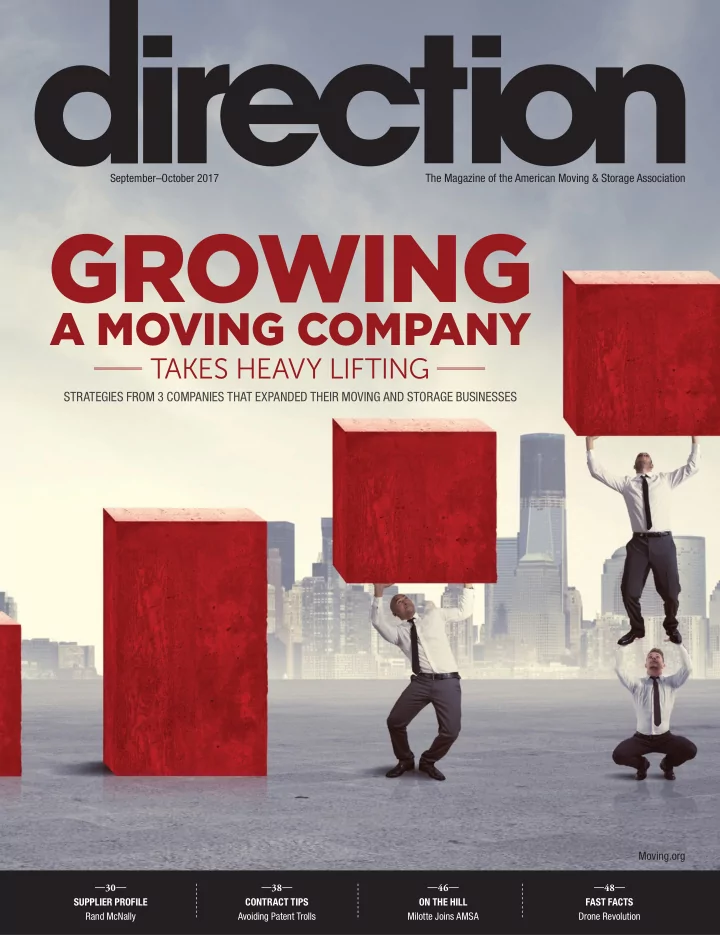
GROWING A MOVING COMPANY TAKES HEAVY LIFTING STRATEGIES FROM 3 - - PDF document

growing
SMART_READER_LITE
LIVE PREVIEW

GROWING A MOVING COMPANY TAKES HEAVY LIFTING STRATEGIES FROM 3 - - PDF document

SeptemberOctober 2017 The Magazine of the American Moving & Storage Association GROWING A MOVING COMPANY TAKES HEAVY LIFTING STRATEGIES FROM 3 COMPANIES THAT EXPANDED THEIR MOVING AND STORAGE BUSINESSES Moving.org 30 38


slide-1
SLIDE 1 Moving.org —30— SUPPLIER PROFILE Rand McNally —38— CONTRACT TIPS Avoiding Patent Trolls —46— ON THE HILL Milotte Joins AMSA —48— FAST FACTS Drone Revolution The Magazine of the American Moving & Storage Association September–October 2017 STRATEGIES FROM 3 COMPANIES THAT EXPANDED THEIR MOVING AND STORAGE BUSINESSES

GROWING

A MOVING COMPANY

TAKES HEAVY LIFTING

slide-2
SLIDE 2

T

ransportation companies have become prime targets for patent infringement lawsuits in recent years. Some mistakenly assume that technology companies are the only companies subject to infringement claims. However, the use
  • f any alleged infringing technology or
service also subjects transportation and logistics providers to expensive lawsuits and licensing fees. WHY ARE TRANSPORTATION COMPANIES TARGETED? Patent trolls (or nonpracticing entities)
  • perate on the business model of hold-
ing patent portfolios in the sole interest
  • f monetization through litigation. A
number of patent troll plaintifs have been widely reported as targeting the transportation and logistics sector. For example, a nonpracticing irm known as Shipping and Transit LLC was America’s biggest iler of patent suits in 2016. Shipping and Transit has been threatening to ile lawsuits and, in fact, litigating against companies that provide notiication of deliveries to customers. Telematics, geofencing and asset tracking—whether cellular
  • r satellite—are also hot areas for
alleging infringement in the transpor- tation ield. The growth in patent troll activity in the transportation ield is due in large part to recent changes in the way transportation and logistics pro- viders conduct business. Technology

PATENT TROLLS

TRANSPORTATION COMPANIES

VS.

By Jonathan Todd and Justin Clark

CONTRACT TIPS TO HELP AVOID PAYING THE TOLL

Direction 38 SEPTEMBER | OCTOBER 2017
slide-3
SLIDE 3 Direction SEPTEMBER | OCTOBER 2017 39
slide-4
SLIDE 4 is an increasingly signiicant part of today’s transportation value propo- sition, in which optimizing logistics networks is essential to driving eiciencies in the supply chains they
  • support. The Transportation (TMS),
Warehouse (WMS) and Order (OMS) Management Systems implemented
  • r homegrown in transportation
providers invariably are either propri- etary or use licensed technology. In either case, the patent trolls may come knocking based on the actual func- tionality provided by the technology. If patent infringement is alleged, then the transportation provider instantly becomes a potential defendant by virtue of its mere use of the subject technology. TARGETING SMALLER COMPANIES Transportation defendants are often small or midsize companies that are more likely to respond to intimidation by negotiating a settlement involving the payment of a license fee rather than facing the uncertainties of patent
  • litigation. Patent trolls know this
reality all too well, and they use it to their advantage. Many transportation defendants ind that they did not pay close attention to reviewing and nego- tiating the relevant provisions in their contracts when purchasing the under- lying technology. All are astonished by the license fees demanded for past and future use of the underlying tech- nology, which can easily exceed tens
  • f thousands of dollars as the cost to
continue conducting business as usual. The best way a transportation and logistics provider can protect itself from the license fees, court costs and damages is to carefully negotiate the technology agreements that support hardware and software license, lease or
  • development. The following are the
most important user-favorable clauses that can often help protect the buyer or licensee of technology.
  • Representations and Warranties:
Require representations and warranties so the underlying tech- nology and its functionality will not violate the intellectual property
  • r other proprietary rights of any
third party in any jurisdiction of
  • use. This gives buyers or licensees
the peace of mind that the vendor stands behind its products and warrants the right of use.
  • Indemniication: Negotiate broad
defense and indemnity in the event
  • f any intellectual property claim
arising out of or relating to use of the technology. Indemniication provisions often include speciic procedures regarding notice and defense, which will provide a roadmap for how the vendor will respond in the event of a claim.
  • Limitations of Liability: Avoid any
limitation of liability to the vendor’s
  • bligation of indemnity against
third-party intellectual property claims, including limitation to avail- able insurance. The cost of defense and indemnity can run to well over $1 million, leaving the buyer without recourse beyond a limitation. Transportation companies that are engaged in hardware and software license, lease or development should consult with an experienced attorney to review and negotiate these and
  • ther contract provisions to ensure
the greatest protection. HAVE AN UNDERLYING TECHNOLOGY CONTRACT Unsuspecting transportation com- panies typically learn they are being targeted by patent trolls via cleverly worded “licensing opportunity” letters from the plaintif’s attorneys, demanding the payment of license fees in settlement. More aggressive patent trolls will sometimes initiate negotiations with the iling of a suit. In either case, the patent troll busi- ness model is based on one goal—to earn the highest fees as quickly as
  • possible. Transportation companies
want to end the threat of litigation as quickly and inexpensively as possible. The path to a swift and favorable result lies squarely in the underlying technology contracts. If your transportation and logistics technology draws the aim of a patent troll, your attorney will assist in conducting an audit of the underlying technologies as well as the licenses and
  • ther contracts (including development
agreements) supporting those technol-
  • gies. Your technology providers will
be put on notice as soon as possible of the alleged infringement in accordance with the indemniication provisions found in your contracts. With well- drafted contracts, your technology providers may bear the entire defense and associated costs of litigation. This, of course, is what you would expect from vendors providing your mission-critical technologies. n Jonathan Todd is of counsel with the national transportation and logistics practice group of Benesch, Friedlander, Coplan &
  • Aronof. Justin Clark is an associate with
the irm’s innovation, information technol-
  • gy and intellectual property group. For
more information, visit beneschlaw.com.

Unsuspecting trans- portation companies typically learn that they are targeted by patent trolls when they receive cleverly worded “licensing

  • pportunity” letters

from the plaintiff’s attorneys demand- ing the payment

  • f license fees in

settlement.

Direction 40 SEPTEMBER | OCTOBER 2017