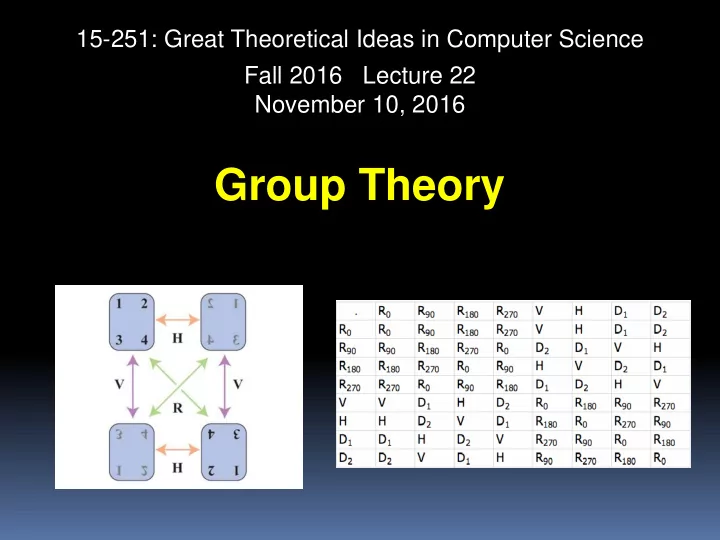
SLIDE 1 15-251: Great Theoretical Ideas in Computer Science
Group Theory
Fall 2016 Lecture 22 November 10, 2016
SLIDE 2 Il est peu de notions en mathematiques qui soient plus primitives que celle de loi de composition.
There are few concepts in mathematics that are more primitive than the composition law.
SLIDE 3 Group Theory
Study of symmetries and transformations
Also, the study of abstract algebraic
(of which ℤN and ℤN* are special cases)
SLIDE 4 What is group theory good for?
Checksums, error-correction schemes Minimizing randomness-complexity of algorithms Cryptosystems Algorithms for quantum computers Hard instances of optimization problems Ketan Mulmuley’s approach to P vs. NP Laci Babai’s graph isomorphism algorithm
In theoretical computer science:
SLIDE 5
What is group theory good for?
“15 Puzzle” Rubik’s Cube SET
In puzzles and games:
SLIDE 6
What is group theory good for?
There’s a quadratic formula:
In math:
SLIDE 7
What is group theory good for?
There’s a cubic formula:
In math:
SLIDE 8
What is group theory good for?
There’s a quartic formula:
In math:
SLIDE 9 x_1 & = & {\frac{-a}{4} - \frac{1}{2}{\sqrt{\frac{a^2}{4} - \frac{2b}{3} + \frac{2^{\frac{1}{3}}( b^2 - 3ac + 12d ) } {3{( 2b^3 - 9abc + 27c^2 + 27a^2d - 72bd + {\sqrt{-4{( b^2 - 3ac + 12d ) }^3 + {( 2b^3 - 9abc + 27c^2 + 27a^2d - 72bd ) }^2}} ) }^{\frac{1}{3}}} + (\frac{{ 2b^3 - 9abc + 27c^2 + 27a^2d - 72bd + {\sqrt{-4 {( b^2 - 3ac + 12d ) }^3 + {( 2b^3 - 9abc + 27c^2 + 27a^2d - 72bd ) }^2}} }} {54})^\frac{1}{3}}} - \frac{1}{2}{\sqrt{\frac{a^2}{2} - \frac{4b}{3}
- \frac{2^{\frac{1}{3}}( b^2 - 3ac + 12d ) } {3{( 2b^3 - 9abc + 27c^2 + 27a^2d - 72bd + {\sqrt{-4{( b^2 - 3ac + 12d ) }^3 + {( 2b^3 - 9abc + 27c^2 + 27a^2d - 72bd ) }^2}} ) }^{\frac{1}{3}}}
- (\frac{{ 2b^3 - 9abc + 27c^2 + 27a^2d - 72bd + {\sqrt{-4 {( b^2 - 3ac + 12d ) }^3 + {( 2b^3 - 9abc + 27c^2 + 27a^2d - 72bd ) }^2}} }} {54})^\frac{1}{3} –
- \frac{-a^3 + 4ab - 8c} {4{\sqrt{\frac{a^2}{4} - \frac{2b}{3} + \frac{2^{\frac{1}{3}} ( b^2 - 3ac + 12d ) }{3 {( 2b^3 - 9abc + 27c^2 + 27a^2d - 72bd +
- {\sqrt{-4 {( b^2 - 3ac + 12d ) }^3 + {( 2b^3 - 9abc + 27c^2 + 27a^2d - 72bd ) }^2}} ) }^ {\frac{1}{3}}} + ( \frac{{ 2b^3 - 9abc + 27c^2 + 27a^2d - 72bd +
- {\sqrt{-4 {( b^2 - 3ac + 12d ) }^3 + {( 2b^3 - 9abc + 27c^2 + 27a^2d - 72bd ) }^2}} } }{54})^\frac{1}{3}}}}}}} \\ x_2 & = & {\frac{-a}{4}
- \frac{1}{2}{\sqrt{\frac{a^2}{4} - \frac{2b}{3} + \frac{2^{\frac{1}{3}}( b^2 - 3ac + 12d ) } {3{( 2b^3 - 9abc + 27c^2 + 27a^2d - 72bd + {\sqrt{-4{( b^2 - 3ac + 12d ) }^3 +
- {( 2b^3 - 9abc + 27c^2 + 27a^2d - 72bd ) }^2}} ) }^{\frac{1}{3}}} + ( \frac{{ 2b^3 - 9abc + 27c^2 + 27a^2d - 72bd + {\sqrt{-4 {( b^2 - 3ac + 12d ) }^3 +
- {( 2b^3 - 9abc + 27c^2 + 27a^2d - 72bd ) }^2}} }} {54})^\frac{1}{3}}} + \frac{1}{2}{\sqrt{\frac{a^2}{2} - \frac{4b}{3} - \frac{2^{\frac{1}{3}}( b^2 - 3ac + 12d ) }
- {3{( 2b^3 - 9abc + 27c^2 + 27a^2d - 72bd + {\sqrt{-4{( b^2 - 3ac + 12d ) }^3 + {( 2b^3 - 9abc + 27c^2 + 27a^2d - 72bd ) }^2}} ) }^{\frac{1}{3}}} –
- ( \frac{{ 2b^3 - 9abc + 27c^2 + 27a^2d - 72bd + {\sqrt{-4 {( b^2 - 3ac + 12d ) }^3 + {( 2b^3 - 9abc + 27c^2 + 27a^2d - 72bd ) }^2}} }} {54})^\frac{1}{3} - \frac{-a^3 + 4ab - 8c}
- {4{\sqrt{\frac{a^2}{4} - \frac{2b}{3} + \frac{2^{\frac{1}{3}} ( b^2 - 3ac + 12d ) }{3 {( 2b^3 - 9abc + 27c^2 + 27a^2d - 72bd + {\sqrt{-4 {( b^2 - 3ac + 12d ) }^3 +
- {( 2b^3 - 9abc + 27c^2 + 27a^2d - 72bd ) }^2}} ) }^ {\frac{1}{3}}} + ( \frac{{ 2b^3 - 9abc + 27c^2 + 27a^2d - 72bd + {\sqrt{-4 {( b^2 - 3ac + 12d ) }^3 +
- {( 2b^3 - 9abc + 27c^2 + 27a^2d - 72bd ) }^2}} } }{54})^\frac{1}{3}}}}}}} \\ x_3 & = & {\frac{-a}{4} + \frac{1}{2}{\sqrt{\frac{a^2}{4} - \frac{2b}{3} +
- \frac{2^{\frac{1}{3}}( b^2 - 3ac + 12d ) } {3{( 2b^3 - 9abc + 27c^2 + 27a^2d - 72bd + {\sqrt{-4{( b^2 - 3ac + 12d ) }^3 + {( 2b^3 - 9abc + 27c^2 + 27a^2d - 72bd ) }^2}} ) }^{\frac{1}{3}}} +
- ( \frac{{ 2b^3 - 9abc + 27c^2 + 27a^2d - 72bd + {\sqrt{-4 {( b^2 - 3ac + 12d ) }^3 + {( 2b^3 - 9abc + 27c^2 + 27a^2d - 72bd ) }^2}} }} {54})^\frac{1}{3}}} –
- \frac{1}{2}{\sqrt{\frac{a^2}{2} - \frac{4b}{3} - \frac{2^{\frac{1}{3}}( b^2 - 3ac + 12d ) } {3{( 2b^3 - 9abc + 27c^2 + 27a^2d - 72bd + {\sqrt{-4{( b^2 - 3ac + 12d ) }^3 +
- {( 2b^3 - 9abc + 27c^2 + 27a^2d - 72bd ) }^2}} ) }^{\frac{1}{3}}} - ( \frac{{ 2b^3 - 9abc + 27c^2 + 27a^2d - 72bd + {\sqrt{-4 {( b^2 - 3ac + 12d ) }^3 +
- {( 2b^3 - 9abc + 27c^2 + 27a^2d - 72bd ) }^2}} }} {54})^\frac{1}{3} + \frac{-a^3 + 4ab - 8c} {4{\sqrt{\frac{a^2}{4} - \frac{2b}{3} + \frac{2^{\frac{1}{3}} ( b^2 - 3ac + 12d ) }
- {3 {( 2b^3 - 9abc + 27c^2 + 27a^2d - 72bd + {\sqrt{-4 {( b^2 - 3ac + 12d ) }^3 + {( 2b^3 - 9abc + 27c^2 + 27a^2d - 72bd ) }^2}} ) }^ {\frac{1}{3}}} +
- ( \frac{{ 2b^3 - 9abc + 27c^2 + 27a^2d - 72bd + {\sqrt{-4 {( b^2 - 3ac + 12d ) }^3 + {( 2b^3 - 9abc + 27c^2 + 27a^2d - 72bd ) }^2}} } }{54})^\frac{1}{3}}}}}}} \\
- x_4 & = & {\frac{-a}{4} + \frac{1}{2}{\sqrt{\frac{a^2}{4} - \frac{2b}{3} + \frac{2^{\frac{1}{3}}( b^2 - 3ac + 12d ) } {3{( 2b^3 - 9abc + 27c^2 + 27a^2d - 72bd +
- {\sqrt{-4{( b^2 - 3ac + 12d ) }^3 + {( 2b^3 - 9abc + 27c^2 + 27a^2d - 72bd ) }^2}} ) }^{\frac{1}{3}}} + ( \frac{{ 2b^3 - 9abc + 27c^2 + 27a^2d - 72bd +
- {\sqrt{-4 {( b^2 - 3ac + 12d ) }^3 + {( 2b^3 - 9abc + 27c^2 + 27a^2d - 72bd ) }^2}} }} {54})^\frac{1}{3}}} + \frac{1}{2}{\sqrt{\frac{a^2}{2} - \frac{4b}{3} –
- \frac{2^{\frac{1}{3}}( b^2 - 3ac + 12d ) } {3{( 2b^3 - 9abc + 27c^2 + 27a^2d - 72bd + {\sqrt{-4{( b^2 - 3ac + 12d ) }^3 + {( 2b^3 - 9abc + 27c^2 + 27a^2d - 72bd ) }^2}} ) }^{\frac{1}{3}}} –
- ( \frac{{ 2b^3 - 9abc + 27c^2 + 27a^2d - 72bd + {\sqrt{-4 {( b^2 - 3ac + 12d ) }^3 + {( 2b^3 - 9abc + 27c^2 + 27a^2d - 72bd ) }^2}} }} {54} )^\frac{1}{3} + \frac{-a^3 + 4ab - 8c}
- {4{\sqrt{\frac{a^2}{4} - \frac{2b}{3} + \frac{2^{\frac{1}{3}} ( b^2 - 3ac + 12d ) }{3 {( 2b^3 - 9abc + 27c^2 + 27a^2d - 72bd + {\sqrt{-4 {( b^2 - 3ac + 12d ) }^3 +
- {( 2b^3 - 9abc + 27c^2 + 27a^2d - 72bd ) }^2}} ) }^ {\frac{1}{3}}} + ( \frac{{ 2b^3 - 9abc + 27c^2 + 27a^2d - 72bd + {\sqrt{-4 {( b^2 - 3ac + 12d ) }^3 +
- {( 2b^3 - 9abc + 27c^2 + 27a^2d - 72bd ) }^2}} } }{54})^\frac{1}{3}}}}}}}
SLIDE 10
What is group theory good for?
There is NO quintic formula.
In math:
SLIDE 11
What is group theory good for?
Predicting the existence of elementary particles before they are discovered.
In physics:
SLIDE 12
So: What is group theory?
http://opinionator.blogs.nytimes.com/2010/05/02/group-think/ Let’s start with an example from
SLIDE 13
Rotate
SLIDE 14
Flip
SLIDE 15
Head-to-Toe flip
SLIDE 16
Q: How many positions can it be in? A: Four.
SLIDE 17
1 2 4 3 4 3 1 2 2 1 3 4 3 4 2 1
Rotate Flip Head- to-Toe Flip Rotate
SLIDE 18 Group theory is not so much about objects (like mattresses). It’s about the transformations
- n objects and how they (inter)act.
SLIDE 19
1 2 4 3 4 3 1 2 2 1 3 4 3 4 2 1
R F H F R F(R(mattress)) = H(mattress) H(F(mattress)) = R(mattress) R(F(H(mattress))) = mattress Id(mattress) FR=H HF=R RFH=Id RIdHFH = H
SLIDE 20
The kinds of questions asked:
Do transformations A and B “commute”? I.e., does AB = BA ? What is the “order” of transformation A? i.e., how many times do you have to apply A before you get to Id ? What is RIdHFH ?
SLIDE 21 Definition of a group of transformations
Let X be a set. Let G be a set of bijections p : X → X. We say G is a group of transformations if:
- 1. If p and q are in G then so is p q.
G is “closed” under composition.
- 2. The ‘do-nothing’ bijection Id is in G.
- 3. If p is in G then so is its inverse, p−1.
G is “closed” under inverses.
SLIDE 22 Example: Rotations of a rectangular mattress X = set of all physical points of the mattress G = { Id, Rotate, Flip, Head-to-toe } Check the 3 conditions:
- 1. If p and q are in G then so is p q.
- 2. The ‘do-nothing’ bijection Id is in G.
- 3. If p is in G then so is its inverse, p−1.
✔ ✔ ✔
SLIDE 23 Example: Symmetries of a directed cycle X = labelings of the vertices by 1,2,3,4 2 3 1 4 |X| = 24 G = permutations
don’t change the graph |G| = 4 G = { Id, Rot90, Rot180, Rot270 }
SLIDE 24 Example: Symmetries of a directed cycle G = { Id, Rot90, Rot180, Rot270 } X = labelings of directed 4-cycle Check the 3 conditions:
- 1. If p and q are in G then so is p q.
- 2. The ‘do-nothing’ bijection Id is in G.
- 3. If p is in G then so is its inverse, p−1.
✔ ✔ ✔
“Cyclic group of size 4”
SLIDE 25 Example: Symmetries of undirected n-cycle X = labelings of the vertices by 1,2, …, n G = permutations
don’t change the graph
(neighbors stay neighbors & non-nbrs stay non-nbrs)
|G| = 2n 1 2 3 4 5 Poll
SLIDE 26 Example: Symmetries of undirected n-cycle X = labelings of the vertices by 1,2, …, n G = permutations
don’t change the graph |G| = 2n 2 1 5 4 3 + one clockwise twist
SLIDE 27 Example: Symmetries of undirected n-cycle X = labelings of the vertices by 1,2, …, n G = permutations
don’t change the graph |G| = 2n 3 2 1 5 4 + one clockwise twist =
SLIDE 28 Example: Symmetries of undirected n-cycle X = labelings of the vertices by 1,2, …, n |X| = n! G = permutations
don’t change the graph |G| = 2n G = { Id, n−1 ‘rotations’, n ‘reflections’ } “Dihedral group of size 2n”
SLIDE 29 Effect of the 16 elements of D8
SLIDE 30
Example: “All permutations” X = {1, 2, …, n} G = all permutations of X e.g., for n = 4, a typical element of G is: “Symmetric group, Sym(n) or Sn”
SLIDE 31 More groups of transformations
Motions of 3D space: translations + rotations (preserve laws of Newtonian mechanics) Translations of 2D space by an integer amount horizontally and an integer amount vertically Rotations which preserve an
- ld-school soccer ball (icosahedron)
SLIDE 32 The group of mattress rotation
G = { Id, R, F, H } Id Id = Id Id R = R Id F = F Id ⚪ H = H R ⚪ Id = R R ⚪ R = Id R ⚪ F = H R ⚪ H = F F Id = F F ⚪ R = H F ⚪ F = Id F ⚪ H = R H ⚪ Id = H H ⚪ R = F H ⚪ F = R H ⚪ H = Id
Id R F H Id Id R F H R R Id H F F F H Id R H H F R Id
Group table
SLIDE 33 The laws of the dihedral group of size 10
G = { Id, r1, r2, r3, r4, f1, f2, f3, f4, f5 }
⚪ Id r1 r2 r3 r4 f1 f2 f3 f4 f5 Id Id r1 r2 r3 r4 f1 f2 f3 f4 f5 r1 r1 r2 r3 r4 Id f4 f5 f1 f2 f3 r2 r2 r3 r4 Id r1 f2 f3 f4 f5 f1 r3 r3 r4 Id r1 r2 f5 f1 f2 f3 f4 r4 r4 Id r1 r2 r3 f3 f4 f5 f1 f2 f1 f1 f3 f5 f2 f4 Id r3 r1 r4 r2 f2 f2 f4 f1 f3 f5 r2 Id r3 r1 r4 f3 f3 f5 f2 f4 f1 r4 r2 Id r3 r1 f4 f4 f1 f3 f5 f2 r1 r4 r2 Id r3 f5 f5 f2 f4 f1 f3 r3 r1 r4 r2 Id
SLIDE 34 God created the integers. All the rest is the work of Man.
Integers ℤ closed under + a+b = b+a a+0 = 0+a=a a+(-a) = 0
(a+b)+c = a+(b+c)
+ 1 2 3 4 1 2 3 4 1 1 2 3 4 2 2 3 4 1 3 3 4 1 2 4 4 1 2 3
Remainders mod 5 Z5 = {0,1,2,3,4} +5 = addition modulo 5 a+n 0 = 0+n a=a a+n (n-a) = 0
(a+nb)+nc = a+n(b+nc)
SLIDE 35
The power of algebra: Abstract away the inessential features of a problem
=
SLIDE 36 Let G be a set. Let be a “binary operation” on G; think of it as defining a “multiplication table”.
a b c a c a b b a b c c b c a
E.g., if G = { a, b, c } then… is a binary operation. This means that c a = b.
Let’s define an abstract group.
SLIDE 37 Definition of an (abstract) group
We say G is a “group under operation ” if:
- 0. [Closure] G is closed under
i.e., a b G ∀ a,b∈G
- 1. [Associativity] Operation is associative:
i.e., a (b c) = (a b) c ∀ a,b,c∈G
- 2. [Identity] There exists an element e∈G
(called the “identity element”) such that a e = a, e a = a ∀ a∈G
- 3. [Inverse] For each a∈G there is an element a−1∈G
(called the “inverse of a”) such that a a−1 = e, a−1 a = e
SLIDE 38 Examples of (abstract) groups
Any group of transformations is a group.
(Only need to check that composition of functions is associative.)
E.g., the ‘mattress group’ (AKA Klein 4-group)
Id R F H Id Id R F H R R Id H F F F H Id R H H F R Id
identity element is Id R−1 = R F−1 = F H−1 = H
SLIDE 39 Examples of (abstract) groups
Any group of transformations is a group. ℤ (the integers) is a group under operation + Check:
- 0. + really is a binary operation on ℤ
- 1. + is associative: a+(b+c) = (a+b)+c
- 2. “e” is 0: a+0 = a, 0+a = a
- 3. “a−1” is −a: a+(−a) = 0, (−a)+a = 0
SLIDE 40
Examples of (abstract) groups
Any group of transformations is a group. ℤ (the integers) is a group under operation + ℝ (the reals) is a group under operation + ℝ+ (the positive reals) is a group under × Q \ {0} (non-zero rationals) is a group under × Zn (the integers mod n) is a group under + modulo n
SLIDE 41
NONEXAMPLES of groups
ℤ, operation − ℤ \ {0}, operation × G = {all odd integers}, operation + + is not a binary operation on G! − is not associative! & No identity! 1 is the only possible identity element; but then most elements don’t have inverses! (Natural numbers, +) No inverses !
SLIDE 42 ⚪ Id r1 r2 r3 r4 f1 f2 f3 f4 f5 Id Id r1 r2 r3 r4 f1 f2 f3 f4 f5 r1 r1 r2 r3 r4 Id f4 f5 f1 f2 f3 r2 r2 r3 r4 Id r1 f2 f3 f4 f5 f1 r3 r3 r4 Id r1 r2 f5 f1 f2 f3 f4 r4 r4 Id r1 r2 r3 f3 f4 f5 f1 f2 f1 f1 f3 f5 f2 f4 Id r3 r1 r4 r2 f2 f2 f4 f1 f3 f5 r2 Id r3 r1 r4 f3 f3 f5 f2 f4 f1 r4 r2 Id r3 r1 f4 f4 f1 f3 f5 f2 r1 r4 r2 Id r3 f5 f5 f2 f4 f1 f3 r3 r1 r4 r2 Id
Permutation property
Dihedral group of size 10 In a group table, every row and every column is a permutation
Follows from “cancellation property”
(which we will prove shortly)
SLIDE 43
Let’s connect back to Modular arithmetic
SLIDE 44 Suppose x y (mod n) and a b (mod n). Then 1) x + a y + b (mod n) 2) x * a y * b (mod n) 3) x - a y – b (mod n)
So instead of doing +,*,- and taking remainders, we can first take remainders and then do arithmetic.
Modular arithmetic
Defn: For integers a,b, and positive integer n, a b (mod n) (read: “a congruent to b modulo n”) means (a-b) is divisible by n, or equivalently a mod n = b mod n (x mod n is remainder of x when
divided by n, and belongs to {0,1,…,n-1} )
SLIDE 45 Modular arithmetic
(Zn, +) is group (understood that + is +n )
+ 1 2 3 4 1 2 3 4 1 1 2 3 4 2 2 3 4 1 3 3 4 1 2 4 4 1 2 3
What about (Z5, *) ? (* = multiplication modulo n)
NOT a group. 1 = candidate for identity, but 0 has no inverse.
Okay, what about (Z5
* , *) where
* 1 2 3 4 1 1 2 3 4 2 2 4 1 3 3 3 1 4 2 4 4 3 2 1
Z5
* = Z5 \ {0} = {1,2,3,4}
Turns out, it is a group.
SLIDE 46 * 1 2 3 4 5 1 1 2 3 4 5 2 2 4 2 4 3 3 3 3 4 4 2 4 2 5 5 4 3 2 1
Multiplication table mod 6 for Z6 \ {0} = {1,2,3,4,5}
2,3,4 have no inverse
NOT a group !
SLIDE 47
Multiplicative inverse in Zn \ {0}
Theorem: For a {1,2,…,n-1}, there exists x {1,2,…,n-1} such that ax 1 (mod n) if and only if gcd(a,n) = 1 Proof (if) : Suppose gcd(a,n)=1 There exist integers r,s such that r a + s n =1 (Extended Euclid) So ar 1 (mod n). Take x = r mod n, ax 1 (mod n) as well.
SLIDE 48
Multiplicative inverse in Zn \ {0}
Theorem: For a {1,2,…,n-1}, there exists x {1,2,…,n-1} such that ax 1 (mod n) if and only if gcd(a,n) = 1 Proof (only if) : Suppose x, ax 1 (mod n) So ax-1 = nk for some integer k. If gcd(a,n)=c, then c divides ax-nk Since ax-nk=1, this means c=1.
SLIDE 49 Recall: Zn
* = {x Zn | gcd(x,n) =1}
Elements in Zn
* have
multiplicative inverses Exercise: Check (Zn
* , *) is a group
(* is multiplication modulo n)
Z6 = {0, 1,2,3,4,5} Z6
* = {1,5}
* 1 2 3 4 5 1 1 2 3 4 5 2 2 4 2 4 3 3 3 3 4 4 2 4 2 5 5 4 3 2 1
SLIDE 50 Z12
* = {0 ≤ x < 12 | gcd(x,12) = 1}
= {1,5,7,11} *12 1 5 7 11 1 1 5 7 11 5 5 1 11 7 7 7 11 1 5 11 11 7 5 1
SLIDE 51 Z15
* * 1 2 4 7 8 11 13 14 1 1 2 4 7 8 11 13 14 2 2 4 8 14 1 7 11 13 4 4 8 1 13 2 14 7 11 7 7 14 13 4 11 2 1 8 8 8 1 2 11 4 13 14 7 11 11 7 14 2 13 1 8 4 13 13 11 7 1 14 8 4 2 14 14 13 11 8 7 4 2 1
SLIDE 52
Fact: For prime p, the set Zp* = Zp \ {0} Proof: It just follows from the definition! For prime p, all 0 < x < p satisfy gcd(x,p) = 1
SLIDE 53 Euler Phi Function 𝜚(𝑜) 𝜚(𝑜) = size of Zn
*
= number of integers 1 ≤ k < n that are relatively prime to n. p prime Zp
*= {1,2,3,…,p-1}
𝜚(p) = p-1
SLIDE 54
Back to abstract groups
SLIDE 55
Abstract algebra on groups
Theorem 1: If (G,) is a group, identity element is unique. Proof: Suppose f and g are both identity elements. Since g is identity, f g = f. Since f is identity, f g = g. Therefore f = g.
SLIDE 56
Abstract algebra on groups
Theorem 2: In any group (G,), inverses are unique. Proof: Given a∈G, suppose b, c are both inverses of a. Let e be the identity element. By assumption, a b = e and c a = e. Now: c = c e = c(ab) = (ca)b = e b = b
SLIDE 57
Theorem 3 (Cancellation): If a b = a c, then b = c Proof: Multiply on left by a-1
Similarly, b a = c a implies b = c So each row and each column of a group table are permutations of the group elements.
SLIDE 58
Theorem 4: For all a in group G we have (a−1)−1 = a. Theorem 5: For a,b∈G we have (a b)−1 = b−1 a−1. Theorem 6: In group (G,), it doesn’t matter how you put parentheses in an expression like a1 a2 a3 · · · ak (“generalized associativity”).
Theorem 3 (Cancellation): If a b = a c, then b = c
SLIDE 59
Notation
In abstract groups, it’s tiring to always write . So we often write ab rather than a b. For n∈ℕ+, write an instead of aaa···a (n times). Also a−n instead of a−1a−1···a−1, and a0 means 1. (again denote a+ a+ … + a by na for additive groups) Sometimes write 1 instead of e for the identity (When operation is “addition”, write 0 in place of e)
SLIDE 60
Algebra practice
Problem: In the mattress group {1, R, F, H}, simplify the element R2 (H3 R−1)−1 One (slightly roundabout) solution: H3 = H H2 = H 1 = H, so we reach R2 (H R−1)−1. (H R−1)−1 = (R−1)−1 H−1 = R H, so we get R2 R H. But R2 = 1, so we get 1 R H = R H = F. Moral: the usual rules of multiplication, except…
SLIDE 61
Commutativity?
In a group we do NOT NECESSARILY have a b = b a Actually, in the mattress group we do have this for all elements; e.g., RF = FR (=H). Definition: “a,b∈G commute” means ab = ba. “G is commutative” means all pairs commute.
SLIDE 62
In group theory, “commutative groups” are usually called abelian groups. Niels Henrik Abel (1802−1829) Norwegian Died at 26 of tuberculosis Age 22: proved there is no quintic formula.
SLIDE 63 Evariste Galois (1811−1832) French Died at 20 in a dual Laid the foundations
- f group theory and Galois theory
SLIDE 64 Some abelian groups: “Mattress group”
(“Klein 4-group”)
Symmetries of a directed cycle (“cyclic group”) (ℝ, +), (Zn
*,×)
Some nonabelian groups: Symmetries of an undirected cycle (“dihedral group”) Permutation group Sn
(“symmetric group on n elements”) Invertible n x n real matrices (under matrix product)
SLIDE 65
More fun groups: Matrix groups
SL2(ℤ): Set of matrices where a,b,c,d∈ ℤ and ad−bc=1. Operation: matrix mult. Inverses: Application: constructing expander graphs, ‘magical’ graphs crucial for derandomization.
SLIDE 66 Isomorphism
Id R F H Id Id R F H R R Id H F F F H Id R H H F R Id
Here’s a group: V = { (0,0), (0,1), (1,0), (1,1) } + modulo 2 is the operation There’s something familiar about this group…
+
00 01 10 11 00 00 01 10 11 01 01 00 11 10 10 10 11 00 01 11 11 10 01 00
The mattress group V same
after renaming:
00↔Id 01↔R 10↔F 11↔H
SLIDE 67
Isomorphism
Groups (G,) and (H,) are “isomorphic” if there is a way to rename elements so that they have the same multiplication table. Formally, bijection : G H such that (a b) = (a) (b) a,b G Fundamentally, they’re the “same” abstract group.
SLIDE 68
Isomorphism and orders
Obviously, if G and H are isomorphic we must have |G| = |H|. |G| is called the order / size of G. E.g.: Let C4 be the group of transformations preserving the directed 4-cycle. |C4| = 4 Q: Is C4 isomorphic to the mattress group V ?
SLIDE 69 Isomorphism and orders
Q: Is C4 isomorphic to the mattress group V ? A: No! a2 = 1 for every element a∈V. But in C4, Rot90
2 = Rot270 2 ≠ Rot180 2 = Id2
Motivates studying powers of elements.
SLIDE 70
Order of a group element
Let G be a finite group. Let a∈G. Look at 1, a, a2, a3, … till you get some repeat. Say ak = aj for some k > j. Multiply this equation by a−j to get ak−j = 1. So the first repeat is always 1. Definition: The order of x, denoted ord(a), is the smallest m ≥ 1 such that am = 1. Note that a, a2, a3, …, am−1, am=1 all distinct.
SLIDE 71 Examples: In mattress group (order 4),
- rd(Id) = 1, ord(R) = ord(F) = ord(H) = 2.
In directed-4-cycle group (order 4),
- rd(Id) = 1, ord(Rot180) = 2, ord(Rot90) = ord(Rot270) = 4.
In dihedral group of order 10 (symmetries of undirected 5-cycle)
- rd(Id) = 1, ord(any rotation) = 5, ord(any reflection) = 2.
SLIDE 72 Order Theorem: For a finite group G & a G
- rd(a) always divides |G|.
G
1 a a2 a3 am−1 x xa xa2 xa3 xam−1
Claim: also of length m. Because xaj = xak ⇒ aj = ak. Let ord(a) = m.
SLIDE 73 Order Theorem: ord(a) always divides |G|.
G
1 a a2 a3 am−1 x xa xa2 xa3 xam−1 y ya ya2
Impossible. Multiply on right by a−1.
SLIDE 74 Order Theorem: a G, ord(a) divides |G|.
G
1 a a2 a3 am−1 x xa xa2 xa3 xam−1 y ya ya2 ya3 yam−1
G partitioned into cycles of size m.
SLIDE 75 Order Theorem:
- rd(a) always divides |G|.
Corollary: If |G| = n, then an=1 for all a∈G. Proof: Let ord(a) = m. Write n = mk. Then an = (am)k = 1k = 1. Corollary: Euler’s Theorem: For a Zn
* , aϕ(n) = 1
That is, if gcd(a,n)=1, then aϕ(n) 1 (mod n) Corollary (Fermat’s little theorem): For prime p, if gcd(a,p)=1, then ap-1 1 (mod p)
SLIDE 76 Cyclic groups
A finite group G of order n is cyclic if G= {e,b,b2,…,bn-1} for some group element b In such a case, we say the element b “generates” G,
- r b is a “generator” of G.
Examples:
What is a generator?
- C4 (Symmetries of directed 4-cycle)
Non-examples: Mattress group; any non-abelian group.
SLIDE 77
How many generators does (Zn, +) have?
Answer: 𝜚(n)
Same holds for any cyclic group with n elements
b generates Zn a s.t. ba 1 (mod n) (ba = b+b+…+b (a times))
SLIDE 78 Subgroups
Definition: Suppose (G ,) is a group. If H G, and if (H,) is also a group, then H is called a subgroup of G. Q: Is (Even integers, +) a group? A: Yes. It is a “subgroup” of (ℤ,+) To check H is a subgroup of G, check:
- 1. H is closed under
- 2. e H
- 3. If h H then h-1 H
- (3rd condition follows from 1,2 if H is finite)
SLIDE 79 Examples
Suppose k, 1 < k < n, divides n.
- Q1. Is ({0, k, 2k, 3k, …, (n/k-1)k}, +n) subgroup of (Zn,+n) ?
- Q2. Is (Zk, +k) a subgroup of (Zn, +n)?
- Q3. Is (Zk, +n) a subgroup of (Zn, +n)?
No! it doesn’t even have the same operation No! Zk is not closed under +n Yes!
Every G has two trivial subgroups: {e}, G Rest are called “proper” subgroups
SLIDE 80 Lagrange’s Theorem
Theorem: If G is a finite group, and H is a subgroup then |H| divides |G|. Proof similar to order theorem.
Corollary (order theorem): If x G, then ord(x) divides |G|.
Proof of Corollary: Consider the set Tx = (x, x2, x3, …) (i) ord(x) = |Tx| (ii) (Tx, ) is a subgroup of (G,) (check!)
SLIDE 81 Definitions: Groups; Commutative/abelian Isomorphism ; order of elements; subgroups Specific Groups: Klein 4-, cyclic, dihedral, symmetric, number-theoretic. Doing: Checking for “groupness” Computations in groups Theorem/proof: Order Theorem; Lagrange Thm Modular arithmetic Euler theorem
Study Guide
SLIDE 82
More fun groups: Quaternion group
Q8 = { 1, −1, i, −i, j, −j, k, −k } Multiplication 1 is the identity defined by: (−1)2 = 1, (−1)a = a(−1) = −a i2 = j2 = k2 = −1 ij = k, ji = −k jk = i, kj = −i ki = j, ik = −j Exercise: valid defn. of a (nonabelian) group.
SLIDE 83 Application to computer graphics
“Quaternions”: expressions like 3.2 + 1.4i −.5j +1.1k which generalize complex numbers (ℂ). Let (x,y,z) be a unit vector, θ an angle, let
q = cos(θ/2) + sin(θ/2)x i + sin(θ/2)y j + sin(θ/2)z k
Represent p=(a,b,c) in 3D space by quaternion P= a i + b j + c k
Then qPq−1 is its rotation by angle θ around axis (x,y,z).