GRMP 2018 Bi-annual Review Meeting Peace / High Level Districts - - PowerPoint PPT Presentation

grmp
SMART_READER_LITE
LIVE PREVIEW

GRMP 2018 Bi-annual Review Meeting Peace / High Level Districts - - PowerPoint PPT Presentation

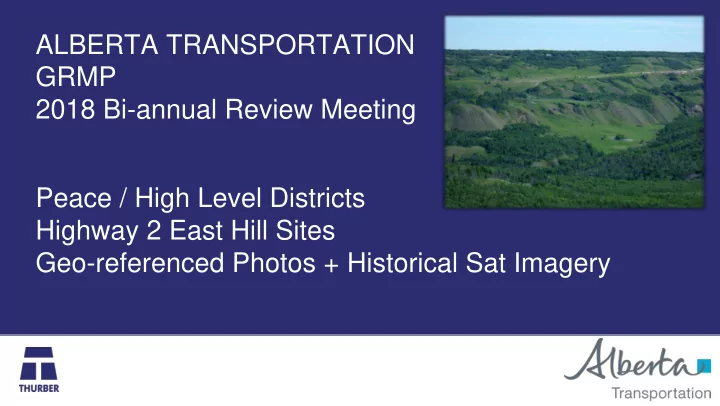
ALBERTA TRANSPORTATION GRMP 2018 Bi-annual Review Meeting Peace / High Level Districts Highway 2 East Hill Sites Geo-referenced Photos + Historical Sat Imagery Peace River Region - Highway 2 - East Hill Site area directly east of the


slide-1
SLIDE 1

ALBERTA TRANSPORTATION GRMP 2018 Bi-annual Review Meeting Peace / High Level Districts Highway 2 East Hill Sites Geo-referenced Photos + Historical Sat Imagery

slide-2
SLIDE 2

2

Peace River Region - Highway 2 - East Hill

  • Site area directly east of the

Town of Peace River

  • Multiple sites within a 4 km

segment of the Highway running along on the south- facing wall of the Heart River Valley.

  • Widespread and highly active

mass wasting processes that include channelized erosion, earth flows, deep and shallow landslides within colluvium and glaciolacustrine sediments (Glacial Lake Matthews).

slide-3
SLIDE 3

3

slide-4
SLIDE 4

4

Peace River Heart River v HWY 2 N

slide-5
SLIDE 5

5

N

CHALLENGES

  • Large site with many active, ongoing and interacting processes
  • Many of the geohazards do not directly impact the highway but could

lead to future instability or retrogressive processes that are cheaper / more practical to mitigate earlier (i.e. proactive approach)

  • Limited time on ground during annual inspections – important to

establish what are the existing conditions, what has changed and setup consistent framework of comparison to make efficient use of time on site.

  • Large processes that can be difficult to interpret or understand

broader site implications from the ground  LiDAR and aerial imagery tools can help

  • Annual viewing of site (or limited instrumentation) – difficult to

establish timeline or evaluate rate of geohazard processes

slide-6
SLIDE 6

6

slide-7
SLIDE 7

7

slide-8
SLIDE 8

8

  • GIS Workspace – all photo locations, waypoints,

tracks, aerial imagery, marked terrain features, ect  can be quickly compared with previous years (photo comparison still manual)

slide-9
SLIDE 9

9

2009

Photo Comparison

2017

slide-10
SLIDE 10

10

2009

Photo Comparison

2017

slide-11
SLIDE 11

11

2014

Photo Comparison

2016

slide-12
SLIDE 12

12

2009

Photo Comparison

2017

slide-13
SLIDE 13

13

Historic Satellite Imagery

2002

slide-14
SLIDE 14

14

Historic Satellite Imagery

2002

slide-15
SLIDE 15

15

Historic Satellite Imagery

2012

1 m LiDAR (2007)

slide-16
SLIDE 16

16

Historic Satellite Imagery

2013

slide-17
SLIDE 17

17

Historic Satellite Imagery

2016

slide-18
SLIDE 18

18

2017 2009

Photo Comparison

slide-19
SLIDE 19

19

Historic Satellite Imagery

2013 2016

slide-20
SLIDE 20

20

2016

slide-21
SLIDE 21

21

  • Comparison methodology used in the

development of the site plan with focus

  • n areas that have observable rates of

activity and/or future potential to cause instability or hazard to the highway

  • Combination of LiDAR and

satellite/aerial imagery allows broader view of site processes

  • Historic imagery provides better context

to the development process and rate of mass waste events

  • Helps create target areas for next year

and guide the inspection process, esp. for future inspectors

  • Process could be refined with new

technology and more frequent data gathering (e.g. drone survey)

Conclusions