
SLIDE 1
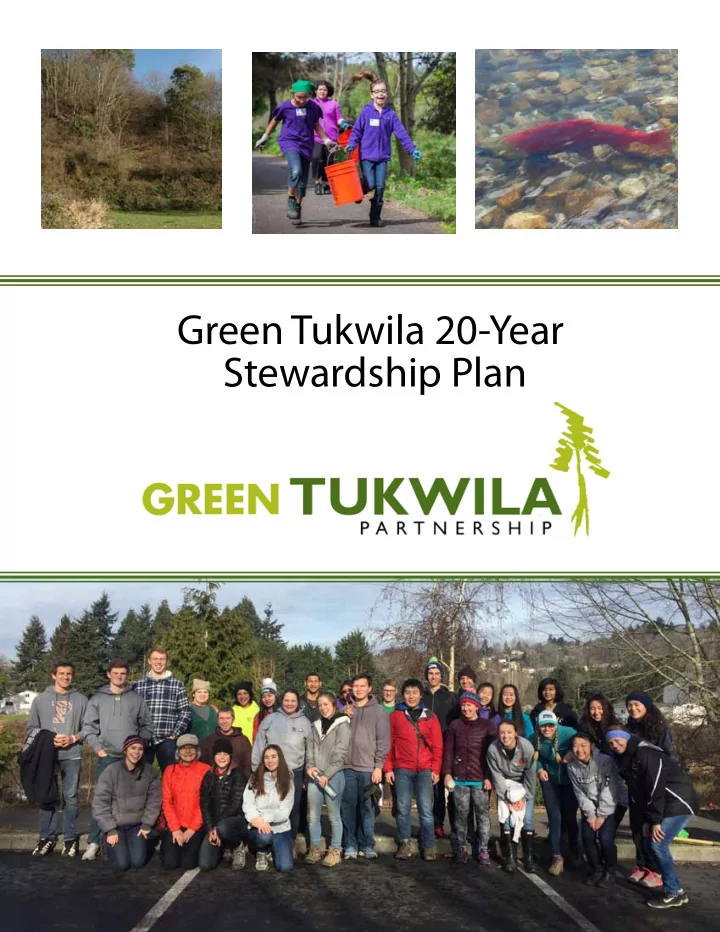
Green Tukwila 20-Year Stewardship Plan Acknowledgments Tie Green - - PDF document
Green Tukwila 20-Year Stewardship Plan Acknowledgments Tie Green City Partnerships program started in 2004, comprises a network of public-private ventures between Forterra, local government agencies, businesses, organizations, and citizens.
Green Tukwila 20-Year Stewardship Plan 1
Tie Green City Partnerships program started in 2004, comprises a network of public-private ventures between Forterra, local government agencies, businesses,
throughout the Puget Sound Region with the formation of new partnerships. We developed the Green Tukwila Partnership based on these efgorts, creating a plan to address the needs of the Tukwila community. Tiis important work was funded, in part, by a generous grant from Boeing’s Healthy Communities Initiative.
city of tukwila elected offjcials
Mayor: Allen Ekberg City Council: Joe Duffje, Council President Dennis Robertson Vema Seal Kathy Hougardy De’Sean Quinn Kate Kruller Tiomas McLeod Park Commission: Mike Martin, Chair Don Scanlon Sean Albert Heidi Watters Matt Mega
tukwila stafg Advisory group
Robert Eaton, Parks and Recreation Manager Carol Lumb, Senior Planner, Department of Community Development Andrea Cummins, Urban Environmentalist, Department of Community Development Mike Perfetti, Habitat Project Manager, Public Works Department
Forterra
Norah Kates, Green Cities Project Manager Kimberly Frappier, Restoration Ecologist Matt Mega, Green Cities Project Manager Joanna Nelson de Flores, Green Cities Director Nicole Marcotte, Green Cities Project Associate Christopher Walter, GIS Director
American Forestry management, Inc.
Data Collection Jesse Saunders, Inventory Forester Ted Hitzroth, GIS Manager
2
llustrations
Andrea Mojzak
Photography
Nicole Marcotte Photography by McRob (www.mcrobphoto.com) Billy Hustace (hustacephotogrpahy.com) Nick Krittawat Uncredited photos were taken by Forterra or Tukwila Parks and Recreation Editing Diane Sepanski
Green Tukwila 20-Year Stewardship Plan 3
Acknowledgements ....................................................................................................................................................................1 Executive Summary ...................................................................................................................................................................6
Tie Need for a Green Tukwila Partnership ......................................................................................................................9 Investing in Tukwila’s Urban Forest: Public Health, Economic and Ecosystem Benefjts...................................................9
.........................................................................................................15 Challenges and Tireats to Sustainability .......................................................................................................................16 Fragmentation ........................................................................................................................................................16 Declining Habitat Quality ......................................................................................................................................16 Invasive Species: Plants ...........................................................................................................................................17 Invasive Species: Insects ..........................................................................................................................................18 Native Vegetation Struggling to Regenerate ............................................................................................................19 Illegal Activity .........................................................................................................................................................19 Climate Change ......................................................................................................................................................19 Resource Limitations on Forest and Natural Area Restoration and Maintenance .....................................................20
Tie Mission and Vision ................................................................................................................................................21 Outcomes .....................................................................................................................................................................22 Goals ............................................................................................................................................................................22 Partnership Roles and Responsibilities ..........................................................................................................................23 City of Tukwila .......................................................................................................................................................23 Seattle City Light ....................................................................................................................................................24 King County Parks .................................................................................................................................................24 Tukwila School Distrcit............................................................................................................................................24 Highline School District .........................................................................................................................................24 Washington Department of Transportation .............................................................................................................24 Washington Department of Natural Resources .......................................................................................................24 Nonprofjt Organizations .........................................................................................................................................25 Volunteers and the Community at Large ................................................................................................................26 Commercial and Nonprofjt Field Crews .................................................................................................................26 Funders, Donors and Sponsors ...............................................................................................................................26 Private Landowners .................................................................................................................................................27
Methods .......................................................................................................................................................................29 Tree-iage and Forest Landscape Assessment Tool (FLAT) ........................................................................................29 Tree-iage Categoroes ...............................................................................................................................................30 Results ..........................................................................................................................................................................33 Tree-iage Matrix ......................................................................................................................................................33 Overstory Species ....................................................................................................................................................34 Regenerating Overstory Species ..............................................................................................................................34 Native Overstory Species ........................................................................................................................................34
4 Native Understory Species ......................................................................................................................................34 Invasive Species .......................................................................................................................................................34 Slope .......................................................................................................................................................................35
Field .............................................................................................................................................................................36 Field Objective 1: Prioritize Parks and Natureal Open Space Sites ..........................................................................37 Field Objective 2: Prioritize Restoration Work Zones Within Sites .........................................................................37 Field Objective 3: Identify Areas that Require Professinal Crew and Stafg Support ..................................................37 Field Objective 4: Implement BMP’s in Restoration and Stewardship on all Project Sites........................................38 Best Management Practices .....................................................................................................................................38 Tie Four-Phase Approach to Restoration Fieldwork ...............................................................................................38 Application to the Tree-age Categories .........................................................................................................................41 Community ................................................................................................................................................................46 Community Objective 1: Promote Positive Engagement with Parks and Natural Open Space ................................46 Community Objective 2: Prioritize Safety and Use Partnership Efgorts to Contribute to Public Safety.....................46 Community Objective 3: Develop and Implement a Community Outreach and Engagement Plan to Equitably Serve Tukwila’s Diverse Residential Population.................................................................................................46 Community Objective 4: Work With Local Businesses to Encourage Corporate Support for th ePartnership..........46 Community Objective 5: Seek Opportuntiies to Engage Youth and Provide Education...........................................48 Community Objective 6: Build a Steward Program to Promote and Support Community Leadership.....................48 Community Objective 7: Appreciate Volunteers and Publicly Celebrate Partnership Success....................................49 Community Objective 8: Engage and Educate Residents and Private Landowners...................................................49 Resources ......................................................................................................................................................................50 Estimating Program Costs.......................................................................................................................................50 Resource Objective 1: Continue Current City Funding and Build Capacity for Future Growth..............................55 Resource Objective 2: Leverage City Funds Tirough Partnerships and Develop Long-Term Funding to Support the Work..........................................................................................................................................................55 Resource Objective 3: Provide Suffjcient Stafg and Resources to Support Fieldwork, Volunteer Outreach and Management, Community Engagement and Program Administration..............................................................55 Resource Objective 4: Coordinate Efgorts by Partner Stafg and Volunteers to Maximize Joint Success and Share Resource.................................................................................................................................................56 Resource Objective 5: Deploy Skilled Field Crews as Appropriate, Prioritizing Training Crews and Job-Skills- Development Programs Available to Tukwila Residents.....................................................................................57 Resource Objective 6: Increase Volunteer Engagement to Leverage Support From Community...............................57 Resource Objective 7: Support Local Businesses.......................................................................................................58
Measuring Success ........................................................................................................................................................60 Program Evaluation ......................................................................................................................................................60 Resource Distribution ...................................................................................................................................................61 Reporting and Knowledge Sharing ..............................................................................................................................61
.......................................................................................................................................63
Appendix A: Neighborhood Tree-iage Maps ..................................................................................................................66 Appendix B: Forest Landscape Assessment T
...............................................74
Green Tukwila 20-Year Stewardship Plan 5 Appendix C. Management Unit Acres per Tree-iage Acre per Park .............................................................................. 75 Appendix D: Dominant Overstory Species by Management Unit Acres ...................................................................... 77 Appendix E: Understory Species Dominance by Management Unit Acres ....................................................................... 78 Appendix F. Invasive Species Occurrences by Management Unit Acres ....................................................................... 79 Appendix G: Public Input ........................................................................................................................................... 80 Appendix H: Short and Long-Term Strategic Plan and Benchmarks ........................................................................... 87 Appendix I: Glossary ................................................................................................................................................ 111
Figure 1: Green Tukwila Partnership Site Map ........................................................................................................................14 Figure 2: A Projection of Forest Decline .................................................................................................................................17 Figure 3: A Projection of Forest Restored .................................................................................................................................21 Figure 4: Tree-iage Legend .......................................................................................................................................................30 Figure 5: Distribution of Management Acres Across Tree-iage Categories ................................................................................30 Figure 6: Canopy Composition ...............................................................................................................................................31 Figure 7: Invasive Cover ..........................................................................................................................................................31 Figure 8: Distribution of Overstory Tree Species by Management Unit Acres ..........................................................................31 Figure 9: Distribution of Top Five Regenerating Overstory Species by Management Unit Acres ..............................................32 Figure 10: Distribution of Top Five Regenerating Overstory Species by Management Unit Acres.............................................32 Figure 11: Distribution of Most Common Invasive Species by Management Unit Acres .........................................................33 Figure 12. Decision tree for prioritizing restoration sites ..........................................................................................................36 Figure 13: Restoration Strategies and Tree-iage Categories.......................................................................................................39 Figure 14: 20-Year Projections of Program Costs and Volunteer Match Value ..........................................................................52 Figure 15. Adaptive Framework Cycle .....................................................................................................................................59
Table 1: Quantity and Value of Air-Quality Services Provided by Tukwila’s Urban Forest ........................................................11 Table 2: Ecological and Public Health Benefjts of Urban Forest and Natural Areas ..................................................................12 Table 3: Green Tukwila Partnership Management Structure ....................................................................................................27 Table 4: Land Ownership (acres) .............................................................................................................................................50 Table 5: Average Restoration Cost per Acr by Tree-iage ...........................................................................................................51 Table 6: Parks and Recreation Land Cost Summary .................................................................................................................52
Table 7 School District land and roW Cost Summay...........................................................................................................................................................53 Table 8: King County, Washington State Dept of Transportation, Seattle City light and Private lands..........................................................53 Table 9: other Jointly Managed lands Cost Summary ...............................................................................................................54 Table 10: all lands Cost Summary
..............................................................................................................................................54
6 Tie Green Tukwila Partnership’s vision is to have healthy forested urban parks supported by an aware and engaged community in which individuals, neighborhoods, nonprof- its, businesses, and city government all working together to protect and maintain their valuable public resources. Tie envisioned management program will be dedicated to restor- ing and maintaining forested parks and natural areas while fostering appreciation and understanding of the long-term benefjts that urban forests provide to the City of Tukwila. Tie intent of this plan is to articulate measurable goals and
establish benchmarks for evaluating success. Tiis plan will ensure the public investment in these lands is efgectively and effjciently allocated across natural areas in Tukwila and that the full implementation of this plan over the 20- year timeframe will be achieved. Tie Plan Objectives are:
forested parks and natural areas within the Green Tukwila Partnership will be enrolled in active restoration and maintenance by 2036.
will be implemented beyond 2036 to ensure lands in active restoration remain ecologically healthy and provide the numerous ecosystem benefjts to the City
utilized to engage volunteers to lead restoration efgorts
community of individuals, families, schools, businesses and non-profjts will be in place.
long-term restoration and management objectives will be secured.
In 2015, the City of Tukwila and Forterra formed a partner- ship to evaluate the condition of Tukwila’s forested parks and natural areas, and develop a plan to help ensure that Tukwila’s vision of a sustainable, healthy system of connected parks and natural areas becomes a reality. Tukwila is the eighth Green City, and joins Seattle, Tacoma, Puyallup, Kent, Redmond, Kirkland, Snoqualmie and Everett. Together, Green Cities in the Puget Sound Region located in three counties (King, Pierce and Snohomish), represent a population of more than 3 million people with a goal to re- store and maintain 9,000 acres of
Tukwila Partner- ship will join this robust network
expertise, help- ing to ensure a livable and healthy region. Tie City of Tuk- wila undertook the creation of this Green Tukwila 20-Year Stewardship Plan to provide a strategy for the active restoration and manage- ment of 138 acres of land. Restoring these lands is considered critical to the health and welfare of the citizens of Tukwila. Although this is an ambitious task, it is important for the health of natural areas and the City of Tukwila, and it is
volunteer leaders. Tukwila’s natural areas face the same kinds
fragmentation, an invasive-dominated understory that inhib- its native species from regenerating, a declining tree canopy, and resource limitations on natural-area management and
by these valuable lands, such as reduced stormwater runofg, improved water and air quality, attractive communities and stronger property values, greenhouse gas reduction, habitat for native wildlife, and improved quality of life.
Photo by nick Krittawat
Green Tukwila 20-Year Stewardship Plan 7
includes volunteer and skilled professional crew coordination and management. Volunteers help ensure long-term success and community ownership. Working side by side with city stafg, volunteers are forecasted to leverage up to an additional $2 million in value for the Partnership during the course of the program. Successful completion of this plan will result in a system
for improved ecosystem benefjts, such as clean air, climate change mitigation and human mental health.
be created and implemented to ensure all lands within Phase 4, long-term maintenance are monitored on a three year rotating basis To accomplish the goals of this plan an analysis of the 138 acres of land was conducted. Tie results of the data analysis demonstrate that two signifjcant factors will infmuence the restoration of forested parks and natural areas in both pri-
(90%) are impacted by invasive vegetation. Sites with a high degree of invasive cover will require multiple treatments over the course of many years. Tiis will extend the length of time needed before these sites can enter into Phase 4, the long- term maintenance phase. While some sites do have Douglas- fjr and western redcedar regeneration, the dominate forest re- generation is black cottonwood, bigleaf maple and red alder. Tiis is signifjcant because it provides an indication of how much planting will be required to restore sites to a healthy
require more tree plantings. Sites with older deciduous trees will also need to be monitored for hazard tree conditions and may necessitate expensive tree removal on some sites. Togeth- er a site with little natural tree regeneration and high invasive vegetation cover will require extensive restoration, including signifjcant invasive plant removal and installation of native plantings, extending the restoration timeline. Based on the condition assessment results, this plan establish- es a method of prioritizing habitat restoration activities and provides a four phase restoration approach. Tie four phase approach to restoration starts with invasive plant removal, initial planting of native species, a period of plant establish- ment and fjnally long-term monitoring and care. Prioritiza- tion will occur based on site conditions, community support, habitat value, geographic distribution and available resources to support restoration. A cost analysis was conducted for the 20-year timeframe and determined that the total cost will be $5.73 million dollars (2016 dollars) to enroll all 138 acres into active restoration. Tie cost analysis was also refjned to provide an estimate to enroll the 88 acres of land owned and managed by the City
for the Green Tukwila Partnership is a signifjcant invest- ment, but one that will ensutre the long-term sustainability
8 Forests and natural open spaces play a vital role in the environmental, economic, and public health of our cities. Tukwila’s parks, trails and open spaces are an invaluable asset for the city and the people who live, work, and play here. When taken care of properly, nature close at hand can make Tukwila’s neighborhoods active and vibrant, and help defjne the community. Tukwila’s urban forest, natural shorelines, streams, and wetlands provide numerous services that benefjt all areas of the city. Tiey absorb stormwater runofg and stabilize shorelines and steep slopes, thereby reducing fmooding and erosion. Tie vegetation and soils in these forests fjlter polluted runofg, providing clean water. Air quality is improved through the capture of particulates intercepted by the tree canopy (McPherson), and by providing shade on the hottest days, which has an efgect on many temperature- dependent and/or ozone-forming chemicals (Nowak 2002). Tie cooling efgect created through a combination of shade and altered patterns of air movement are greatest within a forested area, but also extend to developed areas outside
more comfortable on hot days, but can also have signifjcant impacts on human health, as heat waves cause hundreds of deaths in the United States annually. Vulnerable populations such as the young, elderly, and sick are especially at risk. Natural open spaces also enhance the livability of our neighborhoods, make our city more beautiful, and provide habitat for local wildlife. Historically, development was the largest threat to natural areas in urban and suburban centers in the Puget Sound
this threat by purchasing and conserving natural areas — land conservation is an important fjrst step in preserving the region’s natural resources. Many properties were origi- nally forests set aside to allow nature to take its course with the goal of minimizing human impacts. We have learned, however, that urban environments face unique pressures that render passive management inadequate to maintain a high quality of environmental health. Invasive species, litter, pol- lution, changes in surrounding land use, and parcel fragmen- tation reduce the forest’s ability to thrive within cities and suburban areas. Urban forest areas are disappearing, and with them go the critical services they provide. Lack of engage- ment by residents combined with lack of upkeep can lead to public perception of these areas as neglected, uninviting, and dangerous, which is sometimes true. Tie dominance of nonnative plant species, such as English ivy, Himalayan and evergreen blackberry, reed canary grass, and Scotch broom, is reported to be a major cause of bio- diversity loss and ecosystem degradation in urban forests
What is active Management?
Tukwila’s parks, trails and open spaces have a variety of needs, some of them specifjc to urban
planting native plants, watering, mulching, stabilizing stream banks, removing garbage or yard waste, maintaining trails, or visiting to check for new problems that arise. We refer to these activities as “active management,” which acknowledges that caring for urban natural areas requires a dynamic, hands-on efgort in the fjeld to counteract the pressures they face.
Green Tukwila 20-Year Stewardship Plan 9 (Pimentel et al. 2000; Soule 1991). Tiese invasive weeds lack natural population control (e.g., predators, diseases) and are capable of rapid reproduction; they can quickly blanket the understory and prevent native plants from reseeding (Boersma et al. 2006). Invasive vines such as English ivy and clematis climb into treetops, where they can block light from reaching a tree’s leaves, and their heavy weight can topple
food supply for native wildlife are greatly reduced, and the next generation of native tree canopy is lost. Tiis problem is exacerbated by the fact that a signifjcant portion of for- est canopy in the Puget Sound region is now composed of relatively short-lived, mature bigleaf maples and red alders coming to the end of their life spans. As these trees succumb to age, new seedlings are not present to replace them, result- ing in a loss of forests over time. Tukwila’s urban forests can signifjcantly benefjt from inter- vention to help reverse this trend and prevent major loss of habitat and ecological functions. Tie City of Tukwila and Forterra partnered to develop a coordinated restoration and stewardship program called the Green Tukwila Partnership. Tie Partnership developed this 20-year Stewardship Plan to comprehensively assess the conditions of Tukwila’s forested parkland and natural open space under the jurisdiction of the city and several partner land-owning agencies. Tie plan also assesses agency coordination and capacity, promotes com- munity participation, and establishes the long-term planning needed to support the Partnership’s goals and vision.
the need For A green tukwIlA PArtnershIP
With continued population growth anticipated throughout the Puget Sound region, Tukwila’s residential and business density will be higher. One of the challenges facing the city is how to balance this growth while maintaining a strong economy and exceptional quality of life. For example, since increasing high-density housing, including condominiums and multifamily developments, often results in less personal access to open space and the natural environment, it is im- portant to protect and enhance Tukwila’s parks and natural areas. Additionally, urban developments such as condominiums, townhouses, and offjce parks are considered more desirable when they are conveniently located and accessible by bike or
Miettinen 2000). Tiis measurable value is due to the fact that green space is an important element of livable, attractive
live in cities recreational opportunities and a connection to nature that can help sustain a vibrant urban life. Trees and green space are also associated with a variety of measurable public health benefjts by providing people with access to nature and the amenities needed for exercise, both of which have links to stress reduction and physical wellness (see Table 2). In 2005, Forterra launched the Cascade Agenda, a 100-year vision for conservation and economic growth in the Pacifjc Northwest, with a central focus on building livable urban
How large is 138 acres? at 138 acres, Tukwila’s forested parks and natural areas, combined together, represent and area that is 73 times the size of a regulation soccer fjeld or 2.5 times the size of fort Dent. Soccer field x 73 fort Dent x 2.5 fort Dent Park G r e e n r i v e r
10 key component to a livable city, the City of Tukwila is com- mitted to providing access and care to their valuable natural
make up 138 acres, roughly 2% of the City’s total land area. Tie Partnership aims to bring 138 acres of Tukwila’s forested parkland into active management over the next 20 years. Although this is an ambitious task, it is crucial for the health
be possible with the help of an engaged and dedicated com- munity that has an ownership stake in the Green Tukwila Partnership’s success. Similar Green City Partnerships have already seen success in Seattle, Tacoma, Kirkland, Redmond, Kent, Everett, and
the largest urban-forest restoration programs in the nation.
InvestIng In tukwIlA’s PArks, trAIls And oPen sPAce: PublIc heAlth, economIc, And ecosystem beneFIts
Tie benefjts of caring for Tukwila’s urban forests afgect many aspects of the community. Research indicates that urban for- ests give people a higher quality of life (Dwyer et al. 1992), provide ecosystem functions, and create opportunities to improve physical and mental health, and enjoy nature close at hand. Tiey help keep the air and water cleaner, provide habitat for native wildlife, and make communities more liv- able and beautiful. Tie Puget Sound region’s forests provide measurable, valu- able services that afgect us every day. In 1998, American For- ests, a nonprofjt citizens’ conservation organization, analyzed
38,990 tons of air pollution — a service that was then valued at $166.5 million. Tie study also showed that the trees cre- ated a 2.9 billion-cubic-foot reduction in runofg, a service valued at $5.9 billion (American Forests 1998). Were these forests to be lost, these dollar values become the costs associ- ated with building new infrastructure to carry out equivalent functions. A city with abundant and healthy vegetation enjoys signifj- cantly higher air quality. Conifers, specifjcally, can remove 50 pounds of particulate pollutants from the air per year (Dwyer et al. 1992), which is correlated in studies with a reduced incidence of asthma in children and other related respiratory health issues in people of all ages (Logvasi et al. 2008). Urban forests also help combat climate change and the efgects
ide through the process of photosynthesis and help remove soot and other pollutants through their leaves and branches. Tiey store the carbon from the absorbed carbon dioxide in the woody mass of their branches and trunks, and release
urban trees are responsible for the sequestration of more than 500,000 tons of carbon per year (Nowak and Crane 2001). Each acre of healthy, mature Western Washington forest could be responsible for the storage of more than 300 tons of carbon, which translates to the removal of more than 1,100 tons of carbon dioxide from the atmosphere (Smithwick et
4.7 tons of carbon dioxide per year (EPA 2014). Tiis means each acre of healthy forest removes carbon dioxide emissions for approximately 234 vehicles. Trees in an urban setting combat the “urban heat-island ef- fect” caused by paved surfaces absorbing and radiating heat from the sun. Trees produce shade, refmect sunlight well above the pavement, and convert sunlight through photosynthesis. Urban forests also create microclimates that move air and further cool their surroundings. Tiey have been shown to signifjcantly lower ambient temperatures, making hot days more comfortable and reducing energy consumption needed for artifjcial cooling (Nowak and Crane 2001). A single 25-foot tree reduces a typical residence’s annual heating and cooling costs by an average of 8%–12% (University of Wash- ington Center for Urban Horticulture 1998). While invasive plants such as ivy and blackberry also carry
they are shorter lived and contain less biomass than mature
dioxide from the atmosphere and storing it. Additionally, they often do not supply adequate habitat for local native wildlife and are much less efgective at providing other ecosys- tem functions than healthy native Northwest forest commu-
bushes, it takes a variety of native plants to provide nesting
Tie monocultures that invasive plants typically create do not
Green Tukwila 20-Year Stewardship Plan 11 ecosystem functions provided by urban forests specifjc to the City of Tukwila. Additionally, drawing from the wide body
that the cost of doing nothing to maintain the health of our public natural areas could be high and have negative efgects
As development throughout the region continues at a rapid pace, our remaining parks and natural areas are more impor- tant than ever. foster the diverse assemblage of interrelating native species that keep natural areas healthy and stable. In 2012, Davey Resource Group estimated the benefjt of trees to the City of Tukwila as part of a tree-canopy assess-
intercepted and the value of that service to the city. Tiese values were generated using i-Tree VUE and are referenced in the City of Tukwila Comprehensive Plan 2015. More research is still needed to quantify the economic and
Pollution source Approximate benefjt Approximate value Stored carbon 71,000 tons $1.4 million Sequestered carbon 2,300 tons/year $48,000 Carbon monoxide 4.3 tons/year $4,000 nitrogen dioxide 10 tons/year $89,000
4.3 tons/year $240,000 Sulfur dioxide 8.5 tons/year $18,000 Particulate matter 15.7 tons/year $94,000 Yearly benefjt $1.9 million Table 1. Quantity and value of air-quality services provided by Tukwila’s urban forest
12
Table 2. ecological and public health benefjts of urban forests and natural areas
Green Tukwila 20-Year Stewardship Plan 13
ecological and public health benefjts of urban forests and natural areas continued
14
figure 1. Green Tukwila Partnership site map
Green Tukwila 20-Year Stewardship Plan 15
wamish River and in public rights-of-way. From the aptly named 57th Avenue S Mini Park, less than a quarter acre in total, to the 11 acres of mature deciduous trees battling in- vasive ivy in Southgate Park, the city’s natural areas range in size, access, composition, and health. Many sites lie along the Duwamish River and provide opportunities to collaborate with larger efgorts to help care for this landmark waterway. Sites on school properties ofger excellent spaces for outdoor learning and youth engagement. Sites in the city’s residential areas are places where neighbors can come together, and sites bordering industrial areas and business parks can engage Tukwila’s business community. All together, they have the po- tential to provide much-needed spaces for outdoor recreation and natural ecological processes within a highly developed landscape. For the purposes of this plan, forests are defjned as the por- tions of parklands with forested plant communities that have greater than 25% tree canopy and are not mowed or orna- mentally landscaped. Tie plan also encompasses natural areas
tukwIlA’s PArks, trAIls And oPen sPAces
Tie City of Tukwila is located within the Green-Duwamish River Watershed Water Resource Inventory Area 9, (WRIA 9), split roughly in half between the Duwamish Estuary Subwatershed in the north and the Lower Green River Subwatershed in the south. Land use in the city is a mix of commercial, industrial, and low- and high-density residen-
wetlands, streams, shorelines, and bufgers, managed by the agencies that make up the Green Tukwila Partnership: the City of Tukwila, along with Seattle City Light, Washington State Department of Transportation, King County Parks, Tukwila and Highline School Districts, Washington State Department of Natural Resources. Most of this is publicly
Defjning the Project area
included in the Green Tukwila Partnership area:
noT included in the Green Tukwila Partnership area:
courts Project Area not Included in Project Area
16
Declining Habitat Quality
Several factors contribute to the loss of habitat quality in Tukwila’s forests and natural areas. Compared with the region’s native forest composition, deciduous trees make up much more of Tukwila’s forest canopy than is typical in a healthy Northwest forest. Tiese early-colonizing species help establish a forest in disturbed areas, such as after the logging activity that occurred throughout the Puget Sound in the late 1800s to early 1900s, and again in the mid-1900s. Decidu-
the majority of Tukwila’s forest overstory. Under natural con- ditions, as deciduous trees begin to die ofg, they are typically replaced by longer-lived conifers; however, Tukwila’s forests and natural areas no longer grow under natural conditions. Tie high proportion of deciduous trees in Tukwila’s upland forests indicates that there will be a pronounced decline in tree canopy in the near future. In many areas, the conifer seed bank has been lost through past logging and develop-
nonnative — are nearing the end of their natural life spans. As they die, more sunlight is allowed to reach the ground, resulting in perfect growing conditions for aggressive invasive plants to fmourish. Tie loss of tree canopy allows invasive plants to become the dominant species in many parts of Tukwila’s natural areas, inhibiting the new growth of native trees and understory. Without intervention to help ensure that enough young native trees are present in the understory to make up the next generation of canopy, this plan’s techni- cal analysis projects that the natural death of these deciduous trees could lead to a loss of much of Tukwila’s forest overstory (Figure 2). Additionally, past removal of vegetation, urban development, and channelization along the Duwamish River and Tukwila’s many streams and wetlands resulted in a loss of native species
well as smaller creeks, wetlands, and other sensitive areas, are now buried under a blanket of invasive species such as Hima- layan blackberry, English ivy, and Bohemian knotweed. Tie loss of native vegetation along waterways results in signifjcant impacts on stream temperatures and water quality, and nega- tively afgects aquatic species, including threatened salmon. with less than 25% tree canopy — from riparian and wetland bufgers dominated by woody shrubs to forest edges domi- nated by invasive species, and highly disturbed sites intended for future restoration. Open water, such as in Tukwila Pond Park and the Green-Duwamish River itself, is not included in the Partnership’s scope of work.
chAllenges And threAts to sustAInAbIlIty
Forests and natural areas in urban settings face unique challenges and pressures that require specifjc attention. Tie following section outlines six primary issues that prevent for- ested and natural-area parklands from sustaining themselves
fragmentation
Habitat fragmentation is a problem common to urban environments and occurs when contiguous open spaces are divided, often by development, landscaping, sports fjelds, and roads. Tiis decreases valuable internal habitat areas and increases “edge efgects” along the exterior, thereby increasing the habitat’s exposure to human impacts. Edge efgects refer to the transition between two difgerent habitat types and its ef- fects on the plant and animal communities in the remaining isolated open space. A greater proportion of edge increases a forest’s or wetland’s susceptibility to encroachment by invasive plants from adjacent landscaped areas and the likeli- hood of water-quality issues due to polluted runofg (Brabec et al. 2000). Habitats for birds, amphibians, and mammals become isolated from each other with the loss of connectiv- ity through greenbelts or connecting corridors. Because of this unique pressure on forest and natural areas in urbanized environments, restoration and maintenance of these areas are distinct from that of large swaths of rural forests, for ex- ample, and require continuous vigilance against the spread of invasive plants and other edge efgects.
Green Tukwila 20-Year Stewardship Plan 17 ivy is the primary invasive species in 38% of the Partnership’s project area, and reed canary grass is the primary invasive species in 22%. One or more of these three species is found in almost every site, and a small number of other aggressive invasive species round out the full picture of the threat facing Tukwila’s struggling natural areas (see Figure 11). English ivy can kill a healthy deciduous tree within 20 years by spreading up from the understory into the tree canopy. Ivy can easily spread from neighboring residential landscapes into nearby parks, where it will become a serious problem, as experienced by many other cities throughout the region. Once ivy becomes established, an intense investment of time and resources is required to remove it. Where English ivy is in the early stages of blanketing forest fmoors and trees in Tuk- wila, the opportunity exists to remove the existing growth and prevent further spread and a much bigger future cost of
invasive Species: Plants
Invasive plants now outcompete native understory plants in many of Tukwila’s forests and natural areas. Aggressive, non- native shrubs and vines cover the ground, blocking sunlight from, and competing for nutrients with, native species. Robust Himalayan and evergreen blackberry bushes spread along the ground in large thickets, and birds disperse the seeds to new locations. Invasive blackberry grows densely, choking out native plants and destroying native habitat for wildlife species. Blackberry thickets are especially aggressive when establishing along creeks and gulches, including the Green-Duwamish River shoreline. Himalayan blackberry is the dominant invasive plant in Tukwila’s natural areas: the primary invasive species found in 39% of the Partnership’s project area, and present (as either the primary, secondary, or tertiary invasive species) in 88% of the project area. English
figure 2. a projection of forest decline
18 and rural forests decimated by the emerald ash borer. Tiis wood-boring insect targets ash trees, a deciduous hardwood
now killed millions of ash trees in 22 US states and two Ca- nadian provinces (Herms et al. 2014). Tiey also pose a threat to the native Oregon ash (Fraxinus latifolia) — a signifjcant component of riparian vegetation in Puget Sound lowlands — present in Tukwila’s Macadam Road South Site. Another wood-borer, the citrus longhorned beetle (Ano- plophora chinensis) — a species native to Southeast Asia — was documented in a Washington State nursery in 2001 and 1,000 trees were removed from an area infected in Tukwila (Boersma et al. 2006). Although the eradication was success- ful and a population of these beetles does not yet exist in our region, Tukwila and its surrounding areas still face the risk of
in the northeastern US and California since 1996. Tie Asian long-horned beetle (Anoplophora glabripennis) and the citrus long-horned beetle, which arrive on wood pallets from Asia, are known to attack and kill maple trees and other deciduous hardwoods (Haack et al. 2010). Outbreaks of Asian and European gypsy moths have also been documented in the Pacifjc Northwest, though successful control efgorts have prevented populations from establish-
as in the Northeastern and Midwestern United States, gypsy moths — which forage by defoliating trees— have weakened trees and degraded wildlife habitat on millions of forested
In the Pacifjc Northwest, gypsy moths have been known to attack red alder, Douglas-fjr, and western hemlock (Boersma et al. 2006). To protect Tukwila’s forests and natural areas, the Green Tukwila Partnership will need to stay abreast of potential invasive insect outbreaks in the region. Information is avail- able to stafg and volunteers through the Washington Invasive Species Council and US Department of Agriculture (USDA) Animal and Plant Health Inspection Service. Tie Green Cit- ies program, with funding from the USDA Forest Service, has developed a monitoring protocol for Asian long-horned beetle species. Tiis monitoring protocol is specifjcally de- signed for citizen scientists and volunteers to assist in detec- tion and could be ofgered as training for Green Tukwila forest Stewards. management. Tie native understory is an important food source for native Pacifjc Northwest wildlife and provides much-needed cover and shelter from predators and the elements. In addition to Himalayan blackberry and ivy, other invasive species, such as reed canary grass, Scotch broom, English holly, and morning glory, grow in the understory, crowding out ferns, shrubs, and other native plants. As invasive species begin to dominate the understory, the diversity of food and habitat available throughout the seasons is diminished. While some animals, such as rats, can live and even thrive in the dense monocultures of blackberry or ivy, quality habitat for most native wildlife is degraded by invasive species. Blankets of Himalayan blackberry on stream banks displace native riparian vegetation. Lack of riparian tree cover also decreases shade along creeks, causing water temperature to rise, which reduces the amount of dissolved oxygen that the water can contain. Tiese altered conditions impair water quality and overall suitability of salmon habitat in the Green- Duwamish River and the streams that make up Tukwila’s watersheds. In addition, environmental benefjts such as stormwater re- tention, erosion control, and carbon sequestration are greatly decreased when invasive species displace complex communi- ties of native vegetation that have grown together throughout this region’s history. If the spread of invasive species is not prevented, the result is degraded forests and natural areas
in ivy.
invasive Species: insects
Native insect activity is a natural part of a healthy forest eco-
are a needed food source for wildlife and continue natural ecological processes. However, even small infestations of ex-
and oftentimes stressed forest stands that we fjnd in our urban environments, can negatively impact the sustainability and resilience of Tukwila’s trees and forests. Exotic, invasive insects can have catastrophic efgects on a re- gion’s natural resources and do not contribute to the natural ecological processes found in healthy natural open spaces. For example, states from Michigan to Colorado have seen urban
Green Tukwila 20-Year Stewardship Plan 19 tures, and domestic animals. While addressing all types of illegal activity will require sensitivity, the issue of homeless encampments is undoubt- edly among the most complex. Tie Partnership will approach encampments on project-area sites with sensitivity toward all involved, and work with social services organizations whenever possible to come up with plans of action in the combined best interest of people experiencing homeless- ness, neighbors, volunteers, and the parks and natural areas themselves. Additionally, the sanctuary from built environments that forests and natural areas — especially areas without visible management activity — provide can be a refuge for illegal activity, such as drug use and violent crime. Tiis is an un- fortunate reality of open-space management that challenges many communities, especially in an urban setting. When enough illegal activity takes place, forest and natural areas can become known more for the illegal pursuits they harbor than for the valuable benefjts they provide. Reversing this perception takes a concerted efgort to bring more atten- tion and activity in general to such areas. Problems often arise when people think of undeveloped parks as “empty” or “abandoned” property. However, as an important aspect of responsibly caring for Tukwila’s parklands, and for public spaces in general, ad- dressing illegal activity provides signifjcant opportunities for community engagement. Restoration projects led by the community help reclaim such areas as positive public spaces for everyone by regularly bringing more watchful attention to an area and increasing a sense of public ownership and
place to ensure the safety of park visitors and volunteers. Expanding public awareness and continuing to build a robust Steward program that has high ownership and valuation of forests and natural areas are therefore two main tenets of the Green Tukwila Partnership.
Climate Change
Tie Pacifjc Northwest region faces climate-change impacts that include warmer winters; hotter, drier summers; and changes in precipitation (Littell et al. 2009). Climate change is expected to negatively impact the health and resilience of forests and natural areas by shifting the habitat conditions of As the Green Tukwila Partnership implements its 20-year plan, insect pests and other forest-health threats should be monitored at each restoration site as part of a detailed park stewardship plan. To protect urban forests and natural areas from devastating future pest and disease outbreaks, it is absolutely vital that a diversity of native trees and shrubs is planted at all restora- tion sites. A landscape dominated by just one or a few species is more vulnerable, as most pests and tree diseases attack only certain species. A diverse landscape of difgerent plant species will be more resilient to all kinds of future uncertainties.
native Vegetation Struggling to regenerate
Native-tree-canopy regeneration — especially of conifers — is greatly limited in Tukwila’s forest and natural areas for several reasons. Tie landscape-scale loss of native conifer trees due to residential and commercial development has reduced the seed bank for these trees. At the same time, invasive plants have reduced native-tree regeneration by outcompet- ing or smothering those tree seedlings that do grow. Removal
and ground cover can help the process of native-tree regen- eration move forward. Tiis is critical to ensure the future vitality of the city’s urban tree canopy and natural areas, and the many ecosystem and human health benefjts they provide.
illegal activity
In addition to the indirect efgects of human development, illegal activity has had a direct impact on urban forest and natural areas as well. Trees are damaged and cut for views
yard waste is a common problem in parks and natural areas throughout the city. Yard waste forms a layer of debris that smothers and kills native vegetation and contributes to slope instability as it becomes water saturated and heavy. Invasive plants from private yards can escape from dumped piles and spread throughout parks. Garbage can leach chemicals into the ground, attract rodents or other pests, and smother understory vegetation. Encroachments onto public land from adjoining private property and encampments bring with them any number of problems for natural areas, including removal of native habitat for the establishment of ornamental landscaping, lawns, personal views, access paths, built struc-
20 and budgeting. Unfortunately, the level of need exceeds current staffjng and funding. By continuing to engage the community in a more structured efgort to manage forested parkland, this plan seeks to leverage additional partner in- vestment and volunteer engagement to target this need. native tree species that are common in Puget Sound lowland forests (Kim et al. 2012). Shifts in growing conditions, such as changes to summer and winter temperatures and soil mois- ture, can directly afgect tree health and vigor, and make trees more susceptible to mechanical or physical failure, insect infestations, and disease (Littell et al. 2010). Conservation and restoration of urban forests and natural areas therefore become increasingly important in addressing these changes by reducing urban heat-island efgects, seques- tering carbon, and mitigating stormwater impacts from increased precipitation. Tie Green Tukwila Partnership’s restoration efgorts are essential to preserve forest and natu- ral area health, and ensure the critical ecosystem functions these resources provide. To improve the ability of forests and natural areas to mitigate as well as adapt to climate-change stressors, Green Tukwila Partnership managers will need to integrate adaptation and resilience strategies into their gen- eral management practices and site-level stewardship plans.
resource limitations on forest and natural area restoration and Maintenance
Historically, resources for natural area restoration and main- tenance have been limited. Tie idea that forests and natural areas in urban environments could take care of themselves tended to discourage allocating suffjcient funds for plant- ing native species or removing invasive plants. Many forest and natural areas across the Northwest were left to benign neglect under the assumption that they were self-sustaining and without the understanding that they were susceptible to changing conditions and outside infmuence. Tiis passive man- agement has directly led to declining health in unsupported urban forests and other natural areas. Unfortunately, but un- surprisingly, the longer active management is postponed, the more expensive it becomes, as existing tree canopy declines, invasive species spread prolifjcally, and threats compound. To reverse this trend, this plan recommends additional investment in the active management of forested parklands and natural areas. Natural succession cannot occur without a conifer seed base and healthy understory, both of which are currently missing or greatly impaired. Trees are now recog- nized as city and community assets — or infrastructure — and need to be maintained as such with attendant planning
Green Tukwila 20-Year Stewardship Plan 21 landowners, as well as other government agencies, nonprofjt
the Tukwila community at large. Tie Partnership’s vision is a city with healthy forested parks and natural open space, and an engaged community invested in its urban environment. Sustainable natural areas, specifjcally forests, will contain a multi-aged canopy of trees, where invasive plants pose a low threat, and a forest fmoor with a diverse assemblage of native plants that provide a multitude of benefjts (see Table 2).
MISSION AND VISION
Tie Green Tukwila Partnership’s mission is to engage the community in caring for healthy forested parks and natural
resources for current and future generations to enjoy. Tie Partnership will be a collaborative efgort bringing together Forterra, the City of Tukwila, Tukwila and High- line School Districts, Seattle City Light, Washington State Department of Natural Resources, King County Parks, Washington State Department of Transportation, and private
figure 3. a projection of forest restored
22
OUTCOMES
Achieving the Green Tukwila Partnership’s long-term vision will benefjt the city in a variety of ways. Specifjcally, the Partnership anticipates that success will bring the following
active maintenance.
creased use and enjoyment of a healthy, safe, accessible urban environment.
ment of ecosystem services that a healthy urban environ- ment provides (cleaner air, cleaner water, stormwater retention, safe access to recreation, wildlife habitat, com- munity building, civic pride, and more).
forest and natural open spaces.
GOALS
For the Green Tukwila Partnership’s mission to succeed and for the vision and desired outcomes to become a real- ity, certain goals must be achieved during the next 20 years. Tie following goals, along with measurable benchmarks (see Appendix H), were developed based on current habitat conditions, current capacity to support restoration efgorts, and the experience of other partnerships in the Green Cities
process of monitoring and tracking the program’s success in more detail.
and implement enrollment according to available re- sources and funding.
restoration implementation.
ment of, and connection with, forested parks and natural
community and provide an introduction to stewardship
restoration and stewardship projects in local parks and
number of dedicated participants to take a leadership role in restoration.
ment agencies, nonprofjts, schools, and other partners, beginning with the formation of a Green Tukwila Man- agement Team.
term.
Green Tukwila 20-Year Stewardship Plan 23
PARTNERSHIP ROLES AND CONTRIBUTIONS
Based on the experience of the other Green Cities, this sec- tion describes a management-structure model that has been modifjed for the Green Tukwila Partnership (described in Table 3). Tie structure is intended to support several thou- sand community volunteers, city and nonprofjt stafg, and skilled fjeld crews, who will implement the Partnership by performing the work needed to achieve plan goals. In the Partnership’s fjrst two years, a primary task will be planning and decision-making, working closely with Forterra as neces- sary to establish a strong program. Once the program is up and running, the Partnership will expand the Management Team to help guide the program’s planning and implementa- tion to achieve plan goals. All three program areas (commu- nity, fjeldwork, and resources) should be part of this process, including tracking and reporting each area’s progress. In the fjrst fjve years, the focus is on building and supporting a volunteer base, spreading program awareness, and demon- strating restoration results on the ground. As community support becomes established, stafg time can be reallocated to the fjeldwork component, especially for volunteer manage- ment and coordination of the work done by Stewards and skilled fjeld crews. Support stafg will help facilitate implementation work by co-
need to seek the necessary near-term funding and resources to help meet program goals. Partnering
as Forterra, Earth- Corps, and other or- ganizations and business- es, can help provide stafg, support, and resources not available through the City of Tukwila. During these initial years, the Tukwila Parks Commission will pro- vide guidance and oversight in coordination with the Green Tukwila Partnership Management Team. If there is enough support from interested Tukwila residents, the Partnership may benefjt from establishing a Community Advisory Com-
and representatives from major donors and local corporate sponsors, along with the city and Forterra. Tie key roles of the Community Advisory Committee could be to advance the larger goals of the Partnership, provide guidance regard- ing budgets and funding, and garner community support. All of this is designed to provide resources to support and track on-the-ground fjeldwork undertaken by volunteers and skilled fjeld crews (city stafg, nonprofjts, and other profes- sional contractors). Without advance planning and structure for the Green Tukwila Partnership, the fjeldwork will not be as successful, effjcient, and organized as it should to achieve the plan’s goals during the next 20 years.
City of Tukwila Parks and Recreation
Tie City of Tukwila Parks and Recreation Department cur- rently manages the majority of the sites within the Green Tukwila project area. Parks has a supply of fjeld equipment that may be available for restoration on natural area sites. However, the Maintenance Division’s crew is currently at ca- pacity addressing Parks’ ornamental plantings and lawn areas.
24 Parks stafg members based at the Tukwila Community Center currently do outreach and volunteer recruitment for a vari- ety of city projects. Tiey already help promote restoration projects at Forterra and EarthCorps sites, and will continue to promote additional Green Tukwila Partnership projects. However, more capacity would be needed to expand this role.
Public Works
Tie City of Tukwila Public Works Department currently has
ies, and grant-funded projects on City property. Duwamish Gardens is an example of a new ofg-channel habitat-restora- tion project overseen by Public Works stafg that will, once completed, be handed over to Parks to manage. Tie Habitat Project Manager has a high degree of knowledge of restora- tion ecology, and as such will continue to provide advice to the Partnership regarding site-management best practices.
Community Development
Tie City of Tukwila Department of Community Develop- ment also has a stafg members who will provide oversight for the Green Tukwila Partnership, primarily the Environmen- tal Specialist. Tie Environmental Specialist is familiar with many of the sites in the Green Tukwila project area, especially those containing sensitive areas and shorelines. However, this position is half-time, and more capacity would be needed to expand this role.
Seattle City light
Green Tukwila sites under the ownership of Seattle City Light include the three properties in the Creston-Duwamish Green Line, the restoration corridor under and along the transmission line between the Creston and Duwamish
Duwamish Hill. An additional consideration for these sites is the restriction on the height of trees under transmission lines. Tiere is currently a project being planned for restoration on these sites with native shrubs and groundcover plants that will attract and provide habitat for pollinators, such as bees, butterfmies, birds, and moths. Tiere is already some volunteer engagement on these sites.
King County Parks
Five sites within the Green Tukwila project area are currently
P-17 Pond, Cecil Moses Memorial Park, Chinook Wind, and North Wind’s Weir. EarthCorps’ Puget Sound Stewards program has been an active partner is restoration of the last three sites listed above. EarthCorps will continue to help steward these sites as funds are available in coordination with King County.
Tukwila School District
Tie Tukwila School District owns several properties included in the Green Tukwila Partnership project area: Tukwila and Tiorndyke Elementary Schools, Showalter Middle School, Riverton Park, and Foster High School. Tie properties with
students and classes in stewardship. Tie School District’s communications stafg will help fjnd opportunities for the Partnership to reach students and families.
Highline School District
Crestview Park is the only site in the project area owned by the Highline School District. Currently there is no school located on the property. Crestview is a great neighborhood park that would be a good potential early restoration site. Tie City of Tukwila will act as an intermediary to the School District until we are ready to bring this site into active resto- ration.
Washington State Department of Transportation
Tie West Valley Riverbank is the only Green Tukwila site under the ownership of the Washington State Department
limitations, it is a low priority for the fjrst few years of the
with WSDOT later in the program timeline when resources are available to begin work on this site.
Washington State Department of natural resources
Tie Nelsen Site is the only Green Tukwila site under the
Green Tukwila 20-Year Stewardship Plan 25
Resources (DNR). Tiis site is divided into parcels, some of which are under the ownership of the City of Tukwila. Tie Nelsen site also includes some Duwamish River shoreline and side channels, and so is an important restoration priority for ecological reasons. However, like the West Valley Riverbank, it is identifjed as a tree-iage category 9 site with diffjcult ac- cess and would be a low priority for recreation or community
management, Green Tukwila stafg will coordinate with DNR.
nonprofjt organizations Forterra
Forterra is the state’s largest conservation and community- building organization working to create great communities and conserve great lands. Forterra’s Green Cities Department supports all Green City Partnerships in some way, and works to keep all Partnerships connected through the Green Cities
cus groups open to all Partnership stafg; distributes training, grant, and other announcements via the Network listserv; and ofgers technical and general assistance to participating Green City partner agencies. Forterra has already been invested in ongoing restoration in Tukwila at the Duwamish Hill Preserve and the Duwamish Shoreline Restoration Challenge site for many years. Tie
resources allow. Forterra will be an active member of the Management Team. Forterra will continue to work alongside partner agencies and the public to articulate and advance the goals of the Green Tukwila Partnership. Forterra may also provide additional skilled fjeld crews, program management, outreach, market- ing, development, and greater coordination and connection to the regional Green Cities Network, if needed, through possible future grants or contract funding.
EarthCorps
With more than 20 professional stafg and nearly 50 young adult corps members working full time throughout the year, EarthCorps has nearly 25 years partnering with local mu- nicipalities, nonprofjts and community groups on habitat restoration projects in our region. EarthCorps professional resources include highly trained crews working year round; a group of long-term volunteers who adopt restoration sites (Puget Sound Stewards); a team of volunteer coordinators and volunteer specialists who lead 10-12,000 youth and community volunteers annually; and a professional stafg that includes project managers and ecologists skilled in develop- ing vegetation management plans as well as mapping and monitoring restoration sites.
The Student Conservation Association
Tie Student Conservation Association (SCA) runs youth crews that work on environmental stewardship projects. In the Seattle area, the SCA’s summer crews for high school stu- dents present an excellent opportunity to connect the need for restoration at Green Tukwila sites with youth employ- ment and job-skills training. High School members are paid an hourly minimum wage rate. Tie SCA already recruits crew members from Foster High School, and will seek to deepen its relationship in Tukwila as the Green Tukwila Partnership grows. SCA stafg may join the Green Tukwila Management Team as appropriate.
ECOSS
Tie Environmental Coalition of South Seattle (ECOSS) currently runs a program for newly arriving residents to the city, particularly the immigrant and refugee communities. Tie program helps them get to know their new home and its surrounding environment by ofgering information on issues such as accessing and using public natural areas; and the permits, rules, and regulations regarding harvesting and
to partner with ECOSS to create programming and events that are culturally appropriate, appealing, and accessible to Tukwila’s large immigrant and refugee communities, and that celebrate their use of public parks and natural areas. ECOSS stafg may join the Green Tukwila Management Team as ap- propriate.
Other organizations
It is the Partnership’s intent to look for opportunities to collaborate with organizations that share common goals. Reaching out to various nonprofjt organizations and com-
26 munity groups that serve the Tukwila area and fjnding arenas for mutually benefjcial work will strengthen and leverage community support for the program. Additional groups may supplement work performed by Green Tukwila partner agen- cies in the following capacities:
volunteers.
business, and community organizations.
by volunteers or in areas where the Partnership directs such work.
Volunteers and the Community at large
Volunteers donate their time to the Partnership by helping to restore and maintain forested parks and natural areas, leverag- ing the fjnancial resources of Green Tukwila partner agencies and allowing more areas to be actively cared for. Tiey bolster community interest and support for local parks and natural areas through their advocacy, and build critical local owner- ship of, and investment in, public spaces. A key responsibility
to provide fjeld leadership training, site planning assistance, support, and encouragement. Volunteers committed to a restoration site in their local park will be encouraged to take
as Stewards. An active and educated group of Stewards is essential to expanding the Partnership’s capacity to work in many parks simultaneously, and will help shape the work to fjt the needs of particular neighborhoods and communities. Individual volunteers and groups will be recruited to help Stewards with their forest-restoration projects.
Commercial and nonprofjt field Crews
Professional fjeld crews and contractors will complement the work of volunteers in achieving restoration goals. Professional crews typically focus on steep slopes and other sensitive areas not appropriate for volunteers, or projects that require technical expertise beyond the scope of volunteers. Several local training crews, including EarthCorps, the Student Conservation Association, Washington Conservation Corps, Duwamish Valley Youth Corps, and Duwamish Infrastruc- ture Restoration Training (DIRT) Corps, provide excellent
Photo by Billy Hustace Photo by McRob Photo by McRob
Green Tukwila 20-Year Stewardship Plan 27
sites, along with employment and job-skills development for local residents, especially youth.
funders, Donors, and Sponsors
Tiis plan was made possible, in part, through a generous grant from Tie Boeing Company. Corporate sponsors like Boeing, foundations, private donors, and other grant-making entities are key partners and stakeholders in the Green Tukwila Partnership. Tiese stakeholders may be able to help address funding gaps in implementing the program. Guide City Council Provides policy for larger Partnership goals and resource allocations. Parks Commission Provides advisory guidance and connection to the residential community. Plan Green Tukwila Management Team Implements Partnership goals, creates work plans, tracks accomplishments, and manages the Partnership’s resource allocations. Tie Management Team is made up of partner agency stafg involved in active work. As the Partnership grows, the Management Team may form committees, which may include interested members of the public, to meet separately to address certain areas of work (for example: fjeldwork, public engagement, etc.). Implement Public
District
Department of Natural Resources
Nonprofjts
Private
consultants
Corporate sponsors will also have opportunities to support the Partnership beyond fjnancial donations. Many businesses
will be invited to participate in volunteer restoration events, providing a substantial volunteer labor resource. Sponsors may also be asked to make other contributions as appropri-
expenses by donating event supplies, cofgee and snacks, or services such as graphic design, advertising, or event planning that can be provided through their companies. In return, these corporations receive the opportunity to engage with the
Table 3. Green Tukwila Partnership management structure
28 community and contribute to a healthier, more livable urban environment.
Private landowners
Private and public lands create a patchwork of natural areas across the City of Tukwila. Private lands serve as vital con- nectors between fragmented public green spaces. Many of the pressures on Tukwila’s forested parks and natural areas are related to actions on adjacent private land, which can either enhance surrounding public spaces or lead to their degrada- tion. Landscaping choices or lack of maintenance on private prop- erty is a major source of invasive plants that spread to public
leads to the spread of invasive plants and smothers healthy plant communities. Tukwila landowners who live adjacent to forested parks are encouraged to be more active in stew- ardship of their land. Efgorts to educate landowners about the benefjts of native shrubs and trees, and the problems of invasive species such as English ivy, can play a key role in pre- venting the continued spread of invasive species throughout the city. Working with landowners through education pro- grams, landowner-incentive stewardship programs, and other complementary programs for private property, will help the Partnership generate a community that cares about the well- being of natural areas, both on their own lands and in public
will mobilize an important corps of advocates and volunteers to reverse the trend and improve the health of their property and the parks.
Green Tukwila 20-Year Stewardship Plan 29 tributes beyond tree canopy and invasive plant cover. Tiese include tree age and size class, native understory species present, and indicators of threats to forest health, including low tree-canopy vigor, root rot, mistletoe, and bare soils due to erosion. Tie presence of regenerating trees (canopy spe- cies less than 5 inches in diameter at breast height)—which play an important role in the long-term sustainability of the forest—was also documented. In addition, each stand was deemed “plantable” or “not plantable” based on whether site conditions were appropriate for tree-seedling establishment. Rapid-assessment methodologies such as FLAT produce a snapshot of the overall condition at any one site and on a landscape or city scale. Tie data serves as a high-level baseline from which fjner-scale, site-specifjc restoration planning can be conducted; site-by-site analysis will need to be done as work progresses to help ensure the most appropriate restora- tion practices and species composition are chosen for each
detailed site-level stewardship plans to further assess planting
Efgective and effjcient natural-resource management can
makers have the environmental information on which to base restoration actions. Armed with clear, systematically collected data, the Partnership will be able to understand on- the-ground conditions, identify the strategies and resources needed to accomplish the work, and identify priorities. In 2015, the Green Tukwila Partnership conducted a forest assessment to characterize habitat conditions across the city’s parklands and develop its citywide restoration plan.
methods
Tie habitat assessment focused on the 138 acres of for- ested and natural area parkland owned and managed by the Partnership’s agencies. Tie parcels included in the Partner- ship’s scope are those that currently support, or have the potential to support, (1) native lowland-forest communities with tree canopy cover greater than 25% and (2) forested and shrub-dominated wetlands or emergent wetlands that do not support a full tree canopy. While landscaped parks and street trees provide important ecological benefjts and should be targeted for maintenance, they have not been included in the current scope of work.
Tree-iage and the forest landscape assessment Tool
Baseline ecological data was collected during the fall of 2015 using a rapid-assessment data-collection protocol called the Forest Landscape Assessment Tool (FLAT), developed by the Green Cities Research Alliance (www. fs.fed.us/pnw/research/ gcra; see “Urban Landscape Assessment”). FLAT is based
Seattle Partnership. Tree-iage is a prioritization tool, based on the concept of medical triage, that uses habitat composition (e.g. canopy cover or native plant cover) and invasive plant cover as the two parameters to prioritize restoration (Ciecko et al. in press). Tie FLAT adaptation builds on the existing framework of the tree-iage model to characterize additional habitat at- conditions and outline management recommendations as more park sites are prioritized for restoration activities. Prior to fjeld data collection, natural areas within the Green Tukwila Partnership project area were classifjed through digital
categories: forested, natural, open water, hardscaped, or land-
in the fjeld, and if necessary, the delineations were corrected or the boundaries were adjusted in the GIS. Tie delineated stands are referred to as Management Units (MUs). All MUs were as- signed unique numbers to be used for fjeld verifjcation and data
suitable for active native vegetation management, were removed from the total acreage targeted by the Partnership. In the fjeld, each MU was surveyed to identify its specifjc habitat type (e.g., conifer forest, deciduous forest, riparian shrubland, etc.). MUs were also surveyed to capture information on primary and secondary overstory species and size class, as well as primary and secondary understory species. (Primary refers to those species most abundant in the MU, and secondary refers to the second- most-abundant species.) See Appendix B for the FLAT-modifjed data-collection fmowchart for the tree-iage habitat composition component of the model.
30 From this data, each MU was assigned a value (high, me- dium, or low) for habitat composition, according to the following breakdown: HIGH: MUs with more than 25% native tree-canopy cover, in which evergreen species and/or madrones make up more than 50%
OR, MUs with more than 25% native tree canopy in par- tially inundated wetlands that can support 1%–50% ever- green canopy. OR, MUs in frequently inundated wetlands that cannot sup- port evergreen/madrone canopy. MEDIUM: MUs with more than 25% native tree-canopy cover, in which evergreen species and/or madrones make up between 1% and 50% of the total canopy. OR, MUs with less than 25% native tree canopy in partially inundated wetlands that can support 1%–50% evergreen/ madrone canopy. LOW: MUs with less than 25% native tree-canopy cover. OR forests with more than 25% native tree canopy, in which evergreen species and/or madrones make up 0% of the total canopy. In addition, each MU was assigned one of the following invasive-cover threat values: HIGH: MUs with more than 50% invasive species cover. MEDIUM: MUs with between 5% and 50% invasive species cover. LOW: MUs with less than 5% invasive species cover.
Tree-iage Categories
After habitat-composition and invasive-species-cover values were assigned, a matrix system was used to assign a tree-iage category or priority rating for each MU (Figure 4). Catego- ries range from one to nine. One represents high-quality habitat and low invasive-species threat, and nine represents low-quality habitat and high invasive-species threat. An MU that appears in tree-iage category three scored high for habi- tat value and high for invasive cover threat. MUs scoring low
figure 5. Distribution of management acres across tree- iage categories
Value
HIGH MEDIUM LOW MEDIUM LOW HIGH
Threat
Habitat composition Invasive species cover
figure 4. Tree-iage legend
Green Tukwila 20-Year Stewardship Plan 31 average conditions associated with each MU. Small pockets within MUs may difger from the average across the stand. When the plan refers to specifjc data in a given area, the term “MU acre” will be used. Keeping in mind the purpose of the FLAT analysis, this assessment will help prioritize restoration efgorts during the next 20 years. Tie data gathered will also serve as a baseline from which the efgectiveness of restoration
figure 8. Distribution of overstory tree species by management-unit acres
for habitat value and medium for invasive cover threat were assigned to category eight based on the tree-iage model. It is important to reiterate that this data was collected to provide a broad view of the habitat conditions of Tukwila’s natural open spaces. Data collection occurred at the manage- ment-unit scale. But because MUs are difgerent sizes (ranging from 0.02 acre to 9.14 acres), results are presented here using
Low 11% Med 64% High 25% Low 11% Med 26% High 63% figure 6. Canopy composition figure 7. invasive cover
10 20 30 40 50 60 70 80 90 Black cottonwood Bigleaf maple Douglas-fir Sitka willow Red alder Pacific willow Pacific madrone Western redcedar
Primary Secondary Tertiary
Species Mu (acres)
32 figure 9. Distribution of top fjve regenerating overstory species by management-unit acres
figure 10. Distribution of most common native understory species by management-unit acres 10 20 30 40 50 60 70 bigleaf maple Pacific willow red alder black cottonwood Douglas-fir
Primary Secondary
Species Mu (acres)
10 20 30 40 50 60
Primary Secondary Tertiary
Species Mu (acres)
Green Tukwila 20-Year Stewardship Plan 33 efgorts and the long-term health of Tukwila’s forests and natu- ral areas can be assessed in the future.
results
Tree-iage Matrix
From the data gathered on all MUs during the FLAT assess- ment, a picture of Tukwila’s forests and natural areas begins to form. Figure 5 shows the distribution of acres in each tree-iage category. By summing the acres in each row and column, one can see how much of the total project area (138 acres) currently has low, medium, or high habitat value, and how much currently has low, medium, or high threat from invasive species. Tiis data informs the cost model discussed in Chapter V and is used to develop high-level cost estimates for the Partner- ship to consider when planning the next 20 years. As seen in Table 5, just one percent of the Green Tukwila Partnership project area is in exceptional condition (tree-iage category 1) with high-value habitat and low invasive-cover
habitat composition, categories 1, 2, and 3 combined repre- sent 11% of the acreage (see also Figure 6). Over half of the acres have medium canopy composition (64% in categories 4, 5, and 6). And about 25% of the acres fell into the low-value habitat range (categories 7, 8, and 9). Tie second axis of the tree-iage matrix is the threat from invasive species, which is based on the percentage of the MU that is covered by invasive species (see also Figure 7). Sixty- three percent of Tukwila’s forested and natural area parklands have a high invasive species threat (categories 3, 6, and 9). Twenty-six percent of the project area falls in the medium category (categories 2, 5, and 8) for invasive species threat
figure 11. Distribution of most common invasive species by management-unit acres
Photo by McRob 20 40 60 80 100 120 140 Himalayan blackberry English ivy Reed-canary grass Scotch broom Knotweed English laurel English holly European hawthorn
Primary Secondary Tertiary
Species Mu (acres)
34 fjr, and red alder. Bigleaf maple is by far the most prevalent regenerating tree species in the Green Tukwila project area (Figure 9). Regenerating trees indicate the sustainability and future of the forest canopy, as these trees serve as the next generation of dominant overstory in Tukwila’s parks and natural areas.
native understory Species
Tukwila’s forested parks and natural areas have a variety of native understory species. Salmonberry, beaked hazelnut, snowberry, sword fern, and red osier dogwood are the most
documented during the FLAT assessment, see Appendix E.
invasive Species
Invasive species pose a very large threat to the understory in Tukwila’s parks and natural areas. 86% of the acres in the project area were categorized as having a high level of invasive cover (over 50%). In each MU, the top fjve most abundant invasive species were documented. Figure 11 illustrates the top fjve shrub and ground species, as well as the top three invasive trees. Hima- and 11% has low invasive species threat (categories 1, 4, and 7). Appendix C lists the tree-iage category acres per MU acre per park.
Tie 2015 FLAT results show that Tukwila’s forested parks and natural areas are dominated by middle-aged stands of primarily deciduous tree species, including black cotton- wood, bigleaf maple, and red alder. Some mixed stands of conifer/deciduous canopy include Douglas-fjr and, to a lesser extent, western redcedar. Mature black cottonwood and big- leaf maple were documented as the most dominant overstory species (Figure 8). Note that trees were recorded in order of dominance within each MU. Primary refers to acres where the species is dominant, secondary is second most dominant within a given MU, and tertiary is where the species is third most dominant within a given MU, measured in acres of each respective MU.
regenerating overstory Species
Tie top fjve regenerating tree species documented include bigleaf maple, black cottonwood, Pacifjc willow, Douglas-
Green Tukwila 20-Year Stewardship Plan 35 layan blackberry and English ivy are the biggest threats. Out
was either the primary, secondary, or tertiary invasive species found in 120 acres. Reed canary grass and English laurel were also common, with other invasive species found throughout the project area. See Appendix F for a breakdown of all inva- sive species documented in the FLAT analysis.
Slope
Slope is also an important consideration, as it greatly afgects the diffjculty of restoration activities. For safety reasons, vol- unteers can only work on relatively fmat terrain. Even profes- sional crews need special equipment and training to work on steep slopes, which increases the cost of restoration signifj-
are quite steep, which will require extra planning, profession- al crews and technical expertise. However, when comparing the Green Tukwila Partnership project areas with other Green Cities in the region, Tukwila has a relatively small percentage
that was collected; 47 acres are less than 20% slope; 83 acres are 20% to 40% slope; and only 7 acres are on slopes greater than 40%.
Photo by McRob
36 long term, and how private landowners will be educated and encouraged to complement the Partnership’s efgorts. Tie RESOURCES element examines how suffjcient fjnan- cial, stafg, and volunteer resources will be garnered to imple- ment the plan. Tie three elements have reciprocal relationships. For exam- ple, volunteers are critical to accomplishing fjeldwork, while demonstrating progress in fjeldwork is essential to motivat- ing and retaining volunteers. Similarly, the Partnership needs community support to secure the fjnancial and volunteer resources to restore and monitor sites in the long term. By looking at the complete picture in layers that build on each
work areas so that activities are interconnected and mutually supportive. Tie ability of managers to track progress during the next 20 years will allow challenges to be identifjed early. In response, managers can modify or adapt the program to address and resolve those challenges. See Chapter 5, Adaptive Manage- ment, for further discussion regarding the balanced scorecard and adaptive management.
FIeld
Active management of Green Tukwila Partnership sites will target removing invasive plants and establishing native vegetation as appropriate. Tie citywide habitat assessment
As in the other Green City Partnerships, a Balanced Score- card approach is used to develop and adapt the Green Tuk- wila Partnership implementation strategy (see Table 8). Tie Balanced Scorecard is a widely used business tool that both helps develop a strategy and monitor progress as that strategy is carried out. Tie Balanced Scorecard helps defjne and align the efgorts of complex organizations to achieve targeted outcomes. With these metrics, the Partnership can track the success of vari-
profjts, customer satisfaction, and employee welfare by listing goals and quantifying measures that indicate if actions meet the goals. Its layers focus on increasing shareholder value. For the Green Tukwila Partnership, the layers are modifjed to refmect the ultimate goal of a healthy and sustainable network
ments: fjeld, community, and resources. Tie FIELD element looks at how on-the-ground strategies will be carried out to restore 138 acres of natural open space. Tie COMMUNITY element assesses how an engaged com- munity and a prepared workforce will be maintained in the Habitat Value?
>1 acre of high-quality habitat
location improves geographic distribution of restoration sites?
PrIorIty sIte
Create work plan; begin restoration and maintenance
Financial and staffing resources available to support restoration? not A PrIorIty sIte At thIs tIme Yes Yes Yes Yes No No No No
Community support, volunteer interest, or youth engagement
Figure 12. Decision tree for prioritizing restoration sites
Green Tukwila 20-Year Stewardship Plan 37
to assess progress in acres already enrolled in restoration, characterize baseline ecological site conditions of new acres, prioritize restoration efgorts, and guide goal development.
Field objective 1: Prioritize parks and natural open- space sites
Tree-iage analysis results show that there are 138 acres of forested parks and natural open space in Tukwila in need of various levels of restoration, maintenance, and long-term
Forterra, and EarthCorps) have ongoing restoration projects at six sites: the Duwamish Hill Preserve, Duwamish Shore- line Restoration Challenge Site, Codiga Park, North Wind’s Weir, the Tukwila Community Center, and Cecil Moses Memorial Park. In addition, the City has projects under way at several sites, including the new ofg-channel habitat-resto- ration project at Duwamish Gardens. Tie projects have thus far been disconnected efgorts. A goal of the Green Tukwila Partnership is to take a comprehensive look across the city and coordinate projects at difgerent sites into a single over- arching efgort. Currently active project areas will continue to be priorities for restoration in 2017. Tie Partnership will prioritize new sites based on a site’s ecological condition, and community interest and investment (see Figure 12). Tie Partnership will try to ensure that restoration efgorts are distributed throughout the city so that they are accessible from every
volunteer base, sites will be chosen that are appropriate for volunteers (i.e., less than 40% grade) and where tools and restoration materials can be easily accessed. Since commu- nity engagement and education are key components in the Partnership’s success, sites with high public visibility and high value to Tukwila residents will be chosen to extend education and program promotion.
Field objective 2: Prioritize restoration work zones within sites
Tiere are 53 sites included in the tree-iage analysis, each of which contains management units falling into up to seven difgerent tree-iage categories, and each with difgerent needs. As individual parks are enrolled into active management, forest stands and other natural areas within these sites should be prioritized for annual and multiyear restoration plans. Par- ticular attention should be paid to existing projects to keep restoration efgorts moving forward. Maintaining momentum and preventing sites from reverting to their previous condi- tion were comments made frequently during the public-in- put phase of this plan development. As it is an ineffjcient use
particularly discouraging to the public. Tie second priority is to expand sites already enrolled in restoration by continuing to clear invasive species in areas contiguous with previously cleared sites. As new sites are brought into restoration, the tree-iage model can be used within sites with multiple management units as a guide to anticipate needed restoration. For example, MUs with high-quality habitat and few to no invasive plants (tree- iage category 1) can immediately be given the protection of annual monitoring and maintenance. Other high-value habi- tats, including conifer-dominated forests or wetlands made up of a mosaic of native shrubs and emergent plants (tree- iage categories 2 and 3), will be considered high priorities for protection and restoration. Additional factors, such as public access and safety, and the presence of wetlands, streams, or shorelines are also taken into consideration. Providing main- tenance for recently restored sites is a priority as well.
Field objective 3: identify areas that require professional crew and stafg support
As noted above, not all restoration sites in the Green Tuk- wila project area are suitable for volunteers; some require the use of professional, trained fjeld stafg. Sensitive areas such as steep slopes, wetlands, and riparian bufgers require the expertise and training of such stafg. In addition, some best management practices require the use of herbicides, such as cut-stump treatments for invasive trees like English holly and cherry laurel, or stem injection for knotweed species that ag- gressively invade critical riparian habitat. Herbicide treatment must be conducted by a licensed professional stafg member. Sites that have support available through the City or part- ner- or grant-funded crews will be given priority status for restoration, as well as those where noxious weed control is mandated by King County and that have support from the King County Noxious Weed Control Program (www.king- county.gov/environment/animalsAndPlants/noxious-weeds/
38
Phase 1. Invasive Plant Removal
Tie fjrst phase aims to clear the site of invasive plants, focus- ing on small areas at a time in order to help ensure thorough- ness and minimize regrowth. Specifjc removal techniques will vary by species and habitat type, and it may take more than a year to complete the initial removal. Major invasive-plant reduction will be required on sites with 50% or greater invasive cover (high threat from invasive species: tree-iage categories 3, 6, and 9). Many of these areas will require skilled fjeld crews or special equipment. Given the extent of invasive cover, these sites will also require a large investment of both funding and community volunteers to help ensure restoration success. Areas between 5% and 50% invasive cover (medium threat from invasive species: tree- iage categories 2, 5, and 8) will also require invasive removal. Invasive growth in these spots is patchy. Generally, projects in these sites are appropriate for community volunteers. Areas with less than 5% invasive cover or less (low threat from invasive species: tree-iage categories 1, 4, and 7) require little
involve walking through to check that any small invasive growth is caught before it becomes a larger problem.
Phase 2. Secondary Invasive Removal and Planting
Before planting, a second round of invasive removal is done to target any regrowth before it spreads, and to clear the site for young native plants to be established. Stafg will work with each site on a case-by-case basis to develop an appropriate plant palette and work plan. For example, forested habitats with more than 50% conifer canopy cover (tree-iage categories 1, 2, and 3) will require the least amount of planting, but may need to be fjlled in with ground cover, shrubs, and small trees in the understory. Areas with more than 25% native tree cover but less than 50% conifer cover (tree-iage categories 4, 5, and 6) will generally be fjlled in with native conifer species. Areas with less than 25% native tree-canopy cover that can support tree canopy cover (tree-iage categories 7, 8, and 9) will require extensive planting with native trees, shrubs, and ground cover. Resto- ration practices and planting requirements will, of course, vary, depending on the habitat type and target native-plant
for community volunteers. Tie Green Tukwila Steward Field program-information.aspx).
Field objective 4: implement best practices in restoration and stewardship on all project sites Best Management Practices
Restoration ecology is an interdisciplinary science that draws from the fjelds of ecology, forestry, and landscape horticul-
environments, fjeld practices are refjned and improved. Field experience and best available science will continue to be integrated to improve techniques and restoration success now and in the future. Ongoing restoration projects within the Green Cities Network and other partner natural-resource
tices (BMPs) for Tukwila’s fjeldwork. Tiese BMPs include site planning, invasive control methods, planting and plant establishment, and volunteer management. In 2012, the Green Seattle Partnership created a Forest Stew- ard Field Guide of BMPs suitable for volunteer restoration work, which has since been updated by and adapted for other cities in the Green Cities Network. Tie Green Tukwila Part- nership will create this fjeld guide for Tukwila’s Steward Pro-
the BMPs. Supplemental coursework and training programs will be recommended for all stafg involved in restoration and maintenance of Tukwila’s forested parks and natural areas.
The Four-Phase Approach to Restoration Fieldwork
An important BMP , developed by the Green Seattle Partner- ship, is the four-phase approach to restoration fjeldwork, which has been highly successful. It recognizes that restora- tion activities fall into four major phases, and that, at some sites, it takes several years to move through all the phases:
Because habitat health varies from site to site, and some work is ongoing, not every site will start at phase 1. Each site, how- ever, will need to receive an on-the-ground assessment before work begins in the appropriate phase.
Green Tukwila 20-Year Stewardship Plan 39 Guide will provide volunteer-appropriate BMPs once a plant- ing plan has been established.
Phase 3. Plant Establishment and Follow-up Maintenance
Tiis phase repeats invasive plant removal and includes weed- ing, mulching, and watering newly planted native plants un- til they are established. Although native plants have adapted to the area’s dry summer climate, installed container plant- ings and transplanted plants both experience shock, which afgects root and shoot health; therefore, most plants require at least three years of establishment care to help ensure their
HIGH MEDIUM LOW MEDIUM LOW HIGH
Monitoring & Maintenance Major Invasive Plant Removal & Major Planting Major Invasive Plant Removal Invasive Plant Removal Planting, Maintenance & Monitoring Invasive Plant Removal & Planting Major Invasive Plant Removal & Planting Invasive Plant Removal & Major Planting Evaluation & Possible Planting
Figure 13. restoration strategies and tree-iage categories
40
Phase 4. Long-Term Stewardship and Monitoring
Tie fjnal phase is long-term site stewardship, including monitoring by volunteers and professionals to provide in- formation for ongoing site maintenance. Monitoring may be as simple as neighborhood volunteers patrolling park trails to fjnd invasive species, or it could involve regular measuring and documentation of various site characteristics and plant survivorship rates. Maintenance will typically consist of spot removal of invasive regrowth and occasional planting where survivorship of existing plants is low. Indi- vidual volunteers or small quarterly or annual work parties can easily take care of any needs that come up, as long as they are addressed promptly before problems spread. Tie number of acres in phase 4 is programmed to grow every year, with the goal that all 138 acres will be enrolled in the restoration process and graduate to this phase. Without ongoing, long-term volunteer investment in monitoring and maintenance of areas in restoration, Tukwila’s natural areas will fall back into neglect. For that reason, volunteer commitment needs to be paired with city
science to defjne optimal plant stock and sizes, watering regimes, soil preparation, and other natural open-space restoration techniques. Monitoring will be conducted more frequently in the early phases of the program as the Partnership discovers how the sites respond to restoration. Management units that currently have less than 5% invasive cover and more than 50% native conifer-forest cover or healthy wetland vegeta- tion (tree-iage category 1) may already be in phase 4 and suitable for enrollment into a monitoring and maintenance
restoration in phases 1 through 3. In 2012, the Green Cities program developed a Regional Standardized Monitoring Program in order to understand the success, value, and efgectiveness of restoration activi- ties throughout the Partnerships. Tiese protocols provide procedures for baseline and long-term data collection that can be replicated in the future to measure changes in site characteristics. Tie data shows the composition and structure of a site, which can be an important indicator of
Green Tukwila 20-Year Stewardship Plan 41 Condition: Similar to category 1, these forest stands contain more than 50% conifer or evergreen broadleaf canopy or ap- propriate native wetland vegetation. Forests in this category are at risk because the invasive cover is between 5% and 50%. In these areas, invasive growth is expected to be patchy with difguse edges. A forest in otherwise good condition but subject to a number
tended, this level of invasive coverage could prevent native seedlings from establishing and could compete with exist- ing trees for water and nutrients. However, the forest would persist in good condition if threats were mitigated in a timely manner. Management Strategy: Invasive Plant Removal and Prompt Action Tie main activity is removing invasive plants. Typically, these sites will also require site preparation (e.g., mulching) and infjll planting. Projects in these areas are appropriate for vol-
high priority for the fjrst fjve years.
APPlIcAtIon to the tree-IAge cAtegorIes
Tie four-phase approach can be applied to the tree-iage cat- egories as shown in Figure 14. Each tree-iage category can be assigned appropriate management strategies. Condition: Tiis category contains the healthiest forest areas in the Tukwila system of natural open spaces. Typical stands have more than 50% evergreen canopy. Tiis category includes stands of mature conifers and the mixed conifer/ deciduous stands found in forested wetlands. In scrub-shrub
would not be appropriate, this category has full cover by native vegetation appropriate to the site. Tiese stands are under low threat because the invasive cover is less than 5%. Management Strategy: Monitoring and Maintenance Work is focused on protecting these areas’ existing high quality and making sure that invasive plants do not establish themselves.
Tree-iaGe CaTeGorY 1: High Habitat Composition, low invasive Threat acres in project area: 1.27 Tree-iaGe CaTeGorY 2: High Habitat Composition, Medium invasive Threat acres in project area: 9.39
42 Condition: Forests assigned a medium tree-composition value are typically dominated by native deciduous trees but have at least 25% native tree cover. Between 1% and 50%
not suitable for conifers, these areas have between 1% and 50% cover by appropriate wetland vegetation. Category 4 areas have low levels of invasive plants, covering less than 5%
Management Strategy: Planting and Monitoring We expect planting in these areas to consist of infjlling with native species and establishing conifers to be recruited into the next generation of canopy. Often these sites require some invasive removal and site preparation (e.g., amending with woodchip mulch). Many of these sites may be converted to a conifer forest by the addition of appropriate conifer trees. Addressing category 4 forests is a high priority during the fjrst fjve years. Tiey ofger a high likelihood of success at a minimum investment. Tiese sites are well suited to commu- nity-led restoration efgorts.
Condition: As in categories 1 and 2, forest stands in this cat- egory have mature conifers, madrones, forested wetlands, or wetland vegetation where appropriate. Category 3 areas have a high threat from greater than 50% invasive cover. A forest in this category is in a high-risk situation and contains many desirable trees or highly valuable habitat or
recover and persist in the long term. Management Strategy: Major Invasive Plant Removal and Prompt Action Without prompt action, high-quality forest stands could be
Soil amendments and replanting are needed in most cases. Restoration efgorts in this category are a top priority for the fjrst fjve years. Tree-iaGe CaTeGorY 3: High Habitat Composition, High invasive Threat acres in project area: 4.26 Tree-iaGe CaTeGorY 4: Medium Habitat Composition, low invasive Threat acres in project area: 4.23
Green Tukwila 20-Year Stewardship Plan 43 Condition: Tiese areas are typically dominated by native deciduous trees but have at least 25% native tree cover. Between 1% and 50% of the canopy is made up of native
have between 1% and 50% cover by appropriate wetland
agement unit. A forest that retains important plant elements but is already partially degraded by a high-level risk factor may still have the potential to recover if remediation is prompt. Because these stands are at greater risk than category 5 forests, they also require greater labor investment. Management Strategy: Major Invasive Plant Removal and Planting Extensive invasive removal, site preparation (e.g., amending with woodchip mulch), and replanting are required. Initial invasive removal may be done with the aid of mechanical tools and equipment, and may require professionals. Planting in these areas consists of infjlling with native species. Condition: Areas in this category have between 5% and 50% invasive cover. Invasive growth is expected to be patchy with difguse edges. Tiese areas are estimated to have greater than 25% native canopy cover but less than 50% coniferous
forests, it is greater than 50% native tree canopy cover. In wetland areas not suitable for conifers, these areas have between 1% and 50% cover by appropriate wetland species. Tiese forest stands contain many desirable native trees that are under threat from invasive plants. Management Strategy: Invasive Plant Removal and Planting Tiese sites will require invasive removal and infjll planting. While some restoration work is planned for these areas in the fjrst fjve years, aggressive efgorts are required throughout the life of the Green Tukwila Partnership.
Tree-iaGe CaTeGorY 5: Medium Habitat Composition, Medium invasive Threat acres in project area: 23.66 Tree-iaGe CaTeGorY 6: Medium Habitat Composition, High invasive Threat acres in project area: 59.55
44 Condition: Tiese forests are estimated to have less than 25% native canopy cover in a setting that could support full cano- py cover under good conditions. Forested wetlands will have less than 25% trees or shrubs appropriate to the site. Levels
areas with large canopy gaps (perhaps due to windthrow or die-ofg of mature deciduous trees), sites of recent landslides, unstable slopes, sites with large amounts of fjll, and/or areas dominated by nonnative trees. Management Strategy: Evaluation and Possibly Planting Tie reasons underlying these sites’ low value can difger greatly, and the stands will be addressed on a case-by-case
be quite cost-efgective in some sites. Sites will be evaluated to determine whether conditions and timing are appropriate to move these areas toward a more native forest and what the appropriate composition of that forest should be. In some cases, it may be desirable to remove nonnative trees, especial- ly if they are aggressive. Areas that are ready for conversion to native forest would be a high priority during the fjrst fjve years. Salmonberry
Condition: Areas that are estimated to have less than 25% native tree-canopy cover or forested wetlands with less than 25% cover by trees, and 5% to 50% invasive cover fall into this category. Invasive growth in these areas is likely to be patchy with difguse edges. A forest in this category might be chronically degraded by a variety of threatening processes, and might have lost much of its value in terms of habitat quality or species complement. Management Strategy: Invasive Plant Removal and Major Planting Restoration efgorts in these areas require a large investment
here, this is not a priority category for the fjrst fjve years. Tie Partnership will support efgorts that contain the spread of invasive plants, try out new techniques, or help enthusiastic community-led efgorts. Tiese sites will require major invasive removal and site preparation, such as mulching and infjll
with native species. tree-IAge cAtegory 7: low habitat composition, low Invasive threat Acres in project area: 9.64 Tree-iaGe CaTeGorY 8: low Habitat Composition, Medium invasive Threat acres in project area: 2.7
Green Tukwila 20-Year Stewardship Plan 45 Condition: Areas estimated to have less than 25% native tree- canopy cover or appropriate forested wetland vegetation and greater than 50% invasive cover fall into this category. Management Strategy: Major Invasive Plant Removal and Ma- jor Planting Category 9 sites are not likely to get much worse during the next fjve years. Tiese sites require many years of major inva- sive removal and site preparation in the form of mulching and infjll planting, and will almost defjnitely require the attention
forests in the future, this is not a priority category for the fjrst fjve years. Tie Partnership will support efgorts that contain the spread of invasive plants, try out new techniques, or bolster enthusiastic community-led efgorts.
Tree-iaGe CaTeGorY 9: low Habitat Composition, High invasive Threat acres in project area: 22.79
46
Community objective 3: Develop and implement a community outreach and engagement plan to equitably serve Tukwila’s diverse residential population
Tukwila’s residential population is incredibly racially and ethnically diverse. Creating programs that are culturally relevant, accessible, and enjoyable for the many people who call Tukwila home will be essential to forming a Partnership that equitably serves this community. By continuing to build relationships with local organizations, community groups, and houses of worship, and by reaching out and listening to local residents, we hope to provide a variety of ways for them to engage with the Partnership. Tiere are two existing programs that have already had success in engaging Tukwila’s recent immigrant and refugee commu- nity, and it would be a great asset to collaborate with them
by the Environmental Coalition of South Seattle (ECOSS), helps recently immigrated residents get orientated to the parks system and can foster a positive relationship with local natural areas. Tie Community Connectors program, in part- nership with the City of Tukwila, Global to Local, and Fort- erra, provides a way for residents from immigrant communi- ties to voice their opinions and give feedback on community engagement efgorts, thanks to the work of paid liaisons from within their own communities. Green Tukwila stafg will work with both of these programs over the years to create events and experiences that traditionally underrepresented residents can relate to and enjoy. Community building and an ethic of environmental respon- sibility are at the core of the Green Tukwila Partnership and the Green Cities Network across the Puget Sound. Com- munity members are encouraged to participate in caring for
age, income, ethnicity, or languages spoken at home. Restora- tion volunteer projects provide an opportunity for neighbors, classmates, families, friends, and complete strangers to come together to restore health to their parks, build community through shared experience, and deepen ties to the natural world and each other. Tie Green Tukwila Partnership seeks to build a success- ful volunteer program by strengthening efgorts to provide equitable and inclusive opportunities for the entire Tukwila
communIty
Community objective 1: Promote positive engagement with parks and natural open space
Tiis is a major priority driving all the work of the Green Tukwila Partnership. We believe that Tukwila’s residents, employees, and visitors deserve great parks and natural areas, and that they shouldn’t have to travel far to get there. We want to make sure that there are places to enjoy nature, both for its environmental services as well as for its benefjts for health and well-being, for the future of the city and its people. Restoration and active maintenance are critical for the enjoy- ment of these natural areas, so that trees can thrive and we don’t lose them altogether. Volunteer projects that build com- munity among neighbors also increase a sense of ownership
in addition to just getting people outside. Tie Partnership will also plan and hold events that get more people out into Tukwila’s parks and natural areas, and encourage and inspire them to see these places as the incredible public assets that they are.
Community objective 2: Prioritize safety and use Partnership efgorts to contribute to public safety in the city
Safety is also a key priority for the Partnership. Active main- tenance and regular community events promote more active use of public spaces. As both volunteers and stafg frequent a site, care and stewardship become evident and decrease the sentiment that parks are forgotten, abandoned places; as well, providing more “eyes on the park” discourages illegal activity. Safety concerns will also be taken into account in site selec- tion. Crime Prevention Tirough Environmental Design (CPT- ED), a set of landscape-design principles aimed at increas- ing safety, will be utilized in Green Tukwila projects. From relatively straightforward best practices in trail planning and maintenance to optimize safe view corridors, to complex challenges for activating spaces, these principles will provide valuable insights.
Green Tukwila 20-Year Stewardship Plan 47 based on fjve sources of Limited English Profjciency data and includes GIS “language maps” that enable stafg to identify the language needs of populations specifjcally. To help supplement the County’s information, City stafg can also utilize the Tukwila School District enrollment profjles for neighborhood schools.
unteers, language interpretation should be provided throughout the volunteers’ Green Tukwila experience, including during recruitment and pre-event communi- cation, at the restoration event itself, and following the event, in order to build future engagement. Tie Part- nership may choose to start with one language, such as Spanish, and build from there based on need and com- munity interest.
verse community members, so that potential volunteers can see themselves in Green Tukwila. Utilize inclusive language such as “everyone can help,” and seek feedback from volunteers themselves on how to make events as welcoming as possible.
and neighborhoods that are easily accessible and take specifjc transportation needs into account – whether that is public transit, available parking, walking access, or shuttles when possible. Identify other barriers to partici- pation and address them as resources allow.
a simple meal together, even if it is a picnic at a natural area park, is an efgective community-building tool and can be a great incentive to participation. Work with Healthy Tukwila (a program of the City of Tukwila) and
customs and norms, if any, surrounding food. When in doubt, ask community members about their preferences.
difgerent community’s connections to the environment, green spaces, and/or volunteerism through cultural holi- days or in other ways.
ty members where they gather and where they get news. Utilize ethnic media outlets, and post fmyers in popular
the country and here in Puget Sound typically have trouble engaging communities of color, recent immigrants, and low-income families (Taylor, 2014). Tukwila’s population has become increasingly diverse, with Asian and Pacifjc Islander, African American, and Latino populations all highly repre- sented at 19%, 18%, and 12% respectively, and the white population representing 44% of the community (Tukwila census, 2012). In addition to seeking opportunities to work with existing successful community-engagement programs, the Green Tukwila Partnership will need to employ addition- al creative strategies of its own during the next 20 years. Tie following is a summary of suggested strategies to enhance social equity and diversity, with input from Forterra and a diversity-engagement best practices pilot project researched and undertaken by the Green Redmond Partnership:
hoods as well as the needs and priorities of the commu- nities that live there.
sponsored meetings, prioritizing those reaching com- munities of color, recent immigrants, and low-income
values and goals, and how Green Tukwila can support the neighborhood’s own efgorts to build community.
nonprofjt organizations that work closely with low-in- come and traditionally underserved communities to cre- ate events that will be inclusive, relevant, and enjoyable.
their own Green Tukwila events to increase inclusion in the planning process and create a strong community- driven program.
ship stafg and be mindful of difgerences within cultural
traditions and views of the groups the Partnership is working with.
als for projects or events can be understood by target residents, the Partnership can utilize King County’s language-translation resources to conduct neighborhood- specifjc language-needs assessments. Tiis resource is
48 Outdoors is a Sierra Club volunteer-led program that pro- vides free fun, active, outdoor trips for students at Tukwila Elementary School and Showalter Middle School. Tie Student Conservation Association summer crews are a great
training for high school-age students. EarthCorps and DIRT Corps are local training crews for young people, who can make a living while contributing to projects that improve local environmental health. All these programs are currently available to Tukwila youth. Tie Green Tukwila Partnership will link them together, pursue funding opportunities that would provide support for all these efgorts, and provide ad- ditional opportunities for youth and families to volunteer to- gether in their local parks and green spaces, further improv- ing their access to safe and healthy outdoor public places. Tie Duwamish Valley Youth Corps, run by the Duwamish River Cleanup Coalition, brings together excellent environ- mental-justice education with restoration- and landscaping- skills training for middle and high school students. Currently, it is available for Seattle Youth, and members participate in projects in South Park and Georgetown. With suffjcient funding, DRCC could run a similar program in Tukwila as part of the Green Tukwila Partnership.
Community objective 6: build a Steward Program to promote and support community leadership
Tie intent of the Green Tukwila Steward Program is to build an educated, engaged, and active volunteer base around res- toration, maintenance, and stewardship of Tukwila’s forested parks and natural areas. Tie program provides volunteers with an opportunity to take on leadership responsibilities, expand their skill set, tackle larger challenges associated with restoration and maintenance, and receive support and guid- ance to complete projects that improve the health of public spaces they care about. Tie Partnership will build on the success of existing volunteer leadership programs, such as the Friends of the Duwamish Hill Preserve and EarthCorps’ Puget Sound Stewards program, to build a community of dedicated volunteer leaders across Tukwila. Trained Stewards will work with the Partnership in the following ways:
local businesses.
immigrants, and low-income families to move up the chain of engagement and become leaders in their own
and address them.
to do so is a privilege that is not available to everyone
cessible as possible, and to provide outdoor engagement and healthy, safe public spaces that benefjt those who may not be able to volunteer. Use training and job-skills- development fjeld crews as a way for more people to participate in the work of the Partnership.
Community objective 4: Work with local businesses to encourage corporate support for the Partnership
Corporate support will be needed in order for the Partner- ship to reach its goals. Local businesses have already been involved in restoration projects in Tukwila, primarily through the Duwamish Shoreline Restoration Challenge. We will build on these relationships and expand to work with other businesses as well. Corporate support could come in the form
resources, or fjnancial support through grants and donations.
Community objective 5: Seek opportunities to engage youth and provide education
Tie Green Tukwila Partnership will work with the Tukwila School District to engage youth in outdoor experiences and environmental stewardship. Students at Tukwila Elementary School, Tiorndyke Elementary School, Showalter Middle School, and Foster High School will be able to get involved with restoration and stewardship projects on their own cam- puses. Studies have shown that students’ productivity and creativ- ity is increased by experiencing natural surroundings, due to nature’s calming efgect and its ability to reduce mental fatigue (Kaplan 1995 and Hartig et al. 1991). By working with local partners providing engagement op- portunities for youth at various ages, we will seek to create a pathway of engagement from elementary school through high school and job-skills training. Inspiring Connections
Green Tukwila 20-Year Stewardship Plan 49 allow.
projects in their site.
site.
Partnership’s work log.
resources, and guidance in site planning and restoration work.
Community objective 7: appreciate volunteers and publicly celebrate Partnership successes
Tie Green Tukwila Partnership will continue to celebrate volunteers’ achievements and emphasize the crucial role they play in restoring and maintaining Tukwila’s forested parks and natural areas. Volunteers are a valuable resource and are crucial for completing on-the-ground Partnership goals. Stewards and volunteers are the very heart and soul of the Green Tukwila Partnership and are valued for their expertise and the rich and diverse perspectives they bring, not only to community engagement, but also on-the-ground stew- ardship practices. Tie Partnership will regularly seek the advice of volunteers on which best management practices work well and which may need reassessment. Tie Green Tukwila Partnership will host volunteer-appreciation activities, such as an annual picnic for Green Tukwila Stewards and volunteer appreciation at community vol- unteer events. Tie Partnership seeks to fjnd a variety of ways to recognize Stewards and other volunteers for their valuable efgorts.
Community objective 8: engage and educate residents and private landowners
While stewardship of public forest and natural areas is an important step toward protecting habitat for wildlife, improving water quality, and providing public recre- ational opportunities, private properties cover a greater portion of Tukwila’s land area. Plantings on private lands can greatly degrade the condition of the city’s parklands despite best efgorts to restore, maintain, and steward these
a landowner’s backyard can quickly escape into a forested or natural-area park either by spreading beyond the property line or by birds dispersing the seeds. Many invasive species also spread when yard waste is illegally dumped in parkland. In fact, these are the most common ways public forest and natural areas become infested with invasive species. Alternatively, landowners can be a great resource for their neighborhood parkland by engaging their neighbors, schools, community groups, clubs, and businesses to help support the Partnership’s efgorts. Private land can also be a main source for retaining trees and expanding current forest canopy and
Photo by Nick Krittawat
50
health can serve as important bufgers to adjacent public parklands and help mitigate habitat fragmentation and edge efgects. Potential ways for the Green Tukwila Partnership to educate and engage private landowners as an important constituency include:
about the problems facing forested and natural-area parklands, the benefjts of removing invasive species from their properties and replacing them with native or non- invasive ornamental species, and ways to get involved in the Partnership.
nership’s efgorts on the Partnership’s webpage, in park kiosks, and in neighborhood newsletters and local news- papers.
the National Wildlife Federation’s Certifjed Wildlife Habitat or Schoolyard Habitats.
through the Green Tukwila Steward Program.
disseminate a stewardship-friendly plant list for develop- ers and landowners that discourages invasive species and promotes native or noninvasive species and tree reten- tion.
RESOURCES
Financial resources, stafg capacity, and volunteer contributions will afgect the Green Tukwila Partnership’s ability to restore and maintain the 138 acres identifjed for stewardship in this plan. During the next 20 years (2017– 2036), the Partnership will need an estimated $5.73 million in funding (2016 dollar value), as well as volunteer support, to accomplish the proposed goals. Tie goal of volunteer investment is 71,500 hours over the life of the program. Tiis will leverage an additional value of $2 million as a match to the estimated $5.73 million in direct costs. Volunteer time is valued at $28.99, based on the 2015 Independent Sector valuation of a volunteer hour in Washington State. Tiis is an ambitious plan that relies on additional resources. As a true partnership there will be many entities involved with direct restoration of land and therefore ensuring that there is suffjcient funding available to complete the work under the umbrella of Green Tukwila Partnership. Tie current property ownership breakdown is illustrated in Table
and it is assumed that each land owner would take on some responsibility for securing funding for their respective sites. Also, while difgerent land owners would help secure funding for their respective sites the initial implementation of the Green Tukwila Partnership will be undertaken by the City
the reminder of this cost discussion focuses on the 88 acres
acres of land is $3.47 million.
estimating Program Costs
In 2005, the Green Seattle Partnership estimated the costs of restoring 2,500 acres of forested parks for a 20-year period. It relied on estimates of past costs for removing invasive species, replanting, and ongoing maintenance, as well as stafg needs and costs associated with additional fjeldwork, materials, planning, program design and management, funding de- velopment, outreach and marketing, and fjeld and offjce
For the Green Tukwila Partnership, we used a cost model
acres City of Tukwila 87.57 Tukwila School District 12.43 Seattle City light 10.91 City of Tukwila, DNr 6.04 City of Tukwila, King County 5.41 WSDoT 3.26 Private ownership 3.25 Highline School District 3.12
King County Parks 3.02 roW 2.48 total 137.49
Table 4. land ownership (acres)
Green Tukwila 20-Year Stewardship Plan 51
ramping up of acres enrolled per year. New acres enrolled per year would reach a maximum of 8 acres in year 2025, and remain at 8 new acres per year until 2030. At which time a gradual decrease in new acres per year would occur. All 88 acres of land would be enrolled in restoration by the end of
that it will cost approximately $3.47 million in 2016 dollars to implement the Green Tukwila Partnership through 2036 to enroll all City of Tukwila Parks and Recreation Depart- ment lands. Although the total is a high number, the cost
crews would be more expensive — and more importantly, would not ensure long-term success from community owner- ship in the program. Table 6 provides a breakdown of Tree-iage category and cost for the 88 acres of Parks and Recreation lands, and Figure 14 provides a graphic illustration of the costs of the program and volunteer match over the 20-year time period. adapted from the Green Seattle Partnership’s original es- timates (infmated to 2016 dollars), adjusted to refmect the experience of the other Green Cities. Given that Tukwila’s park system is much smaller than Seattle’s, the Green Tuk- wila Partnership will require lower overall fjeld costs, fewer stafg, and lower overhead. For this plan, all cost estimates and leverage volunteer values are listed in 2016 dollars. Using a cost model that enrolls a percentage of acres from each tree-iage category each year over 20 years, the average costs per acre going through the four phases of restoration and ongoing maintenance can be calculated (Table 6).
Table 5. average restoration Cost per acre by tree-iage Tree-iage Category Cost / acre 1 $22,000 2 $31,200 3 $37,900 4 $27,900 5 $33,500 6 $44,600 7 $31,800 8 $41,700
9 $53,700 For the Green Tukwila Partnership, the model estimates that enrolling all 88 acres in active management will cost from $22,000 per acre for tree-iage category 1 acres to $53,700 per acre for tree-iage category 9 acres. Tiis estimate includes projected program and administrative stafg plus fjeld supplies and support, with a built-in 15% overhead on fjeld expenses and 7% overhead on stafg time. Tiese costs per tree-iage category are specifjc for Tukwila and the length of the pro- gram; they will need to be adjusted for use in other areas and program durations. Tie cost per acre for each tree-iage category is the total esti- mated cost from the time it is enrolled until the end of the plan in 2036. For example, the model projects enrolling 1.5 new acres in 2017, with a combined fjrst-year program cost
more new acres are added each year, the cost model accounts for various phases and maintenance of the total accumulation
52
Figure 14. 20-year projections of program costs and volunteer match value
$- $50,000 $100,000 $150,000 $200,000 $250,000 $300,000 $350,000 $400,000 2017 2018 2019 2020 2021 2022 2023 2024 2025 2026 2027 2028 2029 2030 2031 2032 2033 2034 2035 2036
Total Estimated Program and Field Costs Volunteer Match Value ($28.99/hr)
Direct Program Costs Volunteer Match Value Direct Program Costs Tree-iage Category acres Cost / acre Total Cost 1
0.14
$22,000
$3,080
2
6.82
$31,200
$212,784
3
4.26
$37,900
$161,454
4
2.98
$27,900
$83,142
5
20.98
$33,500
$702,830
6
38.47
$44,600
$1,715,762
7
5.75
$31,800
$182,850
8
2.70
$41,700
$112,590 9 5.47 $53,700 $293,739 totals 87.57 $3,468,231
Table 6 Parks and recreation land cost summary
Green Tukwila 20-Year Stewardship Plan 53
Table 7 School district land and roW cost summary Table 8 King County, Washington State Dept of Transportation, Seattle City light and Private lands
Tie remaining acres and costs are illustrated in the follwing series of Tables 7 through 10, and are broken out by ownership. Table 10 is a summary of all land and costs by Tree-iage.
Tree-iage Category Acres Cost / acre Total Cost 1
0.00
$22,000
$0
2
2.57
$31,200
$80,251
3
0.00
$37,900
$0
4
0.00
$27,900
$0
5
1.11
$33,500
$37,115
6
11.50
$44,600
$513,027
7
0.00
$31,800
$0
8
0.00
$41,700
$0 9 2.85 $53,700 $152,822 totals 18.03 $783,215
Tree-iage Category acres Cost / acre Total Cost 1
1.14
$22,000
$24,974
2
0.00
$31,200
$0
3
0.00
$37,900
$0
4
1.25
$27,900
$34,873
5
1.57
$33,500
$52,626
6
0.15
$44,600
$6,827
7
3.89
$31,800
$123,702
8
0.00
$41,700
$0 9 12.44 $53,700 $668,185 totals 20.44 $911,188
54
Table 9 other jointly managed lands cost summary Table 10 all lands cost summary Tree-iage Category acres Cost / acre Total Cost 1
0.00
$22,000
$0
2
0.00
$31,200
$0
3
0.00
$37,900
$0
4
0.00
$27,900
$0
5
0.00
$33,500
$0
6
9.42
$44,600
$420,040
7
0.00
$31,800
$0
8
0.00
$41,700
$0 9 2.03 $53,700 $108,836 totals 11.44 $528,876
Tree-iage Category acres Cost / acre Total Cost 1
1.27
$22,000
$27,940
2
9.39
$31,200
$293,035
3
4.26
$37,900
$161,454
4
4.23
$27,900
$118,015
5
23.66
$33,500
$792,571
6
59.55
$44,600
$2,655,930
7
9.64
$31,800
$306,552
8
2.70
$41,700
$112,590 9 22.79 $53,700 $1,223,805 totals 137.49 $5,691,892
Green Tukwila 20-Year Stewardship Plan 55
resource objective 1: Continue current City funding and build capacity for future growth
During the program’s fjrst fjve years, the cost model proj- ects an estimated cost of $77,000 in 2017, which grows to $260,000 in 2030 (the highest annual amount). Additional funding sources will need to be secured to bring all 138 acres identifjed in the forest assessment into restoration by 2036.
resource objective 2: leverage City funds through partnerships and develop long-term funding to support the work
Forterra and EarthCorps are already active partners with the City, working on restoration projects within the Green Tukwila project area. By bringing in additional partners, strengthening partner relationships, and seeking outside funding to support partners working together, City funds will be leveraged to achieve this plan’s outcomes.
resource objective 3: Provide suffjcient stafg and resources to support fjeldwork, volunteer outreach and management, community engagement, and program administration Volunteer Management
Currently, volunteers are providing approximately 3,000 hours each year supporting the type of stewardship work in Tukwila’s parks and natural areas that the Partnership seeks to expand. While these are not all specifjc forest-restoration hours, the number serves as a baseline for similar volunteer activity. Tie City of Tukwila does not currently have a dedicated volunteer-coordinator position who could manage Green Tukwila volunteers, although it does have stafg involved in various relevant positions, including critical-area man- agement, outreach, and community events. As the Green Tukwila Partnership approaches its goal of 4,000 volunteer hours at its peak in 2021, experience suggests that at least
annually for managing and coordinating restoration volun- teer efgorts across the program. Tiis position would track volunteer time, recognize volunteer achievements, and recruit additional volunteers, and could also run the Forest Steward Program, discussed below. Forterra will initially play a major role in volunteer management, conducting regular volunteer events to help incorporate the experience gained through implementing the other Green City Partnerships. As a structure becomes established, the City can take the lead in volunteer management internally or continue to contract these services with a professional provider.
Forest Steward Program Management and Training
At its inception, the Green Tukwila Partnership will al- ready include trained site Stewards supported by Forterra and EarthCorps at several sites within the project area. Tie Green Tukwila Partnership will continue to recruit and train additional volunteers who are interested in a higher level of commitment than attending occasional stafg-led volunteer
crease community leadership on the ground and therefore its capacity to reach more restoration sites. Stewards will lead volunteer events, create work plans, track restoration progress, and apply for small grants to manage their sites. Tiis program will also keep regular volunteers interested by providing a challenging and diverse array of work, and increased ownership of the results. Tie success of the Steward Program is dependent upon a stafg member being able to coordinate the program, includ- ing training new stewards, working with them to develop site plans, providing support and encouragement, coordi- nating their efgorts with other city stafg, and keeping track
Tiese duties are estimated to take 520 to 1040 hours an-
volunteer support, it is strongly recommended this role be incorporated into the duties of the volunteer coordinator mentioned above.
Outreach and Education
Stafg time devoted to education and outreach will be critical in helping increase volunteer capacity to 4,000 hours by 2021 and hosting many appreciation and public-engage- ment events each year. Reaching the broader Tukwila public will require a stafg person to devote a portion of time to Green Tukwila Partnership outreach and education. Forterra can help fjll some of this role during the program’s fjrst year,
56 management practices and volunteer management will help ensure that all stafg and contractors are up to speed with the same techniques and approach that are being taught to forest stewards, in addition to crew-specifjc practices that volun- teers are not permitted to perform. Tiis coordination will be one of the functions of the Green Tukwila Management Team.
Program Administration and Fund Development
Designated City stafg will be needed to oversee and adminis- ter the program. Tiis includes establishing annual program work plans and communicating with various City commis- sions and City Council so they remain informed about the programs success and any challenges along the way. Tiis also includes development and management of funding. Stable funding is crucial to supporting the Partnership’s efgorts. Tie role may be large if many small funding sources are com- piled, or less intensive if funding is derived from one or a few larger sources. Tiis role may incorporate grant writing.
resource objective 4: Coordinate efgorts by partner stafg and volunteers to maximize joint success and share resource
Working across ownership boundaries, partner agencies — including both landowners such as the City of Tukwila and coordinate with the Communications Manager, within the Mayor’s Offjce, to take advantage of outreach opportunities that exist through its publications and products. Communications and marketing are linked to the duties
work will be started by Forterra for the fjrst two years of the program and includes creating and implementing a commu- nications and marketing plan. Tiis will help the Partnership increase visibility and recruit volunteers, as well as increase the potential for generating additional program funding by reaching a wider audience.
Field Restoration
Current City of Tukwila staffjng alone cannot meet the management needs of restoring and maintaining all 138 acres by 2036. Tirough the Green Tukwila Partnership, partner agencies and community leadership will play a major role in fjlling the gap. Planning and Urban Environmental Special- ist stafg will continue to play a lead role in evaluating and managing Tukwila’s forested parks and natural areas, espe- cially as more volunteers are brought in to help restoration
Department may contract with skilled fjeld crews for some fjeldwork on sites that are not appropriate for volunteers, and partner agencies will either use their own crews or contract as
everyone Pitching in
if every Tukwila resident contributed just a bit more than 4 hours, we would achieve
make light work!
Tukwila Tukwila
Green Tukwila 20-Year Stewardship Plan 57 Seattle City Light, and partners such as Forterra, EarthCorps, and others helping to implement the work outlined in this plan — will need to work together. All partners will need to communicate and coordinate their efgorts so the work on the ground and in the community is conducted in a way that addresses needs in a comprehensive, rather than piecemeal,
resources and avoid duplicating efgorts, all active partners will meet regularly as a Management Team. Tie Management Team will hold quarterly meetings in the fjrst year of the Partnership, and may meet more often and/or form commit- tees to address certain topics as the Partnership grows. Tie Management Team will also be in communication with other relevant local groups, such as the Duwamish Alive Coalition, Green River Coalition, and Green Cities Network.
resource objective 5: Deploy skilled fjeld crews as appropriate, prioritizing training crews and job- skills-development programs available to Tukwila residents
Professional crews will be needed for priority sites that lack suffjcient volunteer support or sites with diffjcult conditions that are unsafe or otherwise inappropriate for volunteers. Some sites containing extreme invasive plant infestations, steep slopes, riparian areas, and wetlands may be better suited to skilled fjeld crews. Tie Partnership will seek to contract with organizations that focus on forest-habitat management, and will prioritize those that provide training and job-skills development to local resi- dents, especially youth. Tie following activities will support this objective:
management efgorts, volunteer support, and training for Stewards to increase community capacity.
Conservation Corps, Student Conservation Association, EarthCorps, Duwamish Valley Youth Corps, and DIRT Corps) will have priority to be hired, as needed, for fjeldwork at diffjcult sites and occasionally for volunteer management at large events, given their expertise. Crews that ofger jobs and job training to Tukwila residents will be further prioritized.
(commercial crews) will be hired for highly technical projects as budget and need dictate.
engagement to leverage support from the community
Over 20 years, our goal is for volunteers to provide more than 71,500 hours, valued at $2 million, based on the 2015 Independent Sector valuation of a volunteer hour at $28.99 in Washington State. To put this number in perspective, if every Tukwila resident contributed just four hours during the entire 20-year program, the plan would achieve its commu- nity-engagement goals. If every resident contributed just
Photo by McRob
58 youth groups, businesses, and schools can also be used to introduce new volunteers to the program. Diversity within the Partnership will strengthen work efgorts and build community. An important component of outreach efgorts will involve contacting communities that have not traditionally participated in environmental restoration or
by working with local groups, youth organizations, schools, and businesses, looking for ways to collaborate on projects that ofger mutual benefjt and culturally relevant ways to
describing the work under way and inviting participation. Tie existing partnership between the City of Tukwila and the Tukwila School District can be strengthened to provide
nity-service requirements for graduation, and participate in restoration projects on school grounds within the Green Tukwila project area.
resource objective 7: Support local businesses
Tie work of the Green Tukwila Partnership ofgers many op- portunities to support the Tukwila economy and local busi- nesses within the city in the following capacities:
and stewardship
and refreshments for volunteer and other community events
and other professionals to help with promotion of Part- nership activities
teers in a wide variety of topics, from plant identifjcation and ecology to ethnobotany, community engagement, and grant-writing
tions and volunteering, for businesses to get their name
activities. eight hours over the entire 20-year program, the Partnership would double its goals and leverage signifjcantly more toward restoration and management of Tukwila’s parks and natural
To meet the needs of all volunteers, the Green Tukwila Partnership will provide several ways in which they can
in conjunction with community groups and businesses. Community events aimed at promoting more of a connec- tion between local residents and their urban environment will hopefully encourage more people to take an interest in stewardship efgorts. Tie Steward Program can support community leaders in developing and coordinating regu- lar work parties that volunteers can attend as often as they
invasive-plant-removal projects and planting native species to monitoring past restoration. Increased levels of volunteerism will be encouraged. Volun- teers who participate in one-day events with a business or community group will be invited to continue their partici- pation in ongoing work parties. Frequent volunteers may be interested in becoming Stewards so as to increase their
volunteers motivated by showing them how their efgorts, in concert with those of many other volunteers, have a signifj- cant impact in maintaining and restoring Tukwila’s forested parks. Tie Partnership provides opportunities for individuals of varying physical ability and time commitment to get in-
who are uninterested or unable to participate in physical fjeldwork, or who require a more fmexible schedule, including photography, database and administrative work, publicity and marketing, fund-raising, sponsor recruitment, com- munity event support, and bringing snacks and beverages to work parties. In addition to encouraging current volunteers, new volun- teers can be recruited through community outreach that emphasizes their critical need and the important role they play in efgective management. Partnerships with community,
Green Tukwila 20-Year Stewardship Plan 59
Assess Define Strategy Implement Monitor Evaluate Adjust
Figure 15. adaptive management framework cycle
Adaptive management systematically improves management policies and practices. It is a repeating cycle of six steps: problem assessment, strategy development, implementation, monitoring, evaluation, and strategy adjustment (see Fig- ure 15). Once an evaluation is complete, new information gathered from monitoring is used to reassess the problem and develop new strategies as needed. Tien implemen- tation, monitoring, and evaluation occur, and the cycle begins again. Tiis section describes how the Partnership will apply adaptive management and the Balanced Scorecard approach to track and monitor progress, distribute resources, and report on the Partner- ship’s success. Tie Balanced Scorecard approach to strategy development and monitoring helps assess all aspects of the program (fjeldwork, community, and resources) necessary to reach the goal of enroll- ing all 138 acres in restoration by the end of 2036. Simply monitoring the outcomes of fjeldwork would not allow stafg to anticipate problems and make adjustments to other parts of the program. Tie Balanced Scorecard allows stafg to track the resources and community support necessary for ac- complishing the fjeldwork.
Tie Green Tukwila Partnership’s primary goal is to reestablish and maintain healthy, sustainable natural open spaces. Tie Partnership is an inten- sive, one-time intervention to restore the health
action, volunteer efgort, and strategic restoration
projected 138 acres in the program, labor and funding needs can be reduced to a maintenance level, but funding needs will continue to exist. Tie goal of a healthy natural forest or natural-ar- ea park can be achieved only by careful manage- ment of resources. Urban forests and public natural areas are complex ecosystems infmuenced both by natural factors and the human systems that surround them. Tiese human systems that impact and ultimately must care for these ecosystems are equally complex. Any strategy to restore and maintain forested parklands must systematically ad- dress all the factors that afgect the health of those lands. In response to this complexity, an adaptive management model has been developed.
Photo by McRob
60
MEASURING SUCCESS
Two types of information will help in analyzing the Green Tukwila Partnership’s efgectiveness: program monitoring and fjeld monitoring. Monitoring allows for improvement in Partnership program design and performance by measuring the efgectiveness of strategies and techniques used. Tie results
methodology to increase efgectiveness. Monitoring and evalu- ation will also provide accountability to funding sources and supporters, and help ensure that goals and benchmarks (see Appendix J) are met. Table 8 illustrates the Balanced Scorecard for the four pri- mary program elements of implementing the 20-year plan: fjeldwork, community, resources, and administration. By measuring progress toward each objective, one can assess the efgectiveness of the strategies described in the Implementa- tion section. Tie efgectiveness of program strategies needs to be tracked throughout the life of the plan, and, through adaptive management, adjustments made when necessary.
PROGRAM EVALUATION
At the close of each year, Green Tukwila Partnership stafg will continue to collect data on Balanced Scorecard measures and track progress toward the annual work-plan goals and
to record information pertinent to these measurements
Photo by McRob Photo by McRob
Green Tukwila 20-Year Stewardship Plan 61 throughout the year so that progress can easily be summarized at year’s end.
FIELD MONITORING
As the restoration and maintenance program proceeds, rou- tine monitoring of restoration sites will continue to be con- ducted to track the condition and health of restored sites and gauge progress. Success will rely on developing and refjning efgective strategies to remove and control invasive plants. To monitor fjeldwork, new acres will be tracked as they are brought into active restoration and mapped in GIS. Volunteer and skilled-fjeld-crew time will be devoted to revisiting sites that have been previously worked on and assessing their ongo- ing needs as they move through the four phases of restora-
stewardship plans and may vary depending on site conditions
subject to pressure from their surroundings. Although the work needed decreases dramatically each year that an area goes through the program, Phase 4 of restoration continues indefjnitely. As the Partnership enrolls more acres in restoration, track- ing can become complicated. Managing data entry and paperwork as the program grows has proven to be expensive in other Green Cities. Tie Partnership is in the process of ad- dressing this issue and investigating database tools to stream- line data-management processes.
RESOURCE DISTRIBUTION
It is assumed that Green Tukwila Partnership funding will continue to be housed entirely within currently active part- ners — the City of Tukwila, Forterra, and EarthCorps — for at least the fjrst year of the program. After that, stafg from the City and partner organization will continue to oversee pro- gram funding and work toward generating additional funding (both from City and non-City sources) and donations from
20-year span. Tie Partnership will allocate funds for the three program areas — community, fjeldwork, and resources — in proportions that will change during the course of time to help ensure that the program’s basic goals are achieved. As it grows from single-site efgorts to a systemwide program, the emphasis will shift from funding program development to fjeldwork support. At the front end, resources will be directed toward recruiting and supporting Stewards, along with demonstrating on-the- ground results and success in the fjeld, and hosting highly visible community events that foster engagement with Green Tukwila sites. Tiese activities will ramp up during the fjrst fjve years (2017–2021) as volunteer efgorts grow. Once a strong volunteer program is established, some resources can shift to provide more fjeld support for restoration projects. As funding allows in the future, the fjeld-management bud- get can expand from funding Partnership stafg time and sup- porting volunteers to include additional skilled fjeld crews. Implementation tools such as BMPs will be incorporated into their work. As visibility and recognition increase, increased levels of pub- lic and private funding can materialize and support increased volunteer participation. Tie role of volunteers will continue beyond 2036, since parks and natural areas will need ongoing volunteer support and stewardship.
REPORTING AND KNOWLEDGE SHARING
Tie Green Tukwila Partnership’s progress will be reported an- nually to the Tukwila City Council, Tukwila Parks Commis- sion, partners, Stewards, volunteers, and the public. Annual work plans will be adjusted in response to available funding, monitoring results, and emerging knowledge of successful restoration techniques. Partnership stafg will utilize creative outreach strategies, and network with regional restoration groups, which will provide an opportunity for stafg to share information and learn from
the Green Tukwila Partnership will have opportunities to share successes and challenges with other cities (Seattle, Tacoma, Kirkland, Redmond, Kent, Everett, Snoqualmie and Puyallup) that are dedicated to a similar goal and vision. Written materials, including this 20-year plan, will be posted
wila.org), and all parties using these resources will be given the opportunity to provide feedback on the Partnership’s methods and materials.
62
balanced Scorecard
MeaSure restore and maintain 138 acres of parks and natural areas by 2036 # of acres in restoration to annual goal FielDWorK: all 138 acres are restored by 2036 evaluate
evaluate conditions and prioritize sites for restoration using tree-iage model # sites evaluated, prioritized
Plan
Develop annual work plan for each active Park annual work plan completed identifying active management sites at each active Park
implement
implement restoration projects optimizing ecological function, using the 4-phase approach
Monitor
CoMMuNiTY: an informed, involved, and active civic community supports the Green Tukwila Partnership. residents
educate and engage community about problem and solution through Green Tukwila Partnership
distributed Community supports and desires active management of forested parklands through widespread understanding of the issue and support of the Partnership as a solution
encourage businesses to contribute to program goals
in-kind contributions, or volunteer events
Volunteers
engage youth and community organizations in restoration and monitoring
recruit and train forest stewards in volunteer management and bMPs
Demonstrate appreciation for volunteers and seek input into program
reSourCeS: Suffjcient resources are available to actively manage sites and provide long-term maintenance. Financial
Continue current municipal funding $ budgeted and sourced to meet management requirements Develop long-term, stable public funding source Mechanisms in place by 2027 suffjcient to meet need
Paid Stafg & labor
Provide suffjcient stafg to support fjeldwork, volunteer management, and Partnership programs
Deploy skilled fjeld crews for priority sites lacking volunteer support or sites with diffjcult conditions
Volunteer labor
the overall number of volunteers
materials to volunteers
Green Tukwila 20-Year Stewardship Plan 63
American Forests. 1998. Regional Ecosystem Analysis of Puget Sound Metropolitan Area. Final Report 7/25/1998. Washington, D.C.: American Forests. American Forests. 2001. Urban Ecosystem Analysis Atlanta Metro Area: Calculating the Value of Nature. Washington, D.C.: American Forests. arboretum.agnesscott.edu/tree- walk/learn-more/american-forests-urban-ecosystem-analysis- atlanta, accessed September 3, 2016. Boersma, P . D., S. H. Reichard, and A. N. Van Buren, eds.
University of Washington Press. Brabec, E., P . Richards, and S. Schulte. 2000. “Fragmenta- tion, Impervious Surfaces and Water Quality: Quantifying the Efgects of Density and Spatial Arrangement.” Fragmenta- tion and Land Use Planning: Analysis and Beyond Proceed- ings Vol. Tiird International Workshop on Sustainable Land Use Planning works.bepress.com/cgi/viewcontent.cgi?article =1013&context=elizabeth_brabec, accessed May 11, 2015. Brown, B., D. D. Perkins, and G. Brown. 2003. “Place At- tachment in a Revitalizing Neighborhood: Individual and Block Levels of Analysis.” Journal of Environmental Psychol-
Brunson, L. “Resident Appropriation of Defensible Space in Public Housing: Implications for Safety and Community.” (PhD dissertation, University of Illinois at Urbana-Cham- paign, 1999). California Department of Forestry and Fire Protection.
arizona.edu/sites/wrrc.arizona.edu/fjles/UrbanForesty_fact- sheet_print2011.pdf, accessed September 3, 2016. Ciecko, L., D. Kimmett, J. Saunders, R. Katz, K. L. Wolf,
Landscape Assessment Tool (FLAT): Rapid Assessment for Land Management. General Technical Report TBD. Port- land, OR: US Department of Agriculture, USDA Forest Service, Pacifjc Northwest Research Station. City of Tukwila. 2015. Comprehensive Plan. http://www. tukwilawa.gov/wp-content/uploads/DCD-Comprehensive- Plan.pdf. accessed February 2, 2017. Donovan, G. H. and D. T. Butry. 2010. “Trees in the City: Valuing Street Trees in Portland,Oregon.” Landscape and Urban Planning 94: 77–83. Dwyer, J. F., E. G. McPherson, H. W. Schroeder, and R. A.
Urban Forest.” Journal of Arboriculture 18(5): 227–34. Ellaway, A., S. Macintyre, and X. Bonnefoy. 2005. “Graf- fjti, Greenery, and Obesity in Adults: Secondary Analysis of European Cross Sectional Survey.” British Medical Journal 331: 611–12. Environmental Protection Agency Offjce of Transportation and Air Quality. 2014. Greenhouse Gas Emissions from a Typical Passenger Vehicle. (EPA-420-F-14-040a) www.epa. gov/otaq/climate/measuring.htm, accessed September 3, 2016. Fazio, James R. “How Trees Can Retain Stormwater Run-
Arbor Day Foundation. http://docplayer.net/18613997- How-trees-can-retain-stormwater-runofg.html, accessed September 3, 2016. Foster, J., A. Lowe, and S. Winkelman. 2011. Tie Value of Green Infrastructure for Urban Climate Adaptation. Wash- ington, DC: Center for Clean Air Policy. ccap.org/resource/ the-value-of-green-infrastructure-for-urban-climate-adapta- tion, accessed September 3, 2016. Giles-Corti, B., M. H. Broomhall, M. Knuiman, C. Col- lins, K. Douglas, K. Ng, A. Lange, and R. J. Donovan.
Attractiveness, and Size of Public Open Space?” American Journal of Preventive Medicine 28: 169–76. Haack, R. A., F. Herard, J. Sun, and J. J. Turgeon. 2010. “Managing Invasive Populations of Asian Longhorned Beetle and Citrus Longhorned Beetle: A Worldwide Per- spective.” Annual Review of Entomology 55: 521–46. Hartig, T., M. Mang, and G. W. Evans. 1991. “Restorative Efgects of Natural Environment Experiences.” Environment and Behavior 23, 1: 3–26. Heerwagen, J. H., and G. H. Orians. 2002. “Tie Ecological
64 zanowski, and A. Rundle. 2008. “Children Living in Areas with More Trees Have a Lower Prevalence of Asthma.” Jour- nal of Epidemiology and Community Health (62): 647–49. Maas, J., R. A. Verheij, P . P . Groenewegen, S. de Vries, and P .
How Strong Is the Relation?” Journal of Epidemiology and Community Health 60: 587–92. Marzlufg, J. 2000. Make Your Land More Appealing to Wild Birds: Maintain Native Plants! Seattle: University of Wash- ington, College of Forest Resources Fact Sheet #10, Wildlife Science Program. www.urbanforestrysouth.org/resources/ library/ttresources/make-your-land-more-appealing-to-wild- birds-maintain-native-plants, accessed September 3, 2016. McPherson, E. G., and J. Muchnick. 2005. “Efgects of Street Tree Shade on Asphalt Concrete Pavement Performance.” Journal of Arboriculture 31(6): 303-10. http://www.fs.fed.us/psw/publications/mcpherson/ psw_2005_mcpherson001_joa_1105.pdf, accessed October 1, 2016. McPherson, E. G., D. J. Nowak, and R. A. Rowntree. 1994. Chicago’s Urban Forest Ecosystem: Results of the Chicago Urban Forest Climate Project. General Technical Report NE-186. Radnor, PA: U. S. Department of Agriculture, For- est Service, Northeastern Forest Experiment Station. www. nrs.fs.fed.us/pubs/gtr/gtr_ne186.pdf, accessed September 3, 2016. McPherson, E. G., J. Simpson, P . Peper, Q. Xiao, D. Pet- tinger, and D. Hodel. 2001. Tree Guidelines for Inland Empire Communities. Rep. Western Center for Urban For- est Research and Education, USDA Forest Service, Pacifjc Southwest Research Station. https://www.itreetools.org/ streets/resources/Streets_CTG/CUFR_52_Inland_Empire_ CTG.pdf, accessed September 3, 2016. Nowak, D.J. 2002. Tie Efgects of Urban Trees on Air Qual-
fs.fed.us/units/urban/local-resources/downloads/tree_air_ qual.pdf, accessed October 1, 2016. Nowak, D. J., and D. E. Crane. 2002. “Carbon Storage and Sequestration by Urban Trees in the USA.” Environmental Pollution 116: 381–89. http://www.fs.usda.gov/ccrc/sites/ World of Children” in Children and Nature: Psychological, Sociocultural, and Evolutionary Investigations. P . H. Kahn and S.R. Kellert, eds. MIT Press, Cambridge, MA. 29–64. Herms, D. A., D. G. McCullough, D. R. Smitley, C. S. Sadof, and W. Cranshaw. 2014. Insecticide Options for Protecting Ash Trees from Emerald Ash Borer. North Central IPM Center Bulletin. 2nd Edition. extension.entm.purdue. edu/EAB/PDF/NC-IPM.pdf, accessed September 3, 2016. Herrington, L. P . 1974. “Trees and Acoustics in Urban Ar- eas.” Journal of Forestry 72(8):462–65. Isenberg, J. P ., and N. Quisenberry. 2002. “Play: Essential for All Children.” Association for Childhood Education Interna-
Kaplan, S. 1995. “Tie Restorative Benefjts of Nature: To- ward An Integrative Framework.” Journal of Environmental Psychology 15, 3: 169–82. Kim, S., U. Chung, J. J. Lawler, and R. E. Anderson. 2012. “Assessing the Impacts of Climate Change on Urban Forests in the Puget Sound Region: Climate Suitability Analysis for Tree Species.” School of Environmental and Forest Sciences, College of the Environment, University of Washington. greenseattle.org/wp-content/uploads/2015/08/Climate- Change-Final-Report.pdf, accessed September 3, 2016. Kuo, F. E., and W. C. Sullivan. 2001. “Aggression and Vio- lence in the Inner City: Efgects of Environment Via Mental Fatigue.” Environment and Behavior 33(4): 543–71. Littell, J. S., M. McGuire Elsner, L. C. Whitely Binder, and
Impacts Assessment: Evaluating Washington’s Future in a Changing Climate - Executive Summary.” In Tie Wash- ington Climate Change Impacts Assessment: Evaluating Washington’s Future in a Changing Climate. Seattle: Climate Impacts Group, University of Washington. http://www.cses. washington.edu/db/pdf/wacciaexecsummary638.pdf, ac- cessed September 3, 2016. Littell, J. S., E. E. Oneil, D. McKenzie, J. A. Hicke, J. A. Lutz, R. A. Norheim, and M. M. Elsner. 2010. “Forest ecoys- tems, disturbance, and climatic change in Washington State, USA.” Climatic Change 102: 129–158. Logvasi, G. S., J. W. Quinn, K. M. Neckermann, M. S. Per-
Green Tukwila 20-Year Stewardship Plan 65 default/fjles/Nowak_urban_C_seq.pdf, accessed October 1, 2016. Nowak, D. J., D. E. Crane, J. C. Stevens, and M. Ibarra.
eastern Research Station General Technical Report, NE-290. www.nrs.fs.fed.us/pubs/5939, accessed September 3, 2016. Osborne, L. L., and D. A. Kovacic. 1993. “Riparian Veg- etated Bufger Strips in Water-quality Restoration and Stream Management.” Freshwater Biology 29: 243–58. Pimentel, D., L. Lach, R. Zuniga, and D. Morrison. 2000. “Environmental and Economic Costs of Nonindigenous Spe- cies in the United States.” BioScience 50(1): 53–65. Prince George’s County, Maryland, Environmental Services Division, Department of Environmental Resources. Biore- tention Manual. 2007. Ruiz-Jaén, M. C., and T. M. Aide. 2006. “An Integrated Approach for Measuring Urban Forest Restoration Success.” Urban Forestry & Urban Greening 4: 55–68. Schroeder, H. W. 1989. “Environment, Behavior, and Design Research on Urban Forests,” in Advances in Environment, Behavior, and Design, E. H. Zube and G. T. Moore, eds. New York: Plenum. Smithwick, E. A. H., M. E. Harmon, S. M. Remillard, S. A. Acker, and J. F. Franklin. 2002. “Potential Upper Bounds of Carbon Stores in Forests of the Pacifjc Northwest.” Ecologi- cal Applications 12(5): 1303–17. Soule, M. E. 1991. “Conservation: Tactics for a Constant Crisis.” Science 253: 744–50. Sullivan, W. C. , F. E. Kuo, and S. F. DePooter. 2004. “Tie Fruit of Urban Nature: Vital Neighborhood Spaces.” Envi- ronment and Behavior 36, 5: 678–700. Taylor, A. F., F. E. Kuo, and W. C. Sullivan. 2001. “Coping with ADD: Tie Surprising Connection to Green Play Set- tings.” Environment and Behavior 33(1): 54-77. Taylor, D. E. 2014. “Tie State of Diversity in Environmental Organizations.” Ann Arbor, Michigan: University of Michi-
Tyrväinen, L. and A. Miettinen. 2000. “Property Prices and Urban Forest Amenities.” Journal of Environmental Econom- ics and Management 39: 205–23. University of Washington Center for Urban Horticulture. Urban Forest Values: Economic Benefjts of Trees in Cities.
cessed September 3, 2016. USDA National Agroforestry Center. “Is Agroforestry a Solution to the Southeast’s Poultry Overload?” In- side Agroforestry 1998. http://nac.unl.edu/documents/ insideagroforestry/1998spring.pdf, accessed September 3, 2016. US Department of Health and Human Services. 1999. Physical Activity and Health: A Report of the Surgeon Gen-
Center for Chronic Disease Prevention and Health Promo- tion, Atlanta GA. World Health Organization. 2010. “Global Recommenda- tions on Physical Activity for Health.” www.who.int/diet- physicalactivity/factsheet_recommendations/en, accessed September 3, 2016. Xiao, Q., E. G. McPherson, J. R. Simpson, and S. L. Ustin.
Journal of Arboriculture 24(4): 235–44.
66
APPENDIX A. MAPS OF TREE-IAGE CATEGORIES PER SITE: OVERVIEW AND INDIVIDUAL SITE MAPS
Green Tukwila 20-Year Stewardship Plan 67
68
Green Tukwila 20-Year Stewardship Plan 69
70
Green Tukwila 20-Year Stewardship Plan 71
72
Green Tukwila 20-Year Stewardship Plan 73
74
APPendIx b. Forest lAndscAPe Assessment tool (FlAt) FlowchArt For hAbItAt comPosItIon vAlue
Green Tukwila 20-Year Stewardship Plan 75
APPendIx c. mAnAgement-unIt Acres Per tree-IAge cAtegory
Site Name Tree-iage Category acres per site 1 2 3 4 5 6 7 8 9 42nd ave S/S 115th St riverbank 4.3 4.3 57th ave South Mini Park 0.1 0.1 59th ave S Trail 1.1 1.1 allentown Fire Station #53 1.5 0.6 2.1 bicentennial Park 0.1 0.1 0.3 Cecil Moses Memorial Park 0.6 0.6 Chinook Wind 1.7 1.7 Christenson rd Site 1.4 1.4 City Hall Campus 0.3 0.3 Codiga Park 1.6 2.0 3.6 Crestview Park 2.6 0.6 3.1 Crystal Springs Park 9.1 1.0 10.2 Duwamish Gardens 1.8 1.8 Duwamish Hill Preserve 0.1 0.1 1.4 2.7 0.3 3.9 0.7 9.3 Duwamish restoration Challenge 1.2 2.0 3.2 Fort Dent business loop 4.0 4.0 Fort Dent Park 3.1 3.1 Foster Golf links 3.3 2.9 6.2 Foster High School and Showalter Middle School 3.6 3.6 Foster Point lookout Park 0.2 0.2 Gilliam Creek Detention Pond 1.9 1.9 interurban Hill Site 1.7 1.7 Macadam rd S Site 0.5 0.9 1.4 Macadam Wetlands & Winter Garden 2.0 6.4 8.4 Nelsen Site 2.0 2.0 North Wind's Weir 0.6 0.6 P-17 Pond 5.4 5.4 Pamela Drive Site 0.7 0.7 riverton Creek 0.4 0.4 riverton Park 0.6 0.6 S 115th Street riverbank 0.3 0.3 S 152nd roW 0.8 0.8
0.2 0.2
0.8 0.8 SCl - Duwamish Hill 2.2 0.4 2.5 SCl - ryan Creek 1.6 1.7 3.2 6.5 SCl - ryan Hill 1.8 1.8 Siccardi Site 0.9 0.9 Southgate Park 11.6 11.6
76
Site Name Tree-iage Category acres per site 1 2 3 4 5 6 7 8 9 Thorndyke elementary 5.0 5.0 Tib & S 130th St 0.2 0.2 Trail 1 0.9 0.9 Trail 3 0.8 0.8 Trail 4 0.8 0.8 Trail Junction: Green river and interurban 0.2 0.2 Tukwila Community Center 0.8 0.8 Tukwila elementary School 0.4 2.8 3.3 Tukwila Hill reservoir 0.2 0.2 Tukwila Hill Site 1.9 0.1 2.1 Tukwila Park 4.3 4.3 Tukwila Parkway Site 0.9 0.9 Tukwila Pond Park 6.3 6.3 West Valley riverbank 3.3 3.3 acres per tree-iage category 1.3 9.4 4.3 4.2 23.7 59.5 9.6 2.7 22.8 137.5
APPendIx c. cont.
Green Tukwila 20-Year Stewardship Plan 77
Scientifjc name Common name Primary species by Mu acres Secondary species by Mu acres Tertiary species by Mu acres acer macrophyllum bigleaf maple 43.2 26.6 8.8 alnus rubra red alder 2.0 54.5 21.2 Sequoia sempervirens Coast redwood 0.5 5.4 0.4 betula papyifera Paper birch 0.9 betula pendula Silver birch 0.2 fraxinus latifolia
0.5 Pinus contorta Shore pine 0.1 0.2 0.6 Picea sitchensis Sitka spruce 0.9 Populus balsamifera black cottonwood 57.9 8.6 17.1 Prunus emarginata bitter cherry 0.8 1.8 4.4 Pseudotsuga menziesii Douglas-fjr 7.6 10.8 20.7 rhamnus purshiana Cascara 3.3 Salix lucida Pacifjc willow 1.7 0.9 9.0 Salix sitchensis Sitka willow 3.0 5.1 0.8 arbutus menziesii Pacifjc madrone 0.3 Thuja plicata Western redcedar 0.2 0.9 18.3
APPendIx d overstory sPecIes domInAnce by mu Acres
78
APPendIx e. understory sPecIes domInAnce by mu Acres
Scientifjc name Common name Primary Secondary rubus spectabilis Salmonberry 29.3 8.1 Corylus cornuta beaked hazelnut 19.0 8.4 Grass species Grass 17.3 2.2 Salix lutea Yellow willow 14.2 8.1 Symphoricarpos albus Snowberry 12.3 18.1 Cornus sericea red osier dogwood 11.3 22.6 Spiraea douglasii Hardhack; spiraea 7.2 Gaultheria shallon Salal 3.1 Pteridium aquilinum bracken fern 2.8 Juncus efgusus Soft rush 1.7 Polystichum munitum Sword fern 1.3 15.3 Salix scouleriana Scouler's willow 0.8 3.1 Holodiscus discolor
0.6 0.2 Malus fusca Pacifjc crabapple 0.6
indian plum 0.4 20.2 equisetum fmuviatile Swamp horsetail 0.3 Physocarpus capitatus Pacifjc ninebark 0.2 3.1 Mahonia nervosa Dull oregon grape 0.1 6.2 rubus ursinus Trailing blackberry 2.0 Willow species Willow (unknown sp.) 1.7 Mahonia aquifolium Tall oregon grape 0.6
Green Tukwila 20-Year Stewardship Plan 79
APPendIx F. InvAsIve sPecIes occurrences by mu Acres
Scientifjc name Common name Mu acres % of project area rubus armeniacus Himalayan blackberry 121.8 88% Hedera helix english ivy 70.0 51% Phalaris arundinacea reed canary grass 57.1 41% Prunus laurocerasus Cherry laurel 38.5 28% Calystegia sepium Hedge bindweed 28.4 21% Polygonum x sp Knotweed 14.4 10% Cytisus scoparius Scotch broom 12.9 9% ilex aquifolium english holly 11.9 9% Crataegus monogyna english hawthorn 11.0 8% Tanecetum vulgare Common tansy 8.6 6% Geranium robertianum Herb robert 1.9 1% Grass species Grass 1.8 1% Phragmites australis Common reed 1.7 1% robinia pseudoacacia l. black locust 1.0 1% Cirsium arvense Canada thistle 0.1 <1% Solanum dulcamara bittersweet nightshade 0.1 <1%
80
APPendIx g. PublIc InPut
The following answers provide a summary of the public input recieved from members of the community. Informatjon was solicited in person at various public venues as well as online.
activity Percent of responses relax 67% enjoy nature 66% Spend time with friends and family 65% exercise 60% Play sports and games 35% Picnic and bbQ 34% Spend time alone 27% Fish 12% Walk dogs 3% Garden 2% identify wildlife and native fmora 2% bike 1%
When you spend tjme outside, what do you like to do? What is your favorite Tukwila Park or place to go outside?
Park or Natural area Number of responses Green river Trail 12 Duwamish Hill Preserve 12 Duwamish Park 6 Tukwila Community Center 6 riverton Park 6 Fort Dent 5 Crestview Community Park 5 Macadam Winter Garden 4 Foster 4 Cascade View Community Park 4 Tukwila Park 3 Crystal Springs 3 bicentennial Park 2 North SeaTac Park 1 Codiga Park 1 Namaste Garden 1 Christensen Trail 1
Green Tukwila 20-Year Stewardship Plan 81 Where do you typically learn about community news and events? 73% of the survey takers live in Tukwila. The following Tukwila neighborhoods were represented:
response Number of responses Tukwila reporter 16 Word of mouth/neighbors/coworkers/landlord 16
13 email 13 Social media (Facebook and Twitter) 12 Hazelnut 12 Fliers around town (library, cofgee shops, community center, in parks) 12 Neighborhood listserv 10 Through the School District 5 City website 4 Mail 3 Parks and rec Guide 2 Next Door 2 Forterra 2 Tukwila Talk 1 Text message 1 Tukwila Neighborhood Number of responses allentown 13 riverton 11 Tukwila Hill 8 McMicken 8 Foster 6 Cascade View 4 Thorndyke 1 Poverty Hill 1 Tukwila South 1
APPendIx g. cont.
82 What would make volunteering easier or more appealing to you?
response Number of responses easy parking options 19 Clear communication about events 10 easy access from public transportation 8 Transportation from a central location 7 Feel like you are making a difgerence 6 Childcare provided 6 a social atmosphere at volunteer events 4 Volunteer opportunities on the weekend 3 Volunteer opportunities on weekdays 3 Knowing that volunteer work will be maintained 3 Consistent scheduling for volunteer opportunities 2 Difgerent types of volunteer opportunities 2 Volunteer opportunities after work hours 2 informing the school district about opportunities 2 Not enough time to volunteer 2 Food and cofgee at volunteer events 1 Volunteer opportunities held in my neighborhood 1 Kid-friendly activities 1 Volunteer opportunities during lunch hours 1 Volunteer event reminders 1 interpreters available at volunteer events 1 Volunteering with coworkers at a work-sponsored event 1
1
APPendIx g. cont
Green Tukwila 20-Year Stewardship Plan 83 Of the 83 individuals surveyed, the following percent identjfjed as:
race Percent of responses White or Caucasian 67% asian/ Pacifjc islander 14% african-american or black 11% latino 4% native american 2%
1% Chose not to say 6%
APPendIx g. cont.
Age range of the 83 individuals who responded to the survey: Survey answers were collected online and in-person. Of the 83 surveys fjlled out, the responses were collected from the following sources:
age range number of responses under 18 2 18 – 24 4 25 - 34 11 35 - 44 20 45 - 54 20 55 - 64 14 65 and older 7 Chose not to say 5 Survey Source number of responses
43
37
84
APPendIx h. short - And long-term strAtegIc PlAn And benchmArks
Short-Term Strategic Plan benchmarks 2013–2017
FielD 2017 2018 2019 2020 2021 Develop stewardship plans for two priority sites Continue work on 1.5 previously enrolled acres Continue work of 3.5 previously enrolled acres Continue work on 6.5 previously enrolled acres Continue work on 9.5 previously enrolled acres enroll 1.5 acres in initial restoration enroll 2 new aces into restoration enroll 3 new aces into restoration enroll 3 new acres into restoration enroll 4 new acres into restoration Develop tracking plan Develop stewardship plans for any new sites Develop stewardship plans for any new sites Develop stewardship plans for any new sites Develop stewardship plans for any new sites CoMMuNiTY recruit and manage 3,000 volunteer hours recruit and manage 3,000 volunteer hours recruit and mange 3,200 volunteer hours recruit and manage 3,500 volunteer hours recruit and manage 3,800 volunteer hours establish a stewardship program recruit 5 new stewards; support all active stewards recruit 2 new stewards; support all active stewards recruit 2 new stewards; support all active stewards recruit 2 new stewards; support all active stewards Publicize in local media Plan and host signature community planting event Host volunteer appreciation event Host 1 community appreciation event Host signature community planting event Host volunteer appreciation event Host 2 community appreciation event Host signature community planting event Host volunteer appreciation event Host 3 community appreciation event Host signature community planting event Host volunteer appreciation event Host 5 community appreciation event Develop basic branded outreach and promotional items Work with schools on youth stewardship program Create updated branded outreach and promotional materials Publicize fjrst 5 years
update community engagement plan
Green Tukwila 20-Year Stewardship Plan 85
Short-Term Strategic Plan benchmarks 2013–2017 (continued)
reSourCeS 2017 2018 2019 2020 2021 Convene agency partners for preliminary coordination establish management team and working partners Seek additional partners identify and pursue funding to support fjeld, community and administrative work as needed identify and pursue funding to support fjeld, community and administrative work as needed Develop business engagement plan Seek additional partners identify and pursue funding to support fjeld, community and administrative work as needed expand capacity for volunteer and community events explore options for more formalized management structure if needed identify and pursue funding to support fjeld, community and administrative work as needed expand business engagement aDMiniSTraTion begin planning for long-range management structure finalize plans for management structure establish working Community advisory Committee and Management Team Publish and distribute 20-year management plan Write 2017 annual report Write 2018 annual report Write 2019 annual report Write 2020 annual report Develop 2018 work plan Develop 2019 work plan Develop 2020 work plan Develop 2021 work plan Develop 2022 work plan
86
long-Term Strategic Plan benchmarks 2022–2036 (continued)
FielD 2022-2026 2027-2031 2032-2036 Continue work on previously enrolled acres: 13.5 in 2022; 18.5 in 2023; 24.5 in 2024; 31.5 in 2025; 39.5 in 2026 Continue work on previously enrolled acres: 47.5 in 2027; 55.5 in 2028; 63.5 in 2029; 71.5 in 2030; 79.5 in 2031 Continue work on previously enrolled acres: 85.5 in 2032; 87.5 in 2033-2036 enroll 5 acres in 2022; 6 acres in 2023; 7 acres in 2024 ; 8 acres in 2025 & 2026 enroll 8 acres in 2027; 8 acres in 2028; 8 acres in 2029; 8 acres each year in 2030; and 6 acres in 2031 enroll any remaining 2 acres, additional sites and acquisitions if needed Conduct 5-year monitoring and bMP review Conduct 10-year monitoring and bMP review Conduct 15-year monitoring and bMP review CoMMuNiTY recruit and manage 4,000 volunteer hours annually Support 20 active stewards recruit and manage 4,000 volunteer hours annually Support 25 active stewards recruit and manage 3,000 volunteer hours annually Support 25 active stewards Host annual signature planting event Host annual volunteer appreciation event Host annual signature planting event Host annual signature planting event Host annual signature planting event Host annual signature planting event Host bimonthly community appreciation events Host bimonthly community appreciation events Host bimonthly community appreciation events reSourCeS evaluate needs, costs and resources based on fjrst 5 years of work evaluate and update methods evaluate and update methods identify and pursue funding to support fjeld, community and administrative work needed identify and pursue funding to support fjeld, community and administrative work needed identify and pursue funding to support fjeld, community and administrative work needed ensure proper funding base is in place for long-term maintenance, monitoring and community engagement Develop annual work plan and write annual report of accomplishments Develop annual work plan and write annual report of accomplishments Develop annual work plan and write annual report of accomplishments
Green Tukwila 20-Year Stewardship Plan 87 Adaptive Management A structured, repeating process of decision making aimed at better understanding a management system through monitoring, evaluation, and development of new management strategies. Tie Green Tukwila Partnership will utilize an adaptive management strategy to inform its administrative and restoration practices over time. Balanced Scorecard A strategic planning and management tool developed to measure both fjnancial and nonfjnancial performances against strategic goals. Tukwila’s balanced scorecard measures the performance across three key elements: fjeldwork, community, and resources. Canopy Cover Tie percent of a forest fmoor or specifjc geographic area covered by tree crowns. Assessed using aerial
it can be used for all trees in a given geographic area or specifjc tree species. Canopy cover has been shown to be an important ecological indicator used for distinguishing plant and animal habitats as well as assessing on-the- ground conditions in urban areas. Tie canopy cover
verifjcation. Conifers Cone-bearing trees, most of which are evergreen, with needle or scalelike leaves. Examples include pine, fjr, hemlock, and spruce. Tie dominant conifers found in Tukwila’s urban forest include Douglas-fjr, western redcedar, and western hemlock. Crown Closure Canopy closure is the proportion of the sky that is obscured by leafy vegetation when viewed from a single point on the ground, looking up. Closure is afgected by tree heights and tree canopy widths and takes into account light infjltration into the understory. Canopy closure is a data measurement in the Forest Landscape Assessment Tool (FLAT) used to categorize Tukwila’s forested parkland for the 20-Year Plan. Deciduous A tree or shrub that loses its leaves or needles during the fall and winter months (in contrast to an evergreen plant). Examples found in Puget Sound forests include bigleaf maple, red alder, and snowberry. Ecosystem Tie interactive community or relationships of living (biotic) organisms such as plants, animals, and microbes with nonliving (abiotic) components such as air, water, soils, and weather. Forest Restoration Actions and management to reestablish or enhance processes that support a healthy forest’s structure, ecological functions, and biodiversity levels. Restoration actions may include removal of nonnative invasive plants, applying mulch, and planting native trees, shrubs, and ground cover. In an urban environment, the natural ecological processes may never be fully restored. Tierefore, forests will need
monitoring. Green Cities Network Tie combined regional group of Green City Partnerships, which currently includes Seattle, Kirkland, Tacoma, Redmond, Kent, Puyallup, Tukwila, Snoqualmie and
rather, it is made up of the city partners, Forterra stafg,
contribute to achieving the goals of each Green City. Network participants are invited to share best management practices, current relevant research, and funding
Green City Partnership A public-private venture between a local municipality (e.g., parks departments, public works, utilities, and
create a healthy, livable city with sustainable urban forests and natural areas that connect people to nature through community-based stewardship. Greenspace A protected area of undeveloped landscape such as grass, trees, or other vegetation set apart for recreational, aesthetic, or ecological purposes. In the context of the 20- year plan, greenspace refers specifjcally to lawns, greenbelts, meadows, wetlands, and forests within the city of Tukwila. Invasive plants Introduced nonnative plant species with traits that allow
APPendIx I. glossAry oF terms
88 them to thrive outside their natural range and outcompete native plants. Invasive plants are typically adaptable and aggressive, with high reproductive capacity, and likely to cause economic and/or environmental harm. Madrone Arbutus menziesii (aka Pacifjc madrone, madrona) is a broadleaf evergreen tree native to western North America, particularly to Puget Sound lowland forests. Tie bark is a rich orange-red color that when mature naturally peels away in thin sheets, leaving a smooth greenish appearance. Tie Pacifjc madrone is in decline, especially in urban areas, and is a diffjcult species to reestablish. Tie species ofgers important habitat and supports a unique plant community often found
rocky, well-drained soils. MU (Management Unit) A defjned geographic area or forest stand within a park characterized by the vegetation type or conditions present. Forest stands within Tukwila parks were delineated into MUs based on one of fjve categories: forested, natural (nonforested), open water, hardscaped, or landscaped. MUs were then further designated based on tree-iage category as described in the 20-year plan. Mulch A protective covering, usually of organic matter such as leaves, straw, bark, or wood chips, placed around plants to prevent weed growth, moisture evaporation, and the freezing
practice used in urban forest restoration following invasive plant removal and native plant installation. Natural Area Undeveloped land, consisting of native and nonnative vegetation, that is not maintained as an ornamental landscape, and where normal ecological cycles proceed. Natural areas can be public or private land. Tie forest assessment conducted for the 20-year plan defjnes natural areas as those HMUs with less than 25% tree cover, in contrast to “Forested Areas,” which have more than 25% tree cover. Orthophotograph An aerial photograph that has been adjusted for topographic relief, lens distortion, and camera tilt. It can be used to measure true distances, because it is an accurate representation of the Earth's surface, and is often used with geographic information systems (GIS). Overstory Tie uppermost layer of branches and foliage that forms the forest canopy. Common overstory trees found in Puget Sound forests include Douglas-fjr, western redcedar, western hemlock, and bigleaf maple. Photosynthesis A process used by plants and some algae to convert light energy from the sun, carbon dioxide, and water into carbohydrates that provide sustenance for those organisms. Photosynthesis takes place in the chloroplast cells of leaves. Tie primary by-product of photosynthesis is oxygen. Riparian Pertains to the area along the banks of a river, stream, or lake. Runofg Runofg refers to unfjltered rainwater that reaches nearby water bodies by fmowing across impervious surfaces such as roads, parking lots, driveways, roofs, and even compacted soils in landscapes. When the landscape is undeveloped or soils are not compacted, rainwater soaks into forest and meadow soils, where it is fjltered by natural processes, slowly feeding into underground aquifers, streams, and lakes. Tie fjltration process removes pollutants such as motor
in Tukwila assist in reducing stormwater runofg entering Possession Sound, the Snohomish River, and Everett’s other streams and wetlands. Tree Canopy Tie uppermost layer of the forest, formed by leaves and branches of dominant tree crowns. Tie tree canopy forms the forest overstory. Tree Canopy Vigor Vigor refers to a tree’s active, healthy growth. Plants with “low tree canopy vigor” have stunted growth, premature leaf drop, late spring-leaf development, sparse foliage, light green or yellow foliage, twig and branch dieback, or
fmooding, shifts in environmental conditions, or physical damage) reduces a tree’s vigor. Stress on a tree can make it vulnerable to diseases and insects that accelerate its decline. Understory Tie vegetation that grows below the forest canopy. Understory plants consist of saplings of canopy trees, together with smaller understory trees, shrubs, and herbs. Examples of understory plants found in Puget Sound forests
Green Tukwila 20-Year Stewardship Plan 89 include vine maple, beaked hazelnut, tall Oregon grape, salal, and sword fern. Woody Shrub A woody, multistemmed plant that grows to less than 26 feet tall and is found in the forest understory. Examples found in Puget Sound forests include red fmowering currant and tall Oregon grape.