
SLIDE 1
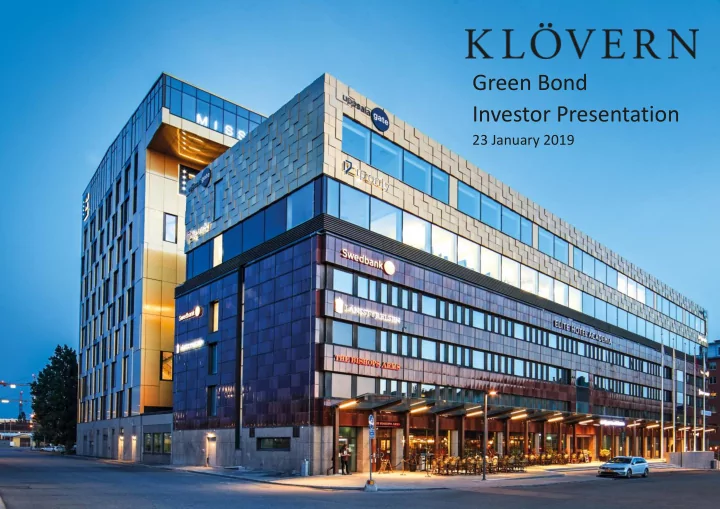
Green Bond Investor Presentation
23 January 2019
Green Bond Investor Presentation 23 January 2019 Disclaimer - - PowerPoint PPT Presentation
Green Bond Investor Presentation 23 January 2019 Disclaimer IMPORTANT INFORMATION Acceptance of limitations: The information in this presentation (the Material) is furnished by Klvern AB ( publ), Reg. Nr 556482- 5833 (the Company)
23 January 2019
2
IMPORTANT INFORMATION Acceptance of limitations: The information in this presentation (the “Material”) is furnished by Klövern AB (publ), Reg. Nr 556482-5833 (the “Company”) solely for the recipient’s information. The intended recipients are determined solely by Danske Bank A/S, Danmark, Sverige Filial, Nordea Bank Abp, filial i Sverige and Swedbank AB (publ) (together the “Managers”). By attending a meeting where the Material is presented, or by reading the Material, you agree to be bound by the limitations and notifications described below. The Material is strictly confidential and may not be disclosed or distributed to any other person unless expressly agreed by the Managers. Use of the Material: This Material does neither constitute an offer to sell nor a solicitation of an offer to buy any securities, and it does not constitute any form of commitment or recommendation in relation thereto. No representation or warranty (expressed or implied) is made as to, and no reliance should be placed on, the fairness, accuracy or completeness of the information in the Material. No financial advice: The Managers are not giving and is not intending to give financial advice to any potential investor, and this Material shall not be deemed to be financial advice from the Managers to any potential investor. Investors should not subscribe for or purchase any financial instruments or securities only on the basis of the information provided herein. Investors are encouraged to request from the Company and other sources such additional information as they require to enable them to make informed investment decisions, to seek advice from their own legal, tax and financial advisors and to exercise an independent analysis and judgment of the merits of the Company. No liability: Although the Company has endeavoured to give a correct and complete picture of the Company, neither the Company nor the Managers can be held liable for any loss or damage of any kind arising from the use of the Material. Information sources: The information in this Material is presented by the Company or constitutes publicly available material and has been produced by the Company assisted by the Managers exclusively for information purposes. This Material may contain forward-looking statements that reflect the Company’s current views with respect to certain future events and potential financial
Managers or their advisors. The information relating to the Company does not constitute a complete overview of the Company and must be supplemented by the reader wishing such completeness. Actuality: The Material is dated 23 January 2019. Neither the Company nor the Managers can guarantee that there has been no change in the affairs of the Company since such date, nor do they intend to, and assume no obligation to, update or correct any information included in the Material. The Material may however be changed, supplemented or corrected without notification. Conflicts of interest: The Managers and their clients and/or employees may hold shares, options or other securities of any issuer referred to in this report and may, as principal or agent, buy or sell such securities. Prospectus: The Material does not constitute a prospectus for purposes of the Prospectus Directive (Directive 2003/71/EC). Accordingly, the Material has not been approved by any supervisory
Authority’s webpage (www.fi.se/Register/Prospektregistret/Prospektregistret/) and at Klövern’s website. Distribution: The information in this Material is not for release, publication or distribution, directly or indirectly, in or into the United States or any other jurisdiction in which such distribution would be unlawful or would require registration or other measures. No securities referred to in this Material have been or will be registered by the Company under the U.S. Securities Act of 1933, as amended (the “Securities Act”) or the securities laws of any state of the United States. This Material may not be distributed into or in the United States or to any “US person” (as defined in Rule 902 of Regulation S under the Securities Act. Applicable law: The Material is subject to Swedish law, and any dispute arising in respect of the Material is subject to the exclusive jurisdiction of Swedish courts (with District court of Stockholm as court of first instance).
kWh in energy savings 2017 Klövern’s locally produced energy from the sun 2017 could: With energy savings (2016-2017):
kWh self-produced electricity from the sun The mean difference between Klövern’s and average energy use for heating and hot water in premises in 2016 can:
Lower heat-consumption than average according to Energimyndigheten 2016 Heat 16,000 apartments for a year Run a residential house for
364,124 days
Drive a Tesla 3,000 times through Sweden Keep a 40W light bulb on for 10 million hours Light up all residential houses in Stockholm for more than three days
”Sustainable development offers a framework to achieve social justice, exercise environmental stewardship and strengthen governance” – Ban Ki-moon
Reduce the CO2 emissions in Stockholm by 12,000 ton
3
4
Issuer: Klövern AB (publ) Instrument: Senior Unsecured Green Bond. Stand alone documentation. Volume: Tap under the framework amount of SEK 2,500m (SEK 900m currently outstanding) Nominal amount: SEK 100,000. Minimum subscription of SEK 1,100,000 Coupon: STIBOR 3m + 400 bps, no STIBOR floor. To be paid quarterly in arrears Tap price: Price corresponding to STIBOR 3m + [·] bps, no STIBOR floor Maturity: April 2022 Use of proceeds: Proceeds are intended to be used in accordance with Klövern’s Green Bond Framework to fund or refinance eligible green assets Financial undertakings: ▪ Equity ratio ≥ 20% (on a consolidated basis) ▪ Interest coverage ratio ≥ 1.25x (on a consolidated basis) General undertakings and
▪ No substantial change of business ▪ Compliance with laws ▪ Disposal of assets ▪ Dealings with related parties ▪ Admission to trading within 6 months ▪ Cross payment default to other financial indebtedness exceeding SEK 50m Put option: Investor put option at 101% of par value if any of the following events occurs: ▪ Change of Control Event: 50% ownership threshold (with certain exceptions) ▪ Delisting Event: the Issuer’s common shares are not listed and traded on Nasdaq Stockholm or any other Regulated market,
▪ Listing Failure: the Notes are not listed on the Nasdaq Stockholm exchange within 60 days after issue date, or are delisted Call option: The Issuer may redeem the Notes three months prior to Final Maturity Date at 100% of Nominal Value Listing: Nasdaq Stockholm Sustainable Bond List Trustee: Nordic Trustee & Agency AB (publ) Isin: SE0011063163 Joint bookrunners: Danske Bank, Nordea and Swedbank
5
6
7
Number of Properties
Property Value
Rental Value
Number of Tenants
Total Lettable Area
Number of Shareholders
Profit from Property Management*
* Trailing 12 months
Among all listed real estate (Sustainable brand index, 2017)
8
9
47%
Stockholm Region including Uppsala
#1 #6 #1 #1 #2 #3 #1 #1 #7 Klövern´s position #8 #5 #3
16%
10-year population growth in the 12 Swedish cities
SEKm 20,000 17,500 15,000
41% 59%
12,500 10,000 7,500 5,000 2,500
8%
SEK47.4bn
in property value
10
Office Warehouse/Logistics Retail
*Including Education/Healthcare/Other
11
2008 2009 2010 2011 2012 2013 2014 2015 2016 2017 2018 Q3 5,000 10,000 15,000 20,000 25,000 30,000 35,000 40,000 45,000 50,000
SEKm
12
13
Average Rent (SEK per sq.m.)*
Economic Occupancy Rate*
Number of Tenants
* For investment properties
Average Age of Properties***
Tenant Credit Rating**
*** Based on property value ** UC Rating Institute
14
15
Private Listed Public Sector
> 60 Listed companies > 25 Government agencies > 20 Municipalities
16
Stapelbädden 4, Malmö Codan house, Copenhagen Stapelbädden 2, Malmö Fairway house, Copenhagen
17
18
19
20
For Klövern, sustainable development means taking responsibility for the long-term economic, environmental and social impact of how we put our business concept and values into practice
ECONOMIC
▪
The adjusted equity ratio shall in the long-term amount to 40 %
▪
The operating margin shall amount to at least 65%
▪
Satisfied Customer Index (NKI) shall in long term amount to at least 75 ENVIRONMENTAL
▪
Reduction in heat consumption by at least 6% during 2016-2018
▪
Reduction in electricity consumption by at least 8% during 2016- 2018
▪
All new suppliers with framework agreements shall sign the code of conduct SOCIAL
▪
The Satisfied Employee Index (NMI) shall in the long-term amount to at least 75%
▪
The Attractive Employer Index (AAI) shall in the long-term amount to at least 80%
▪
All employees shall be trained in business ethics within 6 months from employment
Among listed real estate companies in 2017
Outcome Q3 2018 Award 2017 Selected sustainability goals
* Heat consumption decreased by a total of 5 per cent during 2016 and 2017 ** Electricity consumption decreased by a total of 5 per cent during 2016 and 2017 *** Outcome 2017 NKI***
69
Operating margin
71%
Adjusted equity ratio
37%
NMI***
75%
AAI***
84%
Reduced electricity consumption**
5%
Reduced Heat consumption*
5%
21
# Certified buildings
5 10 15 20 25 2017 2016 2015 2014 2013
Electricity consumption (kWh/sqm)
35 40 45 50 2017 2016 2015 2014 2013
✓ Lifecycle approach with minimum possible use of resources in the development and management of the properties and with the least negative environmental impact ✓ Klövern has a sensible purchasing policy, selecting suppliers with high standards in terms of environmental, social and ethical aspects
✓ First building was certified in 2011, since then a total of 23 properties have been environmentally certified ✓ All new constructions should be classified according to Miljöbyggnad ≥ Silver (or equivalent) ✓ Ambition is to increase the number of certified buildings in the existing property portfolio
✓ The proportion of renewable energy consumption increased to 55.9% during 2017 ✓ Electricity production from solar panels increased to 401MWh during 2017 ✓ Heat consumption reduced by 5% in 2016 and 2017 ✓ Klövern’s average value of heating is 63.9kWh/sq.m. (Dec 2017), compared to national average value (123 kWh/sq.m.) for “heating and hot water in premises”* ✓ Electricity consumption reduced by 5% in 2016 and 2017
✓ Support to tenants in their sustainability work by offering green lease contracts, which reduce the premises’ environmental impact. ✓ 162 green lease contracts in Dec 2017, corresponding to 8% of total contract value ✓ Provide premises with energy retrofits, infrastructure for electric cars, improved waste management, and terrestrial and aquatic biodiversity conservation (e.g. beehives)
Klövern’s environmental work is well integrated into the organisation
*Energy efficiency in BBR expressed as ”Primärenergital (PET)”, Primary Energy Number; measured in kWh/sq.m., year
22
Property Certification Location Type of premise Area Majorna 219:7
SILVER Göteborg Office 18,022 sq.m. Isafjord 8
SILVER Kista Office 30,500 sq.m. Isafjord 4
Kista Office 18,900 sq.m. Kungsängen 10:2
GULD Uppsala Hotel 8,663 sq.m.
23
* Included in the MTN programme
Eligible green assets under Klövern’s Green Bond Framework
Property Location Type of premise Area, sq.m. Rental value (SEKm) Certification Property value Isafjord 4 (part of) Stockholm Office 18,900 62.4 LEED GOLD
Isafjord 8 Stockholm Office 30,500 61.2 Miljöbyggnad Silver Kopparhammaren 2 (part of) Norrköping Office 3,510 10.0 Miljöbyggnad GULD & SILVER Kungsängen 10:1 Uppsala Office 12,113 24.0 Miljöbyggnad SILVER Kungsängen 10:2 Uppsala Hotel 8,663 20.7 Miljöbyggnad GULD Kungsängen 37:13 Uppsala Office and retail 15,240 24.4 LEED GOLD Majorna 219:7 Göteborg Office 18,022 27.2 Miljöbyggnad SILVER Mejramen 1 Göteborg Office 11,169 14.1 Miljöbyggnad SILVER Sigurd 7 Västerås Hotel and office 7,673 15.1 Miljöbyggnad Silver Property Location Type of premise Area, sq.m. Rental value (SEKm) Certification Property value Arenan 8* Stockholm Office 14,150 37.9 Breeam in use
Hilton 3* Solna Office, restaurant, gym, conference 20,051 51.2 Green building Allmogekulturen 5 Västerås Office, hotel and restaurant 14,926 13.0 Green building Barkassen 9 Karlstad Office 7,045 11.0 Green building Diket 10 Norrköping Office and retail 6,012 8.4 Green building Druvan 13 Karlstad Office, retail and residential 5,530 6.6 Green building Flygfyren 3 Malmö Office and warehouse 6,000 5.7 Green building Forskarbyn 2 Örebro Office 5,203 7.8 Green building Kanoten 10 Karlstad Office, warehouse and restaurant 10,165 11.0 Green building Linjalen 60 Täby Warehouse, office and office hotel 4,156 4.7 Green building Oxbacken 7 Örebro Office 2,942 4.6 Green building Pigan 1 Örebro Office and warehouse 932 1.0 Green building Pinassen 2 Karlstad Offices 14,272 31.5 Green building Pottegården Göteborg Office 1,950 1.4 Green building Traktorn 4 Malmö Office and retail 13,900 17.3 Green building Svänghjulet 1 Täby Restaurant, school and office hotel 4,191 4.8 Green building Ugglum 9:242 (part of) Partille Postal sorting 2,086 2.2 Green building Ängsviolen 1 Göteborg Office and warehouse 5,600 4.7 Green building
Other certified properties Properties expected to be certified within 24 months
Property Location Type of premise Area, sq.m. Rental value (SEKm) Pending certification Property value (when completed) Travbanan 2 och 3 Göteborg Fair, hotel and office N/A N/A Miljöbyggnad Silver N/A Kopparhammaren 2 Norrköping N/A N/A Miljöbyggnad Silver
24
Approximately 600 sq.m. solar panel installed producing c. 85,000 kWh per year, corresponding to 33% of the property’s yearly energy consumption Approximately 785 sq.m. of solar panels installed in the end of 2016/beginning of 2017 with an anticipated yearly production of 113,000 kWh. In October 2017 the production had already surpassed that level Energy from district heating is purchased for properties connected to the district heating network of Gothenburg, Norrköping and Örebro and some parts of
heating is purchased to properties certified according to Miljöbyggnad Norrköping Linköping Sustainable energy sources
25
Guldiga hotellet V-ås
Kungsängen 10:1 and 10:2, Uppsala Pinassen 2, Karlstad Bommen 6, Norrköping Travbanan 2-3, Gothenburg
26
27
200 400 600 800 1000 1200 1400 1600 1800 2000 2009 2010 2011 2012 2013 2014 2015 2016 2017 2018 Q3
SEKm
28
City Property Project type Contractor Largest tenant, moving-in year/quarter Project area, sq.m. Fair value, SEKm Estimated investment, SEKm Remaining investment, SEKm Increase in rental value, SEKm Estimated completion year/quarter
Gothenburg Travbanan 2, 3 Fair/hotel BRA Bygg Easyfairs, 19Q1 29,723 510 525 64 54 19Q2 Stockholm Knarrarnäs 4 Hotel Wästbygg Choice Hotels, 18Q4 7,012 250 198 29 12 18Q4 Norrköping Kopparhammaren 2 Office SEFAB Gaia, 19Q3 4,775 78 142 73 10 19Q4 Total 41,510 838 865 166 76
29
Change in fair value of properties due to projects and development of building rights, minus investments
20 40 60 80 100 120 140 160 180 2016 Q4 2017 Q1 2017 Q2 2017 Q3 2017 Q4 2018 Q1 2018 Q2 2018 Q3 Projects Building rights
156 218 374
SEKm
30
31
Planned projects Divested projects
32
Project portfolio ~2,200 units
493 ongoing
32
33
34
Debt maturity schedule Outstanding unsecured bonds vs total assets Capital structure 10 000 20 000 30 000 40 000 50 000 60 000 Other 8.9% 2 000 4 000 6 000 8 000 10 000 2018 2019 2020 2021 2022 2023 Later Loans Bonds 0% 5% 10% 15% 20% 25% 10 000 20 000 30 000 40 000 50 000 60 000 Q3 2018 2017 2016 2015 2014 2013 2012 Unsecured bonds Total assets less unsecured bonds Unsecured bonds as percent of total assets Commercial paper 5.0% Equity 32.1% Unsecured bonds 12.0% Secured bond 1.7% Bank debt 40.3% SEKm SEKm SEKm
35
20 25 30 35 40 2012 2013 2014 2015 2016 2017 2018 Q3 % 37%
36
20 30 40 50 60 70 2012 2013 2014 2015 2016 2017 2018 Q3 % Leverage Leverage, properties 60% 46%
37
1 2 3 4 5 6 7 Q3 2013 Q3 2014 Q3 2015 Q3 2016 Q3 2017 Q3 2018 0,0 0,5 1,0 1,5 2,0 2,5 3,0 3,5 Average interest, % ICR (x) Average interest Interest coverage ratio, trailing 12 months 2.8x 2.5%
38
0,0 0,5 1,0 1,5 2,0 2,5 3,0 3,5 4,0 4,5 Q3 2013 Q3 2014 Q3 2015 Q3 2016 Q3 2017 Q3 2018 Years Fixed interest Tied-up capital 2.8 4.2
Fixed-interest share of credit volume
4.0 3.5 3.0 2.5 2.0 1.5 1.0 0.5 0.0 4.5
39
500 1000 1500 2000 2500 3000 2012 2013 2014 2015 2016 2017 2018 Q3* Profit from property management Net profit
* Trailing 12 months
SEKm
0.5 1.0 1.5 2.0 2.5 3.0
40
2018 2017 2018 2017 Trailing 12m 2017 (SEKm) Jul-Sep Jul-Sep Jan-Sep Jan-Sep Oct-Sep Jan-Dec Income 813 743 2,397 2,261 3,165 3,029 Property costs
Operating Surplus 580 521 1,646 1,553 2,099 2,006 Central administration
Net financial items
Profit from Property Management 367 336 1,047 1,001 1,309 1,263 Income, residential development 42
7
associated co:s to subsidiary
271 346 817 1,371 1,359 1,913 Change in value, derivatives 44 16 54 82 72 100 Change in value, financial assets
Write-down of goodwill
Profit Before Tax 644 692 1,888 2,410 2,689 3,211 Current and deferred tax
Net Profit 578 567 1,774 2,006 2,379 2,611
41
2018 2017 2017 (SEKm) 30 Sep 30 Sep 31 Dec Goodwill 155 196 183 Investment properties 47,378 41,392 42,961 Machinery and equipment 21 17 16 Participation rights in associated companies 221
73 91 113 Properties (current assets) 1,095
2,084 879 945 Liquid funds 350 391 39 Total Assets 51,377 42,966 44,257 Equity attributable to the parent company’s shareholders 16,033 13,927 14,505 Equity attributable to holdings without controlling influence 453 Deferred tax liability 2,697 2,351 2,550 Interest-bearing liabilities 30,298 24,874 25,529 Derivates 300 394 367 Accounts payable 86 99 368 Other liabilities 699 560 403 Accrued expenses and prepaid income 811 761 535 Total shareholders’ equity and liabilities 51,377 42,966 44,257
42
10 20 30 40 50 60 70 80 90 2011 2012 2013 2014 2015 2016 2017 Dividend,% Goal, %
Adjusted equity ratio* Long-term 40%
Klövern achieved an adjusted equity ratio of 37.0% at the end of Q3 2018 Operating margin was 66% at the end of Q3 2018, based on rolling 12 months Dividend in relationship to profit from property management was 57% at year end 2017 The interest coverage ratio was 2.8x at the end of Q3 2018, based on rolling 12 months
Interest coverage ratio ≥ 2.0x Operating margin ≥ 65% Dividend Long-term ≥ 50%
management
Outcome Financial goals Historical outcome (green line illustrates Klövern’s financial goals)
*Reported equity adjusted for the value of derivatives, goodwill and deferred tax liabilities exceeding 5 per cent of the difference between taxable value and fair value of the properties in relation to reported total assets adjusted for goodwill
5 10 15 20 25 30 35 40 45 2011 2012 2013 2014 2015 2016 2017 Q3 2018 Adjusted equity ratio, % Goal, % 0,0 0,5 1,0 1,5 2,0 2,5 3,0 3,5 2011 2012 2013 2014 2015 2016 2017 Q3 2018 ICR, x Goal, x 60 61 62 63 64 65 66 67 2011 2012 2013 2014 2015 2016 2017 Q3 2018 LTM Operating margin, % Goal, %
43
44
Use of Proceeds
and the Sustainability team
Eligible Green Assets during the life of the green bonds
Process for Project/Asset Evaluation
proceeds are financing eligible assets
Management of Proceeds
estimated annual emissions reductions)
Reporting
New construction and major renovations that either have or will have an environmental building certification: ✓ Miljöbyggnad ≥ Silver ✓ LEED ≥ Gold ✓ BREEAM SE ≥ Very Good ✓ BREEAM ≥ Very Good ✓ Or, have an energy class of at least 25 per cent below the current buildings regulation (Swedish BBR code) Existing buildings: Improvements of energy performance to ≤ 100 kWh/sq. m. or reducing energy use by at least 25%. Improvements may include: ✓ Onsite renewable energy (e.g. solar panels) ✓ Energy retrofits (e.g. installing heat pumps and converting to LED lights) ✓ Infrastructure for electric cars ✓ Improved waste management (e.g. recycling) ✓ Terrestrial and aquatic biodiversity conservation (e.g. beehives)
Klövern’s framework was launched in Q1 2018 and aligns to ICMA’s Green Bond Principles 2017
The inaugural unsecured green bond of SEK900m was issued in March 2018
45
46
Investments in bonds always involve a certain degree of risk. In this section a number of risk factors are described, both general risks attributable to Klövern AB (publ) (“Klövern”) and its subsidiaries’ (“Klövern Group” or the “Group”) operations and main risks linked to the Bonds in their capacity of financial instruments. A number of factors affect and may come to affect Klövern Group’s operations, result, financial position and the Bonds. The intention is to describe risks that are related to Klövern Group’s operations and thus also Klövern’s ability to fulfil its obligations in accordance with the Terms and Conditions. Before making a decision to invest in the Bonds, any potential investors should carefully consider the risk factors outlined below, as well as any other relevant information such as the Terms and Conditions of the Bonds and any publicly available financials and other information of Klövern. In addition, an investor must, alone or together with its financial and other types of advisors, engage in a general evaluation of external facts and general information about the property market and property companies from its own perspective. An investor should have adequate knowledge to evaluate the risk factors as well as sufficient financial strength to bear these risks. The below risks are not ranked in order of importance. The risks presented herein are not exhaustive as additional risk factors which are currently unknown or which are currently not deemed to be material may also affect Klövern Group’s future business, financial position and earnings and thus also Klövern’s ability to fulfil its obligations in accordance with the Terms and Conditions. RISKS RELATED TO KLÖVERN AND ITS OPERATIONS Macroeconomic factors The real estate market is to a large extent affected by macroeconomic factors such as the general economic development, growth, employment, level of production of new premises, changes in infrastructure, population growth, inflation and interest rate levels. Economic growth affects the employment rate, which is an essential basis for supply and demand on the rental market and consequently impacts vacancy rates and rental levels. Inflation expectations have an impact on the interest rate and thus affect the net interest income. Interest expenses on debt to credit institutions and bondholders are Klövern Group’s single largest cost items. In the long term, interest rate changes will have significant impact on Klövern Group’s earnings and cash flow. The inflation also impacts Klövern Group’s costs. Furthermore, changes in interest rates and inflation also impact yield requirements and by that, the market value of the properties’ market value. A number of Klövern Group’s lease agreements are wholly or partially linked to the consumer price index (CPI), i.e. the lease agreements are wholly or partially adjusted in accordance with the inflation. There is a risk that Klövern Group is not able to negotiate lease agreements that wholly or partially compensate the inflation. If Klövern Group’s costs increase more due to inflation than Klövern Group’s compensation due to index adjustments, this would have a negative impact on Klövern Group’s earnings. Higher vacancy rates and interest rates, increased costs and lower rental rates could have a significant negative impact on Klövern Group’s business, financial position and earnings. Geographical risks The supply and demand of properties and by that, the return on real estate investments differs between geographical markets and may develop differently within the geographical markets. Klövern has as of 30 September 2018 a property portfolio with 403 properties in different geographical areas. There is a risk that demand does decline on most or all geographical markets in which Klövern operates, which could have a significant negative impact on Klövern Group’s business, financial position and earnings.
47
Rental income and rental development In the long term rental income for commercial properties is affected by, inter alia, the supply and demand on the market. Klövern’s rental income will be affected by the vacancies of the properties, contracted rental levels and that the tenants pay their rent on time. Decreased occupancy rates and rental rates will, regardless of reason, affect Klövern Group’s earnings negatively. The risk for great fluctuations in vacancies and loss of rental income increases, the more single large tenants a real-estate company has. The ten largest tenants as of 31 December 2017 accounted for 17.7 per cent of the total contracted rental income, of which the largest, being Ericsson, accounted for 6.0 per cent. The total number of leases entered into with the ten largest tenants was 225 as of 31 December 2017. There is a risk that Klövern Group’s larger tenants do not renew or extend their lease agreements upon expiry and that the Klövern Group does not find new tenants, which in the long term could lead to a decrease in rental income and an increase in vacancies. The leases entered into with the Klövern Group's ten largest tenants are of different duration. The average remaining term of these leases was 6.1 years as of 31 December 2017. Klövern Group’s earnings and cash flow will be impacted negatively if tenants stop their payments, or otherwise do not fulfil their obligations and could have a significant negative impact on Klövern Group’s business, financial position and earnings. Operating and maintenance costs Operating costs mainly consist of tariff-based costs such as costs for electricity, sanitation, water and heating. Many of these products and services can only be bought from one service provider, which may affect the price. The costs for electricity and heating have the largest impact on the result regarding Klövern’s operating surplus. To the extent increases in such costs are not compensated by terms in lease agreements, or by renegotiation of lease agreements in order to increase the rent, this will impact Klövern Group’s net operating income negatively. Maintenance costs are attributable to actions that intend to maintain the properties’ long term standard in order to comply with market, governmental and legal requirements. Unexpected and large renovation needs that cannot be compensated by an increment of incomes will affect Klövern Group’s earnings negatively which could have a significant negative impact on Klövern Group’s business, financial position and earnings. Interest risk Klövern Group’s business is mainly financed, in excess of equity, by borrowings from credit institutions and the bond market. Klövern Group’s capital structure results in interest expenses being the main costs
current market interest rates and Klövern Group’s strategy as regards hedging the interest rates. The Klövern Group's total interest costs for the financial year of 2017 amounted to SEK 592 million and the Group’s average interest rate level was 2.5 per cent. The market interest rates for long-term interest periods are mainly affected by the expected inflation rate, where pricing of bonds and certificates are determined by supply and demand. The interest rates for short-term interest periods are mainly affected by the Swedish National Bank’s (Sw. Riksbankens) actions and decisions relating to its repurchase rate (Sw. reporäntan), which is a monetary policy rate
Group’s financial position adversely. This could have a significant negative impact on Klövern Group’s business, financial position and earnings. Changes in value of interest derivatives All of Klövern Group’s credit agreements have floating interest rates. Klövern Group uses interest derivatives, mainly interest swaps and interest caps, thus effectively limit the interest rate risk. The interest derivatives are recorded continuously at actual value in the balance sheet and stated as value changes in the income statement. The actual value of the derivatives as of 30 September 2018 was SEK –300
decreases if the market interest rates decrease, which could have a significant negative impact on Klövern Group’s business, financial position and earnings.
48
Credit risk Credit risk is the risk that Klövern Group’s counterparties may not fulfil their obligations to Klövern Group. The financial position of Klövern Group’s current and potential customers may deteriorate to such extent that they become unable to perform their financial obligations towards Klövern Group. Credit risk within Klövern’s financial operations arises for instance from excess cash placements, entering of interest-rate swap agreements and obtaining long- and short-term financing under credit agreements or capital market financing. There is a risk that Klövern’s counterparties do not fulfil their obligations towards Klövern which could have a significant negative impact on Klövern Group’s business, financial position and earnings. Refinancing risks Refinancing risk is the risk that necessary financing may not be obtained, or could only be obtained at significantly increased costs as concerns refinancing of existing debts or new borrowing. As of 30 September 2018, the Klövern Group's net indebtedness amounted to SEK 30,298 million. There is a risk that future refinancing is not possible at all, or is not possible on terms that are attractive for Klövern. In case Klövern Group is unable to refinance existing facilities or obtain additional financing at market terms, as a result of an insufficient supply in the capital market or for any other reason, it will have a negative impact on Klövern Group’s business, financial position and earnings. Financial obligations Klövern Group has obtained financing through bank loans as well as from the capital market. Klövern Group has furnished security and issued guarantees for some loans. Credit agreements may include financial obligations regarding i.e. ownership of the companies being parties to such credit agreements. If such provisions are violated by Klövern Group, relevant loans could be immediately terminated or result in enforcement of the pledged assets. This will have a negative impact on Klövern Group’s business, financial position and earnings. Some of Klövern Group’s credit agreements include cross default provisions. By being in violation of obligations under a specific credit agreement, the cross default provision may entail an acceleration of
Change of control and ownership Some of Klövern’s agreements contain provisions that are activated due to a change of control in Klövern. If such changes occur, certain rights of the opposite party or obligations for Klövern may be activated, which will, in turn, have an impact on Klövern’s future financing. Such impact, which indirectly could affect Klövern’s ownership of properties, could have a significant negative impact on Klövern Group’s business, financial position and earnings. Liquidity risks Liquidity risk is the risk that Klövern would lack sufficient liquid funds to fulfil its financial payment obligations, which mainly consist of operating costs such as electricity, sanitation, water and heating, contracted maintenance fees, investments and debt interest. If Klövern’s access to liquid funds would be impeded, it will have a negative impact on Klövern Group’s business, financial position and earnings. As
including unutilized overdraft facilities of SEK 558 million.
49
Changes in value of properties Klövern Group’s real estate investments are recorded in the balance sheet at actual value and the value changes are recorded in the income statement. Unrealized value changes have no impact on the cash
means that normally each property in the portfolio is valued externally over a rolling 12-month period. Klövern’s loan to value ratio was 60 per cent as of 30 September 2018. The value of the properties is affected by a number of factors, partly by property specific factors such as renting levels, rental rates and operating costs and partly by market specific factors such as yield demands and cost of capital that are derived from comparable transactions on the real estate market. Property related deteriorations such as lower rental income and increased vacancies, as well as market specific factors such as demand for higher return on investments can cause Klövern Group to write down the actual value of its investment properties, which could have a significant negative impact on Klövern Group’s business, financial position and earnings. Change in exchange rate Klövern owns real estate in Denmark and a site leasehold and a real estate in Manhattan in New York, which entails an exposure towards the Danish krona and the U.S. dollar respectively. The income and expenses of the Danish properties are denominated in Danish kroner and the properties are financed mainly through credit facilities in Danish kroner. The income and expenses of the site leasehold and the real estate in Manhattan are denominated in U.S. dollars. Should an exchange rate change occur which is unfavourable for Klövern, this will have a negative impact on Klövern Group’s business, financial position and earnings. Transactions To acquire and sell properties is part of Klövern’s ordinary business and especially acquisitions, involve certain risks. All investments are associated with uncertainties, such as loss of tenants, environmental circumstances and technical problems. There is a risk that future business activities or properties that are added through acquisitions do not result in the anticipated positive impact and, as such, could have a significant negative impact on Klövern Group’s business, financial position and earnings. Further, there is a risk that a seller, in connection with an acquisition, may not fulfil its obligations due to financial difficulties, which may affect Klövern Group’s possibility to bring forward claims on compensation according to contracted indemnities or warranties (which may also be subject to limitations in amount and time). Selling properties involves uncertainties regarding, inter alia, price and the ability to get provision for the properties. Further, Klövern may be subject to claims due to the sale or the condition of the sold
transactions. The willingness and ability to pay for properties that Klövern wishes to sell are affected by several factors. The willingness to pay for properties is dependent on how well the properties are corresponding with the market demands, general price trends on the real estate market, as well as the supply, and cost of, other properties. The ability to pay for properties depends on the general wage trends, employment rate and other factors affecting the economy, such as the ability to make interest deductions and access to financing. These factors may affect potential buyers’ willingness and ability to pay for the properties that Klövern wishes to sell. Realization of any of the risks mentioned in this section could have a significant negative impact on Klövern Group’s business, financial position and earnings.
50
Project risks The operations of Klövern Group also comprise property development projects. When developing property certain risks arise. Larger projects may entail major investments which may lead to an increased credit risk if tenants are unable to fulfil their obligations towards Klövern Group, and Klövern Group in turn would be unable to find other tenants for the premises in question, or if the demand or the price for the property alter during the project. Projects may also be delayed or may entail higher costs than foreseen which may lead to increased costs or decreased earnings. Further, Klövern Group is dependent on receiving the proper authority decisions and permits to carry out property development projects. In the event of the above, there is a risk that this will have a significant negative impact on Klövern Group’s business, financial position and earnings. Residential units A part of Klövern’s business consists of managing and participating in property development projects and sales of residential units, which entails that both the desire and the ability to pay for residential units may affect Klövern’s operations, earnings and financial position. The desire to pay for residential units is, among other things, dependent on how well a specific residential unit corresponds to the market demand, the activity on the residential market, the general price trend on residential units and demographic factors, such as people moving to and from the relevant regions. The desire to pay for residential units is further affected by, among other things, the access and cost for alternative residential forms. The ability to pay for residential units is, among other things, dependent on the development of wages, the employment ratio, the levels of taxes and charges and other factors which generally affect the economy of households. The ability to pay for residential units is also affected by the household’s possibility to make interest deductions, receive loan financing, the development of interest rates for residential loans and of the statutory, or by the banks applied, rules for maximum borrowings and amortisations. Should changes of rules which aim to regulate the households total borrowings be implemented there is a risk that this will have a negative impact on the ability to pay for residential units. If customer’s desire or ability to pay for the residential units which Klövern Group produces decreases, this will have a negative impact on Klövern’s business, financial position and earnings. Public takeover offer of all shares in Agora On 4 October 2018 Klövern, through its indirectly wholly-owned subsidiary Dagon Sverige AB, announced a public cash offer of all shares in A Group of Retail Assets Sweden AB (publ) (“Agora”). On 13 November 2018 Klövern announced that Dagon Sverige AB has decided to complete the offer and that all conditions for the offer are satisfied. On 27 November 2018 Klövern announced that Klövern, through Dagon Sverige AB, owns approximately 99.5 per cent of the outstanding shares and approximately 99.8 per cent of the outstanding votes in Agora. Klövern and Dagon Sverige AB have initiated a compulsory acquisition procedure under the Swedish Companies Act to acquire all shares not tendered in the Offer. As a result of the acquisition, Klövern’s debt in percentage of equity has increased which has entailed that Klövern's loan-to-value ratio has increased, which can have an adverse effect on the Group's business, financial position and earnings. Dependence on subsidiaries Klövern will rely upon receiving dividends from its subsidiaries, and is thus dependent upon receipt of sufficient income deriving from the operations of and the ownership in such subsidiaries to enable it to make payments under the Bonds. The subsidiaries are legally distinct from Klövern and have no obligation to make payments to Klövern of any profits generated from their business, other than the obligation to make payments under any intragroup loans. The ability of Klövern’s subsidiaries to make payments to Klövern is subject to, among other things, the availability of funds (which in turn will depend on the future performance of the subsidiary concerned and therefore to a certain extent on general economic, financial, competitive, legislative, regulatory and other factors that may be beyond its control), corporate law (e.g. limitations on value transfers), local law and the terms of each subsidiary’s financing arrangements. If such subsidiaries are incapable of distributing sufficient dividends to Klövern, there is a risk that this will have a significant negative impact on Klövern Group’s business, financial position and earnings.
51
Executive management, staff and operational risk Operational risk is the risk of incurring losses due to inadequate procedures and/or irregularities. Should Klövern Group’s internal control, administrative system adapted for the purposes, skills development and access to reliable valuation and risk fail, there is a risk that this will have a significant negative impact on Klövern Group’s business, financial position and earnings. The Klövern Group’s employees’ knowledge, experience and commitment are important for Klövern Group’s future development. Klövern Group would be affected negatively if a number of its employees would leave Klövern Group at the same time, or if a number of key employees would leave, or if the Group’s administrative security and control would fail. Negative publicity The Klövern Group’s reputation is important for its business. Should the reputation be damaged, the Klövern Group’s customers and other stakeholders could lose trust in Klövern. For instance, should Klövern
Competition Klövern Group acts in an industry that is exposed to competition. Klövern Group’s future competitive opportunities are dependent on, among other things, Klövern Group’s ability to be at the forefront and respond quickly to existing and future market needs. Klövern Group may therefore be forced to make cost demanding investments, to restructure or to make price reductions in order to adapt to a new competition situation. Increased competition could have a significant negative impact on Klövern Group’s business, financial position and earnings. Technical risks Property investments are associated with technical risks. Technical risk is defined as the risk associated with the technical management of the property, such as the risk for construction errors, other latent defects and deficiencies, damages (for example by fire or other force of nature) and pollution. There is a risk that, if such technical problems would occur, they could cause significant increased costs for Klövern Group and could have a significant negative impact on Klövern Group’s business, financial position and earnings. Legal risks The Klövern Group’s business is regulated by and must be conducted in accordance with several laws and regulations, (inter alia the Swedish Companies Act (Sw. aktiebolagslagen (2005:551)), the Swedish Land Code (Sw. Jordabalken 1970:994), the Swedish Environmental Code (Sw. Miljöbalken (1998:808)) and the Swedish Planning and Building Act (Sw. plan- och bygglagen (2010:900)), detailed development plans, building standards, security regulations, etcetera. There is a risk that Klövern Group’s interpretation of applicable laws and regulations may be incorrect or may change in the future. The Klövern Group may also be required to apply for various permits and registrations with municipalities and authorities in order to pursue property development. There is a risk that Klövern Group will not be granted necessary permits or other decisions for its business activities or that such permits or decisions are appealed, which could result in increased costs and delay in planned development of properties or otherwise have negative impact on the conduct and development of its business. New laws or regulations, or changes concerning the application of existing laws or regulations that are applicable to Klövern Group’s business activities or the tenants’ business activities could have a significant negative impact on Klövern Group’s business, financial position and earnings.
52
Environmental risks Property management and property development have an environmental impact. According to the Swedish Environmental Code (Sw. Miljöbalken), everyone who has conducted a business operation that has contributed to pollution, also has a responsibility for after-treatment of the property. If the responsible person is unable to carry out or pay for the after-treatment of a polluted property, the person who has acquired the property is liable for after-treatment provided that the buyer at the time of the acquisition knew of or should have discovered the pollution. This means that claims, under certain conditions, may be raised against Klövern Group for soil remediation or for remediation concerning presence or suspicion of pollution in soil, water areas or ground water, in order to put the property in a condition pursuant to the Swedish Environmental Code. Such claims may have a negative impact on Klövern Group’s business, financial position and earnings. There is a risk that future environmental risks may have a significant negative impact on Klövern Group’s business, financial position and earnings. Furthermore, changed laws, regulations and requirements from authorities in the environmental area could result in increased costs for Klövern Group with respect to cleaning-up or after-treatment regarding currently held or in the future acquired properties. Such changes could also result in increased costs or delays for the Klövern Group in order to be able to carry out the real estate development as desired. Tax risks and risk of changes in legislation Klövern Group’s operations are conducted in accordance with Klövern Group’s interpretation of applicable tax laws, regulations and case law and in accordance with advice from tax advisors. However, it cannot be ruled out that Klövern Group’s interpretation is incorrect or that such regulations or case law are amended with potential retroactive effect. Thus, through decisions from the Swedish Tax Agency and the Administrative Courts, Klövern Group’s previous or current tax situation may change, which could have a significant negative impact on the Klövern Group’s business, financial position and earnings. Klövern Group’s operations are affected by the tax rules in force from time to time in Sweden. Since these rules have historically been subject to frequent changes, further changes are expected in the future (potentially with retroactive effect). Such changes could have a significant negative impact on the Klövern Group’s business, financial position and earnings. For example, the Swedish Parliament adopted on 14 June 2018 new Swedish interest deduction limitation rules. The new rules are based on the EU Directive 2016/1164 that lays down rules against tax avoidance practices that directly affect the functioning of the internal market. Under the new Swedish rules, a general limitation for interest deductions in the corporate sector is introduced by way of an EBITDA-rule. Under the EBITDA-rule, net interest expenses, i.e. the difference between the taxpayer’s interest income and deductible interest expenses, are only deductible up to 30 per cent of the taxpayer’s EBITDA for tax purposes. The rules has entered into force 1 January 2019. In connection with the introduction of the general interest deduction limitation rules, the Swedish corporate tax rate will be reduced in two steps, initially from the present 22 per cent to 21.4 per cent (as of 1 January 2019) and then in a second step from 21.4 per cent to 20.6 per cent (as of 1 January 2021). Since Klövern Group’s operations are capital intensive and financing costs such as interest expenses constitute the largest current costs in Klövern Group’s operations, the new rules may have a significant negative impact on Klövern Group’s business, financial position and earnings. Also, in June 2015 the Swedish Government appointed a committee to analyse the possibility to divest properties through tax exempt disposals of shares in companies holding properties and, if considered necessary, to propose new legislation to prevent such transactions. The investigation also reviewed whether acquisitions through land parcelling procedures are being abused to avoid stamp duty. The result of the review was presented by the committee in March 2017. The committee’s main proposal is that upon a change of control in a company holding assets that mainly consist of properties, the properties will be considered as divested and re-acquired for a price corresponding to the market value of the properties. The divested real estate company should also report a taxable notional income (instead of stamp duty) corresponding to 7.09 per cent of the highest amount of the market value and the tax assessment value of the properties. Further, stamp duty is proposed to be introduced on acquisitions of properties by land parcelling procedures. It is currently unclear if, and to what extent, the proposals will result in new legislation. If any of the proposals are enacted, it could have a significant negative impact on Klövern Group’s business, financial position and earnings.
53
Accounting risks Klövern is affected by the accounting legislation in force from time to time, including for example IFRS and other international reporting standards. This means that Klövern’s accounting, financial reporting and internal control, in the future, may be affected and in need of adaption to new accounting principles and/or changed application of such legislation. This could entail uncertainty regarding Klövern’s accounting, financial reporting and internal control and could also affect Klövern’s reported earnings, balance sheet and equity, which could have a significant negative impact on Klövern’s business, financial position and earnings. Disputes Klövern Group has no ongoing tax or civil court cases or other issues which have not been accounted for in the financial reports of Klövern. A negative outcome of any other future disputes could have a negative impact on Klövern Group’s business and significant fines and damages could have an adverse effect on Klövern Group’s financial position and earnings. The Klövern Group may in the future be involved in disputes or be subject to claims. Such disputes could be time-consuming and result in costs, the size of which cannot always be foreseen. Disputes could, therefore, have a significant negative impact on Klövern Group’s business, financial position and earnings. RISKS RELATING TO THE BONDS Liquidity risks Klövern cannot assure that a liquid trading of the Bonds will occur and be maintained. Klövern will apply for listing of the Bonds at Nasdaq Stockholm after the Swedish Financial Supervisory Authority (Sw. Finansinspektionen) approves a prospectus for this purpose. However, there is a risk that the Bonds will not be approved for trading. If a Bond is admitted to trading on the regulated market there is a risk that a demand for and trading with the Bonds will not exist. In addition, following listing of the Bonds, the liquidity and trading price of the Bonds may vary as a result of numerous factors, including general market movements and irrespective of Klövern’s performance. This may entail that a Bondholder cannot sell his or her Bonds at the desired time or at a yield which is comparable to similar investments that have an existing and functioning secondary market. A lack of liquidity in the market may have a negative impact on the market value of the Bonds. Credit risk Investments in bonds in general entail a certain degree of risk for investors, including the risk of losing the value of the entire investment. Investors who invest in the Bonds become exposed to a credit risk in relation to Klövern and the Bonds carry a, relatively, high interest, which is to be regarded as a compensation for the, relatively, higher risk an investor carries compared to an investment in Swedish government bonds. The investor’s ability to receive payment under the Terms and Conditions is dependent on the Group’s ability to fulfil its payment obligations, which in its turn is dependent on the development of Klövern Group’s business activities and its financial position. The Group’s financial position is affected by several risk factors, of which a number have been discussed above. An increased credit risk may cause that the Bonds will be attached with a higher risk premium by the market, which would affect the Bonds’ value and price in the secondary market negatively. Another aspect
Interest rate risks The Bonds’ value depends on several factors, one of the most significant over time being the level of market interest. Investments in the Bonds involve a risk that the market value of the Bonds may be adversely affected by changes in market interest rates.
54
Risks relating to green bonds What constitutes a green bond is determined by the criteria set out in Klövern’s green bond framework (the "Green Bond Framework") as it is currently worded on the issue date of the relevant Bonds. There is a risk that the Bonds issued in accordance with the Green Bond Framework will not suit all investors' requirements, demands or specific investment mandates. Every investor should obtain up-to-date information about the risks and principles of the Bonds before making an investment, as the risks and principles may change or develop over time. The Green Bond Framework as well as the market standard for green bonds may develop after a specific issue date which may entail amendments to the Green Bond Framework for subsequent Bonds and amended requirements being applicable to Klövern. Amendments in the Green Bond Framework after the issue date for specific Bonds will not affect the terms of the Bonds already issued. Any failure by Klövern to comply with the Green Bond Framework will not entitle Bondholders to accelerate the Bonds. Neither will Bondholders have the right to an early prepayment or redemption of the Bonds, or any other type of compensation for the failure to comply with the Green Bond Framework. Refinancing risk The Group may eventually be required to refinance certain or all of its outstanding debt, including the Bonds. The ability to successfully refinance its debt is dependent on the conditions of the capital markets and its financial condition at such time. The Group’s access to financing sources may not be available on favorable terms, or at all. The Group’s inability to refinance its debt obligations on favorable terms, or at all, could have a significant negative impact on Klövern Group’s business, financial condition and earnings results and on the Bondholders’ recovery under the Bonds. Priority rights The Bonds constitute direct, unconditional, unsecured and unsubordinated obligations of Klövern and shall rank at least pari passu with other unsecured and unsubordinated obligations of Klövern. This means that a Bondholder, in the event of Klövern’s liquidation, company reorganisation or bankruptcy, normally would receive payment after any prioritised creditors (e.g. lenders or investors that have the benefit of security) have received payment. The Terms and Conditions do not include a so called “negative pledge” undertaking and hence Klövern may post security to other lenders, including for the benefit of holders
programme (the “MTN Programme”) with a framework amount of SEK 10,000,000,000, secured by a pool of properties as underlying assets and fully covered by property mortgage certificates. Klövern has at the date of this Prospectus issued bonds in the total amount of SEK 850,000,000 under the MTN Programme. In the future Klövern may issue more bonds under the MTN Programme which will be secured in accordance with the above. Each investor should be aware of the fact that there is a risk that the person that invests in the Bonds may lose the whole, or parts of, his or her investment in the event of Klövern’s liquidation, bankruptcy or company reorganisation. Structural subordination and dependency on subsidiaries Since Klövern is the parent company to the Group’s property owning companies, Klövern is dependent upon receiving dividends and group contributions from its subsidiaries to be able to fulfil its obligations under the Terms and Conditions. The Bonds are not guaranteed by any of these subsidiaries or any other company or person. This means that the Bonds are structurally subordinated to any indebtedness raised in any of the property owning subsidiaries, and so the creditors of such indebtedness have priority over the Bondholders to the assets and revenue generated in the subsidiaries. The Terms and Conditions do not include any restriction (other than indirectly by way of the interest cover ratio and the equity ratio covenant) on the ability of Klövern to incur additional indebtedness, neither in Klövern nor in any of the subsidiaries. The Group has within the framework of its financing raised loans from credit institutions and has thereby pledged mortgage deeds in certain properties and shares in some of the Group’s property owning
financing). The issuance of secured capital markets financing may negatively affect the liquidity, value and price of the Bonds in the secondary market.
55
Prepayment risk Klövern has a right under the Terms and Conditions to redeem all outstanding Bonds three months prior to the Final Maturity Date. There is a risk that the market value of the Bonds is higher than the price that Klövern may be entitled to redeem the Bonds for. An early redemption can never be made at an amount lower than a nominal amount of 100 per cent. According to the Terms and Conditions, the Bondholders have the right to request prepayment of their Bonds should a Change of Control Event, Delisting Event or a Listing Failure, as defined in the Terms and Conditions, occur. Klövern may further be obliged to redeem the Bonds if it is, or becomes impossible or unlawful, for Klövern to perform any of the provisions of the Terms and Conditions or if the obligations under the Terms and Conditions are not legal, valid, binding or enforceable. There is a risk that Klövern will not have sufficient funds at the time of such prepayment to make the required prepayment of the Bonds. The Bondholders’ right to request prepayment in case of a Change of Control or Delisting Event does, however, not apply if a company (i) that is a real estate company incorporated under the laws of Sweden and (ii) whose shares are listed on Nasdaq’s Nordic Mid Cap or Nasdaq’s Nordic Large Cap, acquires or takes control over the Company or the delisting is a result of such company’s public offer for the shares in the Company. Thus, there is a risk that a change of control or delisting occurs without the Bondholders having a right of prepayment of the Bonds. Currency risks The Bonds are denominated and payable in SEK. If Bondholders measure their investment return by reference to a currency other than SEK, an investment in the Bonds will entail foreign exchange-related risks due to, among other factors, possible significant changes in the value of the SEK relative to the currency by reference to which investors measure the return on their investments could cause a decrease in the effective yield of the Bonds below their stated coupon rates and could result in a loss to investors when the return on the Bonds is translated into the currency by reference to which the investors measure the return on their investments. Government and monetary authorities may impose (as some have done in the past) exchange controls that could adversely affect an applicable exchange rate or the ability of the Issuer to make payments in respect of the Bonds. As a result, there is a risk that investors may receive less interest or principal than expected, or no interest or principal. Ability to comply with the Terms and Conditions Klövern is required to comply with the Terms and Conditions, inter alia, to pay interest under the Bonds. Events beyond Klövern’s control, including changes in the economic and business conditions in which Klövern Group operates, may affect Klövern’s ability to comply with, among other things, the undertakings set out in the Terms and Conditions. A breach of the Terms and Conditions could result in a default under the Terms and Conditions, which could lead to an acceleration of the Bonds, resulting in that Klövern has to repay the Bondholders. It is possible that Klövern will not have sufficient funds at the time of the repayment to make the required redemption of Bonds. Euroclear The Bonds will be connected to Euroclear Sweden AB’s (”Euroclear”) account-based system, why no physical bonds have been or will be issued. Clearing and settlement at trading with the Bonds, as well as payment of interest and redemption of principal amounts will be performed within Euroclear’s account-based system. The investors are therefore dependent on the functionality of Euroclear’s account-based system. Bondholders’ Meeting and Written Procedure The Terms and Conditions of the Bonds include certain conditions regarding the Bondholders’ meeting, or a Written Procedure, that can be held in order to resolve matters relating to the Bondholders’
Procedure, or have voted differently than the required majority, to decisions that have been taken at a duly convened and conducted Bondholders’ Meeting or a Written Procedure.
56
Bondholders’ representation In accordance with the Terms and Conditions, the Agent represents all Bondholders in all matters relating to the Bonds, unless the majority requirements in the Terms and Conditions are observed. Hence, individual Bondholders do not have the right to take legal actions to declare any default by claiming any payment from or enforcing any security granted by Klövern and may therefore lack effective remedies unless and until a requisite majority of the Bondholders agree to take such action. However, this does not rule out the possibility that the Bondholders, in certain situations, could bring their own action against Klövern, which may affect an acceleration of the Bonds or other actions against Klövern negatively. To enable the Agent to represent the Bondholders in court, the Bondholders may have to submit a written power of attorney for legal proceedings. The failure of all Bondholders to submit such a power of attorney could negatively impact the enforcement of the Bonds. Under the Terms and Conditions the Agent has the right in some cases to make decisions and take measures that bind all Bondholders. Consequently, the actions of the Agent in such matters could impact a Bondholder’s rights under the Terms and Conditions in a manner that would be undesirable for some of the Bondholders. Changes in legislation The Terms and Conditions are based on Swedish legislation applicable at the date hereof. Changes in legislation, case law or administrative practice related to corporate income tax, property tax and other tax, leases or the environment could have a significant negative impact on Klövern Group’s business, financial position and earnings. This may in turn affect Klövern’s ability to make payment under the Bonds. Benchmark Regulation The process for determining STIBOR and other interest-rate benchmarks are subject to a number of legislative acts and other regulations. Some of these acts and regulations have already been implemented whilst some are set to be implemented in the near future. The most extensive initiative in this respect is the Benchmark Regulation (Regulation (EU) 2016/1011 of the European parliament and of the council
Regulation (EU) No 596/2014). The Benchmark Regulation came into force on the 1 January 2018. The Benchmark Regulation addresses the provision of benchmarks, the contribution of input data to benchmarks and the use of benchmarks within the European Union. The effect of the Benchmark Regulation cannot yet be fully determined due, among other things, to the limited time period that the regulation has applied. However, there is a risk that the Benchmark Regulation will affect how certain benchmarks are determined and how they develop in the future. This could, for example, lead to increased volatility regarding some benchmarks. A further potential risk is that increased administrative requirements, and resulting regulatory risk, may discourage stakeholders from participating in the production of benchmarks, or that some benchmarks cease to be provided. If this would happen in respect of benchmark that is used for the Bonds, it would potentially have negative effects for the bondholders.
klovern.se