Graphs: Introduction Steve Tanimoto Autumn 2016 Which kind of - - PDF document

graphs introduction
SMART_READER_LITE
LIVE PREVIEW

Graphs: Introduction Steve Tanimoto Autumn 2016 Which kind of - - PDF document

11/10/2016 What is a Graph? CSE373: Data Structures and Algorithms Graphs: Introduction Steve Tanimoto Autumn 2016 Which kind of graph are we going to study? This lecture material represents the work of multiple instructors at the University


slide-1
SLIDE 1

11/10/2016 1

CSE373: Data Structures and Algorithms

Graphs: Introduction

Steve Tanimoto Autumn 2016

This lecture material represents the work of multiple instructors at the University of Washington. Thank you to all who have contributed!

What is a Graph?

Autumn 2016 CSE373: Data Structures & Algorithms 2

Which kind of graph are we going to study?

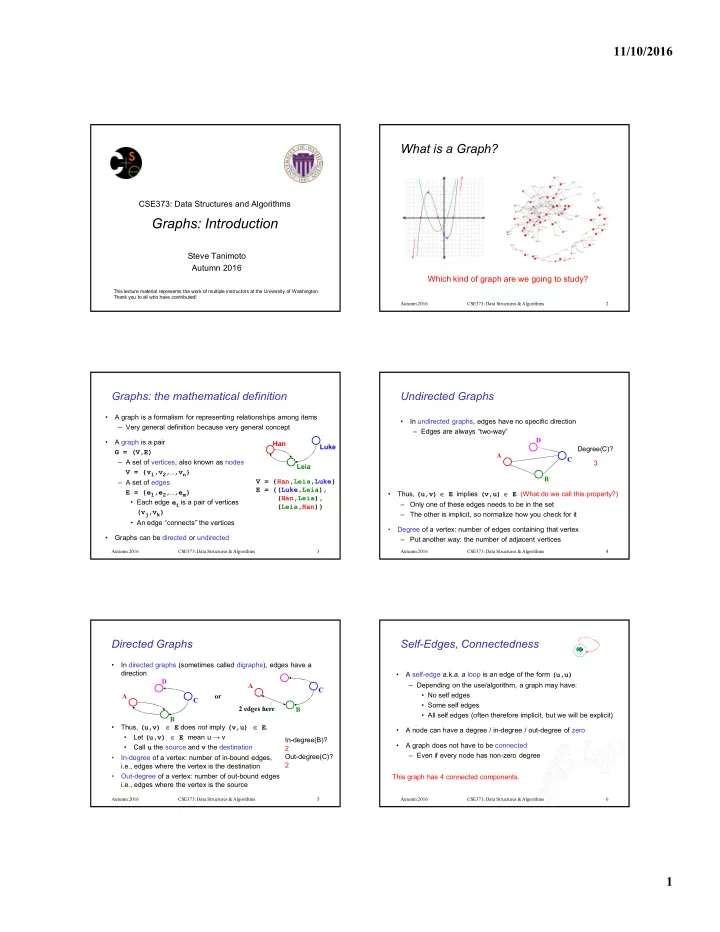
Graphs: the mathematical definition

  • A graph is a formalism for representing relationships among items

– Very general definition because very general concept

  • A graph is a pair

G = (V,E) – A set of vertices, also known as nodes V = {v1,v2,…,vn} – A set of edges E = {e1,e2,…,em}

  • Each edge ei is a pair of vertices

(vj,vk)

  • An edge “connects” the vertices
  • Graphs can be directed or undirected

Autumn 2016 3 CSE373: Data Structures & Algorithms

Han Leia Luke V = {Han,Leia,Luke} E = {(Luke,Leia), (Han,Leia), (Leia,Han)}

Undirected Graphs

  • In undirected graphs, edges have no specific direction

– Edges are always “two-way”

Autumn 2016 4 CSE373: Data Structures & Algorithms

  • Thus, (u,v)  E implies (v,u)  E (What do we call this property?)

– Only one of these edges needs to be in the set – The other is implicit, so normalize how you check for it

  • Degree of a vertex: number of edges containing that vertex

– Put another way: the number of adjacent vertices A B C D Degree(C)? 3

Directed Graphs

  • In directed graphs (sometimes called digraphs), edges have a

direction

Autumn 2016 5 CSE373: Data Structures & Algorithms

  • Thus, (u,v)  E does not imply (v,u)  E.
  • Let (u,v)  E mean u → v
  • Call u the source and v the destination
  • In-degree of a vertex: number of in-bound edges,

i.e., edges where the vertex is the destination

  • Out-degree of a vertex: number of out-bound edges

i.e., edges where the vertex is the source

  • r

2 edges here A B C D A B C In-degree(B)? 2 Out-degree(C)? 2

Self-Edges, Connectedness

  • A self-edge a.k.a. a loop is an edge of the form (u,u)

– Depending on the use/algorithm, a graph may have:

  • No self edges
  • Some self edges
  • All self edges (often therefore implicit, but we will be explicit)
  • A node can have a degree / in-degree / out-degree of zero
  • A graph does not have to be connected

– Even if every node has non-zero degree

Autumn 2016 6 CSE373: Data Structures & Algorithms

This graph has 4 connected components.

slide-2
SLIDE 2

11/10/2016 2

More notation

For a graph G = (V,E):

  • |V| is the number of vertices
  • |E| is the number of edges

– Minimum? – Maximum for undirected? – Maximum for directed?

  • If (u,v)  E

– Then v is a neighbor of u, i.e., v is adjacent to u – Order matters for directed edges

  • u is not adjacent to v unless (v,u)  E

Autumn 2016 7 CSE373: Data Structures & Algorithms

A B C D V = {A, B, C, D} E = {(C, B), (A, B), (B, A) (C, D)}

|V||V+1|/2  O(|V|2) |V|2  O(|V|2)

(assuming self-edges allowed, else subtract |V|) v u 4+3+2+1

Examples

Which would use directed edges? Which would have self-edges? Which would be connected? Which could have 0-degree nodes? 1. Web pages with links 2. Facebook friends 3. Methods in a program that call each other 4. Road maps (e.g., Google maps) 5. Airline routes 6. Family trees 7. Course pre-requisites

Autumn 2016 8 CSE373: Data Structures & Algorithms

Dir Self Con Zero

Weighted Graphs

  • In a weighed graph, each edge has a weight a.k.a. cost

– Typically numeric (most examples use ints) – Orthogonal to whether graph is directed – Some graphs allow negative weights; many do not

Autumn 2016 9 CSE373: Data Structures & Algorithms

20 30 35 60 Mukilteo Edmonds Seattle Bremerton Bainbridge Kingston Clinton

Examples

What, if anything, might weights represent for each of these? Do negative weights make sense?

  • Web pages with links
  • Facebook friends
  • Methods in a program that call each other
  • Road maps (e.g., Google maps)
  • Airline routes
  • Family trees
  • Course pre-requisites

Autumn 2016 10 CSE373: Data Structures & Algorithms

Paths and Cycles

  • A path is a list of vertices [v0,v1,…,vn] such that (vi,vi+1)

E for all 0  i < n. Say “a path from v0 to vn”

  • A cycle is a path that begins and ends at the same node (v0==vn)

Autumn 2016 11 CSE373: Data Structures & Algorithms

Seattle San Francisco Dallas Chicago Salt Lake City Example: [Seattle, Salt Lake City, Chicago, Dallas, San Francisco, Seattle]

Path Length and Cost

  • Path length: Number of edges in a path
  • Path cost: Sum of weights of edges in a path

Example where P= [Seattle, Salt Lake City, Chicago, Dallas, San Francisco, Seattle]

Autumn 2016 12 CSE373: Data Structures & Algorithms

Chicago Seattle San Francisco Dallas Salt Lake City 3.5 2 2 2.5 3 2 2.5 2.5

length(P) = cost(P) = 5 11.5

slide-3
SLIDE 3

11/10/2016 3

Simple Paths and Cycles

  • A simple path repeats no vertices, except the first might be the

last [Seattle, Salt Lake City, San Francisco, Dallas] [Seattle, Salt Lake City, San Francisco, Dallas, Seattle]

  • Recall, a cycle is a path that ends where it begins

[Seattle, Salt Lake City, San Francisco, Dallas, Seattle] [Seattle, Salt Lake City, Seattle, Dallas, Seattle]

  • A simple cycle is both a cycle and a simple path

[Seattle, Salt Lake City, San Francisco, Dallas, Seattle]

Autumn 2016 13 CSE373: Data Structures & Algorithms

Paths and Cycles in Directed Graphs

Example: Is there a path from A to D? Does the graph contain any cycles?

Autumn 2016 14 CSE373: Data Structures & Algorithms

A B C D No No

Undirected-Graph Connectivity

  • An undirected graph is connected if for all

pairs of vertices u,v, there exists a path from u to v

  • An undirected graph is complete, a.k.a. fully connected if for all

pairs of vertices u,v, there exists an edge from u to v

Autumn 2016 15 CSE373: Data Structures & Algorithms

Connected graph Disconnected graph plus self edges

Directed-Graph Connectivity

  • A directed graph is strongly connected if

there is a path from every vertex to every

  • ther vertex
  • A directed graph is weakly connected if

there is a path from every vertex to every

  • ther vertex ignoring direction of edges
  • A complete a.k.a. fully connected directed

graph has an edge from every vertex to every other vertex

Autumn 2016 16 CSE373: Data Structures & Algorithms

plus self edges

Trees as Graphs

When talking about graphs, we say a tree is a graph that is: – Undirected – Acyclic – Connected So all trees are graphs, but not all graphs are trees

Autumn 2016 17 CSE373: Data Structures & Algorithms

Rooted Trees

  • We are more accustomed to rooted trees where:

– We identify a unique root – We think of edges as directed: parent to children

  • Given a tree, picking a root gives a unique rooted tree

– The tree is just drawn differently

Autumn 2016 18 CSE373: Data Structures & Algorithms

A B D E C F H G redrawn A B D E C F H G

slide-4
SLIDE 4

11/10/2016 4

Rooted Trees

  • We are more accustomed to rooted trees where:

– We identify a unique root – We think of edges as directed: parent to children

  • Given a tree, picking a root gives a unique rooted tree

– The tree is just drawn differently

Autumn 2016 19 CSE373: Data Structures & Algorithms

A B D E C F H G redrawn F G H C A B D E

Directed Acyclic Graphs (DAGs)

  • A DAG is a directed graph with no (directed) cycles

– Every rooted directed tree is a DAG – But not every DAG is a rooted directed tree – Every DAG is a directed graph – But not every directed graph is a DAG

Autumn 2016 20 CSE373: Data Structures & Algorithms

Examples

Which of our directed-graph examples do you expect to be a DAG?

  • Web pages with links
  • Methods in a program that call each other
  • Airline routes
  • Family trees
  • Course pre-requisites

Autumn 2016 21 CSE373: Data Structures & Algorithms

Density / Sparsity

  • Let E be the set of edges and V the set of vertices.
  • Then 0 ≤ |E| ≤ |V|2
  • And |E| is O(|V|2)
  • Because |E| is often much smaller than its maximum size, we do not

always approximate |E| as O(|V|2) – This is a correct bound, it just is often not tight – If it is tight, i.e., |E| is (|V|2) we say the graph is dense

  • More sloppily, dense means “lots of edges”

– If |E| is O(|V|) we say the graph is sparse

  • More sloppily, sparse means “most possible edges missing”

Autumn 2016 22 CSE373: Data Structures & Algorithms

What is the Data Structure?

  • So graphs are really useful for lots of data and questions

– For example, “what’s the lowest-cost path from x to y”

  • But we need a data structure that represents graphs
  • The “best one” can depend on:

– Properties of the graph (e.g., dense versus sparse) – The common queries (e.g., “is (u,v) an edge?” versus “what are the neighbors of node u?”)

  • So we’ll discuss the two standard graph representations

– Adjacency Matrix and Adjacency List – Different trade-offs, particularly time versus space

Autumn 2016 23 CSE373: Data Structures & Algorithms

Adjacency Matrix

  • Assign each node a number from 0 to |V|-1
  • A |V| x |V| matrix (i.e., 2-D array) of Booleans (or 1 vs. 0)

– If M is the matrix, then M[u][v] being true means there is an edge from u to v

Autumn 2016 24 CSE373: Data Structures & Algorithms

A(0) B(1) C(2) D(3) 1 2 1 2 3 3

T T T T F F F F F F F F F F F F

slide-5
SLIDE 5

11/10/2016 5

Adjacency Matrix Properties

  • Running time to:

– Get a vertex’s out-edges: – Get a vertex’s in-edges: – Decide if some edge exists: – Insert an edge: – Delete an edge:

  • Space requirements:

– |V|2 bits

  • Best for sparse or dense graphs?

– Best for dense graphs

Autumn 2016 CSE373: Data Structures & Algorithms 25

1 2 1 2 3 3

T T T T F F F F F F F F F F F F

O(|V|) O(|V|) O(1) O(1) O(1)

Adjacency Matrix Properties

  • How will the adjacency matrix vary for an undirected graph?

– Undirected will be symmetric around the diagonal

  • How can we adapt the representation for weighted graphs?

– Instead of a Boolean, store a number in each cell – Need some value to represent ‘not an edge’

  • In some situations, 0 or -1 works

Autumn 2016 CSE373: Data Structures & Algorithms 26

Adjacency List

  • Assign each node a number from 0 to |V|-1
  • An array of length |V| in which each entry stores a list of all

adjacent vertices (e.g., linked list)

Autumn 2016 27 CSE373: Data Structures & Algorithms

1 2 3 1 / / 3 1 / /

A(0) B(1) C(2) D(3)

Adjacency List Properties

  • Running time to:

– Get all of a vertex’s out-edges: O(d) where d is out-degree of vertex – Get all of a vertex’s in-edges: O(|E|) (but could keep a second adjacency list for this!) – Decide if some edge exists: O(d) where d is out-degree of source – Insert an edge: O(1) (unless you need to check if it’s there) – Delete an edge: O(d) where d is out-degree of source

  • Space requirements:

– O(|V|+|E|)

Autumn 2016 CSE373: Data Structures & Algorithms 28

1 2 3 1 / / 3 1 / /

  • Good for sparse graphs

Next…

Okay, we can represent graphs Next lecture we’ll implement some useful and non-trivial algorithms

  • Topological sort: Given a DAG, order all the vertices so that

every vertex comes before all of its neighbors

  • Shortest paths: Find the shortest or lowest-cost path from x to y

– Related: Determine if there even is such a path

Autumn 2016 29 CSE373: Data Structures & Algorithms

Reading for Friday

  • By Friday, have read sections 9.1, 9.2 and 9.3 (up to p. 384).

This is about 25 pages.

Autumn 2016 30 CSE373: Data Structures & Algorithms