Graphs and their representations After this lesson, you should be - - PowerPoint PPT Presentation

graphs and their representations
SMART_READER_LITE
LIVE PREVIEW

Graphs and their representations After this lesson, you should be - - PowerPoint PPT Presentation

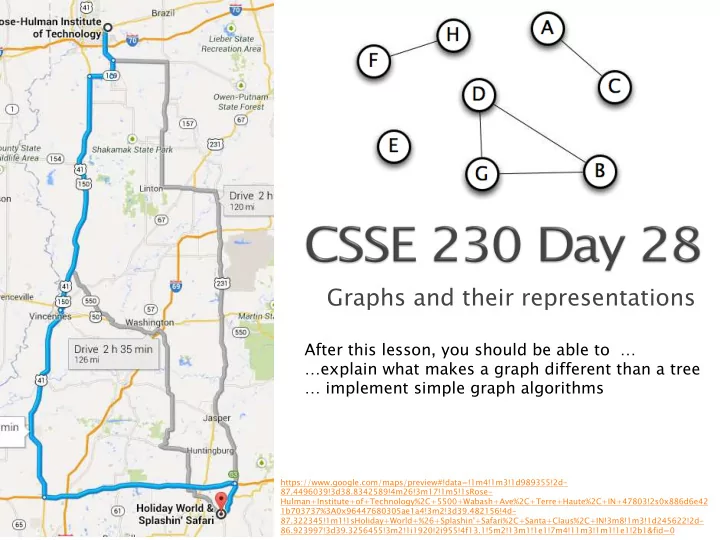
Graphs and their representations After this lesson, you should be able to explain what makes a graph different than a tree implement simple graph algorithms https://www.google.com/maps/preview#!data=!1m4!1m3!1d989355!2d-


slide-1
SLIDE 1

Graphs and their representations

https://www.google.com/maps/preview#!data=!1m4!1m3!1d989355!2d- 87.4496039!3d38.8342589!4m26!3m17!1m5!1sRose- Hulman+Institute+of+Technology%2C+5500+Wabash+Ave%2C+Terre+Haute%2C+IN+47803!2s0x886d6e42 1b703737%3A0x96447680305ae1a4!3m2!3d39.482156!4d- 87.322345!1m1!1sHoliday+World+%26+Splashin'+Safari%2C+Santa+Claus%2C+IN!3m8!1m3!1d245622!2d- 86.923997!3d39.3256455!3m2!1i1920!2i955!4f13.1!5m2!13m1!1e1!7m4!11m3!1m1!1e1!2b1&fid=0

After this lesson, you should be able to … …explain what makes a graph different than a tree … implement simple graph algorithms

slide-2
SLIDE 2

} Hardy Part 2 partner evaluation due

  • Complete during worktime today

} But first…

slide-3
SLIDE 3

Terminology Representations Algorithms

slide-4
SLIDE 4

A graph G = (V,E) is composed of: V: set of vertices (singular: vertex) E: set of edges An edge is a pair of vertices. Can be unordered: e = {u,v} (undirected graph)

  • rdered:

e = (u,v) (directed graph or digraph)

Example: V = {a,b,c,d,e} E = {{a,b},{a,c},{a,d},{b,e}, {c,d},{c,e},{d,e}}

slide-5
SLIDE 5

} Size? Edges or vertices? } Usually take size to be n = |V| (# of vertices) } But the runtime of graph algorithms often

depend on the number of edges, |E|

} Relationships between |V| and |E|?

slide-6
SLIDE 6
  • Adjacent vertices or neighbors: connected by an edge
  • Degree (of a vertex): # of incident edges

Fact: (Why?)

slide-7
SLIDE 7

1

slide-8
SLIDE 8

A A ne necessary ry but ut no not suf ufficient nt co condition fo for a graph to be a tree.

2

slide-9
SLIDE 9

} Each Vertex object contains information

about itself

} Examples:

  • City name
  • IP address
  • People in a social network

} Observations about real graphs?

slide-10
SLIDE 10

} Adjacency matrix

  • 2D array (#V x #V) of booleans, or ints (weighted)
  • True or nonzero denotes edge

} Adjacency list

  • Collection of named vertices: HashMap<String,Vertex>
  • Each vertex stores a List of adjacent vertices

} Edge list

  • Graph object contains the collection of vertices and the

collection of edges

To consider: Why not just use a triangular “matrix”? Does a boolean adjacency matrix make sense?

3-5

slide-11
SLIDE 11

} What’s the cost of the shortest path from A to

each of the other nodes in the graph?

For For much mor

  • re

e on

  • n grap

aphs, s, tak ake e MA/CS CSSE 473 or

  • r MA 477
slide-12
SLIDE 12

} Spanning tree: a connected acyclic subgraph that

includes all of the graph’s vertices

} Minimum spanning tree of a weighted, connected

graph: a spanning tree of minimum total weight Example:

  • N. Chenette – CSSE/MA 473

c d b a

4 2 3 6 7

c d b a

2 3 6

MST:

slide-13
SLIDE 13
  • N. Chenette – CSSE/MA 473

} n cities, weights are travel distance } Must visit all cities (starting & ending at same

place) with shortest possible distance

  • Exhaustive search: how many routes?
  • (n–1)!/2 Î Θ((n–1)!)
slide-14
SLIDE 14
  • N. Chenette – CSSE/MA 473

} Online source for all things TSP:

  • http://www.math.uwaterloo.ca/tsp/
slide-15
SLIDE 15

} What’s the size of the largest connected

component?

In In SVN: Ra RandomGra raphs

6-7