
SLIDE 1
Spring 2018: Week 15 ASTR/PHYS 4080: Introduction to Cosmology
Grand Summary
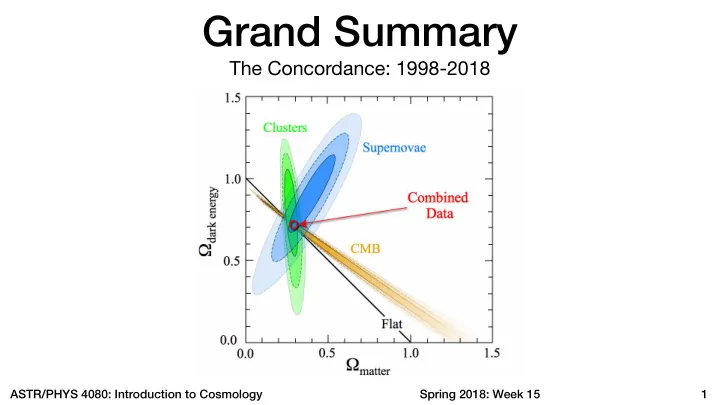
The Concordance: 1998-2018
1
Grand Summary The Concordance: 1998-2018 ASTR/PHYS 4080: - - PowerPoint PPT Presentation
Grand Summary The Concordance: 1998-2018 ASTR/PHYS 4080: Introduction to Cosmology Spring 2018: Week 15 1 Theory ASTR/PHYS 4080: Introduction to Cosmology Spring 2018: Week 15 2 Benchmark Model 2 Kt a e 0 log(a) 2/3 a t
Spring 2018: Week 15 ASTR/PHYS 4080: Introduction to Cosmology
The Concordance: 1998-2018
1
Spring 2018: Week 15 ASTR/PHYS 4080: Introduction to Cosmology
2
Spring 2018: Week 15 ASTR/PHYS 4080: Introduction to Cosmology
3
−10 −8 −6 −4 −2 −6 −4 −2 2 log(H0t) log(a)
trm tmΛ t0 a∝t
1/2
a∝t
2/3
a∝e
Kt
Spring 2018: Week 15 ASTR/PHYS 4080: Introduction to Cosmology
4
strong force freeze out weak force freeze out
Spring 2018: Week 15 ASTR/PHYS 4080: Introduction to Cosmology
5
lp ≡ ✓G~ c3 ◆1/2 = 1.6 × 10⁻³³cm tp ≡ ✓G~ c5 ◆1/2 = 5.4 × 10−44s Mp ≡ ✓~c G ◆1/2 = 2.2 × 10⁻⁵g Ep = Mpc2 = ✓~c5 G ◆1/2 = 1.2 × 1028eV = 1.2 × 10¹⁹GeV Tp = Ep/k = 1.4 × 1032K
Planck time: Planck units: Planck temperature: Planck length: Planck mass: Planck energy:
c = k = ~ = G = 1
Spring 2018: Week 15 ASTR/PHYS 4080: Introduction to Cosmology 6
Spring 2018: Week 15 ASTR/PHYS 4080: Introduction to Cosmology
7
Spring 2018: Week 15 ASTR/PHYS 4080: Introduction to Cosmology 8
Spring 2018: Week 15 ASTR/PHYS 4080: Introduction to Cosmology 9
Spring 2018: Week 15 ASTR/PHYS 4080: Introduction to Cosmology
10
How can we measure the curvature of spacetime?
= Radius of Curvature = area of triangle
Only possible geometries that are homogeneous/isotropic
Spring 2018: Week 15 ASTR/PHYS 4080: Introduction to Cosmology
11
<OR>
straight lines in a given geometry flat or Euclidean space: elliptical or spherical space: hyperbolic space:
Spring 2018: Week 15 ASTR/PHYS 4080: Introduction to Cosmology
12
metrics define the distance between events in spacetime Minkowski (no gravity: metric in SR) Robertson-Walker (with gravity, if spacetime is homogeneous & isotropic) light travels along null geodesics, i.e.: cosmological proper time or cosmic time comoving coordinates
Spring 2018: Week 15 ASTR/PHYS 4080: Introduction to Cosmology
13
Spring 2018: Week 15 ASTR/PHYS 4080: Introduction to Cosmology
14
Spring 2018: Week 15 ASTR/PHYS 4080: Introduction to Cosmology
15
Inflation - quark soup - neutron capture - nucleosynthesis - recomb/decoup kT: 150 MeV 10 MeV 0.07 MeV 3760/2970K baryogenesis photon-baryon ratio
Spring 2018: Week 15 ASTR/PHYS 4080: Introduction to Cosmology
16
Spring 2018: Week 15 ASTR/PHYS 4080: Introduction to Cosmology
17
release energy expect nucleosynthesis to result in all atoms becoming iron does not happen - why not?
Spring 2018: Week 15 ASTR/PHYS 4080: Introduction to Cosmology
18
Spring 2018: Week 15 ASTR/PHYS 4080: Introduction to Cosmology
19
(minus for bosons, plus for fermions) g —> 2 (for non-nucleons, gH=4) chemical potential of photons = 0 Saha Equation
Spring 2018: Week 15 ASTR/PHYS 4080: Introduction to Cosmology
20
Spring 2018: Week 15 ASTR/PHYS 4080: Introduction to Cosmology
21
Spring 2018: Week 15 ASTR/PHYS 4080: Introduction to Cosmology
22
Spring 2018: Week 15 ASTR/PHYS 4080: Introduction to Cosmology 23
Resolution?
Spring 2018: Week 15 ASTR/PHYS 4080: Introduction to Cosmology
24
Radio sources from NVSS (Condon et al. 2003)
Copernican Principle => homogeneous & isotropic (Cosmological Principle)
Spring 2018: Week 15 ASTR/PHYS 4080: Introduction to Cosmology
25
dT/T ~ 10-3
Spring 2018: Week 15 ASTR/PHYS 4080: Introduction to Cosmology
26
Creation process depends on relative abundances at any given time, so have to calculate computationally Nucleosynthesis doesn’t run to completion like in stars — rapidly dropping temperature cuts it off and “freezes” abundance pattern Exact yields depend most on baryon- to-photon ratio: (determines temperature of nucleosynthesis)
Spring 2018: Week 15 ASTR/PHYS 4080: Introduction to Cosmology
27
Luminosity Distance Angular Diameter Distance
Spring 2018: Week 15 ASTR/PHYS 4080: Introduction to Cosmology
28
Spring 2018: Week 15 ASTR/PHYS 4080: Introduction to Cosmology
29
Luminosity Distance Angular Diameter Distance
Spring 2018: Week 15 ASTR/PHYS 4080: Introduction to Cosmology
30
Spring 2018: Week 15 ASTR/PHYS 4080: Introduction to Cosmology
31
2 Mpc 1000 km/s
Spring 2018: Week 15 ASTR/PHYS 4080: Introduction to Cosmology
32
Spring 2018: Week 15 ASTR/PHYS 4080: Introduction to Cosmology 33
Spring 2018: Week 15 ASTR/PHYS 4080: Introduction to Cosmology
34
Spring 2018: Week 15 ASTR/PHYS 4080: Introduction to Cosmology
35
causal contact initial conditions first peak third peak second peak etc peaks size scale of a DM potential well where baryon collapse reaches turnaround due to its pressure
Spring 2018: Week 15 ASTR/PHYS 4080: Introduction to Cosmology
36
By the time of the Big Bang and thereafter, normal matter is the subdominant form of matter in the universe, with some other form of matter (non-baryonic dark matter) making up the majority of non-relativistic matter in the universe Could be primordial black holes that were made before this time (i.e., not from stars).
Spring 2018: Week 15 ASTR/PHYS 4080: Introduction to Cosmology
37
Spring 2018: Week 15 ASTR/PHYS 4080: Introduction to Cosmology
38
b b b d d xd
Spring 2018: Week 15 ASTR/PHYS 4080: Introduction to Cosmology
39
Hot Warm Cold velocity of particles compared to the speed of light relativistic at time of collapse (like neutrinos): hot non-relativistic at time of collapse (like WIMPs): cold fast motions wipe out initial
scales: “free-streaming”
Spring 2018: Week 15 ASTR/PHYS 4080: Introduction to Cosmology
40
Power spectrum defined to be the mean squared amplitude of the Fourier components: Gaussian field: each component uncorrelated and random, drawn from the Gaussian distribution Inflation predicts this (random quantum fluctuations) and a power law power spectrum (with n=1)
Spring 2018: Week 15 ASTR/PHYS 4080: Introduction to Cosmology
41
causal contact initial conditions first peak third peak second peak etc peaks First peak: spatially flat Second peak: existence of “dark baryons” Third peak: amount of dark matter Damping tail: photons can cross entire grav. fluct., wipes out signal damping tail
Spring 2018: Week 15 ASTR/PHYS 4080: Introduction to Cosmology
42
Eisenstein+ 2005 To measure, use galaxies to trace the signature of these oscillations The number of galaxies should be correlated with each other on scales comparable to the sound horizon of the largest acoustic peaks (~150 Mpc comoving) The number of galaxies within a given volume is
Spring 2018: Week 15 ASTR/PHYS 4080: Introduction to Cosmology
43
everything we can now observe in the universe -- generally accurate?
now observe is only one of countless "bubble universes" that could have arisen out of the same process?
each, and how has the dark matter affected the observable structure of the universe?
continue indefinitely into the future?
and one of time (along with any other "hidden" dimensions) come to be as we see them?
every time in the observable universe, or do they vary in some slight but predictable way?
principle observe our own section of the universe if we could only see "far" enough?
from http://www.openquestions.com/oq-cosmo.htm#questions