Good agricultural practices for increased incomes and improved food - - PowerPoint PPT Presentation

good agricultural practices for increased incomes and
SMART_READER_LITE
LIVE PREVIEW

Good agricultural practices for increased incomes and improved food - - PowerPoint PPT Presentation

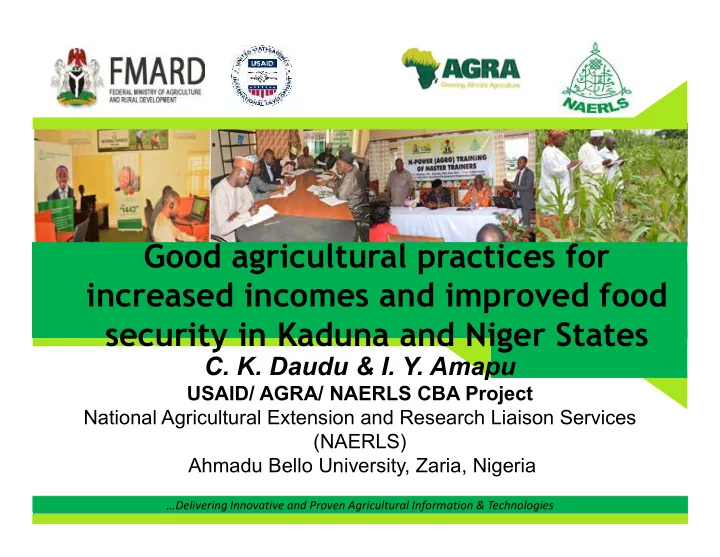
Good agricultural practices for increased incomes and improved food security in Kaduna and Niger States C. K. Daudu & I. Y. Amapu USAID/ AGRA/ NAERLS CBA Project National Agricultural Extension and Research Liaison Services (NAERLS)


slide-1
SLIDE 1

…Delivering Innovative and Proven Agricultural Information & Technologies

Good agricultural practices for increased incomes and improved food security in Kaduna and Niger States

  • C. K. Daudu & I. Y. Amapu

USAID/ AGRA/ NAERLS CBA Project National Agricultural Extension and Research Liaison Services (NAERLS) Ahmadu Bello University, Zaria, Nigeria

slide-2
SLIDE 2

www.naerls.gov.ng …Delivering Innovative and Proven Agricultural Information & Technologies

  • Agriculture is a key component of the Nigerian

economy,

  • income from agricultural production, processing and

marketing is marginal

  • mainly due to low input use by small holder farmers
  • which stems from a lack of awareness resulting from

an in-effective extension service

  • 2

Introduction

slide-3
SLIDE 3

www.naerls.gov.ng …Delivering Innovative and Proven Agricultural Information & Technologies

  • The main reasons for low crop productivity area:
  • Use of low-yielding local varieties with only 5% of

farmers using improved varieties,

– Low use of fertiliser (national average is less than 20 kg / ha), – inappropriate use of organic (manure) and inorganic fertilizers and – Inadequately structured markets for farmers’ produce.

3

Introduction

slide-4
SLIDE 4

www.naerls.gov.ng …Delivering Innovative and Proven Agricultural Information & Technologies

  • The development of training materials for both

extension agents and CBAs

  • The Promotion of new technologies including

improved varieties and fertilizer options:

  • Strengthening use of ICT for Agriculture through

development of content for radios, videos, mobile phones and other methods to reach millions of smallholder farmers. 4

key interventions

slide-5
SLIDE 5

www.naerls.gov.ng …Delivering Innovative and Proven Agricultural Information & Technologies

After this session, participants will be able to:

  • describe basic GAPs principles.
  • apply GAPs principles in field production practices for

maize, rice and soybean. 5

Introduction

slide-6
SLIDE 6

www.naerls.gov.ng …Delivering Innovative and Proven Agricultural Information & Technologies

  • a collection of principles to apply for on-farm

production and post-production processes, resulting in safe and healthy food and non-food agricultural products, while taking into account economical, social and environmental sustainability- FAO

  • Economically (improved livelihoods) and efficiently

produce sufficient (food security), safe (food safety) and nutritious food (food quality)

  • applies to all production steps from cultivating to post-

harvest handling at farm level. 6

Good agricultural practices

slide-7
SLIDE 7

www.naerls.gov.ng …Delivering Innovative and Proven Agricultural Information & Technologies

  • Develop appropriate protocols and processes which fit

the local context, with a special focus to ensure that small and medium- scale farmers increase in output and income

  • Give logical guidance in implementing best

management practices 7

Specific Objectives:

slide-8
SLIDE 8

www.naerls.gov.ng …Delivering Innovative and Proven Agricultural Information & Technologies

  • increased productivity of maize, rice and soybean farming

systems in rainfed agriculture in Niger and Kaduna states

  • To promote best bet agricultural practices (improve

knowledge and skill in GAP) applied to rice, maize and soybean production at a large-scale using mother baby demonstration methods.

  • Generation of higher farmer income through facilitation
  • f smallholder farmers’ access to agricultural inputs and

their participation in agricultural products markets

  • To micro enterprising skills of EA’s and farmers

8

Key Goals

slide-9
SLIDE 9

www.naerls.gov.ng …Delivering Innovative and Proven Agricultural Information & Technologies

  • Smallholder farmers,
  • Agro-dealers,
  • Extensionists,
  • NGOs,
  • Trainers

9

Target :

slide-10
SLIDE 10

www.naerls.gov.ng …Delivering Innovative and Proven Agricultural Information & Technologies

  • GAP should be specific and relevant to each state/ ADP

zone/ geographical area or eco-region- need, market etc based

  • Soil

– Establish a detailed knowledge of the nature, properties, distribution, and potential uses of soils of the farm- soil tests/ literature – Application of fertilizers at appropriate times and in adequate doses – Apply fertilizers, organic and inorganic,

  • 10

Principles

slide-11
SLIDE 11

www.naerls.gov.ng …Delivering Innovative and Proven Agricultural Information & Technologies

  • CROP PRODUCTION-
  • Select crops, cultivars or varieties on an understanding
  • f their

– characteristics, – its responses to sowing/planting time, – Quality/ market acceptability, – suitability to the site (comparative advantage) – productivity

11

Principles

slide-12
SLIDE 12

www.naerls.gov.ng …Delivering Innovative and Proven Agricultural Information & Technologies

  • CROP PRODUCTION-
  • Select crops, cultivars or varieties on an understanding
  • f their

– characteristics, – its responses to sowing/planting time, – Quality/ market acceptability, – suitability to the site (comparative advantage) – productivity

12

Principles

slide-13
SLIDE 13

www.naerls.gov.ng …Delivering Innovative and Proven Agricultural Information & Technologies

  • Kaduna State
  • Maize:Lere,Giwa, Soba, Kauru, Ikara
  • Rice: Makarfi, Kubau, Soba, S/gari, Kagarko
  • Soybeans: Giwa Soba, Kubau, Ikara, Zaria
  • Rice: Wushishi, Lavun, Katcha
  • Maize: Kontagora, Mashegu, Mariga, Magama
  • Soyabeans: Rafi, Paikoro, Lapai
  • LGA selection: AGRA INFORMED??
  • Crop presence in LGA’s?

13

Principles- ranking of LGAs/ crops of comparative advantage.

slide-14
SLIDE 14

www.naerls.gov.ng …Delivering Innovative and Proven Agricultural Information & Technologies

  • The basic principle for pest/ disease management are any

potential management method – environmentally, technologically and economically feasible,

  • Integrated Pest Management is the approach of mutual

integration of available pest control tactics to maintain the pest numbers below economic threshold levels with an aim of least or no hazards to the environment.

  • IDM may be defined as managing plant disease severity below

the economic threshold level following ecologically sound, economically viable and easy operational procedures.

  • Chemical usages is minimized by combining with other non-

chemical or chemical methods.

  • Resistant cultivars and varieties

14

CROP PROTECTION

slide-15
SLIDE 15

www.naerls.gov.ng …Delivering Innovative and Proven Agricultural Information & Technologies

  • Spacing- Simple LSD/ (TOFHAN)
  • Variety – Maize variety selector (TAMASSA), Rice

Advise (AfricaRice)

  • Fertilizer- FOT (OFRA)
  • Decision support tool- CBA
  • Climate informed decision making- NIMET

15

Key GAP Practices

slide-16
SLIDE 16

www.naerls.gov.ng …Delivering Innovative and Proven Agricultural Information & Technologies

  • Land preparation- sow maize in well prepared ridges of

75cm apart

  • Planting Date Plant as soon as the rains are

established-NIMET

  • Choice of variety Choose a variety (certified seeds from

reputable sources) suited to your geographical zone.

  • Date of planting
  • The recommended dates for planting soybean are Early

June–early July

  • Seed dressing Treat seeds with recommended seed

dressing chemical 16

Maize

slide-17
SLIDE 17

www.naerls.gov.ng …Delivering Innovative and Proven Agricultural Information & Technologies

  • Plant spacing and sowing
  • Sow by hand or planter

– Plant a spacing of 75cm x 50cm when two plants per stand or – 75 x 25cm when one plant per stand is adopted

  • Fertilizer

– Fertilizer recommendation is 120-60-60 – N-fertilizer rate should be applied in two split applications. – First dose is applied at planting or within the first week of planting – 2nd dose should be applied between 4 and 5 wap

  • Weeds and their control- herbicide recommendation
  • 17

Maize

slide-18
SLIDE 18

www.naerls.gov.ng …Delivering Innovative and Proven Agricultural Information & Technologies

  • Pests and Diseases and their Control
  • FAW, Striga, stem borers termites and storage pests.
  • Harvesting- Done when the silk has turned brown (55

– 70 days after planting).

  • Post Harvest Processing - Using double intake disc

(may be hand/pedal/engine operated)

  • Grain cleaning
  • Storage and control of storage pests
  • Assembly, bagging and grading actions leading to

aggregators/off-takers possession 18

Maize

slide-19
SLIDE 19

www.naerls.gov.ng …Delivering Innovative and Proven Agricultural Information & Technologies

  • Site Selection/ Land preparation- suitable soils, Upland

rice is better planted on flat. For direct seeded rice, the field is ploughed and harrowed just before the first rain

  • Planting Date Plant as soon as the rains are established-

NIMET

  • Choice of variety Choose a variety (certified seeds from

reputable sources) suited to your geographical zone. e.g. disease or toxicity occurrence

  • Date of planting - The recommended dates for planting

soybean are Early June–early July

  • Seed dressing Chemical treatment should be undertaken

with a mixture of insecticide and fungicide.

19

Rice

slide-20
SLIDE 20

www.naerls.gov.ng …Delivering Innovative and Proven Agricultural Information & Technologies

  • Plant spacing and sowing
  • Sow by hand or planter

– Dibble 5–6 seeds at a spacing of 25 cm between rows and 20 cm intra row and later thin to 3 to 4 seedlings per stand at 2 to 3 weeks after sowing. – Drilling method, drill in rows 15–20 cm apart

  • Fertilizer

– Fertilizer recommendation is 80-30-30 – apply half N and all P and K in furrows between rows at 2 - 3 wap. This could also be spilt applied at sowing or one week after germination – First dose is applied at planting or within the first week of planting – 2nd dose should be applied between 4 and 5 wap

  • 20

Rice

slide-21
SLIDE 21

www.naerls.gov.ng …Delivering Innovative and Proven Agricultural Information & Technologies

  • Water management
  • Weeds and their control- herbicide recommendation
  • Pests and Diseases and their Control
  • Striga, stem borers, army worm, termites and storage pests; rice

blast,

  • Harvesting- Done when 80–85% of the grains have turned straw

colour to avoid shattering (4- 5 weeks after at least 50% flowering).

  • Post Harvest Processing – Threshing, drying, winnowing,

parboiling, dehusking, polishing.

  • Storage and control of storage pests
  • Assembly, bagging and grading actions leading to

aggregators/off-takers possession

21

Rice

slide-22
SLIDE 22

www.naerls.gov.ng …Delivering Innovative and Proven Agricultural Information & Technologies

  • Land preparation
  • plant on ridges or on a flat seedbed.
  • Choice of variety
  • Choose a variety suited to your geographical zone.
  • Date of planting
  • The recommended dates for planting soybean are Early

June–early July

  • Seed dressing
  • Treat seeds with fungicides

22

Soybean

slide-23
SLIDE 23

www.naerls.gov.ng …Delivering Innovative and Proven Agricultural Information & Technologies

  • Plant spacing and sowing
  • Sow soybean by hand, planter, or by drilling .

– Plant 3 to 4 seeds/ hole at a spacing of 75 cm between rows and 10 cm between stands. – Alternatively, drill seeds at 75 cm between rows x 5 cm within rows.

  • Fertilizer

– Mixed 1 bag SSP + ½ bag of urea fertilizer and apply to Mother Demo – 0.5kg NPK 15:15:15 to Baby Demo at land preparation.

  • Weeds and their control
  • Weed at 2 weeks after planting and the second at 5–6

weeks after planting. 23

Soybean

slide-24
SLIDE 24

www.naerls.gov.ng …Delivering Innovative and Proven Agricultural Information & Technologies

  • Insect pests and their control
  • Insect pests can be controlled with a single spray of

Cypermethrin + Dimethoate 10 EC.

  • Harvesting soybean
  • matures within 3–4 months after planting and requires

timely harvesting to check excessive yield losses .

  • Threshing soybean
  • Thresh manually or mechanically when the plants are

properly dry and as soon as possible. The harvest is not planned for storage.

  • actions leading to aggregators/off-takers possession

24

Soybean

slide-25
SLIDE 25

www.naerls.gov.ng …Delivering Innovative and Proven Agricultural Information & Technologies

25

Thank You for Listening.

Website: www.naerls.gov.ng

email: info@naerls.gov.ng

slide-26
SLIDE 26

www.naerls.gov.ng …Delivering Innovative and Proven Agricultural Information & Technologies

  • 26

Integration of CBA’s