Goals for Todays Webinar New Resource: Webinar Page Watch recordings - - PowerPoint PPT Presentation

goals for today s webinar
SMART_READER_LITE
LIVE PREVIEW

Goals for Todays Webinar New Resource: Webinar Page Watch recordings - - PowerPoint PPT Presentation

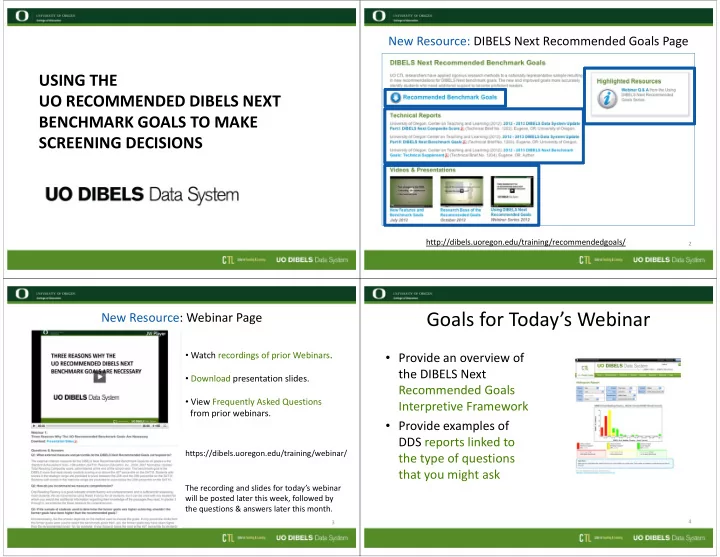
New Resource: DIBELS Next Recommended Goals Page USING THE UO RECOMMENDED DIBELS NEXT BENCHMARK GOALS TO MAKE SCREENING DECISIONS http://dibels.uoregon.edu/training/recommendedgoals/ 2 Goals for Todays Webinar New Resource: Webinar Page


slide-1
SLIDE 1

USING THE UO RECOMMENDED DIBELS NEXT BENCHMARK GOALS TO MAKE SCREENING DECISIONS

New Resource: DIBELS Next Recommended Goals Page

http://dibels.uoregon.edu/training/recommendedgoals/

2

New Resource: Webinar Page

  • Watch recordings of prior Webinars.
  • Download presentation slides.
  • View Frequently Asked Questions

from prior webinars.

https://dibels.uoregon.edu/training/webinar/ The recording and slides for today’s webinar will be posted later this week, followed by the questions & answers later this month.

3

Goals for Today’s Webinar

  • Provide an overview of

the DIBELS Next Recommended Goals Interpretive Framework

  • Provide examples of

DDS reports linked to the type of questions that you might ask

4

slide-2
SLIDE 2

HOW CAN WE USE DIBELS TO CHANGE READING OUTCOMES?

5

88% 87%

Juel, C. (1988). Learning to read and write: A longitudinal study of 54 children from first through fourth grades. Journal of Educational Psychology, 80, 437‐447.

A Tale of Two Students

6

What are DIBELS?

  • Brief and easy to administer measures
  • Indicators of students’ progress over time
  • Exhibit research‐based technical adequacy

7

DIBELS measures are indicators

Daze DORF NWF PSF FSF LNF F W S F W S F W S F W S Kindergarten Grade 1 Grade 2 Grade 3‐6

Accuracy & Fluency Vocabulary Knowledge Comprehension Alphabetic Principle Phonological Awareness

8

slide-3
SLIDE 3

Need for Support (NFS)

20% chance of success 90% chance of success 50% chance of success

IF

the learning trajectory is not changed

9

Matching Resources to Student Need

Intensity of Support Needed Amount of Resources Needed

10 11

Different Reports for Different Decisions

Middle Beginning End

Problem‐Solving Model

(Deno, 1989, 2005)

12

Evaluate the plan Develop a plan

Identify Validate

Determine Need for Support

Implement the plan

slide-4
SLIDE 4

Stage I:

Conduct School Audit and Assess Student Performance

Stage I:

Conduct School Audit and Assess Student Performance School level School level Student Level Student Level

Stage II:

Analyze School and Student Performance

Stage II:

Analyze School and Student Performance

Identify Priorities and Develop Action Plan Identify Priorities and Develop Action Plan Analyze Individual Performance and Plan Instructional Groups Analyze Individual Performance and Plan Instructional Groups

Stage III:

Design Instructional Interventions

Stage III:

Design Instructional Interventions

Design Core Instructional Interventions Design Core Instructional Interventions Customize Intensive and Strategic Interventions Customize Intensive and Strategic Interventions

Stage IV:

Set Goals and Monitor Progress Formatively

Stage IV:

Set Goals and Monitor Progress Formatively

Establish and Implement Progress‐ Monitoring System Establish and Implement Progress‐ Monitoring System Customize Progress‐ Monitoring System for Intensive & Strategic Interventions Customize Progress‐ Monitoring System for Intensive & Strategic Interventions

Stage V:

Evaluate Intervention Efficacy and Adjust Instruction

Stage V:

Evaluate Intervention Efficacy and Adjust Instruction

Evaluate School‐ Level Performance Evaluate School‐ Level Performance Intensify Intervention Intensify Intervention

(Deno, 1989, 2005)

(Simmons, Kame’enui, Good, Harn, Cole, & Braun, 2002)

13

Connecting the Problem‐Solving Model to DDS Reports

14

Evaluate the plan Develop a plan

Identify Validate

Implement the plan

Middle Beginning End

Determine Need for Support

OVERVIEW OF THE DIBELS NEXT RECOMMENDED GOALS INTERPRETIVE FRAMEWORK

Why and how we use DIBELS

15

What is a Primary Measure?

  • A measure that is used to sort selected DDS

reports for screening decisions.

  • As with all prior editions of DIBELS, the

primary measure for Grades 2 – 6 is Oral Reading Fluency (see DIBELS 6th edition Administration & Scoring Guide, pp. 63‐66).

16
slide-5
SLIDE 5

Primary Measures: Key Terms

  • Primary DIBELS measure: The measure that is

the strongest predictor of later reading

  • utcomes. DDS reports sort by this measure.
  • Optional DIBELS measures: Measures that

have not been demonstrated to add appreciably once the primary measure has been used.

17

Third through Sixth Grade Measures

Time of Year Measure Beginning Middle End

DORF‐WRC Primary Primary Primary DORF‐Acc Useful Useful Useful Retell

Not endorsed Not endorsed Not endorsed

Daze

Optional, Endorsed Optional, Endorsed Optional, Endorsed

  • Note. DORF = DIBELS Oral Reading Fluency; WRC = Words Read Correctly; Acc = Accuracy; Daze =

DIBELS Maze; Primary = Primary measure for the time period; Useful = Other required measures; Endorsed = Optional, endorsed measures; Not Endorsed = Optional, not endorsed measures

18

Kindergarten Measures

Time of Year Measure Beginning Middle End

FSF Primary Useful LNF Useful Useful Useful PSF Useful

Optional, Endorsed

NWF‐CLS Primary Primary NWF‐WWR

Optional, Endorsed

Useful

  • Note. FSF = First Sound Fluency; LNF = Letter Naming Fluency; PSF = Phonemic Segmentation

Fluency; NWF = Nonsense Word Fluency; CLS = Correct Letter Sounds; WWR = Whole Words Read; Primary = Primary measure for the time period; Useful = Other required measures; Endorsed = Optional, endorsed measures; Not Endorsed = Optional, not endorsed measures

19

First Grade Measures

Time of Year Measure Beginning Middle End

LNF Useful PSF

Not endorsed

NWF‐CLS Primary Useful Useful NWF‐WWR Useful Useful Useful DORF‐WRC Primary Primary DORF‐Acc Useful Useful Retell

Not endorsed Not endorsed

  • Note. LNF = Letter Naming Fluency; PSF = Phonemic Segmentation Fluency; NWF = Nonsense

Word Fluency; CLS = Correct Letter Sounds; WWR = Whole Words Read; DORF = DIBELS Oral Reading Fluency; WRC = Words Read Correctly; Acc = Accuracy; Primary = Primary measure for the time period; Useful = Other required measures; Endorsed = Optional, endorsed measures; Not Endorsed = Optional, not endorsed measures

20

slide-6
SLIDE 6

Second Grade Measures

Time of Year Measure Beginning Middle End

NWF‐CLS Useful NWF‐WWR Useful DORF‐WRC Primary Primary Primary DORF‐Acc Useful Useful Useful Retell

Not endorsed Not endorsed Not endorsed

  • Note. NWF = Nonsense Word Fluency; CLS = Correct Letter Sounds; WWR = Whole Words Read;

DORF = DIBELS Oral Reading Fluency; WRC = Words Read Correctly; Acc = Accuracy; Primary = Primary measure for the time period; Useful = Other required measures; Endorsed = Optional, endorsed measures; Not Endorsed = Optional, not endorsed measures

21

Summary of how to think about primary measures

Primary measures help us:

  • improve the efficiency and reliability of

screening

  • identify a need for support
  • prioritize measures to improve school and

individual student decision making

22

INTERPRETING DDS REPORTS

Thinking about Primary Measures in Context

23

Finding the Right Report

24

slide-7
SLIDE 7

Efficient Access to Reports

25

Efficient Access to Reports

Don’t forget about the drop down menus.

26

KINDERGARTEN BEGINNING OF THE YEAR EXAMPLE

Primary Measure and Class List Time of Year Measure Beginning Middle End

FSF Primary Useful LNF Useful Useful Useful PSF Useful

Optional, Endorsed

NWF‐CLS Primary Primary NWF‐WWR

Optional, Endorsed

Useful

27

DDS gives you the option to look at the report online

  • r to create an

easy‐to‐print pdf.

28

slide-8
SLIDE 8

Class List General Orientation

29

Ask & Answer

Which measure is the primary measure for this grade level at this time of year?

Kindergarten Beginning of Year

30

Ask & Answer

Which measure is this report sorted by?

Kindergarten Beginning of Year

31

Ask & Answer

Which measure should I look at to group students?

Kindergarten Beginning of Year

32

slide-9
SLIDE 9

Need for Support (NFS)

20% chance of success 90% chance of success 50% chance of success

IF

the learning trajectory is not changed

33

Ask & Answer

How will this teacher serve all of these students in need of intensive support?

Provide high‐quality, explicit instruction for all!

Kindergarten Beginning of Year

34

2ND GRADE MIDDLE OF THE YEAR EXAMPLE

Primary Measure and Class List

Time of Year Measure Beginning Middle End NWF‐CLS Useful NWF‐WWR Useful DORF‐WRC Primary Primary Primary DORF‐Acc Useful Useful Useful Retell Not endorsed Not endorsed Not endorsed

35

Class List General Orientation

36

slide-10
SLIDE 10

Ask & Answer

Which measure is the primary measure for this grade level at this time of year?

2nd Grade Beginning of Year

37

Ask & Answer

Which measure is this report sorted by?

2nd Grade Beginning of Year

38

Ask & Answer

2nd Grade Beginning of Year

Which measure should I look at to group students? At the middle of second you must first look at ORF and then ORF accuracy.

39

Ask & Answer

How should I teach such a wide range of students? Provide high‐quality, explicit, differentiated instruction for all!

2nd Grade Beginning of Year

40

slide-11
SLIDE 11

3RD GRADE BEGINNING OF THE YEAR EXAMPLE

Primary Measure and Class List

Time of Year Measure Beginning Middle End ORF‐WRC Primary Primary Primary ORF‐Acc Useful Useful Useful Retell Not endorsed Not endorsed Not endorsed Daze Optional, Endorsed Optional, Endorsed Optional, Endorsed

41

Class List General Orientation

42

Let’s look at the primary measure for the beginning of 3rd grade, Oral Reading Fluency Words Correct If we look at the primary measure,

  • ver half of our class would need

strategic or intensive support. We may not have the resources.

3rd Grade Beginning of Year

43

The students identified as in need of strategic support, will likely benefit from the same high‐quality core instruction that is delivered to students who are above the benchmark cut point.

3rd Grade Beginning of Year

44

slide-12
SLIDE 12

3rd Grade Beginning of Year

Grouping Option A Based on Primary Measure Only Grouping Option B Based on Primary, Required & Endorsed

3rd Grade Beginning of Year Which one is right? It depends on instructional goals and your resources!

Looking at two measures together illustrates that students across categories may be more similar than students within a category

2 4 6 8 10 12 14 16 18 20 40 60 80 100 120 140 Maze Scores ORF Scores

Validate Need for Support: Grade 3

47

3rd Grade Beginning of Year

You can also use your class list to look for those similarities

slide-13
SLIDE 13

We can look at other DDS reports too!

Let’s take a closer look at the histogram.

49

Histogram General Orientation

Histogram Report - DIBELS Next District: PD School District School: Teaching & Learning Grade: Third Grade Year: 2012-2013 Period: Middle Measure: DIBELS Oral Reading Fluency - Words Correct Need for Support: Recommended Goals

Likely to Need Intensive Support 30% (n=26)

Score range: 0-88 Well Below Benchmark Score range: 0-88 Well Below Benchmark

Likely to Need Strategic Support 26% (n=23)

Score range: 89-114 Below Benchmark Score range: 89-114 Below Benchmark

Likely to Need Core Support 44% (n=39)

Score range: 115-300 At or Above Benchmark Score range: 115-300 At or Above Benchmark

Split Bars Split bars are used when the cutoff scores occur in the middle of a score range. The number of students is indicated by the size of the part. Split Bars Split bars are used when the cutoff scores occur in the middle of a score range. The number of students is indicated by the size of the part.

50

Ask & Answer

What percentage of students across the grade level are likely to need:

  • Core Support?
  • Strategic Support?
  • Intensive Support?

3rd Grade Middle of the Year

51

Ask & Answer

How many students scored in a specific range of scores?

3rd Grade Middle of the Year The Histogram displays the distribution of student scores. It highlights students who score close to meaningful cut points.

52

slide-14
SLIDE 14

Ask & Answer

Which reports can help you identify the need for support for all students throughout the year?

CLASS LIST HISTOGRAM

53

Ask & Answer

Which reports can help you validate the need for support for all students throughout the year?

CLASS LIST HISTOGRAM

54

Summary

55

Evaluate the plan Develop a plan

Identify Validate

Implement the plan

Middle Beginning End

Determine Need for Support

Questions and Answers

56

slide-15
SLIDE 15

Thank you!

For free resources please visit: DIBELS Data System Research and Training pages https://dibels.uoregon.edu You can call us at (888) 497‐4290. We’re here to support you!

57

References

Deno, S. L. (1989). Curriculum‐based measurement and alternative special education services: A fundamental and direct relationship. In M. R. Shinn (Ed.), Curriculum‐based measurement: Assessing special children (pp. 1– 17). New York: Guilford Press. Deno, S. (2005). Problem‐solving assessment. In R. Brown‐Chidsey (Ed.). Assessment for intervention: A problem‐solving approach (pp. 10‐40). New York: Guilford Publications. University of Oregon, Center on Teaching and Learning (2012). 2012‐2013 DIBELS Data System Update Part I: DIBELS Next Composite Score (Technical Brief No. 1202). Eugene, OR: University of Oregon. Simmons, D. C., Kame’enui, E. J., Good, R. H., III, Harn, B. A., Cole, C., & Braun,

  • D. (2002). Building, implementing, and sustaining a beginning reading

improvement model: Lessons learned school by school. In M. R. Shinn, H.

  • M. Walker, & G. Stoner (Eds.), Interventions for academic and behavior

problems II: Preventive and remedial approaches (pp. 537‐569). Washington, DC: National Association of School Psychologists.

58