
SLIDE 1
Giving them away:
Shelter contribution to companion animal disposability
image source: http://www.landfilldogs.com/ date accessed 15/09/2014
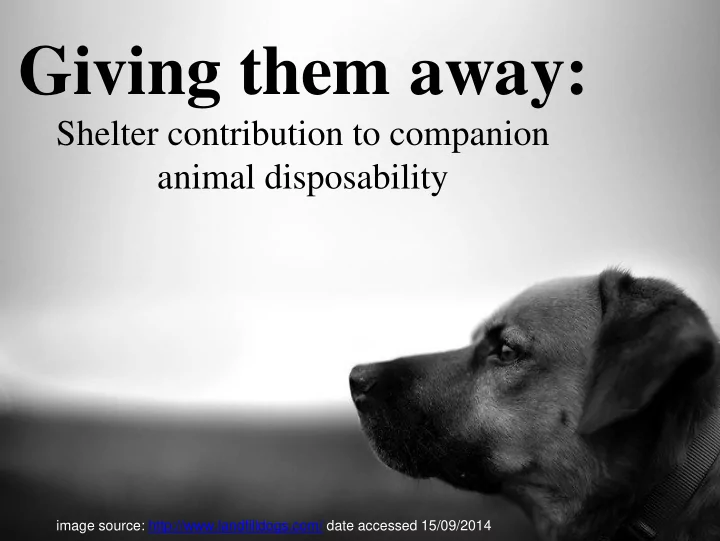
Giving them away: Shelter contribution to companion animal - - PowerPoint PPT Presentation
Giving them away: Shelter contribution to companion animal disposability image source: http://www.landfilldogs.com/ date accessed 15/09/2014 1. What is Companion Animal Disposability and how does the shelter contribute to it? 2. Where do we
image source: http://www.landfilldogs.com/ date accessed 15/09/2014
and how does the shelter contribute to it?
combat CAD and pet rejection?
A situation in which companion animals are seen as able to be sold, abandoned or otherwise disposed of when no longer wanted.
The Cycle of Consumption Consume (Buy) Waste (Bin) Produce (Make)
Bauman, Z. (2007) Consuming Life, Polity Press: Cambridge.
The survival of that society and the well-being of its members hang on the swiftness with which products are consigned to waste and the speed and efficiency of waste removal. Zygmunt Bauman (2005) Liquid Life, pp. 3
What does this mean for companion animals?
image source: http://themodernbark.blogspot.com.au/ date accessed 15/09/2014
Breeding)
The Cycle of Consumption Consume (Buy) Waste (Reject) Produce (Breed/Sell)
Shelters contribute to companion animal disposability in three ways:
cycle which enables the process to continue at an ever increasing rate.
animals as a ‘good’ is reinforced.
human/animal bond to head off ultimate rejection.
Shelters are not villains, willingly promoting CAD to keep themselves in business.
But they aren’t able to completely overturn it either.
Tackling Companion Animal Disposability Consume (Buy) Waste (Reject) Produce (Breed/Sell) Unlinking
companion appear together in public, you form one joint identity.
exhibits socially unacceptable behaviour, it reflects badly on both of you.
image source:www.dogshaming.com; date accessed 15/09/2014
Clinton Sanders observed seven excusing tactics used by owners to cope with this disgrace:
Why should we focus on unlinking?
Because caring for a companion animal is much harder than most anticipate!
image source:www.dogshaming.com; date accessed 15/09/2014
image source:www.dogshaming.com; date accessed 15/09/2014
image source:www.dogshaming.com; date accessed 15/09/2014
When you buy a companion you usually get a ‘puppy/kitten pack’ filled with information about training, vaccination, desexing.
…the companion animal’s behaviour has tarnished the joint identity beyond repair, at which point their human is likely to unlink. reject, rehome, dispose….
Shelters contribute to companion animal disposability in three ways:
cycle which enables the process to continue at an ever increasing rate.
animals as a ‘good’ is reinforced.
the human/animal bond to head off ultimate rejection.
If we are serious about tackling companion animal disposability, we need to intervene BEFORE owners are at the point of unlinking. Shelters are just one of many figures who need to address this.
We (everyday humans) do too.
This issue isn’t going to go away… If there’s one thing furry folk are good at, it’s getting into trouble!
Thank you for your attention!
image source:www.dogshaming.com; date accessed 15/09/2014
image source:www.dogshaming.com; date accessed 15/09/2014
image source:www.dogshaming.com; date accessed 15/09/2014
image source:www.dogshaming.com; date accessed 15/09/2014
image source:www.dogshaming.com; date accessed 15/09/2014
image source:www.dogshaming.com; date accessed 15/09/2014
image source:www.dogshaming.com; date accessed 15/09/2014
image source:www.dogshaming.com; date accessed 15/09/2014