
SLIDE 1
Generative adversarial networks
1
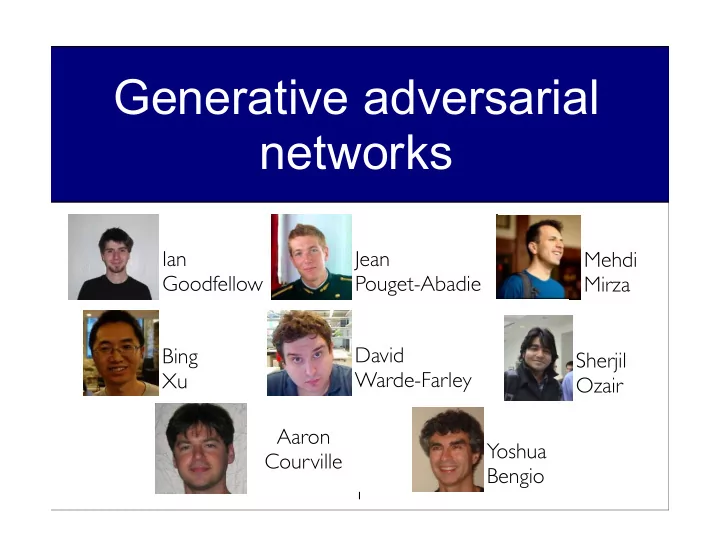
Ian Goodfellow Jean Pouget-Abadie Mehdi Mirza Bing Xu David Warde-Farley Sherjil Ozair Aaron Courville Yoshua Bengio
Generative adversarial networks Ian Jean Mehdi Goodfellow - - PowerPoint PPT Presentation
Generative adversarial networks Ian Jean Mehdi Goodfellow Pouget-Abadie Mirza David Bing Sherjil Warde-Farley Xu Ozair Aaron Yoshua Courville Bengio 1 Discriminative deep learning Recipe for success x 2014 NIPS Workshop on
1
Ian Goodfellow Jean Pouget-Abadie Mehdi Mirza Bing Xu David Warde-Farley Sherjil Ozair Aaron Courville Yoshua Bengio
2014 NIPS Workshop on Perturbations, Optimization, and Statistics --- Ian Goodfellow
2
x
2014 NIPS Workshop on Perturbations, Optimization, and Statistics --- Ian Goodfellow
into the ImageNet 1K competition (with extra data).
2014 NIPS Workshop on Perturbations, Optimization, and Statistics --- Ian Goodfellow
4
into the ImageNet 1K competition (with extra data).
2014 NIPS Workshop on Perturbations, Optimization, and Statistics --- Ian Goodfellow
5
2014 NIPS Workshop on Perturbations, Optimization, and Statistics --- Ian Goodfellow
6
2014 NIPS Workshop on Perturbations, Optimization, and Statistics --- Ian Goodfellow
7
θ
m
2014 NIPS Workshop on Perturbations, Optimization, and Statistics --- Ian Goodfellow
8
h(1) h(2) h(3) x
2014 NIPS Workshop on Perturbations, Optimization, and Statistics --- Ian Goodfellow
9
h(1) h(2) h(3) x d dθi log p(x) = d dθi
˜ p(h, x) − log Z(θ)
dθi log Z(θ) =
d dθi Z(θ)
Z(θ)
2014 NIPS Workshop on Perturbations, Optimization, and Statistics --- Ian Goodfellow
correlated ⇒ leads to divergence of learning.
10
2014 NIPS Workshop on Perturbations, Optimization, and Statistics --- Ian Goodfellow 11
MNIST dataset 1st layer features (RBM)
Coordinated flipping of low- level features
2014 NIPS Workshop on Perturbations, Optimization, and Statistics --- Ian Goodfellow
12
p(x, h) = p(x | h(1))p(h(1) | h(2)) . . . p(h(L−1) | h(L))p(h(L))
h(1) h(2) h(3) x
2014 NIPS Workshop on Perturbations, Optimization, and Statistics --- Ian Goodfellow
13
Conference on Learning Representations (ICLR) 2014.
variational inference in deep latent Gaussian models. ArXiv.
with gradient backpropagation.
2014 NIPS Workshop on Perturbations, Optimization, and Statistics --- Ian Goodfellow
14
2014 NIPS Workshop on Perturbations, Optimization, and Statistics --- Ian Goodfellow
directly.
15
2014 NIPS Workshop on Perturbations, Optimization, and Statistics --- Ian Goodfellow
16
2014 NIPS Workshop on Perturbations, Optimization, and Statistics --- Ian Goodfellow
circumstances.
their opponent’s strategy.
17
1 1
1
You Your opponent Rock Paper Scissors Rock Paper Scissors
2014 NIPS Workshop on Perturbations, Optimization, and Statistics --- Ian Goodfellow
18
2014 NIPS Workshop on Perturbations, Optimization, and Statistics --- Ian Goodfellow
19
2014 NIPS Workshop on Perturbations, Optimization, and Statistics --- Ian Goodfellow
20
Input noise Z Differentiable function G x sampled from model Differentiable function D D tries to
x sampled from data Differentiable function D D tries to
x x
z
2014 NIPS Workshop on Perturbations, Optimization, and Statistics --- Ian Goodfellow
21
min
G max D V (D, G) = Ex∼pdata(x)[log D(x)] + Ez∼pz(z)[log(1 − D(G(z)))].
G Ez∼pz(z)[log D(G(z))]
2014 NIPS Workshop on Perturbations, Optimization, and Statistics --- Ian Goodfellow
22
2014 NIPS Workshop on Perturbations, Optimization, and Statistics --- Ian Goodfellow
23
. . .
Poorly fit model After updating D After updating G Mixed strategy equilibrium Data distribution Model distribution
pD(data)
2014 NIPS Workshop on Perturbations, Optimization, and Statistics --- Ian Goodfellow
24
. . .
Poorly fit model After updating D After updating G Mixed strategy equilibrium Data distribution Model distribution
pD(data)
2014 NIPS Workshop on Perturbations, Optimization, and Statistics --- Ian Goodfellow
25
. . .
Poorly fit model After updating D After updating G Mixed strategy equilibrium Data distribution Model distribution
pD(data)
2014 NIPS Workshop on Perturbations, Optimization, and Statistics --- Ian Goodfellow
26
. . .
Poorly fit model After updating D After updating G Mixed strategy equilibrium Data distribution Model distribution
pD(data)
2014 NIPS Workshop on Perturbations, Optimization, and Statistics --- Ian Goodfellow
27
min
G max D V (D, G) = Ex∼pdata(x)[log D(x)] + Ez∼pz(z)[log(1 − D(G(z)))].
2014 NIPS Workshop on Perturbations, Optimization, and Statistics --- Ian Goodfellow
28
Model MNIST TFD DBN [3] 138 ± 2 1909 ± 66 Stacked CAE [3] 121 ± 1.6 2110 ± 50 Deep GSN [6] 214 ± 1.1 1890 ± 29 Adversarial nets 225 ± 2 2057 ± 26
2014 NIPS Workshop on Perturbations, Optimization, and Statistics --- Ian Goodfellow
29
MNIST TFD CIFAR-10 (fully connected) CIFAR-10 (convolutional)
2014 NIPS Workshop on Perturbations, Optimization, and Statistics --- Ian Goodfellow
30
2014 NIPS Workshop on Perturbations, Optimization, and Statistics --- Ian Goodfellow
along the path between A and B
desired.
31
2014 NIPS Workshop on Perturbations, Optimization, and Statistics --- Ian Goodfellow
32
2014 NIPS Workshop on Perturbations, Optimization, and Statistics --- Ian Goodfellow 33
2014 NIPS Workshop on Perturbations, Optimization, and Statistics --- Ian Goodfellow
34
2014 NIPS Workshop on Perturbations, Optimization, and Statistics --- Ian Goodfellow
35
2014 NIPS Workshop on Perturbations, Optimization, and Statistics --- Ian Goodfellow
36
2014 NIPS Workshop on Perturbations, Optimization, and Statistics --- Ian Goodfellow
37
Emily Denton1∗, Soumith Chintala2∗, Arthur Szlam2, Rob Fergus2
1New York University 2Facebook AI Research ∗Denotes equal contribution
December 16, 2015
Laplacian Pyramid of Generative Adversarial Nets
Parametric generative model of natural images Difficult to generate large natural images in one shot, but we can exploit their multi-scale structure We combine the power of generative adversarial networks (GAN) with a multi-scale image representation (Laplacian pyramid) → → → →
Laplacian Pyramid of Generative Adversarial Nets
Have access to x ∼ pdata(x) through training set Want to learn a model x ∼ pmodel(x) Want pmodel to be similar to pdata
Samples drawn from pmodel reflect structure of pdata Samples from true data distribution have high likelihood under pmodel
Laplacian Pyramid of Generative Adversarial Nets
Unsupervised representation learning
Can transfer learned representation so discriminative tasks, retrieval, clustering, etc.
Train network with both discriminative and generative criterion
Very little labeled data Regularization
Understand data Density estimation ...
Laplacian Pyramid of Generative Adversarial Nets
Goodfellow et al. (2014): Sohl-Dickstein et al. (2015): Gregor et al. (2015):
Laplacian Pyramid of Generative Adversarial Nets
Generative model G: captures data distribution Discriminative model D: trained to distinguish between real and fake samples , defines loss function for G
Laplacian Pyramid of Generative Adversarial Nets
D is trained to estimate the probability that a sample came from data distribution rather than G G is trained to maximize the probability of D making a mistake min
G max D Ex∼pdata(x)[log D(x)] + Ez∼pnoise(z)[log(1 − D(G(z)))]
Laplacian Pyramid of Generative Adversarial Nets
Condition generation on additional info y (e.g. class label, another image) D has to determine if samples are realistic given y
[Mirza and Osindero (2014); Gauthier (2014)]
Laplacian Pyramid of Generative Adversarial Nets
Laplacian Pyramid of Generative Adversarial Nets
Laplacian Pyramid of Generative Adversarial Nets
Train conditional GAN for each level of Laplacian pyramid G learns to generate high frequency structure consistent with low frequency image
Laplacian Pyramid of Generative Adversarial Nets
Each level of Laplacian pyramid trained independently
Laplacian Pyramid of Generative Adversarial Nets
G2
~ I3
G3
z2 ~ h2 z3
G1
z1
G0
z0 ~ I2 l2 ~ I0 h0 ~ I1 ~ ~ h1 l1 l0
Laplacian Pyramid of Generative Adversarial Nets
Small dataset 32x32 images of objects, 50k images, 10 classes
Laplacian Pyramid of Generative Adversarial Nets
Laplacian Pyramid of Generative Adversarial Nets
Laplacian Pyramid of Generative Adversarial Nets
Laplacian Pyramid of Generative Adversarial Nets
Laplacian Pyramid of Generative Adversarial Nets
Humans randomly presented with real or generated image and asked to determine if real of fake Humans think LAPGAN generations are real ∼40% of the time
50 75 100 150 200 300 400 650 1000 2000 10 20 30 40 50 60 70 80 90 100
Presentation time (ms) % classified real Real CC−LAPGAN LAPGAN GAN
Laplacian Pyramid of Generative Adversarial Nets
Large dataset of scenes, ∼10M images, 10 classes.
Laplacian Pyramid of Generative Adversarial Nets
Laplacian Pyramid of Generative Adversarial Nets
Laplacian Pyramid of Generative Adversarial Nets
Laplacian Pyramid of Generative Adversarial Nets
Laplacian Pyramid of Generative Adversarial Nets
Radford, Metz and Chintala (2015) propose several tricks to make GAN training more stable
http://arxiv.org/pdf/1511.06434v1.pdf
Future work: apply same tricks to training of LAPGAN model to potenitally improve samples and produce higher resolution images
Laplacian Pyramid of Generative Adversarial Nets
Proposed a simple generative model that can produce decent quality samples of natural images Potential to be used as a decoder in autoencoder framework for unsupervised learning GAN framework is difficult to train, no clear objective function to track Code & demo: http://soumith.ch/eyescream
Laplacian Pyramid of Generative Adversarial Nets
Code & demo: http://soumith.ch/eyescream
Laplacian Pyramid of Generative Adversarial Nets