Gauss congruences Combinatory Analysis 2018 A Conference in Honor - - PowerPoint PPT Presentation

gauss congruences
SMART_READER_LITE
LIVE PREVIEW

Gauss congruences Combinatory Analysis 2018 A Conference in Honor - - PowerPoint PPT Presentation

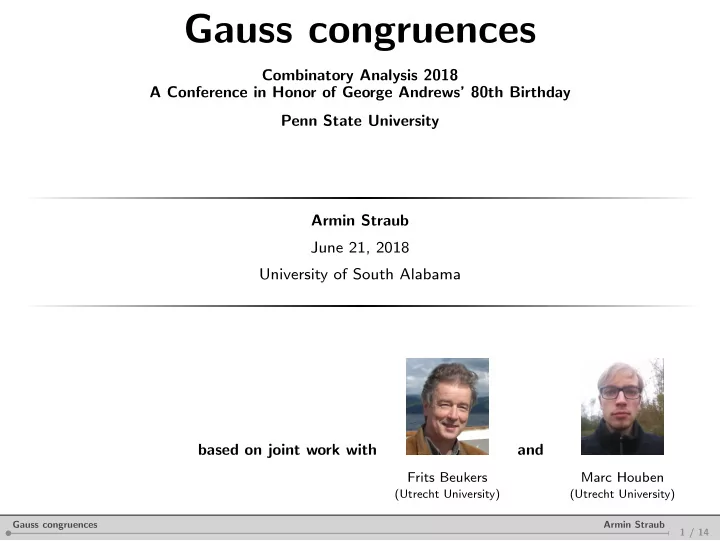
Gauss congruences Combinatory Analysis 2018 A Conference in Honor of George Andrews 80th Birthday Penn State University Armin Straub June 21, 2018 University of South Alabama based on joint work with and Frits Beukers Marc Houben


slide-1
SLIDE 1

Gauss congruences

Combinatory Analysis 2018 A Conference in Honor of George Andrews’ 80th Birthday Penn State University Armin Straub June 21, 2018 University of South Alabama based on joint work with and

Frits Beukers Marc Houben

(Utrecht University) (Utrecht University)

Gauss congruences Armin Straub 1 / 14

slide-2
SLIDE 2

Introduction: Diagonals

  • Given a series

F(x1, . . . , xd) =

  • n1,...,nd0

a(n1, . . . , nd)xn1

1 · · · xnd d ,

its diagonal coefficients are the coefficients a(n, . . . , n). The diagonal coefficients of 1 1 − x − y =

  • n=0

(x + y)n are the central binomial coefficients 2n

n

  • .

EG

Gauss congruences Armin Straub 2 / 14

slide-3
SLIDE 3

Introduction: Diagonals

  • Given a series

F(x1, . . . , xd) =

  • n1,...,nd0

a(n1, . . . , nd)xn1

1 · · · xnd d ,

its diagonal coefficients are the coefficients a(n, . . . , n). The diagonal coefficients of 1 1 − x − y =

  • n=0

(x + y)n are the central binomial coefficients 2n

n

  • .

For comparison, their univariate generating function is

  • n=0

2n n

  • xn =

1 √1 − 4x.

EG

Gauss congruences Armin Straub 2 / 14

slide-4
SLIDE 4

Introduction: Rational generating functions

The Lucas numbers Ln have GF

2−x 1−x−x2 .

Ln+1 = Ln + Ln−1 L0 = 2, L1 = 1

EG

  • The sequences with rational GF are precisely the C-finite ones.

Gauss congruences Armin Straub 3 / 14

slide-5
SLIDE 5

Introduction: Rational generating functions

The Lucas numbers Ln have GF

2−x 1−x−x2 .

Ln+1 = Ln + Ln−1 L0 = 2, L1 = 1

EG

  • The sequences with rational GF are precisely the C-finite ones.

The Delannoy numbers have GF

1 √ 1−6x+x2 .

Dn =

n

  • k=0

n k n + k k

  • They are the diagonal of

1 1−x−y−xy.

EG

  • The sequences with algebraic GF are precisely the diagonals of

2-variable rational functions.

Gauss congruences Armin Straub 3 / 14

slide-6
SLIDE 6

Introduction: Rational generating functions

The Lucas numbers Ln have GF

2−x 1−x−x2 .

Ln+1 = Ln + Ln−1 L0 = 2, L1 = 1

EG

  • The sequences with rational GF are precisely the C-finite ones.

The Delannoy numbers have GF

1 √ 1−6x+x2 .

Dn =

n

  • k=0

n k n + k k

  • They are the diagonal of

1 1−x−y−xy.

EG

  • The sequences with algebraic GF are precisely the diagonals of

2-variable rational functions. The diagonal of a rational function is D-finite. More generally, the diagonal of a D-finite function is D-finite.

F ∈ K[[x1, . . . , xd]] is D-finite if its partial derivatives span a finite-dimensional vector space over K(x1, . . . , xd).

THM

Gessel, Zeilberger, Lipshitz 1981–88 Gauss congruences Armin Straub 3 / 14

slide-7
SLIDE 7

Introduction: Franel numbers

The Franel numbers

n

  • k=0

n k 3

are the diagonal of

1 1 − x − y − z + 4xyz .

Their GF is

1 1 − 2x 2F1 1

3, 2 3

1

  • 27x2

(1 − 2x)3

  • .

EG

Gauss congruences Armin Straub 4 / 14

slide-8
SLIDE 8

Introduction: Franel numbers

The Franel numbers

n

  • k=0

n k 3

are the diagonal of

1 1 − x − y − z + 4xyz .

Their GF is

1 1 − 2x 2F1 1

3, 2 3

1

  • 27x2

(1 − 2x)3

  • .

EG

  • Not at all unique! The Franel numbers are also the diagonal of

1 (1 − x)(1 − y)(1 − z) − xyz .

Gauss congruences Armin Straub 4 / 14

slide-9
SLIDE 9

Introduction: Ap´ ery numbers

The Ap´ ery numbers are the diagonal coefficients of

1 (1 − x1 − x2)(1 − x3 − x4) − x1x2x3x4 .

THM

S 2014

Gauss congruences Armin Straub 5 / 14

slide-10
SLIDE 10

Introduction: Ap´ ery numbers

The Ap´ ery numbers are the diagonal coefficients of

1 (1 − x1 − x2)(1 − x3 − x4) − x1x2x3x4 .

THM

S 2014

  • Univariate generating function:
  • n0

A(n)xn = 17 − x − z 4 √ 2(1 + x + z)3/2 3F2 1

2, 1 2, 1 2

1, 1

1024x (1 − x + z)4

  • ,

where z = √ 1 − 34x + x2.

Gauss congruences Armin Straub 5 / 14

slide-11
SLIDE 11

Introduction: Ap´ ery numbers

The Ap´ ery numbers are the diagonal coefficients of

1 (1 − x1 − x2)(1 − x3 − x4) − x1x2x3x4 .

THM

S 2014

  • Univariate generating function:
  • n0

A(n)xn = 17 − x − z 4 √ 2(1 + x + z)3/2 3F2 1

2, 1 2, 1 2

1, 1

1024x (1 − x + z)4

  • ,

where z = √ 1 − 34x + x2.

  • Well-developed theory of multivariate asymptotics

e.g., Pemantle–Wilson

Gauss congruences Armin Straub 5 / 14

slide-12
SLIDE 12

Introduction: Ap´ ery numbers

The Ap´ ery numbers are the diagonal coefficients of

1 (1 − x1 − x2)(1 − x3 − x4) − x1x2x3x4 .

THM

S 2014

  • Univariate generating function:
  • n0

A(n)xn = 17 − x − z 4 √ 2(1 + x + z)3/2 3F2 1

2, 1 2, 1 2

1, 1

1024x (1 − x + z)4

  • ,

where z = √ 1 − 34x + x2.

  • Well-developed theory of multivariate asymptotics

e.g., Pemantle–Wilson

  • Such diagonals are algebraic modulo pr.

Furstenberg, Deligne ’67, ’84

Automatically leads to congruences such as A(n) ≡

  • 1

(mod 8), if n even, 5 (mod 8), if n odd.

Chowla–Cowles–Cowles ’80 Rowland–Yassawi ’13

Gauss congruences Armin Straub 5 / 14

slide-13
SLIDE 13

Fermat, Euler and Gauss congruences

a(n) satisfies the Fermat congruences if, for all primes p, a(p) ≡ a(1) (mod p).

DEF

Classical: a(n) = an satisfies the Fermat congruences.

EG

Gauss congruences Armin Straub 6 / 14

slide-14
SLIDE 14

Fermat, Euler and Gauss congruences

a(n) satisfies the Fermat congruences if, for all primes p, a(p) ≡ a(1) (mod p).

DEF

Classical: a(n) = an satisfies the Fermat congruences.

EG

In fact, we know that these sequences satisfy stronger congruences:

a(n) satisfies the Euler congruences if, for all primes p, a(pr) ≡ a(pr−1) (mod pr).

DEF

Gauss congruences Armin Straub 6 / 14

slide-15
SLIDE 15

Fermat, Euler and Gauss congruences

a(n) satisfies the Fermat congruences if, for all primes p, a(p) ≡ a(1) (mod p).

DEF

Classical: a(n) = an satisfies the Fermat congruences.

EG

In fact, we know that these sequences satisfy stronger congruences:

a(n) satisfies the Euler congruences if, for all primes p, a(pr) ≡ a(pr−1) (mod pr).

DEF

a(n) satisfies the Gauss congruences if, for all primes p, a(mpr) ≡ a(mpr−1) (mod pr).

DEF

Equivalently,

  • d|m

µ( m

d )a(d) ≡ 0

(mod m).

Gauss congruences Armin Straub 6 / 14

slide-16
SLIDE 16

Gauss congruences

a(n) satisfies the Gauss congruences if, for all primes p, a(mpr) ≡ a(mpr−1) (mod pr).

DEF

  • a(n) = an

EG

Gauss congruences Armin Straub 7 / 14

slide-17
SLIDE 17

Gauss congruences

a(n) satisfies the Gauss congruences if, for all primes p, a(mpr) ≡ a(mpr−1) (mod pr).

DEF

  • a(n) = an
  • a(n) = Ln

Lucas numbers:

Ln+1 = Ln + Ln−1 L0 = 2, L1 = 1 EG

Gauss congruences Armin Straub 7 / 14

slide-18
SLIDE 18

Gauss congruences

a(n) satisfies the Gauss congruences if, for all primes p, a(mpr) ≡ a(mpr−1) (mod pr).

DEF

  • a(n) = an
  • a(n) = Ln

Lucas numbers:

Ln+1 = Ln + Ln−1 L0 = 2, L1 = 1

  • a(n) = Dn

Delannoy numbers: Dn =

n

  • k=0

n k n + k k

  • EG

Gauss congruences Armin Straub 7 / 14

slide-19
SLIDE 19

Gauss congruences

a(n) satisfies the Gauss congruences if, for all primes p, a(mpr) ≡ a(mpr−1) (mod pr).

DEF

  • a(n) = an
  • a(n) = Ln

Lucas numbers:

Ln+1 = Ln + Ln−1 L0 = 2, L1 = 1

  • a(n) = Dn

Delannoy numbers: Dn =

n

  • k=0

n k n + k k

  • EG
  • Later, we allow a(n) ∈ Q. If the Gauss congruences hold for all but finitely

many p, we say that the sequence (or its GF) has the Gauss property.

  • Similarly, for multivariate sequences a(n), we require

a(mpr) ≡ a(mpr−1) (mod pr). That is, for instance, for a(n1, n2), a(m1pr, m2pr) ≡ a(m1pr−1, m2pr−1) (mod pr).

Gauss congruences Armin Straub 7 / 14

slide-20
SLIDE 20

More sequences satisfying Gauss congruences

a(mpr) ≡ a(mpr−1) (mod pr) (G)

  • realizable sequences a(n), i.e., for some map T : X → X,

a(n) = #{x ∈ X : T nx = x} “points of period n”

Everest–van der Poorten–Puri–Ward ’02, Arias de Reyna ’05

In fact, up to a positivity condition, (G) characterizes realizability.

Gauss congruences Armin Straub 8 / 14

slide-21
SLIDE 21

More sequences satisfying Gauss congruences

a(mpr) ≡ a(mpr−1) (mod pr) (G)

  • realizable sequences a(n), i.e., for some map T : X → X,

a(n) = #{x ∈ X : T nx = x} “points of period n”

Everest–van der Poorten–Puri–Ward ’02, Arias de Reyna ’05

In fact, up to a positivity condition, (G) characterizes realizability.

  • a(n) = trace(Mn)

J¨ anichen ’21, Schur ’37; also: Arnold, Zarelua

where M is an integer matrix

Gauss congruences Armin Straub 8 / 14

slide-22
SLIDE 22

More sequences satisfying Gauss congruences

a(mpr) ≡ a(mpr−1) (mod pr) (G)

  • realizable sequences a(n), i.e., for some map T : X → X,

a(n) = #{x ∈ X : T nx = x} “points of period n”

Everest–van der Poorten–Puri–Ward ’02, Arias de Reyna ’05

In fact, up to a positivity condition, (G) characterizes realizability.

  • a(n) = trace(Mn)

J¨ anichen ’21, Schur ’37; also: Arnold, Zarelua

where M is an integer matrix

  • (G) is equivalent to exp

  • n=1

a(n) n T n

  • ∈ Z[[T]].

This is a natural condition in formal group theory.

Gauss congruences Armin Straub 8 / 14

slide-23
SLIDE 23

Minton’s theorem

f ∈ Q(x) has the Gauss property if and only if f is a Q-linear combination of functions xu′(x)/u(x), with u ∈ Z[x].

THM

Minton, 2014

Gauss congruences Armin Straub 9 / 14

slide-24
SLIDE 24

Minton’s theorem

f ∈ Q(x) has the Gauss property if and only if f is a Q-linear combination of functions xu′(x)/u(x), with u ∈ Z[x].

THM

Minton, 2014

  • If u(x) = s

i=1(1 − αix) then

xu′(x) u(x) = −

s

  • i=1

αix 1 − αix = s −

s

  • i=1

1 1 − αix.

Gauss congruences Armin Straub 9 / 14

slide-25
SLIDE 25

Minton’s theorem

f ∈ Q(x) has the Gauss property if and only if f is a Q-linear combination of functions xu′(x)/u(x), with u ∈ Z[x].

THM

Minton, 2014

  • If u(x) = s

i=1(1 − αix) then

xu′(x) u(x) = −

s

  • i=1

αix 1 − αix = s −

s

  • i=1

1 1 − αix.

  • Assuming the αi are distinct,

s

  • i=1

1 1 − αix =

  • n0

s

  • i=1

αn

i

  • xn =
  • n0

trace(Mn)xn,

where M is the companion matrix of s

i=1(x − αi) = xsu(1/x).

Gauss congruences Armin Straub 9 / 14

slide-26
SLIDE 26

Minton’s theorem

f ∈ Q(x) has the Gauss property if and only if f is a Q-linear combination of functions xu′(x)/u(x), with u ∈ Z[x].

THM

Minton, 2014

  • If u(x) = s

i=1(1 − αix) then

xu′(x) u(x) = −

s

  • i=1

αix 1 − αix = s −

s

  • i=1

1 1 − αix.

  • Assuming the αi are distinct,

s

  • i=1

1 1 − αix =

  • n0

s

  • i=1

αn

i

  • xn =
  • n0

trace(Mn)xn,

where M is the companion matrix of s

i=1(x − αi) = xsu(1/x).

  • Minton: No new C-finite sequences with the Gauss property!
  • Can we generalize from C-finite towards D-finite?

Gauss congruences Armin Straub 9 / 14

slide-27
SLIDE 27

The multivariate case

Let P, Q ∈ Z[x] with Q linear in each variable. Then P/Q has the Gauss property if and only if N(P) ⊆ N(Q).

THM

BHS

Gauss congruences Armin Straub 10 / 14

slide-28
SLIDE 28

The multivariate case

Let P, Q ∈ Z[x] with Q linear in each variable. Then P/Q has the Gauss property if and only if N(P) ⊆ N(Q).

THM

BHS

The Delannoy numbers Dn1,n2 are characterized by 1 1 − x − y − xy =

  • n1,n2=0

Dn1,n2xn1yn2.

EG

Beukers, Houben, S 2017

Gauss congruences Armin Straub 10 / 14

slide-29
SLIDE 29

The multivariate case

Let P, Q ∈ Z[x] with Q linear in each variable. Then P/Q has the Gauss property if and only if N(P) ⊆ N(Q).

THM

BHS

The Delannoy numbers Dn1,n2 are characterized by 1 1 − x − y − xy =

  • n1,n2=0

Dn1,n2xn1yn2. By the theorem, the following have the Gauss property: N 1 − x − y − xy with N ∈ {1, x, y, xy}

EG

Beukers, Houben, S 2017

Gauss congruences Armin Straub 10 / 14

slide-30
SLIDE 30

The multivariate case

Let P, Q ∈ Z[x] with Q linear in each variable. Then P/Q has the Gauss property if and only if N(P) ⊆ N(Q).

THM

BHS

The Delannoy numbers Dn1,n2 are characterized by 1 1 − x − y − xy =

  • n1,n2=0

Dn1,n2xn1yn2. By the theorem, the following have the Gauss property: N 1 − x − y − xy with N ∈ {1, x, y, xy} In other words, for δ ∈ {0, 1}2, Dmpr−δ ≡ Dmpr−1−δ (mod pr).

EG

Beukers, Houben, S 2017

Gauss congruences Armin Straub 10 / 14

slide-31
SLIDE 31

The multivariate case, cont’d

Let f1, . . . , fm ∈ Q(x) = Q(x1, . . . , xn) be nonzero. Then x1 · · · xm f1 · · · fm det ∂fj ∂xi

  • i,j=1,...,m

(D) has the Gauss property.

THM

Beukers, Houben, S 2017

Gauss congruences Armin Straub 11 / 14

slide-32
SLIDE 32

The multivariate case, cont’d

Let f1, . . . , fm ∈ Q(x) = Q(x1, . . . , xn) be nonzero. Then x1 · · · xm f1 · · · fm det ∂fj ∂xi

  • i,j=1,...,m

(D) has the Gauss property.

THM

Beukers, Houben, S 2017

Suppose f ∈ Q(x) has the Gauss property. Can it be written as a Q-linear combination of functions of the form (D)?

Q

BHS

Gauss congruences Armin Straub 11 / 14

slide-33
SLIDE 33

The multivariate case, cont’d

Let f1, . . . , fm ∈ Q(x) = Q(x1, . . . , xn) be nonzero. Then x1 · · · xm f1 · · · fm det ∂fj ∂xi

  • i,j=1,...,m

(D) has the Gauss property.

THM

Beukers, Houben, S 2017

Suppose f ∈ Q(x) has the Gauss property. Can it be written as a Q-linear combination of functions of the form (D)?

Q

BHS

  • Yes, for n = 1, by Minton’s theorem.

Gauss congruences Armin Straub 11 / 14

slide-34
SLIDE 34

The multivariate case, cont’d

Let f1, . . . , fm ∈ Q(x) = Q(x1, . . . , xn) be nonzero. Then x1 · · · xm f1 · · · fm det ∂fj ∂xi

  • i,j=1,...,m

(D) has the Gauss property.

THM

Beukers, Houben, S 2017

Suppose f ∈ Q(x) has the Gauss property. Can it be written as a Q-linear combination of functions of the form (D)?

Q

BHS

  • Yes, for n = 1, by Minton’s theorem.
  • Yes, for f = P/Q with Q linear in all, or all but one, variables.

Gauss congruences Armin Straub 11 / 14

slide-35
SLIDE 35

The multivariate case, cont’d

Let f1, . . . , fm ∈ Q(x) = Q(x1, . . . , xn) be nonzero. Then x1 · · · xm f1 · · · fm det ∂fj ∂xi

  • i,j=1,...,m

(D) has the Gauss property.

THM

Beukers, Houben, S 2017

Suppose f ∈ Q(x) has the Gauss property. Can it be written as a Q-linear combination of functions of the form (D)?

Q

BHS

  • Yes, for n = 1, by Minton’s theorem.
  • Yes, for f = P/Q with Q linear in all, or all but one, variables.
  • Yes, for f = P/Q with Q in two variables and total degree 2.

Gauss congruences Armin Straub 11 / 14

slide-36
SLIDE 36

The multivariate case, cont’d

Let f1, . . . , fm ∈ Q(x) = Q(x1, . . . , xn) be nonzero. Then x1 · · · xm f1 · · · fm det ∂fj ∂xi

  • i,j=1,...,m

(D) has the Gauss property.

THM

Beukers, Houben, S 2017

Suppose f ∈ Q(x) has the Gauss property. Can it be written as a Q-linear combination of functions of the form (D)?

Q

BHS

  • Yes, for n = 1, by Minton’s theorem.
  • Yes, for f = P/Q with Q linear in all, or all but one, variables.
  • Yes, for f = P/Q with Q in two variables and total degree 2.

Can

x(x + y + y2 + 2xy2) 1 + 3x + 3y + 2x2 + 2y2 + xy − 2x2y2 be written in that form? EG

Gauss congruences Armin Straub 11 / 14

slide-37
SLIDE 37

A hint of supercongruences

  • a(n) =

2n

n

  • is the diagonal of

1 1−x−y. Hence,

a(mpr) ≡ a(mpr−1) (mod pr).

For primes p 5, this actually holds modulo p3r.

Gauss congruences Armin Straub 12 / 14

slide-38
SLIDE 38

A hint of supercongruences

  • a(n) =

2n

n

  • is the diagonal of

1 1−x−y. Hence,

a(mpr) ≡ a(mpr−1) (mod pr).

For primes p 5, this actually holds modulo p3r.

For primes p, simple combinatorics proves the congruence 2p p

  • =
  • k

p k

  • p

p − k

  • ≡ 1 + 1

(mod p2). For p 5, Wolstenholme showed that this holds modulo p3.

EG

Gauss congruences Armin Straub 12 / 14

slide-39
SLIDE 39

A hint of supercongruences

  • a(n) =

2n

n

  • is the diagonal of

1 1−x−y. Hence,

a(mpr) ≡ a(mpr−1) (mod pr).

For primes p 5, this actually holds modulo p3r.

For primes p, simple combinatorics proves the congruence 2p p

  • =
  • k

p k

  • p

p − k

  • ≡ 1 + 1

(mod p2). For p 5, Wolstenholme showed that this holds modulo p3.

EG

  • Andrews proved a q-analog of this congruence.
  • It is not well understood which other sequences (including Ap´

ery-like numbers) satisfy these stronger Gauss congruences.

George Andrews

q-analogs of the binomial coefficient congruences of Babbage, Wolstenholme and Glaisher Discrete Mathematics 204, 1999

Gauss congruences Armin Straub 12 / 14

slide-40
SLIDE 40

Some open problems

  • Which rational functions have the Gauss property?

A(npr) ≡ A(npr−1) (mod pr)

When are these necessarily combinations of x1···xm

f1···fm det

  • ∂fj

∂xi

  • ?
  • Which rational functions satisfy supercongruences?

A(npr) ≡ A(npr−1) (mod pkr), k > 1 And can we prove these? 1 1 − (x + y + z) + 4xyz , 1 1 − (x + y + z + w) + 27xyzw

  • Is there a rational function in three variables with the ζ(3)-Ap´

ery numbers as diagonal?

Gauss congruences Armin Straub 13 / 14

slide-41
SLIDE 41

THANK YOU!

Slides for this talk will be available from my website: http://arminstraub.com/talks

  • F. Beukers, M. Houben, A. Straub

Gauss congruences for rational functions in several variables Preprint, 2017. arXiv:1710.00423

  • A. Straub

Multivariate Ap´ ery numbers and supercongruences of rational functions Algebra & Number Theory, Vol. 8, Nr. 8, 2014, p. 1985-2008

Gauss congruences Armin Straub 14 / 14

slide-42
SLIDE 42

Bonus

Ap´ ery-like sequences

Gauss congruences Armin Straub 15 / 25

slide-43
SLIDE 43

Ap´ ery numbers and the irrationality of ζ(3)

  • The Ap´

ery numbers

1, 5, 73, 1445, . . .

A(n) =

n

  • k=0

n k 2n + k k 2 satisfy (n + 1)3A(n + 1) = (2n + 1)(17n2 + 17n + 5)A(n) − n3A(n − 1).

Gauss congruences Armin Straub 16 / 25

slide-44
SLIDE 44

Ap´ ery numbers and the irrationality of ζ(3)

  • The Ap´

ery numbers

1, 5, 73, 1445, . . .

A(n) =

n

  • k=0

n k 2n + k k 2 satisfy (n + 1)3A(n + 1) = (2n + 1)(17n2 + 17n + 5)A(n) − n3A(n − 1). ζ(3) = ∞

n=1 1 n3 is irrational.

THM

Ap´ ery ’78

The same recurrence is satisfied by the “near”-integers B(n) =

n

  • k=0

n k 2n + k k 2  

n

  • j=1

1 j3 +

k

  • m=1

(−1)m−1 2m3n

m

n+m

m

 . Then, B(n)

A(n) → ζ(3). But too fast for ζ(3) to be rational.

proof

Gauss congruences Armin Straub 16 / 25

slide-45
SLIDE 45

Zagier’s search and Ap´ ery-like numbers

  • Recurrence for Ap´

ery numbers is the case (a, b, c) = (17, 5, 1) of (n + 1)3un+1 = (2n + 1)(an2 + an + b)un − cn3un−1. Are there other tuples (a, b, c) for which the solution defined by u−1 = 0, u0 = 1 is integral?

Q

Beukers, Zagier

Gauss congruences Armin Straub 17 / 25

slide-46
SLIDE 46

Zagier’s search and Ap´ ery-like numbers

  • Recurrence for Ap´

ery numbers is the case (a, b, c) = (17, 5, 1) of (n + 1)3un+1 = (2n + 1)(an2 + an + b)un − cn3un−1. Are there other tuples (a, b, c) for which the solution defined by u−1 = 0, u0 = 1 is integral?

Q

Beukers, Zagier

  • Essentially, only 14 tuples (a, b, c) found.

(Almkvist–Zudilin)

  • 4 hypergeometric and 4 Legendrian solutions (with generating functions

3F2

1

2, α, 1 − α

1, 1

  • 4Cαz
  • ,

1 1 − Cαz 2F1 α, 1 − α 1

  • −Cαz

1 − Cαz 2 ,

with α = 1

2, 1 3, 1 4, 1 6 and Cα = 24, 33, 26, 24 · 33)

  • 6 sporadic solutions
  • Similar (and intertwined) story for:
  • (n + 1)2un+1 = (an2 + an + b)un − cn2un−1

(Beukers, Zagier)

  • (n + 1)3un+1 = (2n + 1)(an2 + an + b)un − n(cn2 + d)un−1

(Cooper)

Gauss congruences Armin Straub 17 / 25

slide-47
SLIDE 47

The six sporadic Ap´ ery-like numbers

(a, b, c) A(n) (17, 5, 1)

Ap´ ery numbers

  • k

n k 2n + k n 2

(12, 4, 16)

  • k

n k 22k n 2

(10, 4, 64)

Domb numbers

  • k

n k 22k k 2(n − k) n − k

  • (7, 3, 81)

Almkvist–Zudilin numbers

  • k

(−1)k3n−3k n 3k n + k n (3k)! k!3

(11, 5, 125)

  • k

(−1)k n k 34n − 5k 3n

  • (9, 3, −27)
  • k,l

n k 2n l k l k + l n

  • Gauss congruences

Armin Straub 18 / 25

slide-48
SLIDE 48

Supercongruences for Ap´ ery numbers

  • Chowla, Cowles, Cowles (1980) conjectured that, for primes p 5,

A(p) ≡ 5 (mod p3).

Gauss congruences Armin Straub 19 / 25

slide-49
SLIDE 49

Supercongruences for Ap´ ery numbers

  • Chowla, Cowles, Cowles (1980) conjectured that, for primes p 5,

A(p) ≡ 5 (mod p3).

  • Gessel (1982) proved that A(mp) ≡ A(m)

(mod p3).

Gauss congruences Armin Straub 19 / 25

slide-50
SLIDE 50

Supercongruences for Ap´ ery numbers

  • Chowla, Cowles, Cowles (1980) conjectured that, for primes p 5,

A(p) ≡ 5 (mod p3).

  • Gessel (1982) proved that A(mp) ≡ A(m)

(mod p3). The Ap´ ery numbers satisfy the supercongruence

(p 5)

A(mpr) ≡ A(mpr−1) (mod p3r).

THM

Beukers, Coster ’85, ’88

Gauss congruences Armin Straub 19 / 25

slide-51
SLIDE 51

Supercongruences for Ap´ ery numbers

  • Chowla, Cowles, Cowles (1980) conjectured that, for primes p 5,

A(p) ≡ 5 (mod p3).

  • Gessel (1982) proved that A(mp) ≡ A(m)

(mod p3). The Ap´ ery numbers satisfy the supercongruence

(p 5)

A(mpr) ≡ A(mpr−1) (mod p3r).

THM

Beukers, Coster ’85, ’88

For primes p, simple combinatorics proves the congruence 2p p

  • =
  • k

p k

  • p

p − k

  • ≡ 1 + 1

(mod p2). For p 5, Wolstenholme’s congruence shows that, in fact, 2p p

  • ≡ 2

(mod p3).

EG

Gauss congruences Armin Straub 19 / 25

slide-52
SLIDE 52

Supercongruences for Ap´ ery-like numbers

  • Conjecturally, supercongruences like

A(mpr) ≡ A(mpr−1) (mod p3r) hold for all Ap´ ery-like numbers.

Osburn–Sahu ’09

  • Current state of affairs for the six sporadic sequences from earlier:

(a, b, c) A(n) (17, 5, 1)

  • k

n

k

2n+k

n

2

Beukers, Coster ’87-’88

(12, 4, 16)

  • k

n

k

22k

n

2

Osburn–Sahu–S ’16

(10, 4, 64)

  • k

n

k

22k

k

2(n−k)

n−k

  • Osburn–Sahu ’11

(7, 3, 81)

  • k(−1)k3n−3k n

3k

n+k

n

(3k)!

k!3

  • pen

modulo p3 Amdeberhan–Tauraso ’16

(11, 5, 125)

  • k(−1)kn

k

34n−5k

3n

  • Osburn–Sahu–S ’16

(9, 3, −27)

  • k,l

n

k

2n

l

k

l

k+l

n

  • Gorodetsky ’18

Robert Osburn Brundaban Sahu

(University of Dublin) (NISER, India) Gauss congruences Armin Straub 20 / 25

slide-53
SLIDE 53

Multivariate supercongruences

Define A(n) = A(n1, n2, n3, n4) by 1 (1 − x1 − x2)(1 − x3 − x4) − x1x2x3x4 =

  • n∈Z4

A(n)xn.

  • The Ap´

ery numbers are the diagonal coefficients.

  • For p 5, we have the multivariate supercongruences

A(npr) ≡ A(npr−1) (mod p3r).

THM

S 2014

Gauss congruences Armin Straub 21 / 25

slide-54
SLIDE 54

Multivariate supercongruences

Define A(n) = A(n1, n2, n3, n4) by 1 (1 − x1 − x2)(1 − x3 − x4) − x1x2x3x4 =

  • n∈Z4

A(n)xn.

  • The Ap´

ery numbers are the diagonal coefficients.

  • For p 5, we have the multivariate supercongruences

A(npr) ≡ A(npr−1) (mod p3r).

THM

S 2014

  • n0

a(n)xn = F(x) = ⇒

  • n0

a(pn)xpn = 1 p

p−1

  • k=0

F(ζk

p x) ζp = e2πi/p

  • Hence, both A(npr) and A(npr−1) have rational generating function.

The proof, however, relies on an explicit binomial sum for the coefficients.

Gauss congruences Armin Straub 21 / 25

slide-55
SLIDE 55

Multivariate supercongruences

Define A(n) = A(n1, n2, n3, n4) by 1 (1 − x1 − x2)(1 − x3 − x4) − x1x2x3x4 =

  • n∈Z4

A(n)xn.

  • The Ap´

ery numbers are the diagonal coefficients.

  • For p 5, we have the multivariate supercongruences

A(npr) ≡ A(npr−1) (mod p3r).

THM

S 2014

  • By MacMahon’s Master Theorem,

A(n) =

  • k∈Z

n1 k n3 k n1 + n2 − k n1 n3 + n4 − k n3

  • .

Gauss congruences Armin Straub 21 / 25

slide-56
SLIDE 56

Multivariate supercongruences

Define A(n) = A(n1, n2, n3, n4) by 1 (1 − x1 − x2)(1 − x3 − x4) − x1x2x3x4 =

  • n∈Z4

A(n)xn.

  • The Ap´

ery numbers are the diagonal coefficients.

  • For p 5, we have the multivariate supercongruences

A(npr) ≡ A(npr−1) (mod p3r).

THM

S 2014

  • By MacMahon’s Master Theorem,

A(n) =

  • k∈Z

n1 k n3 k n1 + n2 − k n1 n3 + n4 − k n3

  • .
  • Because A(n − 1) = A(−n, −n, −n, −n), we also find

A(mpr − 1) ≡ A(mpr−1 − 1) (mod p3r).

Beukers ’85

Gauss congruences Armin Straub 21 / 25

slide-57
SLIDE 57

An infinite family of rational functions

Let λ ∈ Zℓ

>0 with d = λ1 + . . . + λℓ. Define Aλ(n) by

1

  • 1jℓ
  • 1 −
  • 1rλj

xλ1+...+λj−1+r

  • − x1x2 · · · xd

=

  • n∈Zd

Aλ(n)xn.

  • If ℓ 2, then, for all primes p,

Aλ(npr) ≡ Aλ(npr−1) (mod p2r).

  • If ℓ 2 and max(λ1, . . . , λℓ) 2, then, for primes p 5,

Aλ(npr) ≡ Aλ(npr−1) (mod p3r).

THM

S 2014

λ = (2, 2) λ = (2, 1)

1 (1 − x1 − x2)(1 − x3 − x4) − x1x2x3x4 1 (1 − x1 − x2)(1 − x3) − x1x2x3 EG

Gauss congruences Armin Straub 22 / 25

slide-58
SLIDE 58

Further examples

1 (1 − x1 − x2)(1 − x3) − x1x2x3

has as diagonal the Ap´ ery-like numbers, associated with ζ(2),

B(n) =

n

  • k=0

n k 2n + k k

  • .

EG

1 (1 − x1)(1 − x2) · · · (1 − xd) − x1x2 · · · xd

has as diagonal the numbers

d = 3: Franel, d = 4: Yang–Zudilin

Yd(n) =

n

  • k=0

n k d .

EG

  • In each case, we obtain supercongruences generalizing results of

Coster (1988) and Chan–Cooper–Sica (2010).

Gauss congruences Armin Straub 23 / 25

slide-59
SLIDE 59

A conjectural multivariate supercongruence

The coefficients Z(n) of 1 1 − (x1 + x2 + x3 + x4) + 27x1x2x3x4 =

  • n∈Z4

Z(n)xn satisfy, for p 5, the multivariate supercongruences Z(npr) ≡ Z(npr−1) (mod p3r).

CONJ

S 2014

  • Here, the diagonal coefficients are the Almkvist–Zudilin numbers

Z(n) =

n

  • k=0

(−3)n−3k n 3k n + k n (3k)! k!3 ,

for which the univariate congruences are still open.

Gauss congruences Armin Straub 24 / 25

slide-60
SLIDE 60

THANK YOU!

Slides for this talk will be available from my website: http://arminstraub.com/talks

  • F. Beukers, M. Houben, A. Straub

Gauss congruences for rational functions in several variables Preprint, 2017. arXiv:1710.00423

  • A. Straub

Multivariate Ap´ ery numbers and supercongruences of rational functions Algebra & Number Theory, Vol. 8, Nr. 8, 2014, p. 1985-2008

Gauss congruences Armin Straub 25 / 25