
SLIDE 1
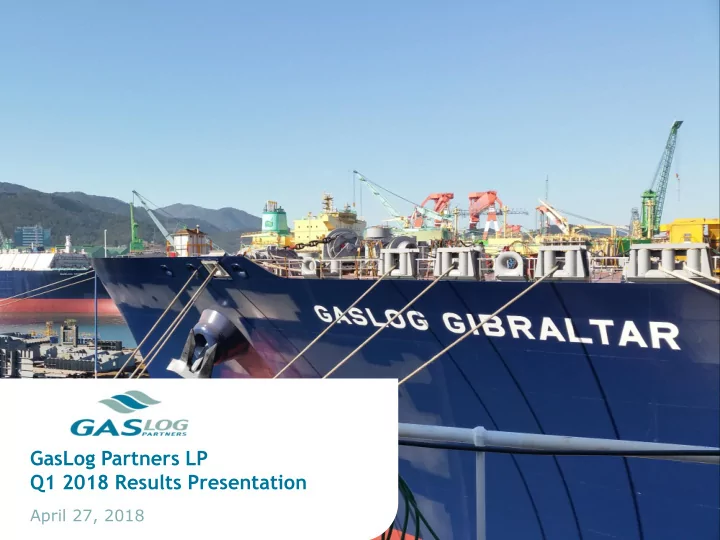
GasLog Partners LP Q1 2018 Results Presentation
April 27, 2018
GasLog Partners LP Q1 2018 Results Presentation April 27, 2018 2 - - PowerPoint PPT Presentation
GasLog Partners LP Q1 2018 Results Presentation April 27, 2018 2 Forward-Looking Statements All statements in this presentation that are not statements of historical fact are forward -looking statements within the meaning of the U.S.
April 27, 2018
All statements in this presentation that are not statements of historical fact are “forward-looking statements” within the meaning of the U.S. Private Securities Litigation Reform Act of 1995. Forward-looking statements include statements that address activities, events or developments that the Partnership expects, projects, believes or anticipates will or may occur in the future, particularly in relation to our operations, cash flows, financial position, liquidity and cash available for dividends or distributions, plans, strategies, business prospects and changes and trends in our business and the markets in which we operate. We caution that these forward-looking statements represent our estimates and assumptions only as of the date of this presentation, about factors that are beyond our ability to control or predict, and are not intended to give any assurance as to future results. Any of these factors or a combination of these factors could materially affect future results of operations and the ultimate accuracy of the forward-looking statements. Accordingly, you should not unduly rely on any forward-looking statements. Factors that might cause future results and outcomes to differ include, but are not limited to, the following: ▪ general LNG shipping market conditions and trends, including spot and long-term charter rates, ship values, factors affecting supply and demand of LNG and LNG shipping, technological advancements and opportunities for the profitable operations of LNG carriers; ▪ fluctuations in charter hire rates and vessel values; ▪ changes in our operating expenses, including crew wages, maintenance, dry-docking and insurance costs and bunker prices; ▪ number of off-hire days and dry-docking requirements including our ability to successfully complete scheduled dry-dockings on time and within budget; ▪ planned capital expenditures and availability of capital resources to fund capital expenditures; ▪
the latest technology at such time which may impact the rate at which we can charter such vessels; ▪
▪ fluctuations in prices for crude oil, petroleum products and natural gas including LNG; ▪
▪
▪ the ability of GasLog to maintain long-term relationships with major energy companies; ▪ changes in the ownership of our charterers; ▪
▪
▪
▪
into on April 3, 2017 and our ability to meet our restrictive covenants and other obligations under our credit facilities; ▪ future, pending or recent acquisitions of ships or other assets, business strategy, areas of possible expansion and expected capital spending; ▪ the expected cost of and our ability to comply with environmental and regulatory conditions, including changes in laws and regulations or actions taken by regulatory authorities, governmental organizations, classification societies and standards imposed by our charterers applicable to our business; ▪ risks inherent in ship operation, including the discharge of pollutants; ▪ GasLog’s relationships with its employees and ship crews, its ability to retain key employees and provide services to us, and the availability of skilled labor, ship crews and management; ▪ potential disruption of shipping routes due to accidents, political events, piracy or acts by terrorists; ▪ potential liability from future litigation; ▪
▪ any malfunction or disruption of information technology systems and networks that our operations rely on or any impact of a possible cybersecurity breach; and ▪
We undertake no obligation to update or revise any forward-looking statements contained in this presentation, whether as a result of new information, future events, a change in our views or expectations or otherwise. New factors emerge from time to time, and it is not possible for us to predict all of these factors. Further, we cannot assess the impact of each such factor on our business or the extent to which any factor, or combination of factors, may cause actual results to be materially different to those contained in any forward-looking statement. The declaration and payment of distributions are at all times subject to the discretion of our board of directors and will depend on, amongst other things, risks and uncertainties described above, restrictions in our credit facilities, the provisions of Marshall Islands law and such other factors as our board of directors may deem relevant.
2
3
(“IFRS”). For the definition and reconciliation of these measures to the most directly comparable financial measure calculated and presented in accordance with the Partnership Performance Results, please refer to the Appendix to these slides.
▪ Highest-ever quarterly Partnership Performance Results(1) for Revenues, Profit, Adjusted Profit (2), EBITDA and Distributable cash flow(2) ▪ Increased cash distribution to $0.53 per common unit, 1.2% higher than the fourth quarter of 2017 and 6.0% higher than the first quarter of 2017 – Distribution coverage ratio(3) of 1.13x, or 1.18x prior to post quarter-end common and general partner unit issuances ▪ Completed public offering of 8.200% Series B Perpetual Fixed to Floating Rate Preference Units, raising gross proceeds of $115.0 million ▪ Announced and, post quarter-end, completed the acquisition of the GasLog Gibraltar from GasLog Ltd. (“GasLog”) for $207.0 million, with attached multi-year charter to a subsidiary of Royal Dutch Shell plc (“Shell”) ▪ Successfully re-chartered the GasLog Santiago for approximately three and a half years and one of the Partnership’s modern steam vessels for one year to a new customer ▪ Retired $103.9 million in total debt
4
Purchase Price $207.0 million NTM EBITDA(1) $22.4 million NTM DCF(1) $11.5 million Acquisition Multiple 9.2x NTM EBITDA(1) Financing $45.0 million in common units to GLOG $18.4 million in cash $143.6 million in assumed debt
1. For the first 12 months after the closing. Estimated NTM DCF, NTM EBITDA and Distributable cash flow are non-GAAP financial measures. Please refer to the Appendix of this presentation for a definition and discussion of the assumptions used to calculate the NTM figures.
GasLog Gibraltar Acquisition
Loan Amount $45.0 million Interest Rate 9.125% Maturity Date March 2022 Repayment Date March 23, 2018 Financing $45.0 million in cash from 8.200% Series B Preference Unit
Intercompany Loan Repayment
Each Transaction Accretive To Distributable Cash Flow (1) Per LP Unit
5
definition and reconciliation of these measures to the most directly comparable financial measure calculated and presented in accordance with the Partnership Performance Results, please refer to the Appendix to these slides.
(In Millions Of USD, Except Per Unit Data) % Change From Q1 2018 Q4 2017 Q1 2017 Q4 2017 Q1 2017 Revenues $77.1 $76.2 $57.0 1.1% 35.2% EBITDA(2) $55.8 $55.4 $42.0 0.9% 32.8% Distributable Cash Flow(2) $27.5 $26.9 $23.5 2.0% 16.9% Quarterly Cash Distribution Per Unit $0.530 $0.524 $0.500 1.2% 6.0% Annualized Cash Distribution Per Unit $2.120 $2.094 $2.000 1.2% 6.0% Distribution Coverage Ratio 1.13x 1.18x 1.17x
Distribution Coverage Ratio ex. Dry-Dockings(3) 1.13x 1.24x 1.17x
6
Frequency Once every 5 years Estimated Duration Typically 30 days per vessel Revenue Impact No revenue earned during drydocking Operating Expenses and CAPEX Added costs for maintenance and repairs Reserves $270K/quarter per vessel
Dry-Docking Fundamentals
Estimated Duration 40 days per vessel Revenue Impact 80 days off hire (total) Vessel Enhancements Reliquefaction modules Additional CAPEX $19.3 million remaining of $28 million total cost for reliquefaction upgrades Financing Cash on hand
Dry-Docking Of GasLog Santiago And GasLog Sydney
We Anticipate Reduced Distribution Coverage In Any Quarter With Vessel Dry-Dockings
7
Benefits To GasLog Partners Reliquefaction Module For The GasLog Santiago
Lower unit freight costs (UFC) and increased operational flexibility for our customers
GasLog Santiago and GasLog Sydney expected to be more efficient than 70% of the on-the-water fleet
Can be installed during routine dry- dockings with minimal additional downtime
Modest CAPEX requirement
Enhanced marketability and commercial value
8
Liquidity And Credit Metrics Scheduled Debt Payments
9
Vessel Propulsion Built Capacity (cbm) Charterer 2018 2019 2020 2021 2022 2023 2024 2025 2026
GasLog Gibraltar Dropdown, New Charter Agreements Increase Contracted Days To 90% In 2018 And 83% In 2019
Please refer to the Appendix of this presentation for footnotes pertaining to the fleets of GasLog Ltd. and GasLog Partners
10
▪ Over 33 Mtpa of new liquefaction capacity expect to enter commercial service in 2018, an increase of 10% over 2017 ‒ Cove Point began commercial production earlier this month ‒ Cameroon and Wheatstone T2 expected to start commercial operations later in Q2 ▪ At least 125 Mtpa of LNG production capacity in planning has a breakeven of <$10/mmBTU
Source: IGU, Wood Mackenzie, Poten
Expected LNG Capacity Additions 2018-2020 Possible & Speculative Supply Sources
11
LNG Imports (million tonnes) By Country During Q1 2018 vs. Q1 2017
Source: Poten
LNG Imports Q1 2017: 73 million tonnes Q1 2018: 78 million tonnes YoY increase: 8%
Imports to China, South Korea, Pakistan and India were up a combined 30% YoY during Q1 2018
12
Projected LNGC Vessel Supply & Demand Balance
1. Projected LNG Vessel Demand high and low cases are based on Wood Mackenzie LNG Demand(2) (3) forecast and the respective vessel-to-volume multipliers, as annotated in the chart legend 2. Demand breakdown between US and Rest of World (RoW) is based on Wood Mackenzie supply estimates 3. Annual Wood Mackenzie Demand forecasts assumed to increase quarterly on a linear basis Source: Wood Mackenzie, Poten
Projected LNG Vessel Supply (160k cbm equivalent assuming no scrappages) Projected LNG Vessel Supply (excluding unfixed pre-2000 built vessels) Projected LNG Vessel low case demand(1) (160k cbm equiv.) – Vessel-to-volume multiplier of 1.5x for US and 1.3x for RoW Projected LNG Vessel high case demand(1) (160k cbm equiv.) – Vessel-to-volume multiplier of 1.7x for US and 1.4x for RoW Range between projected low and high demand cases
`
35 - 62 Vessels 85 - 117 Vessels
More Ships Required To Meet LNG Demand 2020+
13
Source: Clarksons, Poten
TFDE Headline Spot Rates (2011-18) And Quarterly Spot Fixtures (2015-2018 YTD)
Clarksons Currently Quoting Average TFDE Headline Rates Of $38,000/Day, +27% Y-Y
14 GasLog is a founding member of The Cool Pool, the first LNG shipping pool, controlling 18 TFDE vessels trading worldwide GasLog benefits from interaction with a broad range of customers and the ability to showcase our operational capabilities, as well as improved utilisation Customers benefit from increased flexibility through a range of unique and innovative commercial solutions such as forward-fixing and COAs
Cool Pool Customers
15
Distributable Cash Flow(1) Per LP Unit
Cash Distribution Paid Per LP Unit 2018 Distribution Guidance
1. Distributable Cash Flow is a non-GAAP financial measure, and should not be used in isolation or as a substitute for GasLog’s financial results presented in accordance with IFRS. For a definition and reconciliation of this measure to the most directly comparable financial measures calculated and presented in accordance with IFRS, please refer to the Appendix to these slides. Calculation based on unit count as of March 31, 2018.
16
definition and reconciliation of these measures to the most directly comparable financial measures calculated and presented in accordance with the Partnership Performance Results, please refer to the Appendix of this presentation.
Non-GAAP Financial Measures: EBITDA is defined as earnings before interest income and expense, gain/loss on interest rate swaps, taxes, depreciation and amortization. EBITDA, which is a non- GAAP financial measure, is used as a supplemental financial measure by management and external users of financial statements, such as investors, to assess our financial and operating performance. The Partnership believes that this non-GAAP financial measure assists our management and investors by increasing the comparability of our performance from period to period. The Partnership believes that including EBITDA assists our management and investors in (i) understanding and analyzing the results of our operating and business performance, (ii) selecting between investing in us and other investment alternatives and (iii) monitoring our
excluding the potentially disparate effects between periods of financial costs, gain/loss on interest rate swaps, taxes, depreciation and amortization, which items are affected by various and possibly changing financing methods, financial market conditions, capital structure and historical cost basis, and which items may significantly affect results of operations between periods. EBITDA has limitations as an analytical tool and should not be considered as an alternative to, or as a substitute for, or superior to, profit, profit from operations, earnings per unit or any other measure of operating performance presented in accordance with IFRS. Some of these limitations include the fact that it does not reflect (i) our cash expenditures or future requirements for capital expenditures or contractual commitments, (ii) changes in, or cash requirements for, our working capital needs and (iii) the cash requirements necessary to service interest or principal payments, on our debt. Although depreciation and amortization are non-cash charges, the assets being depreciated and amortized will often have to be replaced in the future, and EBITDA does not reflect any cash requirements for such
calculate this measure differently to how we do, limiting its usefulness as a comparative measure. EBITDA excludes some, but not all, items that affect profit or loss and these measures may vary among other companies. Therefore, EBITDA as presented herein may not be comparable to similarly titled measures of other companies. Distributable cash flow means EBITDA, on the basis of the Partnership Performance Results, after considering financial costs for the period, including realized loss on interest rate swaps and excluding amortization of loan fees, estimated dry-docking and replacement capital reserves established by the Partnership and accrued distributions on preference units, whether or not declared. Estimated dry-docking and replacement capital reserves represent capital expenditures required to renew and maintain over the long-term the operating capacity of, or the revenue generated by, our capital assets. Distributable cash flow, which is a non-GAAP financial measure, is a quantitative standard used by investors in publicly-traded partnerships to assess their ability to make quarterly cash distributions. Our calculation of Distributable cash flow may not be comparable to that reported by other companies. Distributable cash flow has limitations as an analytical tool and should not be considered as an alternative to, or substitute for, or superior to, profit or loss, profit or loss from operations, earnings per unit or any other measure of
18
19
the Partnership and its subsidiaries).
GasLog Gibraltar - Estimated NTM EBITDA For the entity owning GasLog Gibraltar, estimated EBITDA for the first 12 months of operation following the completion of the acquisition is based on the following assumptions:
GasLog and GasLog Partners consider the above assumptions to be reasonable as of April 26, 2018, but if these assumptions prove to be incorrect, actual EBITDA for the entity owning the vessel could differ materially from our estimates. The prospective financial information was not prepared with a view toward public disclosure or with a view toward complying with the guidelines established by the American Institute of Certified Public Accountants, but, in the view of management, was prepared on a reasonable basis and reflects the best currently available estimates and judgments. However, this information is not fact and should not be relied upon as being necessarily indicative of future results, and readers of this document are cautioned not to place undue reliance on the prospective financial
contained above, nor have they expressed any opinion or any other form of assurance on such information or its achievability and assume no responsibility for, and disclaim any association with, such prospective financial information. .
20
21
the related time charters for a period of either three or five years at its election. The charterer of the GasLog Seattle and the Solaris may extend the term of each time charter for a period ranging from five to ten years. The charterer of the GasLog Greece may extend the term of the time charter for a period of five years. The charterer of the GasLog Geneva may extend the term of the time charter by two additional periods of five and three years, respectively. The charterer of the GasLog Gibraltar may extend the term of the time charter by two additional periods of five and three years, respectively.
vessel.
substitution will take effect after the completion of the GasLog Skagen’s drydocking in the third quarter of 2018.