
SLIDE 1
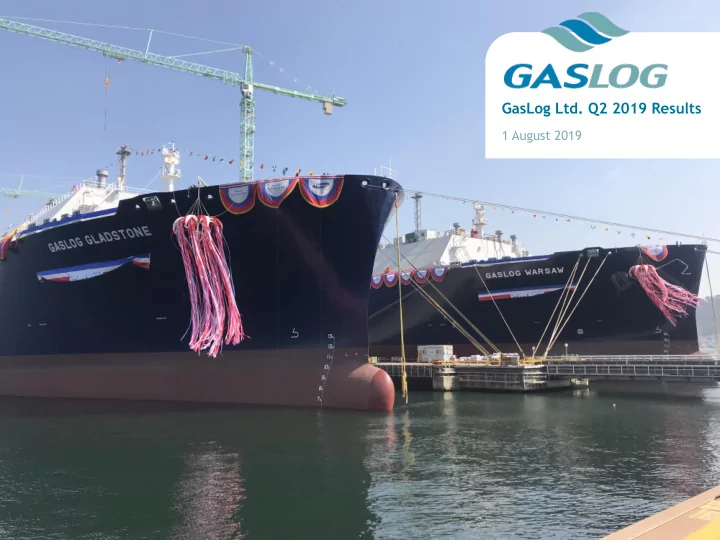
GasLog Ltd. Q2 2019 Results 1 August 2019 2 Forward Looking - - PowerPoint PPT Presentation
GasLog Ltd. Q2 2019 Results 1 August 2019 2 Forward Looking Statements All statements in this presentation that are not statements of historical fact are forward -looking statements within the meaning of the U.S. Private Securities
All statements in this presentation that are not statements of historical fact are “forward-looking statements” within the meaning of the U.S. Private Securities Litigation Reform Act of 1995. Forward- looking statements include statements that address activities, events or developments that the Company expects, projects, believes or anticipates will or may occur in the future, particularly in relation to
which we operate. We caution that these forward-looking statements represent our estimates and assumptions only as of the date of this presentation, about factors that are beyond our ability to control
accuracy of the forward-looking statements. Accordingly, you should not unduly rely on any forward-looking statements. Factors that might cause future results and outcomes to differ include, but are not limited to, the following:
and opportunities for the profitable operations of LNG carriers;
have the latest technology at such time which may impact the rate at which we can charter such vessels;
and other obligations under our credit facilities;
We undertake no obligation to update or revise any forward-looking statements contained in this presentation, whether as a result of new information, future events, a change in our views or expectations
The declaration and payment of dividends are at all times subject to the discretion of our board of directors and will depend on, amongst other things, risks and uncertainties described above, restrictions in
2
3
4
6 Term Charters 2 Term Charters 18 Term Charters 2 Term Charters 2 Term Charters 1 Term Charter 1 Term Charter 1 Term Charter
5
$15,395 $14,319
1. Term TCE Revenue is calculated as Term Charter Revenues Less Term Charter Voyage Expenses and Commissions. Net Pool Performance is calculated as Pool Gross Revenues Less Pool Gross Voyages Expenses and Commissions ± GasLog’s Net Pool Allocation Source: Company
6
Source: Company
1. EBITDA is a non-GAAP financial measure, and should not be used in isolation or as substitutes for GasLog’s financial results presented in accordance with International Financial Reporting Standards (“IFRS”). For reconciliations of EBITDA to the most directly comparable financial measure calculated and presented in accordance with IFRS, please refer to the Appendix to these slides.
7
these measures to the most directly comparable financial measure calculated and presented in accordance with IFRS, please refer to the Appendix to these slides
GasLog Gladstone
March 2019
Q1 2029 to Shell
$25.3 million
$165.8 million
Newbuilding Deliveries
8
Source: Company
9
10
11
Source: Poten
LNG Demand Q3 17 – Q2 18: 304 million tonnes Q3 18 – Q2 19: 342 million tonnes YoY increase: 13% Demand from top 10 countries increased by 42 mtpa year-over-year, representing 55% growth
12
Source: Wood Mackenzie
13
Source: Wood Mackenzie
FID in 2018 / 19
14
Source: Poten
1. Numbers represent the number of cargoes imported to each country 2. Normalised to a vessel capacity of 160,000 m3
15
1. Projected LNG Vessel Demand high and low cases are based on Wood Mackenzie LNG Demand(3) (4) forecast and the respective vessel-to-volume multipliers, as annotated in the chart legend 2. Projected LNG Vessel Demand are based on Wood Mackenzie LNG Supply(3) (4) forecast and the respective vessel-to-volume multipliers, as annotated in the chart legend 3. Demand breakdown between US and Rest of World (RoW) is based on Wood Mackenzie supply estimates 4. Annual Wood Mackenzie demand & supply forecasts assumed to increase quarterly on a linear basis Source: Wood Mackenzie, Poten
Vessel Supply (no scrappages) Vessel Demand (LNG Demand(1) @ 1.6x US & 1.25x RoW) Vessel Demand (LNG Demand(1) @ 2.0x US & 1.35x RoW)
16
Source: Clarksons, Poten
17
Source: Clarksons
18
Source: Clarksons, Poten
(1,2,3,4,5 6) For notes and cautionary statements please see the Appendix to this presentation
19
2017 EBITDA(2) Revenue Driven EBITDA(2) Growth Targeted Cost-Saving Driven EBITDA(2) Growth
Recovery to $70-80,000/day mid- cycle spot rates(3) $1,500/day target for fleet opex & G&A savings per vessel(4) Contracted EBITDA(2) on fixed vessels and $70,000/day assumed on uncommitted(5) EBITDA(2) from future fleet growth(6)
$356m
100% of revenue driven EBITDA(2) growth is generated by the C-Corp and potentially increases the MLP dropdown pipeline
(2) (2)
Five newbuilds
Investor Day Tight market expected across H2 2019-2020 at least
20
Non-GAAP Financial Measures: EBITDA is defined as earnings before depreciation, amortization, financial income and costs, gain/loss on derivatives and taxes. Adjusted EBITDA is defined as EBITDA before foreign exchange gains/losses. Adjusted Profit represents earnings before write-off and accelerated amortization of unamortized loan fees/bond fees and premium, foreign exchange gains/losses and non-cash gain/loss on derivatives that includes (if any) (a) unrealized gain/loss on derivative financial instruments held for trading, (b) recycled loss
adjusted for non-cash gain/loss on derivatives as defined above, foreign exchange gains/losses and write-off and accelerated amortization of unamortized loan/bond fees and premium, all adjustments calculated at Group level without deduction for non-controlling interests, divided by the weighted average number of shares outstanding. EBITDA, Adjusted EBITDA, Adjusted Profit and Adjusted EPS are non-GAAP financial measures that are used as supplemental financial measures by management and external users of financial statements, such as investors, to assess our financial and operating performance. We believe that these non-GAAP financial measures assist our management and investors by increasing the comparability of our performance from period to period. We believe that including EBITDA, Adjusted EBITDA, Adjusted Profit and Adjusted EPS assists our management and investors in (i) understanding and analyzing the results of our operating and business performance, (ii) selecting between investing in us and
taxes, depreciation and amortization; in the case of Adjusted EBITDA, foreign exchange gains/losses; and in the case of Adjusted Profit and Adjusted EPS, non-cash gain/loss
and possibly changing financing methods, financial market conditions, capital structure and historical cost basis, and which items may significantly affect results of operations between periods. EBITDA, Adjusted EBITDA, Adjusted Profit and Adjusted EPS have limitations as analytical tools and should not be considered as alternatives to, or as substitutes for, or superior to, profit, profit from operations, earnings per share or any other measure of operating performance presented in accordance with IFRS. Some of these limitations include the fact that they do not reflect (i) our cash expenditures or future requirements for capital expenditures or contractual commitments, (ii) changes in, or cash requirements for, our working capital needs and (iii) the cash requirements necessary to service interest or principal payments on our debt. Although depreciation and amortization are non-cash charges, the assets being depreciated and amortized will have to be replaced in the future, and EBITDA and Adjusted EBITDA do not reflect any cash requirements for such replacements. EBITDA, Adjusted EBITDA, Adjusted Profit and Adjusted EPS are not adjusted for all non-cash income or expense items that are reflected in our statements of cash flows and other companies in our industry may calculate these measures differently than we do, limiting their usefulness as a comparative measure. In evaluating Adjusted EBITDA, Adjusted Profit and Adjusted EPS, you should be aware that in the future we may incur expenses that are the same as or similar to some of the adjustments in this presentation. Our presentation of Adjusted EBITDA, Adjusted Profit and Adjusted EPS should not be construed as an inference that our future results will be unaffected by the excluded items. Therefore, the non-GAAP financial measures as presented below may not be comparable to similarly titled measures of other companies in the shipping or other industries. .
22
23 Reconciliation of Profit to EBITDA and Adjusted EBITDA Reconciliation of Profit to Adjusted Profit
24 Reconciliation Of Profit to Earnings/(Loss) Per Share And Adjusted (Loss)/Earnings Per Share
25
1. Each growth estimation on this slide is based on numerous assumptions and estimates that are inherently uncertain. Please review the cautionary statements and risk factors referenced in "Forward-Looking Statements" on slide 2 in this presentation. Any of those factors could cause the results of our operations to vary materially from the examples above. The growth estimations on this slide are not fact and should not be relied upon as being necessarily indicative of future results. 2. Consolidated EBITDA is a non-GAAP measure. Please refer to the Appendix of this presentation for a definition of EBITDA. 3. Consolidated EBITDA growth from the Existing Fleet assumes that each vessel currently operating in the spot market achieves mid-cycle TCE rates at an average TCE per day rate of $70,000 – $80,000, less the revenue contribution from those vessels included in the 2017 EBITDA. Vessels coming off charter within the next five years are assumed to be re-chartered at rates in-line with their existing charters. These illustrative potential growth estimates also reflect no adjustment for increases in operating or
4. Assumes the full, timely and successful implementation of our cost optimisation programme, which represents a target to reduce per vessel opex and G&A by $1,500/day per vessel within 3 years. LNG carriers are complex and their operations are technically challenging, and we may not be able to successfully implement this programme. 5. Consolidated EBITDA growth resulting from hypothetical incremental market share capture by GasLog is derived from the share of projected aggregate LNG carrier demand as at the of end 2022, estimated by us to be captured by GasLog based on the assumption that we maintain our historical market share capture since IPO, as the aggregate LNG carrier fleet increases. This example assumes we will acquire up to 8 vessels between now and the end of 2022. The assumed EBITDA per ship is based on 99.5% utilization, at an average day rate of $70,000/day per vessel and vessel operating expenses of $15,000/day. Future acquisitions of vessels are subject to various risks and uncertainties which include, but are not limited to, general LNG and LNG shipping market conditions and trends; our ability to enter into shipbuilding contracts for newbuildings and our expectations about the availability of existing LNG carriers to purchase, as well as our ability to consummate any such acquisitions; our future financial condition and liquidity; our ability to obtain financing to fund acquisitions, funding by banks of their financial commitments, and our ability to meet our obligations under our credit facilities. The vessels required to be ordered or acquired to meet the hypothetical incremental market share capture as illustrated have not been ordered
Source: Company Information and estimates
26
See the following slide for the footnotes pertaining to the GasLog Ltd. and GasLog Partners Fleets
27
provides us with advance notice of declaration. The charterer of the GasLog Sydney may extend the term of this time charter for a period ranging from six to twelve months, provided that the charterer provides us with advance notice of declaration. The charterer of the Methane Becki Anne and the Methane Julia Louise has unilateral options to extend the term of the related time charters for a period of either three or five years at their election, provided that the charterer provides us with advance notice of declaration of any option in accordance with the terms of the applicable charter. The charterer of the GasLog Greece and the GasLog Glasgow has the right to extend the charters for a period of five years at the charterer’s option. The charterer of the GasLog Geneva and the GasLog Gibraltar has the right to extend the charter by two additional periods of five and three years, respectively, provided that the charterer provides us with advance notice of declaration. The charterer of the GasLog Houston, the GasLog Genoa and the GasLog Gladstone has the right to extend the charters by two additional periods of three years, provided that the charterer provides us with advance notice of declaration. The charterer of the GasLog Hong Kong has the right to extend the charter for a period of three years, provided that the charterer provides us with advance notice of declaration. Endesa has the right to extend the charter of the GasLog Warsaw by two additional periods of six years, provided that the charterer provides us with advance notice of declaration.
2019, at the Partnership’s option, until November or December 2020, with the charterer having the option to extend the charter from one to four years.
consideration approximately equivalent to its book value at the time of the sale. GasLog has leased back the vessel under a bareboat charter from Lepta Shipping for a period of up to 20 years. GasLog has the option to re-purchase the vessel on pre-agreed terms no earlier than the end of year ten and no later than the end of year 17 of the bareboat charter. The vessel remains on its eleven-year-charter with Methane Services Limited, a subsidiary of Shell.
28
GasLog Partners Profit: $19.1 million Earnings Attributable to Preference Units: $7.6 million Common Unitholders: $11.3 million General Partner Units: $0.2 million Profit Allocation to GLOG Owners Profit Allocation to GLOP Owners GasLog Common Units: $3.5 million Common Units (Non-Controlling Interest): $7.8 million GasLog Total Share of GLOP Profit: $3.7 million GasLog Loss From Owned Vessels: $(29.7) million GasLog Loss to Owners of the Group: $(26.0) million