Gaps and Duplication Creation of an organizational mechanism to - - PowerPoint PPT Presentation

gaps and duplication
SMART_READER_LITE
LIVE PREVIEW

Gaps and Duplication Creation of an organizational mechanism to - - PowerPoint PPT Presentation

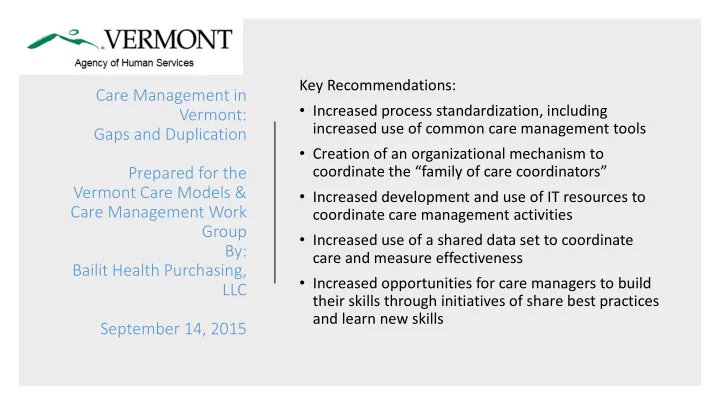
Key Recommendations: Care Management in Increased process standardization, including Vermont: increased use of common care management tools Gaps and Duplication Creation of an organizational mechanism to coordinate the family of care


slide-1
SLIDE 1

Care Management in Vermont: Gaps and Duplication Prepared for the Vermont Care Models & Care Management Work Group By: Bailit Health Purchasing, LLC September 14, 2015

Key Recommendations:

  • Increased process standardization, including

increased use of common care management tools

  • Creation of an organizational mechanism to

coordinate the “family of care coordinators”

  • Increased development and use of IT resources to

coordinate care management activities

  • Increased use of a shared data set to coordinate

care and measure effectiveness

  • Increased opportunities for care managers to build

their skills through initiatives of share best practices and learn new skills

slide-2
SLIDE 2
  • necarevt.org

2

Complex Care Program can Aid in Achieving Quadruple Aim & APM Goals

  • Better Health for Patients
  • Improved access to primary care (and other needed services)
  • Reduced prevalence and morbidity of chronic disease
  • Reduce deaths due to suicide and drug overdose
  • Better Patient Satisfaction
  • Improved understanding and coordination of services and supports
  • Better Cost Control
  • Savings to reinvest in population health programs
  • Better Workforce Satisfaction
  • Retain employees; recruit new employees
  • Improve joy in work
slide-3
SLIDE 3

Population Health Approach: A plan for every person

➢ 44% of the population ➢ Focus: Maintain health through preventive care and community-based wellness activities ➢ Key Activities:

  • Preventive care (e.g. wellness exams, immunizations,

health screenings)

  • Wellness campaigns (e.g. health education

and resources, wellness classes, parenting education)

  • RiseVT

Category 1: Healthy/Well

(includes unpredictable unavoidable events)

Category 2: Early Onset/ Stable Chronic Illness Category 3: Full Onset Chronic Illness & Rising Risk Category 4: Complex/High Cost Acute Catastrophic

LOW RISK MED RISK HIGH RISK VERY HIGH RISK

➢ 40% of the population ➢ Focus: Optimize health and self-management of chronic disease ➢ Key Activities: Category 1 plus

  • utreach for annual Comprehensive Health

Assessment (i.e. physical, mental, social needs)

  • Disease & self-management support* (i.e.

education, referrals, reminders)

  • Pregnancy education

➢ 6% of the population ➢ Focus: Address complex medical & social challenges by clarifying goals of care, developing action plans, & prioritizing tasks ➢ Key Activities: Category 3 plus

  • Designate lead care coordinator (licensed)*
  • Outreach & engagement in care coordination (at

least monthly)*

  • Coordinate among care team members*
  • Assess palliative & hospice care needs*
  • Facilitate regular care conferences *

➢ 10% of the population ➢ Focus: Active skill-building for chronic condition management; address co-

  • ccurring social needs

➢ Key Activities: Category 2 plus

  • Outreach & engagement in care coordination

Create & maintain shared care plan*

  • Coordinate among care team members*
  • Emphasize safe & timely transitions of care

* Activities coordinated via Care Navigator software platform

  • necarevt.org

3

slide-4
SLIDE 4
  • necarevt.org

4

Central Components of the Care Coordination Model

Vision

To provide high-quality, person- centered, community-based care coordination services in an integrated delivery system to achieve optimal health outcomes 1 2 3 4 5 Person-centered Shared Care Plan Multi- disciplinary Care Teams Risk Stratification Tools & Training Inclusive Payment Model

slide-5
SLIDE 5

Agency of Human Services 5 8/8/2019

PCMH Community Health Team

Nurses, Social Workers, Counselors, Health Coaches, Dieticians, Community Health Workers Whole population, all payer supported

Mental Health Agencies & Independent Providers Long-Term Support Services Alcohol &Substance Abuse Programs Medical Specialists In-Patient Programs Emergency Departments Housing Providers Area Agencies on Aging Home Health Schools Economic Services Legal Aid Criminal Justice Family Services Disease Management Programs

slide-6
SLIDE 6

Agency of Human Services 6 8/8/2019

  • ST. JOHNSBURY

Patients/Clients In Common

slide-7
SLIDE 7

Agency of Human Services 7 8/8/2019

  • ST. JOHNSBURY

Full Network

Services, Schools Elder Care Services Medical Services Mental Health, Substance Abuse, Child & Family Services, Schools

slide-8
SLIDE 8

Agency of Human Services 8 8/8/2019

BENNINGTON

Full Network

Child & Family Services Elder Care Services

slide-9
SLIDE 9

OneCareVT.org 9

Looking to 2020 and Beyond… initial ideas

  • Mature & Expand Adoption of the Care Model
  • Evolve OneCare’s Complex Care Payment Model (capacity building → paying for value)
  • Explore expansion to additional payers and increase # Vermonters under an aligned care model (scale)
  • Tests: home health longitudinal care project, Chronic Kidney Disease care coordination intervention, etc…
  • Advance the approach to population segmentation for the pediatric population
  • Ensure Sustainability of Community-based Model by Demonstrating:
  • Positive outcomes for patients
  • Financial Return On Investment (ROI)
  • Explore Community Health Workers and other approaches to extended care

teams

  • Continue to evolve IT resources to support effective coordination of care and

reduce administrative burdens

  • E.g. Care Navigator, Patient Ping, technology-enabled devices, telemedicine
  • Coordinate data sharing across AHS and ACO (e.g. integrate social determinant
  • f health data)
slide-10
SLIDE 10

OneCareVT.org 10

Looking to 2020 and Beyond…

What ideas do you have?