Gap Analysis Outreach Briefing TIM Program Managers (Credit: FHWA) - - PowerPoint PPT Presentation

gap analysis outreach briefing
SMART_READER_LITE
LIVE PREVIEW

Gap Analysis Outreach Briefing TIM Program Managers (Credit: FHWA) - - PowerPoint PPT Presentation

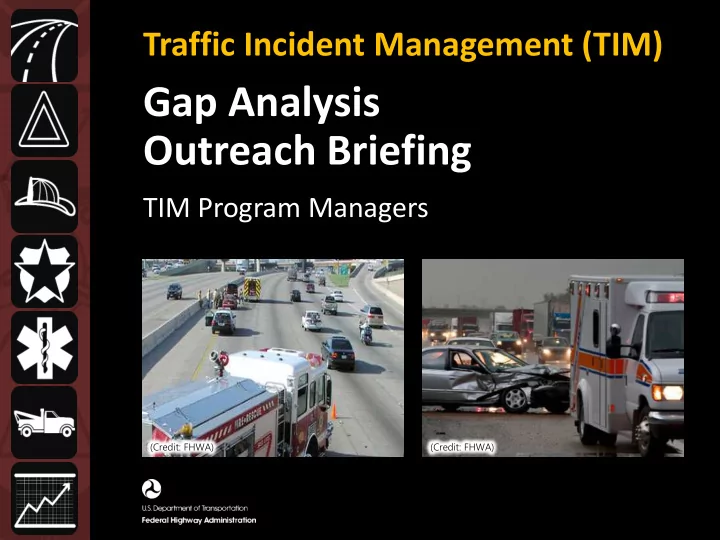
Traffic Incident Management (TIM) Gap Analysis Outreach Briefing TIM Program Managers (Credit: FHWA) (Credit: FHWA) TRAFFIC INCIDENT MANAGEMENT GAP ANALYSIS OUTREACH BRIEFING - TIM PROGRAM MANAGERS 2 Outline Briefing Objective and

slide-1
SLIDE 1

Traffic Incident Management (TIM)

Gap Analysis Outreach Briefing

TIM Program Managers

(Credit: FHWA) (Credit: FHWA)

slide-2
SLIDE 2

TRAFFIC INCIDENT MANAGEMENT GAP ANALYSIS OUTREACH BRIEFING - TIM PROGRAM MANAGERS 2

Outline

  • Briefing Objective and Overview
  • Primer Objectives and Outline
  • TIM Gap Analysis
  • Successful TIM Program
  • Steps to Establish a TIM Program and

Action Plan

slide-3
SLIDE 3

Traffic Incident Management Gap Analysis Outreach Briefing - TIM Program Managers

Briefing Objective and Overview

slide-4
SLIDE 4

TRAFFIC INCIDENT MANAGEMENT GAP ANALYSIS OUTREACH BRIEFING - TIM PROGRAM MANAGERS 4

Briefing Objective

  • To provide traffic incident management

practitioners and technical staff with guidance to design, operate, and maintain a sustainable traffic incident management program

slide-5
SLIDE 5

TRAFFIC INCIDENT MANAGEMENT GAP ANALYSIS OUTREACH BRIEFING - TIM PROGRAM MANAGERS 5

Background

  • Traffic incident – “Any non-recurrent event,

such as a vehicle crash, vehicle breakdown,

  • r other special event, that causes a

reduction in highway capacity and/or an increase in demand”

Source: I-95 Corridor Coalition "Coordinated Incident Management Toolkit for Quick Clearance” 2007

slide-6
SLIDE 6

TRAFFIC INCIDENT MANAGEMENT GAP ANALYSIS OUTREACH BRIEFING - TIM PROGRAM MANAGERS 6

Background

  • Non-recurring incidents dramatically

reduce the available capacity and reliability

  • f the entire transportation system and

when an incident occurs, congestion quickly builds up and chances of a secondary incident increase.

slide-7
SLIDE 7

TRAFFIC INCIDENT MANAGEMENT GAP ANALYSIS OUTREACH BRIEFING - TIM PROGRAM MANAGERS 7

Impact of Incidents

  • Significant threat to life safety and

influence travel time, economic productivity, and transportation system performance

  • Requires pre-planning to achieve quick

incident clearance

slide-8
SLIDE 8

TRAFFIC INCIDENT MANAGEMENT GAP ANALYSIS OUTREACH BRIEFING - TIM PROGRAM MANAGERS 8

Overview of Traffic Incident Management (TIM)

  • Timeline of Stages in the TIM Process:

Source: FHWA Traffic Incident Management Handbook 2010

National Averages Roadway Clearance Time Incident Clearance Time 2012 70.29 min. 55.66 min. 2013 68.90 min. 56.34 min.

Source: 2013 FHWA Traffic Incident Management Self- Assessment Executive Summary

slide-9
SLIDE 9

TRAFFIC INCIDENT MANAGEMENT GAP ANALYSIS OUTREACH BRIEFING - TIM PROGRAM MANAGERS 9

Overview of Traffic Incident Management (TIM)

  • Effective TIM programs reduce the

duration and impacts of traffic incidents and improves the safety of motorists, crash victims, and emergency responders

slide-10
SLIDE 10

TRAFFIC INCIDENT MANAGEMENT GAP ANALYSIS OUTREACH BRIEFING - TIM PROGRAM MANAGERS 10

TIM Goals

  • Promote the safety of motorists, crash

victims, and incident responders

  • Reduce the time for incident detection and

verification

slide-11
SLIDE 11

TRAFFIC INCIDENT MANAGEMENT GAP ANALYSIS OUTREACH BRIEFING - TIM PROGRAM MANAGERS 11

TIM Goals

  • Exercise proper and safe on-scene

management of personnel and equipment, while keeping as many lanes, as possible,

  • pen to traffic
  • Conduct an appropriate response,

investigation, and safe clearing of an incident

slide-12
SLIDE 12

TRAFFIC INCIDENT MANAGEMENT GAP ANALYSIS OUTREACH BRIEFING - TIM PROGRAM MANAGERS 12

Overview of TIM Stakeholder Involvement

Traditional Responders Special/Extreme Circumstance Responders Incident Information Providers Transportation System Providers and Users

  • Law

Enforcement

  • Fire and Rescue
  • Emergency

Medical Services (EMS)

  • Towing and

Recovery

  • Transportation

Agencies

  • HazMat

Contractors

  • Coroners and

Medical Examiners

  • Emergency

Management Agencies

  • Environmental/

Natural Resources/ Departments of Health (DOH)

  • Utilities
  • Public Safety

Communications

  • Traffic Media
  • Traveler

Information Services

  • Transportation

Agencies

  • Traveling Public
  • Trucking

Industry

  • Insurance

Industry

  • Public

Transportation Providers

  • Motorist

Organizations

Source: FHWA Traffic Incident Management Handbook 2010

slide-13
SLIDE 13

Traffic Incident Management Gap Analysis Outreach Briefing - TIM Program Managers

Primer Objectives and Outline

slide-14
SLIDE 14

TRAFFIC INCIDENT MANAGEMENT GAP ANALYSIS OUTREACH BRIEFING - TIM PROGRAM MANAGERS 14

Statement of the Problem

  • Policies and operating procedures for TIM

programs not only vary from state to state, but vary regionally within each state and between rural, suburban, and urban areas

slide-15
SLIDE 15

TRAFFIC INCIDENT MANAGEMENT GAP ANALYSIS OUTREACH BRIEFING - TIM PROGRAM MANAGERS 15

Primer Objectives

  • Identify and summarize the current state
  • f TIM practice and activities
  • Identify and summarize gaps found in TIM

activities/information

slide-16
SLIDE 16

TRAFFIC INCIDENT MANAGEMENT GAP ANALYSIS OUTREACH BRIEFING - TIM PROGRAM MANAGERS 16

Primer Organization

  • Introduction
  • TIM Gap Analysis

Summary

  • Components of

Successful TIM Program

slide-17
SLIDE 17

TRAFFIC INCIDENT MANAGEMENT GAP ANALYSIS OUTREACH BRIEFING - TIM PROGRAM MANAGERS 17

Primer Organization

  • Roles and

Responsibilities of TIM Stakeholders

  • TIM Program with

Transportation Operations Program

  • Conclusions and

Recommendations

slide-18
SLIDE 18

Traffic Incident Management Gap Analysis Outreach Briefing - TIM Program Managers

TIM Gap Analysis

slide-19
SLIDE 19

TRAFFIC INCIDENT MANAGEMENT GAP ANALYSIS OUTREACH BRIEFING - TIM PROGRAM MANAGERS 19

TIM Gap Analysis

  • Inventory of institutional, technical, and

financial capabilities of current TIM programs at different government levels

  • Two-tier Analysis
  • Federal and National
  • State and Local
slide-20
SLIDE 20

TRAFFIC INCIDENT MANAGEMENT GAP ANALYSIS OUTREACH BRIEFING - TIM PROGRAM MANAGERS 20

Current TIM Gaps

  • Represent focus areas for national level

TIM agencies in order to most effectively support state/local programs in achieving their TIM goals

  • Examples of Program/Institutional Gaps:
  • Multiagency involvement from all TIM partners
  • Formal documentation of the TIM agreements

(e.g., MOUs)

  • Multidisciplinary TIM training
slide-21
SLIDE 21

TRAFFIC INCIDENT MANAGEMENT GAP ANALYSIS OUTREACH BRIEFING - TIM PROGRAM MANAGERS 21

Current TIM Gaps

  • Examples of Operational Gaps:
  • Responder safety procedures and practices
  • Equipment staging and scene management
  • Accident reconstruction and investigations
  • 24/7 responder availability
  • Safety service patrol (SSP) availability
slide-22
SLIDE 22

TRAFFIC INCIDENT MANAGEMENT GAP ANALYSIS OUTREACH BRIEFING - TIM PROGRAM MANAGERS 22

Current TIM Gaps

  • Examples of Communication/Technology

Gaps:

  • Emergency communications systems during

incident response

  • Prompt incident detection and notification
  • Interoperable data sharing
slide-23
SLIDE 23

TRAFFIC INCIDENT MANAGEMENT GAP ANALYSIS OUTREACH BRIEFING - TIM PROGRAM MANAGERS 23

TIM Gap Analysis Results

  • A key role of the national multidisciplinary

TIM efforts and agencies is to develop and promote TIM policies and procedures at a national policy level that enhance and advance TIM training and practices at the state/local operations level

slide-24
SLIDE 24

TRAFFIC INCIDENT MANAGEMENT GAP ANALYSIS OUTREACH BRIEFING - TIM PROGRAM MANAGERS 24

TIM Gap Analysis Results

  • The ability to efficiently achieve the 18

strategies of the National Unified Goal (NUG), represents the key framework for a successful complete TIM program

  • Cross-Cutting Strategies
  • Responder Safety
  • Safe, Quick Clearance
  • Prompt, Reliable Incident Communications
slide-25
SLIDE 25

TRAFFIC INCIDENT MANAGEMENT GAP ANALYSIS OUTREACH BRIEFING - TIM PROGRAM MANAGERS 25

The Nation Unified Goal (NUG) Gap Analysis Framework

  • Document the identified challenges and

barriers (i.e. gaps) in the current TIM practice

  • Develop a means to bridge these

challenges and barriers

  • Propose the components of a complete

TIM program

slide-26
SLIDE 26

TRAFFIC INCIDENT MANAGEMENT GAP ANALYSIS OUTREACH BRIEFING - TIM PROGRAM MANAGERS 26

The NUG Gap Analysis Framework (Examples)

National Unified Goal (NUG) Strategy Key Elements Challenges & Barriers Strategies to Overcome Challenges & Barriers

TIM Partnerships and Programs Synchronized TIM programs at the state, multistate, regional, and local levels Departments of Transportation (DOTs) often are not included in emergency planning and preparedness organizations’ activities Agency executive/senior leader engagement and buy-in Multidisciplinary NIMS and TIM Training Cross training of the incident scene roles and responsibilities Volunteer agencies do not have the same time available for training that full-time agencies have Availability of multidisciplinary TIM training courses and delivery processes appropriate for full-time and volunteer agencies Goals for Performance and Progress Having a systematic approach for measuring TIM program performance across national and state/local levels. Performance metrics vary across agencies, making it difficult to compare results Development of performance measures (PM) and data collection methods including those for each stage of an incident TIM Technology Sustainable and interoperable ITS technologies for TIM Consistent use of existing technologies by all disciplines Establishment and implementation of standard and efficient use of technology Effective TIM Policies Formal strategic plans and written interagency operational policies. Lack of interagency coordination at all levels including the senior executive level. TIM Task Force representatives with information to educate their agencies, senior leaders. Awareness and Education Partnerships Develop partnerships to educate responders and motorists on responsibilities of the safe, quick clearance of incidents. Lack of awareness and education regarding the public’s role. Identification of the best ways of getting information out to the public.

slide-27
SLIDE 27

TRAFFIC INCIDENT MANAGEMENT GAP ANALYSIS OUTREACH BRIEFING - TIM PROGRAM MANAGERS 27

The NUG Gap Analysis Framework (Examples)

National Unified Goal (NUG) Strategy Key Elements Challenges & Barriers Strategies to Overcome Challenges & Barriers

Recommended Practices for Responder Safety Promote practices to protect responders on-scene. Lack of coordinated safety practices for TIM responders. Developing and adopting coordinated safety practices. Move Over/Slow Down Laws Ensure that motorists provide a safety buffer for responders when possible. Lack of and challenges related to legislation and enforcement. Coordination with the advancement

  • f legislation with multi-organization

support. Driver Training and Awareness Teach drivers how to prevent secondary incidents from behaviors such as incident scene curiosity. Driver understanding of what to do in an incident scene. Use technology to help drivers respond properly to diversions as well as awareness. Multidisciplinary TIM Procedures Encourage widespread adoption

  • f procedures for quickly clearing

incident scenes. Coordination of TIM

  • perations.

Active participation of TIM stakeholder agencies. Response and Clearance Time Goals Establish benchmarks, or time goals for incident response and clearance. Lack of data consistency. Establishment of metrics based on

  • btainable data.

24/7 Availability Encourage 24 hours a day, 7 days per week availability of traffic incident responders and equipment. Organizational capabilities on a 24/7 basis. Identification of availability of TIM resources on a 24/7 basis.

slide-28
SLIDE 28

TRAFFIC INCIDENT MANAGEMENT GAP ANALYSIS OUTREACH BRIEFING - TIM PROGRAM MANAGERS 28

The NUG Gap Analysis Framework (Examples)

National Unified Goal (NUG) Strategy Key Elements Challenges & Barriers Strategies to Overcome Challenges & Barriers

Multidisciplinary Communications Practices and Procedures Develop guidelines for standardized communications practices and procedures. Communication capabilities of TIM organizations. Common language, operational channels. Prompt, Reliable Responder Notification Develop systems and procedures to ensure prompt and reliable notification of incident information to incident responders. Lack of understanding of information needs of other agencies. Provide timely notification of incidents to responders. Interoperable Voice and Data Networks Create links between incident responder information and communications systems. Incompatibility of current voice and protocol data networks. Determine how interoperable communications equipment could improve TIM and promote implementation. Broadband Emergency Communications Systems Promote integrated broadband networks linking emergency service providers. Integration between broadband emergency communication systems. Promote integration of TMC and law enforcement CAD systems. Prompt, Reliable Traveler Information Systems Encourage the development and deployment of traveler information systems to deliver real-time traveler information. Timely and relevant information to the motorists to avoid additional incidents. Examine additional outlet mechanisms for traveler information. Partnerships with News Media and Information Providers Develop recommended practices for working with news media and ISP to deliver timely and reliable traveler information. Conflicting priorities and unfamiliarity with the media’s TIM role. Educate media of their TIM role.

slide-29
SLIDE 29

Traffic Incident Management Gap Analysis Outreach Briefing - TIM Program Managers

Successful TIM Program

slide-30
SLIDE 30

TRAFFIC INCIDENT MANAGEMENT GAP ANALYSIS OUTREACH BRIEFING - TIM PROGRAM MANAGERS 30

TIM Program Framework

Strategic

Form a framework for TIM activities; as well as how to plan, prepare for, and measure performance of the program

Tactical

Provide the tools and technologies for traffic management and interagency communications for on-scene

  • perations

Support

Provide for the operational, tactical, and institutional support for effective communication and information exchange

slide-31
SLIDE 31

TRAFFIC INCIDENT MANAGEMENT GAP ANALYSIS OUTREACH BRIEFING - TIM PROGRAM MANAGERS 31

Key TIM Program Elements

Strategic (Institutional)

  • Have a TIM multiagency team or task force which meets regularly to discuss and plan for

TIM activities

  • Conduct multiagency training held at least once a year on TIM-specific topics
  • Conduct multiagency post-incident debriefings
  • Develop and distribute summaries of after action reports
  • Conduct planning for special events
  • Have multiagency agreements/MOUs
  • Conduct planning to support the TIM activities across and among participating agencies

including the MPO

  • Have someone from at least one of the participating agencies responsible for coordinating

the TIM program as their primary job function

  • Have multiagency agreement on the two PM being tracked
slide-32
SLIDE 32

TRAFFIC INCIDENT MANAGEMENT GAP ANALYSIS OUTREACH BRIEFING - TIM PROGRAM MANAGERS 32

Key TIM Program Elements

Strategic (Institutional) – Cont’d

  • Have established methods to collect and analyze the data necessary to measure

performance in reduced roadway clearance time and reduced incident clearance time

  • Have targets (e.g., time goals) for performance of the two measures
  • Routinely review whether progress is made in achieving the targets
  • Track performance in reducing secondary incidents
  • Deploy effective and affordable TIM technology to support TIM activities
  • Have 24/7 availability of key responders and equipment
  • Develop and perform efficient and effective multiagency resource management
  • Have a multiagency commitment and approach to the establishment of effective budgeting

to provide stable funding for TIM within the processes and capabilities of the individual and/or collective agencies as appropriate to the activity

  • Education and Awareness Partnerships including driver training and awareness
slide-33
SLIDE 33

TRAFFIC INCIDENT MANAGEMENT GAP ANALYSIS OUTREACH BRIEFING - TIM PROGRAM MANAGERS 33

Key TIM Program Elements

Tactical (Technical/Operational)

  • Have "authority removal" laws allowing pre-designated responders to remove disabled or

wrecked vehicles and spilled cargo:

  • "Authority removal" law in place
  • Understood and utilized by responders
  • Have "driver removal" laws that require drivers involved in minor crashes (i.e., not involving

injuries) to move vehicles out of the travel lanes:

  • "Driver removal" law in place
  • Adequately communicated to motorists
  • Use a safety service patrol for incident and emergency response
  • Utilize the ICS onscene
  • Have response equipment pre-staged for timely response
  • Identify and document resources so that a list of towing and recovery operators (including
  • perator capabilities and special equipment) is available for incident response and

clearance

  • Identify and document resources so that a list of HazMat contractors (including capabilities

and equipment) is available for incident response

  • Give at least one responding agency the authority to override the decision to utilize the

responsible party's HazMat contractor and call in other resources

  • Have the medical examiner response clearly defined and understood for incidents involving

fatalities

slide-34
SLIDE 34

TRAFFIC INCIDENT MANAGEMENT GAP ANALYSIS OUTREACH BRIEFING - TIM PROGRAM MANAGERS 34

Key TIM Program Elements

Tactical (Technical/Operational) – Cont’d

  • Have the electric utility companies' role clearly defined for incidents involving downed

electrical wires

  • Have procedures in place for expedited accident reconstruction/ investigation
  • Have a policy in place for removal of abandoned vehicles
  • Have "Move Over" laws that require drivers to slow down and if possible move over to the

adjacent lane when approaching workers or responders and equipment in the roadway:

  • "Move Over" law in place
  • Adequately communicated to drivers
  • Train all responders in traffic control following MUTCD guidelines
  • Routinely utilize transportation resources to conduct traffic control procedures for various

levels of incidents in compliance with the MUTCD

  • Routinely utilize traffic control procedures for the end of the incident traffic queue
  • Have mutually understood equipment staging and emergency lighting procedures onsite to

maximize traffic flow past an incident while providing responder safety:

  • Vehicle and equipment staging procedures
  • Light-shedding procedures
  • Personal protective equipment used by responders
  • Pre-established, signed accident investigation sites
  • Have procedures in place for prompt responder notification
slide-35
SLIDE 35

TRAFFIC INCIDENT MANAGEMENT GAP ANALYSIS OUTREACH BRIEFING - TIM PROGRAM MANAGERS 35

Key TIM Program Elements

Support (Financial/Technological)

  • Use a TMC/TOC to coordinate incident detection, notification and response
  • Share data/video between agencies
  • Have specific policies and procedures for traffic management during incident response:
  • Signal timing changes
  • Pre-planned detour and alternate routes identified and shared between agencies
  • Provide for interoperable, interagency communications onsite between incident responders
  • Have a real-time motorist information system providing incident-specific information:
  • Traveler information delivered via 511/ website
  • Traveler information delivered via mobile applications
  • Traveler information delivered through traffic/news media partnerships/access to TMC/

TOC data/ information

  • Provide motorists with travel time estimates for route segments
  • Develop and implement Cost Recovery and Management systems including:
  • Costs recovery for the reimbursement for services from sources outside of the direct

budget that funds the program seeking reimbursement

  • Cost management includes efforts to maximize the cost-benefit relationship of program

activities via a cyclical loop of cost planning, tracking, analysis, and evaluation and reprogramming

slide-36
SLIDE 36

TRAFFIC INCIDENT MANAGEMENT GAP ANALYSIS OUTREACH BRIEFING - TIM PROGRAM MANAGERS 36

Success Story New York State TIM Program

  • Established in 2010
  • TIM Components
  • A statewide strategic plan.
  • NYS Emergency Traffic

Control and Scene Management Guidelines.

  • A “Move Over” law.
  • Numerous well developed

regional TIM programs.

(Credit: VHB) (Credit: NYSDOT)

slide-37
SLIDE 37

TRAFFIC INCIDENT MANAGEMENT GAP ANALYSIS OUTREACH BRIEFING - TIM PROGRAM MANAGERS 37

Success Story NYS TIM Program

  • TIM Components
  • An active statewide TIM

task force.

  • Model partnerships with

the state police.

  • A statewide service patrol.
  • TMCs operational for 24

hours and 7 days a week in most regions.

(Credit: VHB)

slide-38
SLIDE 38

Traffic Incident Management Gap Analysis Outreach Briefing - TIM Program Managers

Steps for Establishing a TIM Program and Action Plan

slide-39
SLIDE 39

TRAFFIC INCIDENT MANAGEMENT GAP ANALYSIS OUTREACH BRIEFING - TIM PROGRAM MANAGERS 39

Steps for Establishing a TIM Program

  • Identify Stakeholders
  • Define the Problem
  • Set Goals and

Objectives

  • Develop Alternatives
  • Evaluate and Select Alternatives
  • Implement Alternatives
  • Reevaluate Alternatives
  • Refine the System

(Credit: VHB)

slide-40
SLIDE 40

TRAFFIC INCIDENT MANAGEMENT GAP ANALYSIS OUTREACH BRIEFING - TIM PROGRAM MANAGERS 40

Steps for Establishing a TIM Program

  • Identify Stakeholders
  • Identifying relevant stakeholders is a critical

first step to the success of a TIM program

  • Once these stakeholders commit to establishing

a TIM program, they can sponsor a TIM Task Force that meets periodically to enhance and guide the program

slide-41
SLIDE 41

TRAFFIC INCIDENT MANAGEMENT GAP ANALYSIS OUTREACH BRIEFING - TIM PROGRAM MANAGERS 41

Steps for Establishing a TIM Program

  • Define the Problem
  • Defining the problem can be accomplished

through a combination of data collection, data compilation, brainstorming, and a constructive assessment of existing practices

slide-42
SLIDE 42

TRAFFIC INCIDENT MANAGEMENT GAP ANALYSIS OUTREACH BRIEFING - TIM PROGRAM MANAGERS 42

Steps for Establishing a TIM Program

  • Set Goals and Objectives
  • These "guiding principles" usually consist of a

mission statement with goals and objectives based on the identified problems. These goals and objectives describe what the program is designed to accomplish and are meant to reflect multiagency efforts and not those of individual agencies

slide-43
SLIDE 43

TRAFFIC INCIDENT MANAGEMENT GAP ANALYSIS OUTREACH BRIEFING - TIM PROGRAM MANAGERS 43

Steps for Establishing a TIM Program

  • Develop Alternatives
  • TIM programs consist of numerous individual

practices, tools and infrastructure elements

  • Based on the goals and objectives developed

previously, alternatives should be determined to combine available TIM tools and techniques into program packages for evaluation

slide-44
SLIDE 44

TRAFFIC INCIDENT MANAGEMENT GAP ANALYSIS OUTREACH BRIEFING - TIM PROGRAM MANAGERS 44

Steps for Establishing a TIM Program

  • Evaluate and Select Alternatives
  • The developed alternatives should be evaluated

based on:

  • Prioritization
  • High-level cost estimates
  • Expected benefits
slide-45
SLIDE 45

TRAFFIC INCIDENT MANAGEMENT GAP ANALYSIS OUTREACH BRIEFING - TIM PROGRAM MANAGERS 45

Steps for Establishing a TIM Program

  • Implement Alternatives
  • As alternatives are being implemented,

mechanisms for resolving the issues associated with incident management must be developed

  • Example issues include:
  • Jurisdictional boundaries
  • Operational responsibilities
  • Funding sources
slide-46
SLIDE 46

TRAFFIC INCIDENT MANAGEMENT GAP ANALYSIS OUTREACH BRIEFING - TIM PROGRAM MANAGERS 46

Action Plan

  • Establish the baseline of where your

jurisdiction is regarding statutes, policies, and procedures

  • Identify counterparts in each pertinent

local/state discipline and contact them

  • Hold a kick-off team meeting to start

establishing relationships

slide-47
SLIDE 47

TRAFFIC INCIDENT MANAGEMENT GAP ANALYSIS OUTREACH BRIEFING - TIM PROGRAM MANAGERS 47

Action Plan

  • Develop key policies and documents
  • Create an Open Roads policy
  • Develop a Concept of Operations
  • Execute operational MOUs
  • Implement multi-disciplinary TIM teams
  • Implement a multi-disciplinary training

program

  • Enable interagency communications and

info exchange

slide-48
SLIDE 48

For national level questions, please contact:

Laurel Radow

Traffic Incident and Events Management Team Office of Operations, Federal Highway Administration (202) 366-2855 Laurel.Radow@dot.gov

Thank You!