
SLIDE 1
Functions
x f(x)=x2
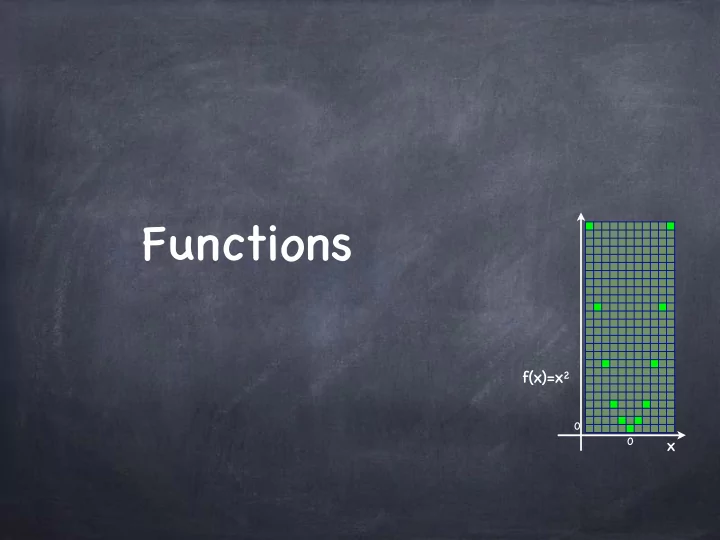
Functions f(x)=x 2 0 0 x Functions For each element in a - - PowerPoint PPT Presentation
Functions f(x)=x 2 0 0 x Functions For each element in a universe (domain), a predicate assigns one of two values, True and False. Co-domain is {True,False} pair AIW 2 Likes(pair) Functions: more general (Alice, Alice) TRUE
x f(x)=x2
For each element in a universe (domain), a predicate assigns one of two values, True and False. “Co-domain” is {True,False} Functions: more general co-domains f : A → B A function maps each element in the domain to an element in the co-domain To specify a function, should specify domain, co-domain and the “table” itself pair∈AIW2 Likes(pair)
(Alice, Alice) TRUE (Alice, Jabberwock) FALSE (Alice, Flamingo) TRUE (Jabberwock, Alice) FALSE (Jabberwock, Jabberwock) TRUE (Jabberwock, Flamingo) FALSE (Flamingo, Alice) FALSE (Flamingo, Jabberwock) FALSE (Flamingo, Flamingo) TRUE
eg: Extent of liking, f: AIW2 → {0,1,2,3,4,5} Note: no empty slot, no slot with more than
Not all values from the co-domain need be used Image: set of values in the co-domain that do get used For f:A→B, Im(f) ⊆ B s.t. Im(f) = { y∈B | ∃x∈A f(x) = y } x∈Domain f(x)∈Co-Domain
(Alice, Alice) 5 (Alice, Jabberwock) 1 (Alice, Flamingo) 4 (Jabberwock, Alice) (Jabberwock, Jabberwock) 4 (Jabberwock, Flamingo) (Flamingo, Alice) 1 (Flamingo, Jabberwock) (Flamingo, Flamingo) 5
eg: Extent of liking, f: AIW2 → {0,1,2,3,4,5} x∈Domain f(x)∈Co-Domain
(Alice, Alice) 5 (Alice, Jabberwock) 1 (Alice, Flamingo) 4 (Jabberwock, Alice) (Jabberwock, Jabberwock) 4 (Jabberwock, Flamingo) (Flamingo, Alice) 1 (Flamingo, Jabberwock) (Flamingo, Flamingo) 5
(Alice, Alice) (Alice, Jabberwock) (Alice, Flamingo) (Jabberwock, Alice) (Jabberwock, Jabberwock) (Jabberwock, Flamingo) (Flamingo, Alice) (Flamingo, Jabberwock) (Flamingo, Flamingo)
5 4 3 2 1
As a relation between domain & co-domain, Rf ⊆ domain × co-domain Rf = { (x,f(x)) | x ∈ domain } Special property of Rf: every x has a unique y s.t. (x,y) ∈ Rf Can be represented using a matrix Convention: domain on the “x-axis”, co-domain on the “y-axis” Every column has exactly one cell “switched on”
2 1
(A,A) (A,J) (A,F) (J,A) (J,J) (J,F) (F ,A) (F ,J) (F ,F)
5 4 3
When both domain and co-domain are numerical (or otherwise totally ordered), we often “plot” the function Shows only part of domain/codomain when they are infinite (here f:Z→Z)
x f(x)=x2 x f(x)=5x
x f(x)=x
x f(x)= ⌊x/5⌋
Composition of functions f and g: g○f : Domain(f) → Co-domain(g) g○f(x) ≜ g(f(x))
5 4 3 2 1
(Alice, Alice) (Alice, Jabberwock) (Alice, Flamingo) (Jabberwock, Alice) (Jabberwock, Jabberwock) (Jabberwock, Flamingo) (Flamingo, Alice) (Flamingo, Jabberwock) (Flamingo, Flamingo)
High Medium Low
High Medium Low
(Alice, Alice) (Alice, Jabberwock) (Alice, Flamingo) (Jabberwock, Alice) (Jabberwock, Jabberwock) (Jabberwock, Flamingo) (Flamingo, Alice) (Flamingo, Jabberwock) (Flamingo, Flamingo)
g○f input
input
Defined only if Im(f) ⊆ Domain(g) Typically, Domain(g) = Co-domain(f) g○f : Domain(f) → Co-domain(g) Im(g○f) ⊆ Im(g) Composition of functions f and g: g○f : Domain(f) → Co-domain(g) g○f(x) ≜ g(f(x))
5 4 3 2 1 High Medium Low
(Alice, Alice) (Alice, Jabberwock) (Alice, Flamingo) (Jabberwock, Alice) (Jabberwock, Jabberwock) (Jabberwock, Flamingo) (Flamingo, Alice) (Flamingo, Jabberwock) (Flamingo, Flamingo)
f g
High Medium Low
(Alice, Alice) (Alice, Jabberwock) (Alice, Flamingo) (Jabberwock, Alice) (Jabberwock, Jabberwock) (Jabberwock, Flamingo) (Flamingo, Alice) (Flamingo, Jabberwock) (Flamingo, Flamingo)
g○f